Visar inlägg med etikett gravitation. Visa alla inlägg

måndag 6 februari 2023

Explaining Spiral Galaxy Rotation Speed with or without Dark Matter

A spiral galaxy is flat and so may not need dark matter to explain constant rotational speed.

This is a continuation of previous posts on the gravitational potential  $\phi (x)$ as primordial giving mass density $\rho (x)$ to matter by the specification $\rho =\Delta\phi$ where $\Delta$ is the Laplacian differential operator with respect to a space coordinate $x$ of dimension $d$. 

If $d=3$ then $\phi (x)=\frac{1}{4\pi\vert x\vert}$ generates a unit point mass at $x$. The corresponding gravitational force is given by $\nabla\phi (x)\sim -\frac{1}{\vert x\vert^2}$. Balancing inertial and gravitational force for a body moving around the unit point mass in a circle with radius $R$ with speed $V$ gives the following relation:

  • $V \sim \frac{1}{\sqrt{R}}$    (1)

If $d=2$ then $\phi (x)=-\frac{1}{2\pi}\log{\vert x\vert}$ generates a unit point mass at $x$. The corresponding gravitational force is given by $\nabla\phi (x)\sim -\frac{1}{\vert x\vert}$. Balancing inertial and gravitational force for a body moving around the point mass in a circle with radius $R$ with speed $V$ gives the following relation:

  • $V \sim 1$      (2)
We see a speed decay with increasing $R$ of $V\sim\frac{1}{\sqrt{R}}$ if $d=3$, while $V=constant$ independent of $R$ if $d=2$. 

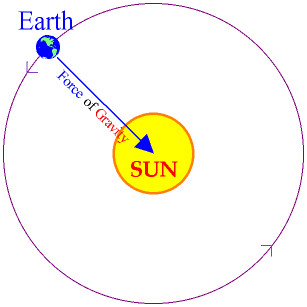
Observations of the velocities of spiral galaxies agree with (2), which has a logic because spiral galaxies are flat disc-like connecting to $d=2$, see figure above. 

The reason planets and stars are spherical is that gravitation is balanced by pressure acting in all directions. The reason galaxies are flat is that gravitation is balanced by rotational inertial forces.  

The motivation to introduce dark matter is that observations do not agree with (3), asking for a spherical halo of dark matter to give extra gravitational force to motivate non-decay of speed. But no dark matter has not been found. 

The explanation of agreement with observations with $d=2$ is elementary, and is also made here. But how is it possible that this has escaped the minds of modern physicists? Or has it been discovered as being too simplistic? Is a spiral galaxy really a 2d object? Does the specification of mass density according to $\rho =\Delta\phi$ really take place in 2d? The creation process of mass density from gravitational potential may carry an answer.

Note that $d=2$ gives a form of MOND as Modified Newtonian Dynamics, which with the gravitational potential being primordial perhaps can be motivated as a geometrical effect (to be returned to). Or it is simply that if $\Delta\phi (x)$ is not intense enough, then $\rho (x)$ is not visible as dark matter.  More in the next post.

Also recall that with the gravitational potential being primordial, there is neither instant action at distance to explain, only local action.

Newtonian gravity may be seen as a form a priori knowledge in the sense of Kant as knowledge which can be deduced without experimental input. It lives up to Einstein's ideal of a mathematical model without parameter to determine by experiment. 


lördag 4 februari 2023

What is Wrong with Newtonian Gravity?

This is a continuation the previous post on the Universality of Newtonian Gravity. If Newtonian Gravity is Universal, how come that this is not what modern physics is saying? In what sense was Newton wrong?

Here are the main answers to the question What is Wrong with Newtonian Gravity?:

  1. Newtonian Gravity is an “action-at-a-distance” theory. Newton himself was deeply concerned about this.
  2. Newtonian Gravity is not compatible with the world of special relativity. 
  3. Newtonian Gravity is contradicted by observation of the perihelion advance of Mercury and gravitational waves.
  4. Newtonian Gravity does not interact with propagation of light. 
Let us now analyse the validity of these arguments. In our non-standard view with gravitational potential primordial, there is no action at distance and so 1. is not an issue. 

Special relativity is a theory empty of real physics as shown in Many-Minds Relativity and so 2. is neither an issue. 

The claimed disagreement of Newtonian Gravitation with observations of the perihelion advance of Mercury may very well depend on neglect of proper influence from other planets and from the Sun. Until all such aspects have been taken properly into account, it is impossible to say that Newtonian Gravitation is wrong and so 3. is not necessarily an issue.

Newtonian Gravitation concerns dynamics of particles/bodies with mass and so say nothing about interaction with massless light, and so 4. is neither necessarily an issue. 

Summing up, we find that the reasons behind viewing Newtonian Gravity to be wrong are weak. The price to pay by dismissing it is very high, since Newtonian Gravity appears as the only Theory of Everything in  physics.  


Universality of Newton's Law of Gravitation

Newtonian Gravitation and Quantum Mechanics is a Theory of Everything ToE.

This is a continuation of previous post on the connection between gravitational potential $\phi (x)$ and mass density $\rho (x)$ through the relation $\rho =\Delta\phi$ where $\Delta$ is the Laplacian differential operator with respect to $x$ as Euclidean space coordinate. 

We take here a non-standard view and consider the gravitational potential $\phi$ to be primordial, from which mass density $\rho =\Delta\phi$ is given to matter by differentiation as an instant local action. 

This is to be compared with the standard view with $\rho$ primordial and $\phi$ obtained by solving the equation $\Delta\phi =\rho$ as a global integration/summation process requiring instant global action or instant action at distance.

Here instant local action, like establishment of contact forces, does not pose the problem of instant action at distance, which may be unsolvable. 

Let us now see how the connection $\rho =\Delta\phi$ can be established viewing $\phi$ as primordial. 

The first step is to see that $F=\nabla\phi$ represents gravitational force field and as such is a conservative force, which means the the work required to move a body from one point to another is independent of the path. As an example the work required to lift a body in the gravitational force field of the Earth only depends on change of level and not path with motion without change of level not requiring work. The gravitational force field is thus given as the gradient of a potential.

The next step is to show that $\nabla\cdot F=\rho$, where $\nabla\cdot F$ is the divergence of $F$. We recall from Calculus  that 

  • $\int_\Omega \nabla\cdot F\, dx =\int_\Gamma F\cdot n\, ds$

for a volume $\Omega$ with boundary $\Gamma$ with outward unit normal $n$ with $dx$ volume element and $ds$ boundary surface element.  Viewing $F$ as a flux, $F\cdot n$ is the flux out of $\Omega$ and $\nabla\cdot F$ is the corresponding source inside $\Omega$. 

We can now (simply) define gravitational mass density $\rho =\nabla\cdot F=\nabla\cdot\nabla\phi =\Delta\phi$ to be the source of the gravitational field given by the potential $\phi$, and we can from this relation derive Newton's Law of gravitation in its familiar form as did Laplace in his Celestial Mechanics. 

We see that Newton's Law of gravitation reflects (i) observation that a gravitational force field is conservative, together with (ii) definition of gravitational mass density as the source of this field. 

Newton's Law of Gravitation thus comes out from assuming that a gravitational force field is conservative, which is supported by observation, together with definition of gravitational mass. 

Connecting to Newton's 2nd Law of motion with inertial mass the same as gravitational mass, brings universality to cosmic interaction.

We conclude that Newton's Law of Gravitation can be seen much like an a priori statement about physics in the sense of Kant. We compare with the a priori statement that the length of the circumference of a circle with radius $1$ is equal to $2\pi$, which has universal validity. 

This gives Newton's Law of Gravitation universal validity leaving Einstein's General Theory of Relativity without mission. In particular, it resolves the main dilemma of modern physics of the perceived incompatibility between Quantum Mechanics and General Relativity, since Newtonian gravitation is fully compatible with Schrödinger's quantum mechanics as a Theory of Everything ToE.  

We recall Niels Bohr:

  • How wonderful that we have met with a paradox. Now we have some hope of making progress.          
How wonderful that we have found incompatibility of Quantum Mechanics and General Realativity. Now we can make some progress...

fredag 3 februari 2023

Newton's Cosmic Model: Irony of Modern Physics

  • From the same principles, I now demonstrate the frame of the System of the World. (Newton)

This is a continuation of the previous post on the primordial role of a gravitational potential $\phi (x)$ as giving gravitational mass $\rho (x)=\Delta\phi$ to matter through the Laplacian operator $\Delta$ as instant local action by differentiation with $x$ a 3d Euclidean space coordinate. This is Newton's Law of Gravitation describing gravitational force.  

We obtain a model of cosmic interaction as a set of point masses represented by $\rho (x,t)$ moving according to Newton's 2nd Law of Motion $F=am$ connecting inertial force $F$ to acceleration $a$ and mass $m$, subject to gravitational force $\nabla\phi (x,t)$ with $t$ a time coordinate. You can follow the dynamics by starting  Cosmic Interaction on Leibniz World of Math and clicking in point masses. 

Combining Newton's Law of Gravitation and 2nd Law of Motion we thus have a mathematical model capable of describing cosmic interaction on any scale as point masses all "falling freely" with gravitational and inertial forces balancing to net zero force. This is the weightless zero-stress state so happily experienced by Stephen Hawking when visiting Virgin Galactic: 


We understand that it is the gravitational potential/force which creates the dynamics of cosmos through the key creative steps of 

  1. Giving gravitational mass to matter through $\rho =\Delta\phi$ according to Newton's Law of Gravitation. 
  2. Stipulating that inertial mass = gravitational mass to invoke Newton's Law of Motion.    

This is Newton's Cosmic Model describing cosmic interaction on all scales. It is a computable model of extreme simplicity with only one parameter $G$ connecting gravitational force to mass and distance, yet with a universal scope. This is a triumph of classical physics which has not been matched by modern physics. 

We can compare with the Standard Model of particle physics as an uncomputable model of extreme complexity including 19 parameters with a very limited scope:


Newton's Cosmic Model is not a part of modern physics based on the Standard Model without gravitation and Einstein's General Theory of Relativity with gravitation viewed to be incompatible. The unmatched triumph of classical physics is thus not a part of modern physics. This is deeply ironic. It does not help that Einstein ask for mercy: Newton forgive me! It is a travesty.


tisdag 31 januari 2023

The Gravitational Potential Gives Mass to Matter

In previous posts I have presented a non-standard view on the connection between mass density $\rho (x)$ and gravitational potential $\phi (x)$ connected by Poisson's equation

  • $\Delta \phi = \rho$   
where $\Delta $ is the Laplacian differential operator with respect to the spatial coordinate $x$ in 3d Euclidean space and the gravitational force is given by $\nabla\phi (x)$ as the gradient of $\phi$.

The standard view is to consider the mass density $\rho (x)$ somehow creating the gravitational potential and so the gravitational force, through the formula
  • $\phi (x) = \frac{1}{4\pi}\int \frac{\rho (y)}{\vert x-y\vert}dy$,
that is, the gravitational potential/force is created by global summation over the global presence of mass as an instant action at distance. The appearance is that the gravitational potential/force at the position $x$ is the instant effect of the total presence of mass at all points $y$ different from $x$. 

The trouble with this standard view is that generates questions which have never been satisfactorily answered:
  1. How can action be instantly transmitted over arbitrarily large distances?
  2. Is there self-interaction between a point mass and the gravitational potential/force it creates? 
In the Standard Model of fundamental/particle physics, forces are transmitted by force carrying particles but no such particle (named graviton) for gravitational force has been found. It seems that the standard view has reached a dead end.

In the non-standard view the roles of mass density and potential are switched: The potential $\phi (x)$ is then viewed to endow matter with mass density $\rho (x)$ through the formula
  • $\rho (x) = \Delta\phi (x)$  (*)
that is, $\rho (x)$ is created by differentiation of $\phi (x)$.  This is a local instant operation which does not require instant action at distance and thus eliminates questions 1. Further, there is no self-interaction because the flow of information is one-way from $\phi (x)$ to $\rho (x)$. 

The dynamics of a Newtonian Universe can thus be described by (*) combined with Newton's 2nd Law, more precisely in the form of the Euler equations for a compressible gas in terms of gravitational potential, momentum and internal energy as shown in detail here.  

To see the role of a potential, let us we compare with what we see on weather maps as rotational flow around high and low pressure zones with the pressure acting like a potential (click on arrow to start simulation)


We see the trace of air particles moving around high and low pressure zones driven by pressure/Coriolis and inertial forces, in a way similar to planets moving around Suns subject to gravitational and inertial forces, with pressure and gravitational potential playing the same role. 

The power of the gravitational potential is to supply matter with the quality of mass as the capability to react to gravitational force according to Newton's 2nd Law, and then in a next step react the same way subject to inertial forces as an expression of equality of gravitational and inertial mass. 

In this non-standard view, the gravitational potential thus supplies matter with mass and so opens to motion under gravitational force from the potential. The gravitational potential is thus primordial, while it changes according to the dynamics it creates, which can be seen as a form of feed-back. The non-standard view avoids the unresolved problems of the standard view with matter/mass as primordial, with further rationale here.  

The fact that we can see celestial bodies move subject to gravitational force, while we cannot see the gravitational potential, only feel its gravitational force, can give us the impression of the standard view that it is the celestial bodies, which creates the gravitational force by Newton's Law of gravitation. If we could see the gravitational potential we would be led to the non-standard view with the gravitational potential somehow giving mass to matter.  

Ultimately motion is created by the gravitational potential giving gravitational mass to matter to react to gravitational force and then to inertial force with inertial mass equal to gravitational mass. The origin of dynamics as motion in space is thus the gravitational potential.  

PS The gravitational potential vs mass is a hen vs egg problem, with the gravitational potential playing the role of the hen laying an egg by local action, which is in a way understandable. On the other hand the creation of a hen out of an egg is more mysterious as a creation seemingly out of nothing, and so is the original creation of the gravitational potential. 

However it is possible to think of the source as a local oscillation $\bar\phi$ of an original null state $\phi_0 =0$ satisfying $\Delta\phi_0 =0$ with $\Delta\bar\phi =\bar\rho$ where $\bar\rho (x)$ has variable sign representing positive and negative mass, which by gravitational dynamics repel each other and so separate into two Universa with no further contact, where we happen to live in the Universe with positive mass. The creation of the gravitational potential would thus result from a perturbation in an original null state $\phi_0$ satisfying the equation  $\Delta\phi_0 =0$ serving as a laboratory ready for perturbation, like a violin string before the stroke by a bow. The creation miracle is then reduced to the stretching of a string. 

Notice that by the nature of the differentiation action of the Laplacian $\Delta$ a small localised perturbation $\bar\phi$ will give an amplified mass density $\bar\rho =\Delta\bar\phi$ output as an apparent creation out of nothing.


torsdag 25 juli 2019

Speed of Gravity? Newton or Einstein?


Tom Van Flandern (1940-2009) was a free-thinking physicist who with perplexion made the observation (along with Laplace and also Newton of course) that the Earth on its path around the Sun at every instant in time accelerates in the direction of the actual position of the Sun, which is about 20 arc seconds ahead of the position of the Sun as seen in the sky from the Earth, because of the 8 minutes it takes for light to travel the distance from the Sun to the Earth. See also this review of Van Flandern’s work.

This observation is in accordance with Newtonian gravitation, which is assumed to propagate with infinite speed. If gravitation propagated with the speed of light, the acceleration would be instead in the direction of the visible Sun, but this is not what is observed (because it would be unstable).

I have discussed this observation in various posts with conclusion that the connection between mass density $\rho (x,t)$ and gravitational potential $\phi (x,t)$ as given by Poisson's equation in Newtonian gravitation
  • $\Delta\phi (x,t)=\rho (x,t)$      
with $\Delta$ the Laplacian with respect to a space coordinate $x$ and $t$ being a time coordinate, is to be interpreted as a relation where mass $\rho (x,t)$ somehow is "created" at $x$ at time $t$ by the local operation of differentiation through the Laplacian $\Delta$ acting on the gravitational potential $\phi (x,t)$. 

This is different from the standard interpretation where instead the presence of mass $\rho (x,t)$ at a specific point in space at time $t$ contributes to $\phi (x,t)$ for all points $x$ somehow through instant action at distance. Like Tom Van Flandern I view instant action at distance as physically impossible, while local instant action may be physical. The creation of mass from gravitational potential through the Laplacian thus may be possible, while its detailed physics remains to be discovered...

In any case the observation of the acceleration of the Earth towards the actual position of the Sun is only compatible with a speed of propagation of gravitational waves (if they exist), which is much bigger than the speed of light. This observation is in accordance with Newton's mechanics (with both the new and old interpretations of the mass-potential connection), but not with Einstein's mechanics.

What is your conclusion concerning who describes physics of gravitation best? Newton or Einstein? Be careful when you look at the Sun for answer.

The current wisdom among physicists is that despite the above Earth-Sun observation, for sure there are gravitational waves because Einsteins so says, waves which propagate with the speed of light and that these waves can be detected, not gravitational waves from the Sun, but from distant mergers of black holes and stuff. Do you buy this?

Sorry to say Tom passed away in 2009, but his ideas live.

PS Of course there is a cover up suggesting that also in Einstein's mechanics does the Earth accelerate in the direction of the current position of the Sun, even if the speed of gravitational waves is the finite speed of light,  because there is a subtle cancellation of the effect of the 8 minute delay from another effect, a most happy and welcome cancellation which allows a stable observable planetary system not only according to Newton but also for Einstein. But why Einstein if Newton explains what is observed? No wonder that Einstein begged for pardon in his: "Newton, forgive me!".

torsdag 5 oktober 2017

LIGO vs Neo-Newtonian Cosmology

The Earth is pulled in the direction of the present position of the Sun at each  instant, right?


Let us continue our reflections on LIGO recalling my earlier post on Neo-Newtonian Cosmology as an alternative to Einstein's Cosmology based on Einstein's equations with related posts here and the discussion about The Hen and the Egg.

In Neo-Newtonian Cosmology a gravity potential $\phi (x,t)$ (depending on an Euclidean space coordinate $x$ and time $t$) is connected to mass distribution $\rho (x,t)$ through Poisson's equation
  • $\Delta\phi =\rho $
which is interpreted as creation of mass $\rho$ by the action of $\Delta$ upon the gravitational potential $\phi$ through a local instant operation of differentiation.  

This is different from the standard interpretation in Newtonian cosmology with instead the gravitational potential $\phi$ created from mass $\rho$ by instant action at distance corresponding to solving or integrating Poisson's equation, as if gravitational force/potential is propagated at infinite speed. We thus have: 
  • Neo-Newtonian Cosmology: matter created from gravitational potential by instant local action.
  • Newtonian Cosmology: gravitational potential created from mass by instant action at distance.
Now, the big mystery of Newtonian Gravitation/Cosmology is the instant action at distance, which with the optics of Neo-Newtonian Cosmology is a fictional problem, which thus can be replaced by local instant action, with the mystery of instant action at distance eliminated. 

The beauty with both Newtonian and Neo-Newtonian Cosmology, as compared with Einstein's, is that motion of the Earth around the Sun gets an theoretical explanation agreeing with the following observation:
  • The Earth accelerates at each instant of time in the direction of the present position of the Sun as if the action of the Sun is instant at distance.  
In particular, the Earth does not accelerate in the direction where the Sun is seen, since that position through the finite speed of light, has a delay of 8 minutes. The difference comes out in the thought experiment that the Sun suddenly disappears into nothing: In Neo-Newtonian Cosmology that would mean the instant disappearance of the gravitational field and thus leave the Earth instantly continuing in the tangent direction, while with finite speed of propagation of gravitational force created at distance by the mass of the Sun, that would take 8 minutes and the path would then be different.

In Einstein' Cosmology gravitation is propagated with the finite speed of light, but that does not seem to be the case for the Sun-Earth system.  Right?

Recall that Einstein was obsessed with choice of coordinates in both the special and general theory, as  if this choice has anything to do with physics, as if physics carries around coordinate systems imprinted in the "fabric of space-time" as the name of the game. But coordinate systems are inventions/conventions made by humans and not the Creator of the World, who had no need of such things when putting things together and letting it go...

söndag 15 maj 2016

Instant Action at Distance and Simultaneity not Needed in New Theory of Gravitation including Dark Energy

                           Einstein won the game. But what was the game about? Simultaneity?

Einstein's theory of relativity grew out from a question of simultaneity in time of events at different locations in space, which Einstein could not answer in a non-ambiguous way and then jumped to the conclusion that a fundamental revision of our concepts of space and time was necessary. Einstein took so on the responsibility in the service of science and humanity to make the revision and thereby open the door to a modern physics of "curved space-time" with all its wondrous new effects of time dilation and space contraction, albeit too small to be detected.

It is clear that simultaneity plays an important role in our society, to set schedules and allow people to meet at the same place and for these purposes we all have clocks synchronized to a reference clock. And to decide which scientist first submitted an article reporting a certain new scientific break-through and to navigate...

But what role does simultaneity play in physics? In what sense do distant physical objects care about simultaneity? Do they all have synchronised clocks? Of course not. What they do is to react to local forces acting locally in time, and no simultaneity with the action of distant objects is involved.

Or is it? What about gravitation, isn't it supposed to act instantly over distance and thus require a form of exact simultaneity? Yes, it so seems because in Newtonian gravitation the Earth is instantly acted upon by a gravitational force from the Sun directed towards the present position of the Sun, and not towards the position where we see the Sun because of the 8 minute time delay of the light from the Sun.

The standard view on gravitation, is thus that the presence of matter instantly generates a gravitational potential/force (Newton) or "curvature of space" (Einstein) at distance. This view comes with the following questions:
  1. What is the physics of the instant action at distance? Gravitons?
  2. What is the physics of the simultaneity associated with instant action? 
Since no progress towards any form of answer has been made over all the centuries since Newton, it is natural to shift and instead view the gravitational potential $\phi$ as primordial from which matter density $\rho$ is obtained by the differential equation acting locally in space and time:
  • $\Delta\phi =\rho$.    (*)      
With this view there is no instant action at distance to explain and no associated simultaneity, since the action of Laplacian $\Delta$ as differential operator is local is space and time. 

It may thus be that the questions 1. and 2. are not the right questions, and then also that Einstein's relativity originating from a question about simultaneity, is not the right answer to the right question.

More precisely, simultaneity does not appear to be a matter of the physics of the world, since atoms are not equipped with a man-made system of synchronised clocks, and so it is not reasonable to make a complete revision of Newtonian mechanics starting from an ad hoc idea of probably little significance.        

The equation (*) further suggests that with $\phi$ primordial there is no reason to insist that $\rho$ as a derived quantity must be non-negative, thus (*) opens to the possible existence of matter density $\rho$ of both signs, that is to both positive and negative matter. 

This idea is explored in the app Dark Energy on App Store with in particular a simulation of a universe resulting from a fluctuation of the gravitational potential with associated positive and negative matter, with the negative matter forcing a positive matter world into accelerating expansion, which may be the missing dark energy you are looking for. Try it!

onsdag 17 februari 2016

Gravitation, Motion, Programming with Codea and Zeno's Paradox

                                     Fresh reprinting of the world at each new time instant.  

The experience with the programming platform Codea which I am reporting on Matematik-IT  connects to an earlier view exposed on The World as Computation on the connection between matter and gravitation described by Newton's gravitational equation
  • $\Delta\phi =\rho$,            (1)
where $\phi (x,t)$ is gravitational potential and $\rho (x,t)$ mass density depending on a Euclidean space coordinate $x$ and a time coordinate $t$, and $\Delta$ is the Laplacian differential operator. 

The conventional way of viewing (1) is to think of mass density $\rho$ as primordial which generates a gravitational potential $\phi$, and corresponding gravitational force $\nabla\phi$, through the integral
  • $\phi (x,t) =\frac{1}{4\pi}\int\frac{\rho (y,t)\, dy}{\vert x-y\vert}$      (2)
with apparent (instant) action at distance expressed by the global nature the integral. The trouble with this view is that the physics of (instant) action at distance, supposedly being transmitted by graviton particles (appearently traveling at infinite speed), is still completely open despite centuries of deep thinking by deeply thinking physicists. The idea of matter density as primordial may come from primitive thinking that what we can see/touch, must come first and what we cannot see/touch, must be secondary.

But there is another way of thinking, maybe less primitive, which is to view instead gravitational potential $\phi (x,t)$ as primordial and mass density
  • $\rho (x,t) =\Delta\phi (x,t)$      (3)
as being produced by the local operation of differentiation. With this view, there is no action at distance to explain.  What asks for understanding is the physics of (3).

Viewing the world as computation then connects to the way Codea works with the screen being freshly redrawn 60 times a second from the code under function draw()....end, without storing anything previously written on the screen.  This is the same way we perceive the world with our eyes with a fresh image at each new instant.

With this perspective we can think of (3) as the computer code which at each instant draws the world in a new configuration with new mass density $\rho (x,t)$  from a gravitational potential $\phi (x,t)$ which is changing in time according Newtonian mechanics.

In the same way as motion is exhibited by Codea by a sequence of fresh images coded under function draw()...end, the motion of matter we perceive would be a result of fresh reprinting of the world at each new instant according to the code (3).

The alternative view suggests a solution to Zeno's paradox, still unsolved after 2500 years, with the arrow being reprinted at each new instant in time giving the appearance of motion as change of position with time. Think of that!

Note that it Einstein's equations in nearly flat Minkowski space-time reduces to a wave equation variant of Newton's equation of the form
  • $-\frac{1}{c^2}\frac{\partial^2h_{\alpha\beta}}{\partial t^2}+\Delta h_{\alpha\beta} =\frac{16\pi G}{c^4}T_{\alpha\beta}$,
where $h_{\alpha\beta}$ is metric perturbation and $T_{\alpha\beta}$ stress-energy. This equation allows waves traveling at the speed $c$ of light as "ripples of the fabric of space-time" in the common mysterious jargon of relativity theory, but the presence of the factor $c^4$ make such waves vanishingly weak. In short, there seems to be little reason to expect a wave equation variant of (1) to have physical significance, which can be seen as support of the alternative view.


söndag 14 februari 2016

Gravitational Waves in Newtonian Mechanics?


We consider a cosmological model in the form of a compressible gas under interaction by gravitation: Find $(\phi ,m,e)$ depending on a space-time coordinate $(x,t)$, such that for all $(x,t)$
  • $\Delta\dot\phi + \nabla\cdot m =0$
  • $\dot m +\nabla\cdot (um) +\nabla p + \nabla\phi =0$
  • $\dot e +\nabla\cdot (ue) +p\nabla\cdot u =0$,       
where $\rho = \Delta \phi$ is matter density with $\phi$ gravitational potential, $u=\frac{m}{\rho}$ is matter velocity with $m$ momentum, $p=(\gamma -1)e$ is pressure with $\gamma > 1$ a gas constant and $e$ is internal (heat) energy, and the dot denotes differentiation with respect to time, see Many-Minds Relativity 20.3.

In the case $u=0$ and $\nabla p=0$, this model reduces to
  • $\Delta\dot\phi + \nabla\cdot m =0$,                      (1a)
  • $\dot m +\nabla\phi =0$,                                (1b)     
from which follows by differentiating the first equation with respect to time:
  • $\Delta\ddot\phi + \nabla\cdot\dot m =0$,
  • $\dot m +\nabla\phi =0$,      
that is
  • $\Delta\ddot\phi + \Delta\phi =0$,
and thus
  • $\ddot\phi + \phi =0$,
which expresses a periodic oscillation of $\phi (x,t)$ in time.

Alternatively, eliminating instead $\phi$ in (1), gives the following wave equation in $m$:
  • $\ddot m + \nabla\Delta^{-1}\nabla\cdot m=0$. 
A universe in the form of a compressible gas thus allows a periodically varying gravitational potential $\phi (x,t)$ with corresponding periodic mass density $\rho (x,t)=\Delta\phi (x,t)$, if we extend the model to include mass density varying from positive to negative mass, along with periodic momentum $m$.  The effect of such a locally in space oscillating gravitational potential may at distance be perceived as a varying gravitational field and and thus as a gravitational wave. In this context, recall the recent post on dark energy and dark matter where you can follow the expansion a gravitational wave originating from a local oscillation of gravitational potential:


Newtonian mechanics extended to include both positive and negative mass,  thus appears to allow gravitational waves.  The conclusion that gravitational waves somehow require Einstein's general theory of relativity, may be drawn too quickly. Maybe Newton's theory extended to negative mass is enough.

lördag 1 mars 2014

More on New View of Motion under Gravitation

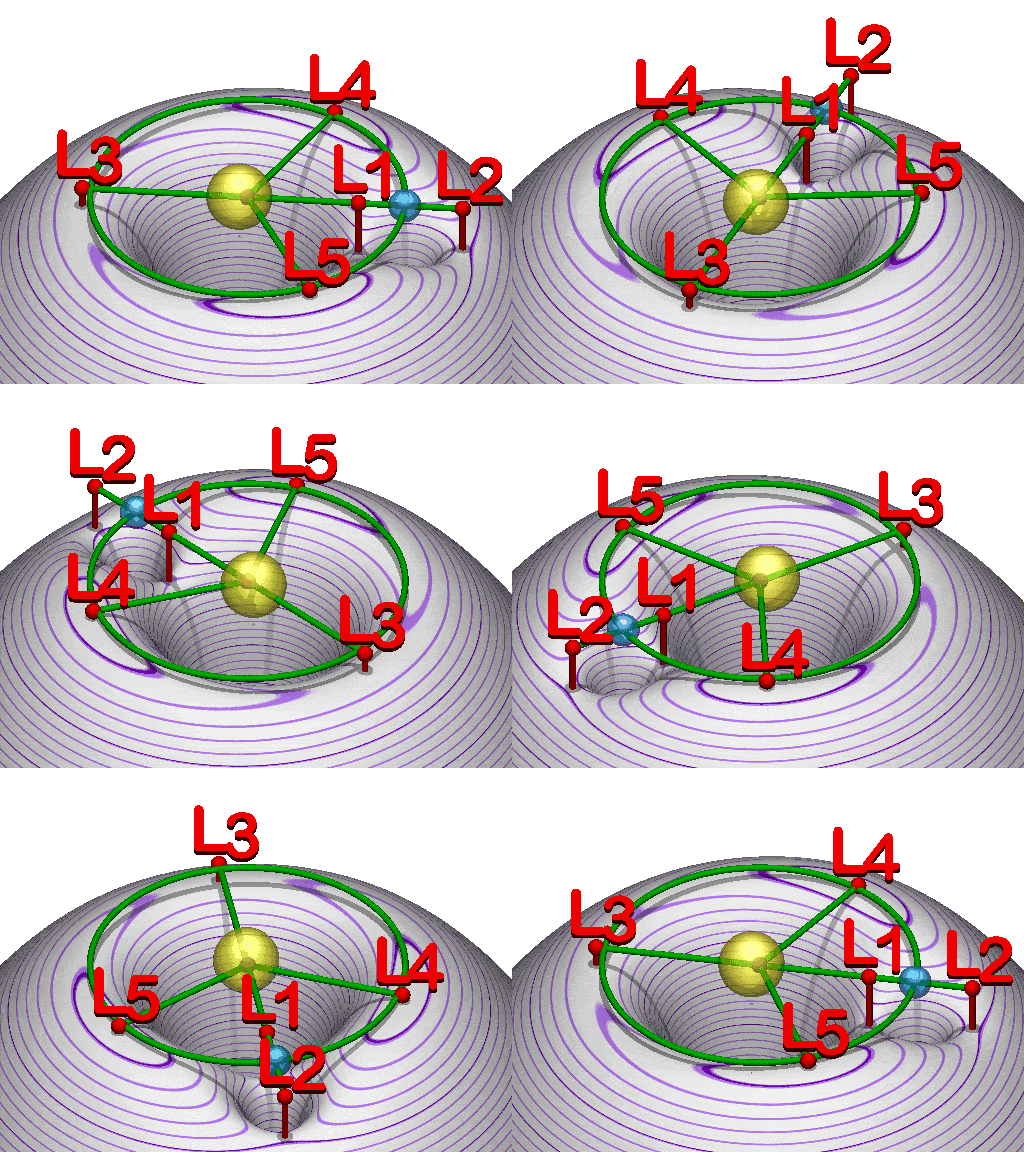
        Combined gravitational potential $\phi (x(t),t)$ for Earth--Moon system with Lagrange points.

Motion under gravitation is according to the New View described by the following set of equations in terms of the gravitational potential $\phi (x,t)$ and immaterial free fall trajectories $x(t)$;
  1. $\Delta\dot\phi +\nabla\cdot (u\Delta\phi ) = 0$,                         (mass conservation)
  2. $u(x(t),t)=\dot x(t)$,
  3. $\ddot x(t) +\nabla\phi (x(t),t) = 0$,                          (Newton's 2nd Law)
where the mass density $\rho (x,t)$ does not appear, but is instead tied to $\phi (x,t)$ by the relation $\rho (x,t)=\Delta\phi (x,t)$ by differentiation as instant local action in space.  Notice that the immaterial trajectories cover space even where $\Delta\phi (x,t)=0$ expressing absence of matter. The differential equations 1-3 are complemented by initial conditions $\phi (x,0)$ and $x(0)$ and $\dot x(0)$.

To avoid local gravitational collapse from the tendency of gravitational motion to concentrate matter, a pressure force $-\nabla p$ with $p$ a pressure is needed to balance the gravitational force $\rho\nabla\phi$ locally. With such a pressure force present the basic case to consider is a two-body problem as the motion of two bodies 1 and 2 as solid spheres of mass $m_1$ and $m_2$ under gravitation. The corresponding gravitational potential can be expressed as a smoothed version of the potential of the corresponding point masses (in normalized form):
  • $\phi (x,t) =\phi_1(x,t) +\phi_2(x,t)\equiv \frac{m_1}{\vert x - x_1(t)\vert} + \frac{m_2}{\vert x - x_2(t)\vert}$
where $x_1(t)$ is the position of the center of body 1 at time $t$ and $x_2(t)$ that of body 2. The net gravitational force $F_{12}(t)$ acting on body 1 will then be given by
  • $F_{12}(t)=m_1\nabla\phi_2(x_1(t),t) = \frac{m_1m_2}{\vert x_1(t) - x_2(t)\vert^2}e_{12}$,
where $e_{12}$ is a unit vector in the direction $x_2(t) - x_1(t)$, because the the force from $\phi_1$ will be balanced by a local pressure. Likewise the net gravitational force $F_{21}$ acting on body 2 is given by
  • $F_{21}(t)=m_2\nabla\phi_1(x_2(t),t) = \frac{m_1m_2}{\vert x_2(t) - x_1(t)\vert^2}e_{21}= -F_{12}(t)$.
We thus recover Newton's law of gravitation, which is no surprise of course, but the important aspect is that the full gravitational potential $\phi (x,t)$ is the sum of the gravitational potentials $\phi_1(x,t)$ and $\phi_2(x,t)$, both changing with time, and that the self-gravitational force with $\nabla\phi_1$ acting on body 1 is balanced by a local pressure and thus effectively is canceled. This means that the trajectory $x_1(t)$ is determined by Newton's 2nd law with $\phi =\phi_2$.

The whole mystery of motion under gravitation is now expressed in the equation $\Delta\dot\phi +\nabla\cdot (u\Delta\phi ) = 0$, which is no mystery since it expresses  mass conservation.

fredag 28 februari 2014

Physics Illusion 14: Gravitational Motion by Instant Action at Distance

Newton envisioning a trajectory of free fall by watching an apple fall and contemplating about a possible New View of gravitational motion without instant action at distance.

In the New View of Gravitational Motion the gravitational potential $\phi (x,t)$ is primordial with mass density $\rho (x,t)$ derived as $\rho (x,t) =\Delta\phi (x,t)$, formally by differentiation as instant local action in space with Euclidean coordinate $x$ and with $t$ a time coordinate.

In the Standard View instead the mass density $\rho (x,t)$ is primordial and the gravitational potential $\phi (x,t)$ is formally generated as solution to Poisson's equation  $\Delta\phi (x,t)=\rho (x,t)$ as instant global action in space.

The basic mystery in the Standard View is the instant action at distance acknowledged by the inventor Newton himself:
  • That gravity should be innate, inherent and essential to matter, so that one body may act upon another at-a-distance, through a vacuum, without the mediation of anything else by and through which their action may be conveyed from one to another, is to me so great an absurdity that I believe no man, who has in philosophical matters a competent faculty of thinking, can ever fall into it. 
  • So far I have explained the phenomena by the force of gravity, but I have not yet ascertained the cause of gravity itself. ... and I do not arbitrarily invent hypotheses. (Newton. Letter to Richard Bentley 25 Feb. 1693)
There is no progress towards a resolution of the absurdity of instant action at distance. The New View offers a way to get around this basic difficulty instead of running head-on into it. 

The New View presents gravitational motion by an evolution equation for the gravitational potential expressing mass conservation (with the dot indicating differentiation with respect to time):
  • $\Delta\dot\phi +\nabla\cdot (u\Delta\phi ) = 0$,
combined with an equation defining free fall trajectories $x(t)$ as the motion of immaterial pointwise particles according to Newton's 2nd law:  
  • $\ddot x(t) +\nabla\phi (x(t),t) = 0$,
which define the immaterial velocity $u(x(t),t) =\dot x(t)$ in the evolution equation for $\phi$. 

Motion under gravitation is thus according to the New View described by the following set of equations in terms of the gravitational potential $\phi (x,t)$ and immaterial free fall trajectories $x(t)$;
  1. $\Delta\dot\phi +\nabla\cdot (u\Delta\phi ) = 0$,
  2. $u(x(t),t)=\dot x(t)$,
  3. $\ddot x(t) +\nabla\phi (x(t),t) = 0$,
where the mass density $\rho (x,t)$ does not appear, but is instead tied to $\phi (x,t)$ by the relation $\rho (x,t)=\Delta\phi (x,t)$ by differentiation as instant local action in space.  Notice that the immaterial trajectories cover space even where $\Delta\phi (x,t)=0$ expressing absence of matter. The differential equations 1-3 are complemented by initial conditions $\phi (x,0)$ and $x(0)$ and $\dot x(0)$.  

The New View would be the view of an observer who is blind to real matter, but can envision immaterial free fall trajectories $x(t)$ and instant local action. In the New View the gravitational potential changes and as result moves matter.  Watching an apple fall is envisioning a free fall trajectory and corresponding change of gravitational potential.

The Standard View is natural to an observer who can envision real matter and instant action at distance, but is blind to immaterial free fall trajectories.  In the Standard View matter moves and as a result changes the gravitational potential. 

The New View and Standard View describe the same physics, for example the Earth moving around the Sun or a falling apple. The Standard View requires instant action at distance, which is unthinkable physics. The New View involves instant local action, which is thinkable physics. 

Which view do you prefer? 

tisdag 25 februari 2014

Physics Illusion 12: Modern vs Classical World

Leibniz develops a solution of the mind-body problem arising from the dualism of Descartes as an analogy to the well known physical phenomenon of resonance between two pendula or tuning forks swinging in perfect harmony together:


Leibniz World is a world in such perfect harmony, and as such a Best of Worlds, with everything in resonance with everything else as an expression of Pre-established Perfect Harmony without cause-effect.

Another example is a coldblooded animal with temperature in perfect harmony with that of the environment, again by a resonance phenomenon as analyzed in Computational Black Body Radiation:


Leibniz World is a Classical World in stationary state of resonance with forces in equilibrium, to be compared with a Modern World in rapid change from non-equilibrium of forces.

In a Classical World in a stationary state of resonance, a distinction between cause and effect cannot be made because the directional aspect of time, with a cause necessarily appearing before an effect, is missing. An example is the Newton's law of gravitation $\rho =\Delta\phi$ between mass density $\rho$ and gravitational potential $\phi$, possibly without cause-effect or in any case not with $\rho$ the cause and $\phi$ the effect, as discussed at length in the present sequence of posts.

In a Modern World changing in time the cause-effect relation is of basic importance, in particular for anyone with ambitions to exercise control and there are many. In a Modern World with the physics of control becomes of paramount importance, and then the basic idea of modern physics of force carrying particles comes in handy:
  • If you want to control something far away, just send some force carrying particles, like rockets or drones and you will be able to complete your mission.
  • A hot body is sending heat energy carrying particles named photons to warm up a cold body.
  • Gravitational forces between bodies are established by exchange of force carrying particles named gravitons.
  • Electromagnetic forces are transmitted by force carrying particles named photons.
  • Strong and weak nuclear forces are transmitted by force carrying particles named gluons and W/Z-bosons. 
While there are rockets and drones, the physical existence of particles like photons and gravitons may be more fiction than reality.

Ambitions of control may be huge, while reality of control is another thing. The cause-effect relation may not be want you would like it to be.

Below is a modern physics view of a world filled with force carrying particles:


Modernity is change and cause-effect action expressed as Will to Power by Nietzsche and in the dynamics of a capitalistic system, in contrast to a classical society in equilibrium. But sociology and politics is not physics, and so the modernity of modern physics may be illusion more than reality.

The revolution into modern physics the beginning of the 20th century (relativity and quantum mecahnics) came along with a revolution of technology (car, telephone, electricity, oil) combined with revolutions in politics, art, music, where old systems were overthrown with radical novelty of top priority. But physics is eternal and does not care about novelty, and so a lot of relevant classical physics (Newtonian mechanics and Maxwellian electromagnetics) was dumped in modern physics.

Modernity as motion was expressed in the avant-garde art movement of futurism:

                                    Unique Forms of Continuity in Space, by Umberto Boccioni (1913).

måndag 24 februari 2014

Physics Illusion 10: Fabric of Curved Space-Time

                Curved space coordinate system in which free fall follows coordinate lines. Believing that this coordinate system shows us the true "fabric of curved space-time" is deeply mystical, yet supposed to be a foundation of modern physics.
         
In general relativity the distribution of matter/energy is supposed to determine the "fabric of space and time" and make more or less "curved" according to Einstein's equation (assuming the speed of light and gravitational constant normalized to unity)
  • $G_{\mu\nu}=8\pi T_{\mu\nu}$, 
where $G_{\mu\nu}$ is Einstein's tensor measuring curvature and $T_{\mu\nu}$ is a stress-energy tensor. The folklore explanation in the words of John Wheeler reads as follows:
  • Matter tells space how to curve. Space tells matter how to move (by free fall).
In the basic case of flat Minkowski space-time and infinite speed of light (standard Euclidean space with coordinate $x$ and separate time coordinate $t$), Einstein's equations reduce to 
Newton's equations
  • $\Delta\phi =\rho$,                                            (Newton's law of gravitation)
  • $\ddot x(t) + \nabla\phi (x(t),t)=0$,                    (Newton's 2nd law)
where $\rho (x,t)$ is mass density, $\phi (x,t)$ is gravitational potential and $x(t)$ denotes the trajectory of a mass particle moving subject to gravitational forces given as $-\nabla\phi (x,t)$.  As a Wheeler paraphrase, Newton's equations could be expressed:
  • Matter determines the gravitational potential. The gradient of the gravitational potential determines how matter moves. 
Einstein's supposedly great idea was to reduce all motion to free fall in a space-time coordinate system where the equations of motion take the form $\ddot x(t)=0$ as if no gravitational forces were present. 

Einstein thus replaces the gravitational potential by space-time curvature, which makes things more complicated, and then balances by using a trivial form of Newton's 2nd law. 

The question is if there is a net gain or loss by this shift? I would vote for Newton's formulation because both Newton's laws are easy to grasp. On the other hand, Einstein's concept of "curved space-time" supposedly being realized in some "fabric of space-time" makes things much more difficult to grasp at the small gain of having only to deal with Newton's 2nd law in trivial form, thus with a net loss.

Einstein's was hooked to the idea of choosing a coordinate system in which the equations of motion reduce to the trivial form for free fall, as if the essence of physics was hidden in a coordinate system.
But real physics cannot rely on the choice of coordinate system. In principle any coordinate system can be used and a coordinate system does not need any "fabric" to be erected as it is immaterial. 

Believing that there are certain coordinate systems with higher scientific value than others, may lead to seek to identify such royal coordinate systems through some form of material existence expressed as "fabric of space-time".  But that is deeply mystical and as such can only be an illusion.

Newtonian gravitation can be combined with Maxwell's equations for electromagnetics and Schrödinger's equations for quantum mechanics into a Unified Field Theory. Einstein struggled for 40 years to combine Einstein's equations with Maxwell's and Schrödinger's equations without any success, and nobody else got further.

The effective way out of this dilemma, which has paralyzed physicists for 100 years, may well be to replace Einstein's equations by Newton's equations at no loss of anything of real value to physics. 

Physics Illusion 9: Instant Action at Distance Not Physical Nor Needed

                     Gravitational potential generating mass at the tip of the potential well.    

Viewing physics as a form of analog computation based on computational exchange of local information, suggests that instant action at distance is unphysical, because a large number of local computations would be required to transfer information globally, which would require time.

Newton's law of gravitation can be expressed through the relation $\Delta\phi (x,t) =\rho (x,t)$, where $\phi (x,t)$ is gravitational potential and $\rho (x,t)$ mass density with $x$ a Euclidean space coordinate. The potential $\phi $ may be computed by explicit time stepping to stationary state, each  step exchanging local information only, of the parabolic evolution equation (heat equation)
  • $\dot\phi (x,t) - \Delta\phi (x,t)=\rho (x,t)$ for all $x$ and $t > 0$ with $\phi (0,x)$ given,
which would require time and thus cannot be accomplished instantly. Here a dot signifies differentiation with respect to time $t$.

We conclude that in the relation $\Delta\phi =\rho$ connecting $\phi$ and $\rho$, we cannot view $\rho$ as input or cause and $\phi$ as output or effect, but rather the other way around with the potential $\phi$ as primordial input/cause and $\rho$ as the output/effect. With this view $\rho (x,t)=\Delta\phi (x,t)$ is produced locally by the Laplacian differential operator $\Delta$ acting locally in space on the potential $\phi (x,t)$, thus without action at distance and thus in principle allowing instant action. 

We may compare with Faraday's law of induction in electromagnetics:
  • $J = -\dot E + \nabla\times B$, 
where $J(x,t)$ is electrical current density, $E$ is electrical field and $B$ magnetic field, which can also be expressed by the wave equation
  • $-\dot J =\ddot E -\Delta E \equiv\square E$, 
with a common notation. Here we see the current $J$ being generated by the electrical field $E$ by differentiation acting locally in space and time and we thus face a concrete physical example of a field by generating a flow of charge or current locally by differentiation. By analogy we may envision the gravitational field $\phi$ generating mass $\rho =\Delta\phi$ locally by differentiation.

We thus have the following two relations with the fields $\phi$ and $E$ acting as input and the output $\rho$ and $\dot J$ being produced locally by differentiation:
  1. $\rho = \Delta\phi $,
  2. $\dot J =- \square E$ or $J = -\dot E + \nabla\times B$.          
Here 2 expresses the familiar physics of induction, while 1 expresses unfamiliar generation of mass by gravitational potential. The question if we can learn to become as familiar with 1 as we already are with 2? Von Neumann reflected:
  • In mathematics you don't understand things. You just get used to them.
Maybe it is the same with physics, and then it seems better to get used to constructive real physics which can be simulated by digital computation, than with illusionary physics, which can only be simulated by illusions of thinking without connection to the realities of physics. Such an illusion is instant action at distance as in the conventional view of gravitation with matter generating gravitational potential and force.

söndag 23 februari 2014

Physics Illusion 7: What You See Is What There Is

                                               To see a duck which is a rabbit (or vice versa).

In the New View of Motion under Gravitation we consider in the basic relation $\Delta\phi =\rho$, the gravitational potential $\phi (x,t)$ to be primordial and the mass density $\rho (x,t)$ to be derived from
$\phi (x,t)$ by instantaneous local action in space of the Laplace differential operator.

In the standard view instead the mass density $\rho (x,t)$ is viewed to be primordial and the potential
$\phi (x,t)$ is viewed to be derived as the solution to the equation $\Delta\phi =\rho$ by instantaneous action at distance in a solution process which can be described as global integration:
  • $\phi (x,t) =\frac{1}{4\pi}\int \frac{\rho (y,t)}{\vert x - y\vert}\, dy$. 
Why then is $\rho$ chosen to be primal (input) and $\phi$ secondary (output) in the standard view? The answer appears to be twofold:
  1. Matter is visible to the human eye, while gravitational potential and forces are invisible.
  2. Matter distribution can easily be imagined by the human mind as input, while corresponding gravitational potential and forces are more difficult to grasp (output).  
A human mind may thus be led to the standard view by reasons which are superficial from physics point of view. In particular, if we consider physics to be some form of computational process, we expect that intantaneous action at distance as instantaneous solution of the differential equations $\Delta\phi =\rho$, cannot be realized as a physical process. The standard view would then seem to be unphysical, and rather reflect how human minds see things than how things in fact are. 

fredag 21 februari 2014

Physics Illusion 6: Gravitational Force Between Each Pair of Particles


                         The Millenium Run: Gravitational N-body problem with $N \sim 10^{10}$.

Imagine that each atom of the Earth is communicating with each atom of the Sun by exchanging force carrying particles named gravitons through which a gravitational force is established between each such pair of atoms (neglecting internal gravitation for simplicity).

The number of atoms in the Earth is estimated to be around $10^{50}$ and that in the Sun around $10^{57}$, which gives a number of pairs much larger than a  $googol = 10^{100}$, while the total number of atoms in the Universe may be of order $10^{80}$.

To store the total set of gravitational forces between the Earth and the Sun, thus would require a hard disk much heavier than the Universe, and there would be no place for the gravitational force between the Earth and the Moon, to name one example.

Do you now start to feel that there is something strange about the standard model of gravitation, which is precisely the one described above?

Do you now start to feel that the very idea of each atom of the Universe making its presence felt to all other atoms of the Universe by creating a gravitational field extending over the entire Universe, is very strange or more precisely describes a complete impossibility?

Do you now start to feel that the Millennium Run with $10^{10}$ particles interacting by gravitation requires way to much computational work to represent physics?

Do you now start to think that maybe, maybe, it is the other way around; that is that the gravitational potential $\phi$ and gravitational field $\nabla\phi$ is primordial and that matter with density $\rho$ is generated locally formally by differentiation as $\rho =\Delta\phi$?

If so, then you are starting to develop a New View.

torsdag 20 februari 2014

Physics lllusion 5: Particles as Force Carriers

        Is Hermes as boson as carrier of force between fermions Greek mythology rather than physics? 

The Standard Model identifies two main types of elementary particles: fermions as carriers of charge and mass such as the electron and proton, and bosons as carriers of force such as the photon supposedly carrying the electromagnetic force and carriers of the weak and strong nuclear force.

The Standard model thus includes the electromagnetic, weak and strong forces,  but the 4th fundamental force of gravitation is excluded, which is viewed to be a main defect of the Standard Model defying all attempts of correction.

The hypothetical carrier of the gravitational force is the graviton, but there is no experimental evidence of the existence of such a particle.

From these facts, it is natural to question the fundamental idea of the Standard Model that there are certain carriers of forces in the form of boson particles carrying forces over distance between fermions: If there is no particle carrying the gravitational force from the Sun to the Earth, why must there be a particle named photon carrying electromagnetic forces from mobile telephone mast to the mobile phone in our hand, like a Hermes of electromagnetics? A particle without mass and charge which has not been identified experimentally.

In the New View we turn the perspective around and view the boson force field with everywhere presence in space as primordial from which the fermion field is locally generated and acted upon without any need of carrying force over distance. This opens to a reduction of the number of elementary particles by eliminating particles serving the purpose of carrying forces around.

In the New View the force field is everywhere present and is not carried around. In the New View the gravitational field is everywhere, from which matter is locally generated thus eliminating the need of instantaneously carrying force over  distance.

tisdag 18 februari 2014

Physics Illusion 1: Gravitational Attraction as Instant Action at Distance

In New View of Motion under Gravitation I suggest to view gravitational potential $\phi (x,t)$ as primordial and matter density $\rho (x,t)$ generated by $\phi$ by action of the Laplacian: $\rho (x,t) =\Delta\phi (x,t)$ which is local space and time, with $x$ a Euclidean space coordinate and $t$ time.

With this view there is no action at distance, which is the main unresolved mystery of Newton's mechanics with matter density $\rho$ primordial and gravitational potential $\phi$ as the solution of the differential equation $\Delta\phi =\rho$.  Istant action at distance has never been explained.


lördag 15 februari 2014

New View of Motion under Gravitation vs Einstein's View

Stephen Hawking: The happiest experience of my life testing General Relativity in free fall under the illusion of zero gravitational force.

If we compare the New View of Motion under Gravitation presented in recent posts with Einstein's General Relativity, we find

New View:
  1. gravitational potential $\phi (x,t)$ primordial, 
  2. matter with density $\rho (x,t)$ from $\phi (x,t)$ by $\rho (x,t) =\Delta\phi (x,t)$: action local in space and time,
  3. gravitational free fall motion along trajectory $x(t)$ from $\phi$ by $\ddot x(t)=-\nabla\phi (x(t),t)$,
  4. $\rho\nabla\phi$ gravitational force,
  5. Newton's 2nd law $\rho\ddot x= - \rho\nabla\phi$ consequence of 3.
  6. Equivalence Principle consequence of 3.
  7. definition of non-gravitational force $F\equiv \rho\ddot x + \rho\nabla\phi$,
  8. Euclidean space coordinate $x$ specified up to translation with constant velocity, 
  9. $\dot x =\frac{dx}{dt}$ derivative with respect to universal time differential $dt$,
  10. gravitational potential satisfies evolution equation: $\Delta\dot\phi +\nabla\cdot (u\Delta\phi )=0$, where $u(x(t),t)=\dot x(t)$ is velocity.     
General Relativity:
  • Equivalence principle ad hoc assumption: gravitational force = inertial force, 
  • matter distribution primordial,
  • curved space-time from matter distribution: action at distance,
  • motion as free fall along geodesic in curved space time under zero gravitational force, 
  • non-zero gravitational force illusion because gravitational force = inertial force. 
The New View starts from gravitational potential and gravitational force as primordial and ends with matter by action local in space and motion as reality. Newton's 2nd law and the Equivalence principle are consequences of the New View and not ad hoc assumptions. The coordinate system is Euclidean without rotation since centrifugal forces are missing in 3, and with origin and translation at constant velocity free to choose. One such system is determined by the fixed stars, assuming no rotation of the visible Universe. Notice that a free fall trajectory $x(t)$ is immaterial and thus exists as solution to $\ddot x(t)=-\nabla\phi (x(t),t)$ also in vacuum where $\Delta\phi (x(t),t)=0$.  The evolution equation for $\phi$ then express that matter moves along immaterial free fall trajectories. No medium for propagation of gravitational forces is required, because all action is local and trajectories are immaterial.
Free fall trajectories could be used to locally define curved coordinate systems, but reason to do so lacking.  

General Relativity starts from matter creating curved space-time by action at distance gearing motion and ends with gravitational force as illusion. Einstein was led to General Relativity from the idea of extending Special Relativity with zero gravitation to the case non-zero gravitation by changing the coordinate system to give the illusion of zero gravitation. The Equivalence principle as ad hoc assumption serves to identify gravitational force with inertial force. Einstein based his physics on thought experiments with people being stuck in elevators in free fall.  Einstein put the emphasis on the choice of coordinate system, as if real physics could depend on the coordinates chosen to describe physics.   

Einstein thus developed a gravitational theory based on an idea that gravitation is illusion. No wonder if  General Relativity is also only illusion and not physics.

Recall that Einstein fell in love with the idea of gravitational force as illusion, viewing it as the happiest thought of my life:
  • The gravitational field has only a relative existence... Because for an observer freely falling from the roof of a house -at least in his immediate surroundings - there exists no gravitational field.
Einstein's example shows the consequences of falling in love too much with an idea, in particular with an idea that serves your preconceived agenda.

Recall that modern theoretical physics is paralyzed by the incompatibility of general relativity with quantum mechanics, but physicists thoroughly trained to confess to the dogma of general relativity are unable to get out of the dead-lock. And so the happiest thought of Einstein's life has brought death to physics, in accordance with the logic of tragedy.

Occasionally you may hear a famous physicist like Feynman confessing: I still can't see how Einstein thought of general relativity, while media like Times sells copies by propagating big mystery physics:
  • Even now scientists marvel at the daring of general relativity.
  • But the great physicist (Einstein) was also engagingly simple, trading ties and socks for mothy sweaters and sweatshirts. 
  • He tossed off pithy aphorisms ("Science is a wonderful thing if one does not have to earn one's living at it") and playful doggerel as easily as equations. 
  • Viewing the hoopla over him with humorous detachment, he variously referred to himself as the Jewish saint or artist's model. 
  • He was a cartoonist's dream come true.