Visar inlägg med etikett cosmology. Visa alla inlägg

fredag 19 maj 2023

Do Galaxies Recede at a Speed larger than the Speed of Light?

Maximally observed redshift  z=8.

The light from far away galaxies receding from us with a speed $v$ is received with a redshift frequency factor given by the Doppler effect formula with the speed of light normalised to 1: 

  • $f=\frac{1}{1+v}$
or in alternative common notation
  • $1+z=\frac{1}{f}$
with $z=v$. This is a consequence of Maxwell's equations in a Euclidean space coordinate system fixed to Earth in accordance with the cosmological model of Many-Minds Relativity. There is no compelling reason to reject Maxwell's equations as a correct model of the propagation of light. There is no compelling reason to invoke any coordinate system moving with respect to Earth since observations are made on Earth not in receding galaxies. Since thus only one coordinate system is used, Einstein's special theory of relativity with objective to coordinate observations in different coordinate systems according to the Lorentz transformation, does not appear to have anything to offer.  

The largest observed redshift is about $z=8$ (see above figure) indicating a recession speed 8 times larger than the speed of light. Observations thus indicate an expansion speed of the Universe which is much larger than the speed of light. This seems to be in contradiction with Einstein's basic postulate of the speed of light in vacuum as maximal speed of both light and matter.  

In short, no real physics appears to prevent the Universe from expanding faster than the speed of light, and  this is what in fact is observed. This puts a big question mark to Einstein's basic postulate. 

Since light governed by Maxwell's equations does not seem to interact with Newton's mechanics for the motion of material bodies (explored in more detail in Many-Minds Relativity), there is no reason to expect that the speed of light sets a limit to the possible recession speed of material bodies. In Leibnizian terms, there is no sufficient reason for something like that to be true. In addition, observations show recession speeds much larger than the speed of light. Your conclusion?

tisdag 17 januari 2023

Accelerating Expanding Universe: Reality or Illusion?


Hubble's Law collects observations of redshifts of the light from galaxies suggesting that the Universe is expanding away from the Earth at speeds proportional to the distance from the Earth. The Nobel Prize in Physics was awarded work showing larger expansion suggesting an Accelerating Universe with redshifts seemingly corresponding to superluminal speeds at the edge of the observable Universe. 

Speculations about an enormous amount of dark energy as driver of the acceleration expansion were made but, nothing is known about this type of energy supposed to make up 68% of the total energy of the Universe. 

Other speculations seek to solve the mystery generated by the observations of large redshifts by suggesting they are just illusions resulting from measurement techniques. Like the apparent decrease of size with view distance.

Let us make a connection to Many-Minds Relativity where velocities are computed from observed Doppler effects and includes a law of adding two velocities $v$ and $w$ from composite Doppler effects of the form 
  • $v+w+vw$ 

as a variant of Einstein's velocity addition law of Special Relativity. Here $v+w+vw$ is the velocity perceived by an observer X moving with velocity $v$ with respect to another observer Y observing the velocity $w$. 

The computed velocity is seen to be larger than the standard $v+w$, and will increase with increasing number of composite Doppler shifts, which could be connected to increasing distance. In the limit that gives from a nominal real velocity $v$ a computed velocity $\exp(v)$ suggesting an expansion of the Universe which is exponentially increasing with distance. We understand that this is an illusion depending on the way we compute velocities from composite Doppler shifts.

So, we have two possibilities of explaining observations of an expanding Universe: 

  1. dark matter
  2. illusion. 

Which is more reasonable? To believe in 1. requires a massive addition to the total energy of the Universe, a big deal. To believe in 2.  requires simply some understanding of how velocities are computed from redshift observations, no big deal. Your choice.    


tisdag 8 oktober 2019

Nobel Prize to Cosmology with Dark Energy

Dark energy filling the announcement of the 2019 Nobel Prize in Physics.
The previous post on dark energy and exponential cosmic expansion anticipated the 2019 Nobel Prize in Physics announced today with motivation:
  • for contributions to our understanding of the evolution of the universe and Earth’s place in the cosmos
including in particular the discovery that the dark energy apparently filling 68% of the Universe,
is not understood at all.

As a compensation, the previous post contributes the understanding that the exponential expansion being observed and then believed to require massive dark energy, in fact can largely be viewed to be an optical illusion from misinterpretation of red-shifts and if true reduces the need of massive dark energy.

Take a look and see if light enters your mind. There is a new Prize to collect 2020.

torsdag 5 oktober 2017

LIGO vs Neo-Newtonian Cosmology

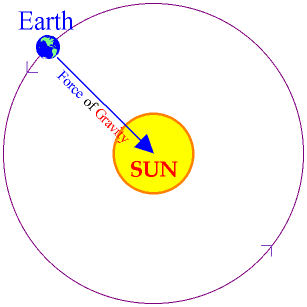
The Earth is pulled in the direction of the present position of the Sun at each  instant, right?


Let us continue our reflections on LIGO recalling my earlier post on Neo-Newtonian Cosmology as an alternative to Einstein's Cosmology based on Einstein's equations with related posts here and the discussion about The Hen and the Egg.

In Neo-Newtonian Cosmology a gravity potential $\phi (x,t)$ (depending on an Euclidean space coordinate $x$ and time $t$) is connected to mass distribution $\rho (x,t)$ through Poisson's equation
  • $\Delta\phi =\rho $
which is interpreted as creation of mass $\rho$ by the action of $\Delta$ upon the gravitational potential $\phi$ through a local instant operation of differentiation.  

This is different from the standard interpretation in Newtonian cosmology with instead the gravitational potential $\phi$ created from mass $\rho$ by instant action at distance corresponding to solving or integrating Poisson's equation, as if gravitational force/potential is propagated at infinite speed. We thus have: 
  • Neo-Newtonian Cosmology: matter created from gravitational potential by instant local action.
  • Newtonian Cosmology: gravitational potential created from mass by instant action at distance.
Now, the big mystery of Newtonian Gravitation/Cosmology is the instant action at distance, which with the optics of Neo-Newtonian Cosmology is a fictional problem, which thus can be replaced by local instant action, with the mystery of instant action at distance eliminated. 

The beauty with both Newtonian and Neo-Newtonian Cosmology, as compared with Einstein's, is that motion of the Earth around the Sun gets an theoretical explanation agreeing with the following observation:
  • The Earth accelerates at each instant of time in the direction of the present position of the Sun as if the action of the Sun is instant at distance.  
In particular, the Earth does not accelerate in the direction where the Sun is seen, since that position through the finite speed of light, has a delay of 8 minutes. The difference comes out in the thought experiment that the Sun suddenly disappears into nothing: In Neo-Newtonian Cosmology that would mean the instant disappearance of the gravitational field and thus leave the Earth instantly continuing in the tangent direction, while with finite speed of propagation of gravitational force created at distance by the mass of the Sun, that would take 8 minutes and the path would then be different.

In Einstein' Cosmology gravitation is propagated with the finite speed of light, but that does not seem to be the case for the Sun-Earth system.  Right?

Recall that Einstein was obsessed with choice of coordinates in both the special and general theory, as  if this choice has anything to do with physics, as if physics carries around coordinate systems imprinted in the "fabric of space-time" as the name of the game. But coordinate systems are inventions/conventions made by humans and not the Creator of the World, who had no need of such things when putting things together and letting it go...

tisdag 13 maj 2014

Parameter-Free Fluid Models: How to Make Einstein Happy


In recent work (here and here) we have shown that mean-value outputs of computed turbulent solutions of the incompressible Navier-Stokes equations with small viscosity, vary little with the absolute value of the viscosity. This makes this mathematical model to an example of Einstein's ideal as a physics model without parameters or coefficients requiring experimental determination.

For example, we show in New Theory of Flight that the lift and drag of an airplane can be accurately computed using this model, thus ab initio without input of any experimental measurement. This is very remarkable and would have made Einstein very happy.

Augmenting this model to include self-gravitation as in the blog post Equivalence of Inertial and Heavy Mass, gives a parameter-free cosmological model, by choosing the unit of mass so that
  • $\Delta\phi (x,t) = \rho (x,t)$, 
where $\phi (x,t)$ is the gravitational potential and $\rho (x,t)$ mass density for a given unit of length specified by the $x$ coordinate, and the unit of time $t$ so that Newton's 2nd law takes the form
  • $\ddot x = - \nabla\phi (x,t)$,
connecting particle accelleration $\ddot x(t)$ to the gradient $\nabla\phi (x,t)$, where $x(t)$ is the trajectory of a particle of unit mass.

Such a  model can describe galactic scales after galaxy and star formation from interstellar dust under compression, as an incompressible fluid of small viscosity under self-gravitation, without any parameter to determine experimentally. This could have made Einstein even happier.


fredag 14 februari 2014

The Equivalence Principle from Newton's 2nd Law


We now continue New View of Motion under Gravitation without Classical Mysteries with a study of the Equivalence Principle (EP) stating that inertial mass is equal to gravitational  (heavy) mass, or in other words, that all matter independent of mass and composition reacts the same way to gravitation. EP was identified by Galileo and by Newton made into a corner stone of his theory of gravitation.

The question is if EP is a deep mystery or a necessity which can be understood? Why does a stone and a feather fall the same way when dropped from the Tower of Pisa (assuming no air resistance)? Is it mystery or not?

We recall our Newtonian model of matter subject to gravitation expressed by the equations (to be satisfied for all $x$ and positive time $t$):
  • $\rho (x,t) =\Delta\phi (x,t)$                              (Newton's law of gravitation)
  • $\ddot x(t)= -\nabla\phi (x(t),t)$                          (Newton's 2nd law in math form)
  • $\Delta\dot\phi +\nabla\cdot (u\Delta\phi )=0$                        (Evolution equation for $\phi$),
where $\phi$ is a gravitational potential $\phi (x,t)$ depending on a Euclidean space coordinate $x$ and time $t$, and $\rho (x,t)$ is matter density and $x(t)$ denotes a trajectory with acceleration $\ddot x(t)$ and velocity $\dot x(t)=u(x(t),t)$ specified by initial conditions $x(0)$ and $\ddot x(0)$, with the dot denoting differentiation with respect to time. 

We thus consider the gravitational potential $\phi$ as the primordial object  and the matter density $\rho (x,t)$ as a derived physical quantity given by Newton's law of gravitation: $\rho (x,t) =\Delta\phi (x,t)$. 

We consider trajectories $x(t)$ as mathematical constructs given by Newton's 2nd law in its mathematical form: $\ddot x(t)= -\nabla\phi (x(t),t)$. Newton's 2nd law in math from states a connection between motion $\ddot x(t)$ and the gradient of the gravitational potential $\nabla\phi (x,t)$, which can be viewed to reflect a balance between two types of energy: 
  • KE(t) = $\frac{\vert\dot x(t)\vert^2}{2}$                                              (kinetic energy) 
  • GE(t) = $\phi (x(t),t)$,                                     (gravitational energy):
with
  • $\frac{d}{dt}(KE + GE)=0$. 
We view $\rho (x,t) =\Delta\phi (x,t)$ as expressing local "creation of matter" with density $\rho (x,t)$ by "action" of the Laplacian differential operator $\Delta$ operating on the gravitational potential $\phi (x,t)$ locally in space and time. We note that the "creation of matter" does not depend on the nature or composition of matter, and we can thus view the created matter to be a form of primordial matter with only quality being density $\rho$ from which all matter with different nature and composition is formed. 
Suppose now we multiply Newton's 2nd law by $\rho (x,t)$ to get
  • $\rho\ddot x(t)= -\rho (x,t)\nabla\phi (x(t),t)$,              (Newton's law in physics form)    
and make the following physical interpretation
  • $F =-\rho (x,t)\nabla\phi (x(t),t)$ is gravitational force
  • $\ddot x(t)$ is material acceleration
  • $\rho (x,t)$ is matter density.
We can then view Newton's 2nd law in physics form to express EP in the form:
  • Material motion under gravitation is independent of matter nature, composition and density.
We sum up:
  • EP is a consequence of Newton's 2nd law.
  • Newton's 2nd law serves to maintain a balance between kinetic energy depending on motion and gravitational energy depending on position.  
The essence given by the Creator is thus a Universe with a dynamics in time based on a balance between two forms of energy, kinetic energy of motion and gravitational energy of position, maintained by Newton's 2nd law. In this Universe, EP is valid as a consequence of Newton's 2nd law. 

Defining non-gravitational forces $F(x(t),t)$ by Newton's law in the form 
  • $F(x(t),t) \equiv \rho(x(t),t)\ddot x(t) + \rho (x(t),t)\nabla\phi (x(t),t)$,
extends this Universe to effects of forces other than gravitation. 

Einstein's general theory of relativity is supposedly based on EP. If now EP is a consequence of Newton's 2nd law, we are led to the conclusion that Einstein's mechanics is no different from Newton's. 

Comparison with Standard Newtonian Mechanics

If we now accept that EP is a consequence of Newton's 2nd law, it is natural to ask in what sense the New View may be more illuminating than the standard view?

In standard Newtonian mechanics, matter with density $\rho (x,t)$ is primordial with the gravitational  potential $\phi$ being generated from $\rho$ as a solution of $\Delta\phi =\rho$ (requiring instant action at distance). The gravitational force acting on a lump of matter of density $\rho$ will then be given by $\rho\nabla\phi$ and EP will then, as above, be equivalent to Newton's law in the form $\rho\ddot x + \rho\nabla\phi=0$. 

In this case matter of density $\rho$ appears in three forms: (i) as generator of gravitation in $\Delta\phi =\rho$, (ii) as gravitational mass in $\rho\nabla\phi$ and (iii) as inertial mass in $\rho\ddot x$,  all supposed to be the same, which may be viewed as coincidence or as a mystery. 

In the New View, $\rho =\Delta\phi$ appears in only one form as a product of $\phi$ combined with Newton's 2nd law in math form expressing a balance of kinetic and potential energies, and the equivalence of this form of mass with gravitational and inertial mass is simply a matter of definition and thus no mystery. 

The New View thus opens to understanding that EP is rather a matter of definition, which is true by the construction of language,  than a statement about physics, which may be true or false. In particular, it points to obvious difficulty of avoiding circular reasoning when seeking to test EP experimentally.
  

onsdag 12 februari 2014

New View of Motion under Gravitation without Classical Mysteries

Mysteries of Classical Mechanics

There are two main mysteries in classical Newtonian mechanics and cosmology addressed in a recent sequence of posts:
  • Gravitation force created by instant action at distance from local presence of matter?
  • Motion of matter (Zeno's paradox: moving arrow is still at each instant)?

Resolution of Mysteries by New View of Motion under Gravitation

Both mysteries can be resolved, or circumvented, by viewing the gravitational potential $\phi (x,t)$ depending on a Euclidean space coordinate $x$ and time $t$ as the primordial object, from which matter with density $\rho (x,t)$  and motion along trajectories $x(t)$ with acceleration $\ddot x(t)$ and velocity $\dot x(t)$ with the dot denoting differentiation with respect to time, are derived by the following equations to be satisfied for all $x$ and $t$:
  • $\rho (x,t) =\Delta\phi (x,t)$                                         (Newton's law of gravitation)
  • $\ddot x(t)= -\nabla\phi (x(t),t)$                                    (Newton's 2nd law).   
The gravitational potential $\phi (x,t)$ itself is governed by the evolution equation 
  • $\Delta\dot\phi = - \nabla\cdot (u\Delta\phi )$               (E)
where $u(x,t)$ is trajectory velocity defined by $u(x(t),t)=\dot x(t)$, which is a reformulation of mass conservation commonly expressed in the form
  • $\dot\rho +\nabla\cdot (u\rho )=0$.                                   (mass conservation)
With the gravitational potential $\phi (x,t)$ as the primordial object, matter $\rho (x,t)$ will be created locally by the operation of the Laplacian $\rho (x,t) =\Delta\phi (x,t)$ expressing Newton's law of gravitation and trajectories $x(t)$ will be defined by Newton's 2nd law, and the gravitational potential will evolve governed by the evolution equation (E) which is a form of wave equation.

Wave Motion

The gravitational potential $\phi (x,t)$ will thus transform as a wave satisfying a wave equation and matter with density $\rho (x,t)$ will be created/annihilated locally according $\rho (x,t)=\Delta\phi (x,t)$
and thereby appear to follow trajectories $x(t)$ given by Newton's 2nd law. 

Motion of matter will then be an illusion of real gravitational potential wave motion, in the same way that the illusion of horisontal motion of heaps of water across a water surface is generated by water molecules in reality in circular motion up and down, where heaps of water are continuously created/annihilated giving the illusion of progression:


Notice that the trajectories $x(t)$ are mathematical constructs, and not "real particle trajectories" since there are no "particles in motion along particle trajectories". The motion consists wave motion of the gravitational potential, which is geared to follow mathematical trajectories.

The Hen and the Egg

The gravitational potential $\phi$ thus appears as a hens farm capable of laying eggs (creating matter) anywhere which are picked up by the farmer (annihilation of matter). An illusion of eggs in motion can then be formed this way, while the reality is that each egg (like Zeno's arrow) lays still after being laid and before being picked up and a moved egg in reality is a new recreated egg. 


Summary of New View

We are thus led to a New View of Motion under Gravitation offering a resolution of the main mysteries of classical mechanics of gravitational force acting at distance and Zeno's paradox of a moving arrow which is still and not moving at instant of time.

In the New View the primordial entity is the gravitational potential $\phi (x,t)$ governed by an evolution equation expressing mass conservation under motion. In the New View all action is local and Zeno's arrow is allowed to be still at each moment of time, yet capable of giving the illusion of motion by a process of creation/annihilation resulting from real wave motion of the gravitational potential $\phi$.

In particular in the New View there is no need to introduce gravitons as some form of "force carrying particles" transmitting gravitational forces over long distance by moving with infinite or finite speed. There is no evidence of the existence of such particles.

In the New View the only motion is wave motion in the gravitational potential with velocity given by trajectories governed by Newton's 2nd law.

In the New View the equations are those of classical Newtonian mechanics, but the interpretation and cause-effect is different. In the New View the gravitational potential is the cause, matter is the effect and motion of matter an illusion.

In the New View there is no need of general relativity with motion of matter governed by the "fabric of curved space-time", which is also a mystery understood by nobody. In the New View there is no need to speculate about the existence of gravitational waves progressing at the speed of light, which lack any form of experimental support despite major efforts.

The New View offers a look behind the scene of the visible motion on the stage of our planetary system with the planets accelerating towards the Sun as if governed by a God's hand of instant action at distance.  What we can see on scene is mostly illusion of reality and not reality.

Is there then no mystery in the New View?  Yes, of course there is and it is the generation of matter from gravitational potential according to $\rho =\Delta\phi$. This is the mystery of how a hen can generate an egg. We compare with the mystery of how an egg can generate a hen. Which mystery would you prefer to explain: (i) an egg from a hen or (ii) a hen from an egg?  My choice is (i) and yours? To remove all mystery may well be beyond human capacity, but we can always seek to minimize the amount of mystery, or if your are a professional physicist to maximize the mystery in order to maximize government grants to support multiplication of string and multiverse theorists.

The New View is expanded in Newtonian Matter and Antimatter (also here).

Zeno's Paradox Unresolved in Classical Mechanics

Notice that physicists (and philosophers) are still struggling to resolve Zeno's paradox without any success declared. Often a reference to Calculus as a resolution is made with a hint that the arrow appearing at different places at different times follows a differentiable curve with a certain momentary velocity defined by the limit process of differentiation, and so must be moving. But that is a fake solution because the essence which is the physics of an arrow appearing at different places at different times, is hidden and the limit process is purely mathematical. Thus Zeno's paradox of the impossibility of motion is unresolved in classical Newtonian mechanics, which does not reveal the physics of motion simply taking it for granted by pointing to the Moon traversing the sky.

As an example, consider the nonsense explanation in Stanford Encyclopedia of Philosophy: 
  • The answer is correct, but it carries the counter-intuitive implication that motion is not something that happens at any instant, but rather only over finite periods of time. Think about it this way: time, as we said, is composed only of instants. 
  • No distance is traveled during any instant. So when does the arrow actually move? How does it get from one place to another at a later moment? 
  • There's only one answer: the arrow gets from point X at time 1 to point Y at time 2 simply in virtue of being at successive intermediate points at successive intermediate times—the arrow never changes its position during an instant but only over intervals composed of instants, by the occupation of different positions at different times. 


fredag 7 februari 2014

The Universe as Weakly Compressible Gas subject to Pressure and Gravitational Forces


Our Milky Way Galaxy as a weakly compressible gas modeled by the Euler equations expressing conservation of mass, momentum and energy, combined with constitutive laws connecting pressure and gravitational forces to mass density.

After the excursion on Newton vs Einstein in recent posts, we are back to a cosmological model in the form of Euler's equations for a compressible gas subject to Newtonian gravitation: Find $(\rho ,m, e ,\phi ,p)$ depending on a Euclidean space coordinate $x$ and time $t$ , such that for all $(x,t)$:
  • $\dot\rho + \nabla\cdot (\rho u ) =0$       (or $\frac{D\rho}{Dt} = -\rho\nabla\cdot u$)
  • $\dot m +\nabla\cdot (mu) +\nabla p + \rho\nabla\phi =0$
  • $\dot e +\nabla\cdot (eu) +p\nabla\cdot u +\rho\nabla\cdot m=0$,
where $\rho$ is mass density, $u=\frac{m}{\rho}$ is matter velocity, $p$ is pressure, $\phi$ is gravitational potential, and $e$ is internal energy as the sum of heat energy $\rho T$ with $T$ temperature and gravitational energy $\rho\phi$and the dot indicates time differentiation and
  • $\frac{D\rho}{Dt}=\dot\rho +u\cdot\nabla\rho$
is the convective time derivative of $\rho$, see Many-Minds Relativity 20.3 and Computational Thermodynamics Chap 32.

These equations express conservation of mass $\rho$, conservation of momentum $m$ with $\nabla p$ pressure force and $-\nabla\phi$ gravitational force, and conservation of internal energy $e$. These laws of conservation are complemented with constitutive laws connection $p$ and $\phi$ to density of the following form:

A1: Weakly compressible gas ($\delta$ small positive constant):
  • $\Delta p =\frac{\nabla\cdot u}{\delta}= - \frac{1}{\delta\rho}\frac{D\rho}{Dt}$
or

A2: Compressible perfect gas ($0 < \gamma < 1 $): 
  • $p=\gamma \rho T$.
B: Newton's law of gravitation:
  • $\Delta\phi =\rho$ with $\phi =0$ at infinity.            
We observe
  1. Similarity of $\nabla p$ and $\nabla\phi$ in momentum equation. 
  2. Similarity between A1 and B connecting $\Delta p$ to $-\frac{D\rho}{Dt}$ (or $-\rho$) and $\Delta\phi$ to $\rho$.
  3. $p \ge 0$ and $\phi \le 0$.
Here 1 can be seen as the Equivalence Principle (equality of heavy and inertial mass) expressing that there is no difference between gravitational and other forces (pressure) in Newton's 2nd law expressing conservation of momentum.

Further, 2 expresses that the constitutive laws A1 and B both can be viewed as action at distance if $\rho$ is viewed as the cause, but represent local action of differentiation if $\rho$ is viewed as the effect. 

For a weakly compressible gas described by A1, there is no need per se to identify a cause-effect relation between $p$ and $\rho$; it is enough to say that $p$ and $\rho$ are connected in a certain way expressing a form of "perfect harmony". 

In the same way, there is no need per se to identify a cause-effect relation between $\phi$ and $\rho$; it is enough to say that $\phi$ and $\rho$ are connected in certain way expressing a form of  "perfect harmony" in the spirit of Leibniz.

The relation $\Delta\phi =\rho$ is explored in Newtonian Matter and Antimatter with $\Delta\phi > 0$ identifying matter and $\Delta\phi < 0$ antimatter. Mind-boggling!

It may be that the above Newtonian model is just as good (or even better) than Einstein's equations as cosmological model, because it is understandable and may contain relevant large scale physics without the mysteries of "curved space-time fabric" of general relativity.

Second Law of Thermodynamics

Viscosity solutions of the Euler equations satisfy the following 2nd law:
  • $\dot K = W_p + W_\phi - D$
  • $\dot E = - (W_p + W_\phi ) + D$,  
where at a given time instant $t$
  • $K=\int\frac{\vert m\vert^2}{2\rho}\, dx$ is total kinetic energy
  • $E=\int e\, dx$ is total internal energy 
  • $W_p=\int p\nabla\cdot u\, dx$ is total work performed by pressure 
  • $W_\phi =\int \phi\nabla\cdot m\, dx$ is total work performed by gravitation
  • $D>0$ is turbulent dissipation.
The sign of the turbulent dissipation $D$ gives an irreversible transfer of kinetic energy $K$ into internal energy $E$, which defines the direction of time. Transfer from internal energy requires $W_g+W_\phi >0$, that is expansion with $\nabla\cdot u > 0$ if $W_\phi=0$ and contraction with $\nabla\cdot u < 0$ if $W_p=0$. Note also that
  • $W_\phi =- \int \phi\dot\rho\, dx =-\int\phi\Delta\dot \phi\, dx =\frac{d}{2dt}\int\vert\nabla\phi\vert^2\, dx$.
Notice that the above 2nd law does not involve the notion of entropy, and thus avoids the trap of common formulations of the 2nd in terms of an ill-defined concept without physical realization. The above 2nd law only uses the physical concepts of kinetic and heat energy, work and dissipation.

Choice of coordinate system

The Euclidean coordinate system could be fixed to distant fixed stars with the origin at the projected center of the universe. A rotation of this system would show up as extra centrifugal forces, which could explain the apparent accelerated expansion of the universe.

Uni-directional transfer of energy - Alternative pressure laws

Note that A1 implies that $W_p= - \int\delta\int\vert\nabla p\vert^2\, dx < 0$ showing uni-directional transfer of energy from kinetic energy to internal energy. Transfer in the other direction can appear with the stronger effect of compressibility in A2. Of course, combinations of A1 and A2 are thinkable, as well as a pressure analog of B in the form A3: $-\Delta p \sim e$ with $e=\rho T$ and $T$ temperature.

Recall that $W_\phi = \frac{d}{2dt}\int\vert\nabla\phi\vert^2\, dx$, thus with a positive contribution to kinetic energy $K(t)$ over time.

Basic dynamics

The basic dynamics of the above Euler model can be described as local gravitational collapse with gravitational energy being transformed first into kinetic energy and then into heat energy, followed by pressure build up setting a limit to concentration of matter, leading to cosmic web of matter separated by voids:


Visible matter would correspond to $\Delta\phi$ being singular (points, lines, surfaces), while dark matter would correspond to  $\Delta\phi$ being smoothly distributed (and positive).

PS Note that the momentum equation can be formulated:
  • $\rho\dot u +\rho u\cdot \nabla u + \nabla p + \rho\nabla\phi =0$, that is
  • $\dot u +\rho u\cdot \nabla u + \nabla\phi = F$ or    $\frac{Du}{Dt} + \nabla\phi = F$,
where $F$ (with here $F = - \frac{1}{\rho}\nabla p$) can be viewed as a definition of mass density normalized force $F$ in terms of acceleration $\frac{Du}{Dt}$ and gravitational potential gradient $\nabla\phi$. This connects to the common notion of gravitation(al force) as acceleration, with acceleration acting locally in space and time. Again, the basic question is the (lack of) cause-effect in the relation $\Delta\phi =\rho$, where we are not compelled to view $\rho$ as the cause and $\phi$ the effect from instant action at distance, and thus may instead view $\rho$ as the effect of the Laplace operator acting locally in space and time on $\phi$, or simply bypass the question by viewing $\rho$ and $\phi$ to be connected in "perfect harmony by the relation $\Delta\phi =\rho$ without cause-effect dynamics.  


tisdag 4 februari 2014

Universality of Newton's Law of Gravitation


Newton's gravitational law can be formulated (in normalized form):
  1. $F=\nabla\phi$,
  2. $\nabla\cdot F =\rho$,
that is, eliminating $F$,
  • $\Delta\phi=\rho$, 
where $F$ is gravitational force, $\phi$ gravitational potential and $\rho$ is mass density, all depending on an Euclidean space coordinate $x$ and on time $t$.

Here 1 expresses that the gravitational force $F$ is conservative in the sense that the work to move a mass particle subject to the gravitational force $F$ between any two points, is independent of path. Further, 2 expresses conservation of force flux under the presence of a source.

We note that 2 is fully analogous to Gauss' law in electrostatics:
  • $\nabla\cdot E =\rho$, where $E$ is the electrical field and $\rho$ charge density. 
We now ask if Newton's law can serve as a universal law connecting the gravitational potential and force field to distribution of matter or mass density? In particular we ask if there is reason to consider instead of the static $\Delta\phi =\rho$, a wave equation of the form
  • $- \ddot\phi + \Delta\phi =\rho$,  where $\ddot\phi = \frac{\partial^2\phi}{\partial t^2}$? 
If we were convinced that gravitational effects propagate with finite speed, because we believe in Einstein's relativity theory, then this would be the way to go.

We would then face the problem of giving a meaning to $- \ddot\phi$ and then also to $\frac{1}{2}\dot\phi^2$ with $\dot\phi =\frac{\partial\phi }{\partial t}$, as some new form of energy. We would further face a complete lack of experimental evidence that this wave equation describes physics better than the static equation. And we would find no help from electromagnetics, where nobody has found any reason to seek an alternative to the static Gauss law $\nabla\cdot E =\rho$. 

We are thus led to the conviction that Newton's gravitational law $\Delta\phi =\rho$ is universal in the sense that we cannot find any reason to consider some more elaborate form e.g. a wave equation extension, or Einstein's equations. And according to Ockham's razor, we should not make things more complex, unless there is a reason to do so.

But what about the speed of propagation of gravitational effects? Doesn't the static equation $\Delta\phi =\rho$ require that changes in $\rho$ instantly cause changes of $\phi$ globally over any distance thus with infinite speed of propagation? Yes, if we insist that this cause-effect relation is real.

But how do we know that this the way Nature works? No, we don't know that and it has been a mystery ever since Einstein suggested that there might be gravitational waves traveling across the Universe which we might record to learn about distant invisible regions. Despite ingenious instrumentation in the LIGO project, nothing was found.

If we thus free ourselves from a preconceived cause-effect relation with matter generating gravitational force through action at distance, we may instead write Newton's law $\rho =\Delta\phi$ viewing either $\rho$ to be "created" as $\Delta\phi$ through the local operation of differentiation of $\phi$ without interaction over distance, or as an expression of "perfect harmony" between $\phi$ and $\rho$ without any need to search for any cause-effect relation.

Leibniz would say that there is no sufficient reason to brake up such a "perfect marriage"at any cost.

A universal cosmological model in the spirit of Leibniz is explored in Computational Thermodynamics Chap 32 with extension to Newtonian Matter and Antimatter.

Compare with The Speed of Gravity - What Experiments Say.     

måndag 3 februari 2014

Does Einstein's Generalization of Newton's Gravitation Survive Ockham's Razor?


In a recent sequence of post we are exploring Newton's theory of gravitation based on Poisson's equation:
  1. $\rho (x,t)=\Delta\phi (x,t)$  for all $(x,t)$,                    
where $\rho (x,t)$ is mass density at space-time coordinate $(x,t)$ and $\phi (x,t)$ is the corresponding gravitational potential connected through the Laplace differential operator $\Delta$.

The idea is to view the connection $\rho =\Delta\phi$ as an expression of "perfect harmony", instead of viewing matter with mass density $\rho$ as the cause and the gravitational force $\nabla\phi$ as the effect in a cause-effect relation. Or with $\phi$ the cause and $\rho =\Delta\phi$ the effect created by the local process of differentiation, without any action at distance.

Newton's equation $\Delta\phi =\rho$ is nothing but Einstein's equation in flat Minkowski space-time, which appears to be the space-time we are living in, assuming infinite speed of propagation of light or gravitational effects.

Viewing 1 as a cause-effect relation with matter the cause and gravitational force as the effect, Einstein's equation emerges as a generalization of Newton's equation from infinite to finite speed of propagation of the gravitational force. 

On the other hand, if we do not view $\rho =\Delta\phi$ this way, then the question of speed of propagation of gravitational effects does not arise, and so the motivation to generalize Newton's equation into Einstein's equation suddenly disappears. General relativity would then be cut off from the tree of science under Ockham's Razor.

No evidence of finite speed of propagation of gravitational force has been found despite serious efforts  in the LIGO project to detect associated postulated "ripples in curved space-time". The search now continues in the Advanced LIGO project from the zero result of LIGO. The hope is that increasing the sensitivity by a factor 100, it will be possible to detect some miniscule gravitational effect from a massive gigantic galactic collision of supernovas or black holes. This amounts to detecting a smallest possible effect of a biggest possible cause, which has become the trade-mark of modern super-collider experimental physics, described in the Aesop fable about the mountain that gave birth to a mouse:


But if no evidence can found indicating that it is matter which generates gravitational potential/force, irrespective of infinite or finite speed of propagation, then we will have to give up this idea at least if we decide to follow the device of Richard Feynman:
  • If the fact will not fit the theory---let the theory go.
So we have search a new theory and what comes up is then to give up a matter-gravitational potential  cause-effect relation with $\rho$ given and $\phi$ the solution of the equation $\Delta\phi =\rho$, and either view the connection as somehow established in "perfect harmony" without cause-effect, or to search for some physical mechanism allowing a gravitational potential as cause to "generate" matter as the effect through a procedure of local differentiation according to $\rho =\Delta\phi$.

Regularizing the relation $\rho =\Delta\phi$ by adding terms depending on derivatives of $\phi$ can bring out different cause-effect relations depending on the regularization. For example, the wave equation
  • $- \frac{1}{c^2}\frac{\partial^2\phi}{\partial t^2}+\Delta\phi = \rho$, 
emerges as Einstein's equations in flat Minkowski space with speed of light equal to $c$, reducing to
$\Delta\phi =\rho$ with $c=\infty$. Experimental measurement of speed of propagation of gravity are inconclusive but there is some evidence pointing to a speed larger than the speed of light.

It may be that all we need to know about gravitation is expressed in the relation $\rho =\Delta\phi$, while the true physics behind the relation is hidden to us, because we cannot see the gravitational potential itself, because it does not emit/reflect light, yet is there as a "dark source" of the gravitational force we can feel.

Of course, discussing this possibility with a physicist will lead nowhere,  because even if gravitational waves or ripples in space-time can never be detected, they must exist because Einstein said so (but did not believe himself), or if he did not say so he must have meant so (he suffered from senility already in early middle-age, as we all know...). This is one of the reasons for the deep crisis of physics today, driving physicist into increasing absurdities away from rationality and reality.   

Gravitational Law as Perfect Harmony as Perfect Marriage


This is a continuation of From Spooky Action at Distance to Dig Where You Are.

We are used to saying that the Earth moves around the Sun geared by a gravitational force accelerating the Earth towards the present position of the Sun of magnitude proportional to the inverse of the square of momentary distance. This makes the Earth track an elliptical orbit around the Sun with the Sun in one of the foci, as proved mathematically by Newton in his Principia Mathematica and thereby rocketing him fame. Newton could thus describe the motions of the planets from one single law of physics, Newton's law of gravitation of the form:
  • $F = G \frac{M_eM_s}{R^2}e$, 
where at a given moment of time shared by the Earth and the Sun, $F$ is the force acting on the Earth directed towards the Sun, $G$ is a universal constant of gravitation, $M_s$ is the mass of the Sun, $M_e$ the mass of the Earth, $R$ is the distance from Earth to the Sun and $e$ is a unit vector pointing from the Earth towards the Sun.

Despite the fame his law of gravitation brought, Newton was not happy because his required instantaneous action at distance, which Newton admitted was an absurdity.

We have noted that Newton's law of gravitation can be formulated as follows (with suitable normalization)
  • $\Delta\phi (x,t)=\rho (x,t)$ for all points in space $x$ and moments of time $t$,
where $\Delta$ is the Laplace differential operator, $\phi (x,t)$ is the gravitational potential at $(x,t)$ with the gravitational force equal to the gradient $\nabla\phi$ and $\rho (x,t)$ density of matter or mass density with $(x,t)$ serving as space-time coordinates. This was the starting point in Laplace's monumental Mecanique Celeste in 5 volumes 1829 - 1839.

The conventional way of looking at the equation $\Delta\phi =\rho$ is to view the mass density $\rho$ to be given and $\phi$ to be created instantaneously by instantaneous solution of the differential equation $\Delta\phi =\rho$.

For example, if $\rho$ is a delta function at the origin, then $\phi = -\frac{1}{4\pi\vert x\vert}$ with $\nabla\phi$ giving Newton's law of gravitation.

Because mass density $\rho$ is visible by light emission/reflection while the gravitational potential $\phi$ is invisible and can only be felt as a force,  it was natural to Newton and still may appear natural to us today to view $\rho$ as primary given data (what we can see) and $\phi$ as secondary derived quantity (what we cannot see) somehow caused or generated by some physical "solution process" producing the solution of the equation $\Delta\phi = \rho$, instantaneously without time delay. This amounts to a cause-effect relation with mass the cause and gravitational potential the effect with the solution of the differential equation being a non-local operation of integration requiring transmission of information over distance and thus massive computational work, which is in conflict with instantaneity.

From this perspective major efforts have gone into uncovering this solution process as an exchange of some form of force carrying particles named gravitons, but without any form of success. Newton's law of gravitation with instantaneous action at distance, is to us today the same absurdity as it was to Newton!

We thus have to shift strategy, and it is then natural to reverse to the cause-effect and view the gravitational potential $\phi$ as given data and $\rho =\Delta\phi$ as solution as the reverse operation of differentiation which is local in space and time. With this perspective there is no absurd inexplicable instantaneous action at distance, but instead we face some form of "creation process" with matter emerging as an effect of the "curvature" $\Delta\phi$ as the cause. 

A third possibility is to give up the idea of cause-effect in the relation $\Delta\phi =\rho$ and in the spirit of both Leibnitz and Einstein to view this relation as a form of "perfect harmony" like a "perfect marriage" with each partner following individual wishes turning out to be exactly what the other partner would like to see, without any form of domination of one over the other. 

In any case, there seems to be some hitherto unexplored possibilities of getting around the spell of absurdity of Newton's law of gravitation as requiring instantaneous action at distance.  Let's get to work!  A starting point can be

söndag 19 januari 2014

Tegmark's Unphysical Mathematical Universe


Max Tegmark is now touring to sell his latest book Our Mathematical Universe with the following opening:
  • This book is my quest to explore the ultimate nature of reality, from the microcosm to our universe and beyond. 
Here are some main quotes from the book:
  • When I think about the Copenhagen interpretation I just can't get this Hamlet quote out of my mind: "There is something rotten in the state of Denmark".
  • The wave function never collapses. Ever.
  • The fundamental reason that quantum mechanics appears random even though the wave function evolves deterministically, is that the Schrödinger equation can evolve a wave function with a single you into one with clones of you in parallel universes.
  • So how does it feel to get cloned? It feels random!
Tegmark says that the randomness of quantum mechanics is an illusion resulting from a deterministic multiverse containing the ensemble of all possible versions or clones of yourself or the universe we happen to live. The ensemble of all possible universa thus is made into some kind of reality in Tegmark's multiverse. But this is against principles of both physics and statistics. 

There is a simpler way out of the "rotten state of the Copenhagen interpretation", namely to eliminate as the basis of quantum mechanics the linear multidimensional Schrödinger equation and its solutions as multidimensional wave functions without physical meaning requiring a probabilistic interpretation,  and replace the linear multidimensional Schrödinger with a system of nonlinear wave equations in three space dimensions with solutions having a physical meaning without any need to impose randomness.

The insistence to view atomistic physics to be based on a linear multidimensional wave equation (in 3N space dimensions for an atom with N electrons) without direct physical meaning, is a fundamental mystery of modern physics. Why insist on linearity? Why insist on 3 independent space dimensions for each particle without any common space to share? Why start out with an equation without physical interpretation which forces a probabilistic interpretation, as if physics is a giant insurance company?

Ockham's principle says that you should not ad hoc assume anything which makes things more complicated than necessary. Nothing dictates that quantum mechanics must be based on a unphysical linear wave equation in multi dimensions. At least what I can see.

The simpler way avoiding these unsurmountable unnecessary ("rotten") complications, is to go back to the original idea of Schrödinger, who together with Einstein never accepted a probabilistic interpretation of quantum mechanics. One possibility in this direction is explored in Many-Minds Quantum Mechanics. Here the world is one, but there are many perspectives on the world. Have a look from your perspective!

PS My question to Max what makes him believe in a linear multidimensional wave equation asking for  the Copenhagen interpretation, which Max says is rotten, did not get any answer. Instead of answering my question, Max asked me a question. I have met this tactic in discussions with both climate scientists and physicists, which may be quite effective in science. But it would be ridiculus for politician when asked a question by a journalist to turn the situation around and instead subject the journalist to interrogation, instead of answering the question posed. But here I am the journalist and my question remains to be answered. 

onsdag 16 oktober 2013

The Higgs: Searching for an Elephant by Microscope


Modern physics is based on two supposedly incompatible theories for the four forces of physics acting on different scales
  1. gravitational force: macroscopic: relativity theory: cosmology 
  2. electromagnetic, weak and strong forces: microscopic: quantum mechanics: atoms  
The incompatibility has made a unified theory impossible and has driven modern physics into absurdities such as searching for the origin of macroscopic gravitation on microscopic atomistic scales.

The 2013 Nobel Prize for the Higgs particle falls into this tradition: The idea is that mass or matter as the subject of macroscopic gravitation is generated from subatomic interactions through the Higgs particle with the Higgs field as an endless ocean in which the Universe is floating. 

Since the manifestation of mass is gravitation, it means to search for macroscopics in microscopics, that is searching for an Elephant using a microscope (quantum loop gravity and string theory) . It does not seem to me to be a constructive approach.   

A different approach is sketched in my pet theory described in Newtonian Gravitation of Matter and Antimatter exploring the possibility that 
  • the basic element of the Universe is a gravitational field $\phi (x,t)$ depending on a space coordinate $x$ and time coordinate $t$
  • matter and antimatter of density $\vert\rho (x,t)\vert $ is created by differentiation with respect to $x$ of the field $\phi (x,t)$ through the Laplace operator $\Delta$: $\rho =\Delta\phi$ with matter where $\Delta\phi >0$, antimatter where $\Delta\phi < 0$ and vaccum where $\Delta\phi =0$
  • a gravitational force $F$ arises as the space gradient $\nabla$ of the field $\phi$: $F = \nabla\phi$.    
It is thus the gravitational field $\phi$ which 
  • creates visible matter where $\Delta\phi$ is positive and singular
  • creates visible antimatter where $\Delta\phi$ is negative and singular
  • creates dark matter and antimatter where $\Delta\phi$ is smooth  
  • separates matter and antimatter by gravitational repulsion
  • concentrates matter by gravitational attraction.
What about that? Hint: The Hen and the Egg of (Dark) Matter. This is something completely different from the Higgs as an "explanation" of the origin of mass.
  

torsdag 20 september 2012

Strindberg om Skapelsens Matematik


Den Bortglömde August Strindberg grävs förtjänstfullt fram i dagens Svd i en intressant artikel av författare Bo Gustavsson, som nära kopplar till The World as Computation:
  • De centrala texterna i ”Ordalek och småkonst” är de båda tankedikterna ”Rosa mystica” och ”Skapelsens tal och lagar”
  • De representerar en höjdpunkt i Strindbergs lyriska författarskap. 
  • Det är märkliga texter där han förenar matematik och mystik, naturvetenskap och spekulativ filosofi. 
  • Grundidén är att universum styrs av matematiska lagar, vilket ju även utgör premissen för modern vetenskap. 
  • Strindberg skulle kunna instämma i Einsteins uttalande att Gud inte kastar tärning.
  • Slumpen existerar inte i vårt ordnade kosmos utan där gäller matematiska talförhållanden både på mikro- och makronivå.
  • "Skapelsens tal och lagar" inleds med ett citat ur Leibniz ”Teodicé”: 
  • Calculat Deus et mundus fit (Gud planerar och världen skapas). 
  • Inspirerad av pythagoreiska tankegångar gör Strindberg Skaparen till en matematiker och geometriker som likt kabbalans Gud tänker universums grundstruktur:
Calculat Deus et mundus fit!; det är
uttolkat: Varde!
Varde med tal och med mått; så börjar
Skapelseverket.
Punkten är vila; den rör sig framåt, och
linjen är skapad.
Linjen s’en med sig själv den alstrar en
täckande yta.
Ytorna avla, och straxt den rummet
fyllande kroppen
Blivit en verklighet, försedd med tyngd och
med dragning.
Kropparne draga varann, de större de
draga de smärre;
Detta är kraft, den dragande kraft, som rör
Universum.
Kärleken kallas den ock, som håller Alltet
tillsammans;
Hatet det stöter ifrån; det söndrar, löser och
dödar. –
Rörelse alltså i tal och i skönmått är början
till livet.
  • Här anspelas på Newtons gravitationslag och Empedokles idé att två krafter styr tillvaron: kärleken och hatet. 
  • Det är en mäktig upptakt till en modern lärodikt. Utifrån ”Zohar”, kabbalans urkund, låter Strindberg talmystik bli ordningsprincipen i universum. Ett är Skaparens tal, oföränderligt och evigt detsamma. 
  • Två är fördelningens tal och tre är familjens, statens och rikenas tal. Sedan för han ett intrikat resonemang om matematiska relationer mellan avstånden från planeterna till solen i ”sfärernas harmoni”. 
  • Även materien styrs av talförhållanden och en ömsesidig dragningskraft mellan grundämnena som Strindberg i alkemisk anda uppfattar som erotisk-mystisk.
Läs och begrunda. Notera särskilt att statistik och tärningskast inte ingår i Skapelsen.


måndag 2 januari 2012

onsdag 28 december 2011

Clue to Puzzle: God's Equation

There is a new post on The World As Computation about about the connection between matter/antimatter/dark-matter and gravitation/dark-energy.

lördag 24 december 2011

Christmas and New Year Puzzle


The World as Computation presents a Christmas and New Year Puzzle.

Many thanks to the Readers of this blog for this year!

måndag 19 december 2011

fredag 16 december 2011

How to Get a Nobel Prize

There is a new post on The World as Computation presenting a scientific method of How to Get a Nobel Prize.

Keep confidential. Do not spread!

Is the Cosmological Principle Valid?

I have written a new post on The World as Computation: