Visar inlägg med etikett thermodynamics of global climate. Visa alla inlägg

torsdag 1 september 2022

Corruption of Modern Physics 1: Light as Particles

Photon/Energy Quanta Corrupters of Modern Physics

Modern Physics identified by quantum mechanics/atom mechanics as a revolution of classical non-atomistic continuum wave mechanics, was initiated by Planck in 1900 with his mathematical derivation of the spectrum of blackbody radiation based on a concept of energy quanta $hf$ (Joule) as discrete packets of energy with $h=6,62607015·10^{-34}$ Planck's constant and a $f$ a natural number (1,2,3,...) representing a frequency. 

Planck described his long struggle to motivate a high-frequency cut-off needed to avoid an  ultra-violet catastrophe with energies tending to infinity from frequencies without upper bound, as follows:   

  • the whole procedure was an act of despair because a theoretical interpretation had to be found at any price, no matter how high that might be...
Frequencies can range from $10^{12}$ for infrared light to $10^{19}$ for gamma rays with corresponding energy quanta $hf$ ranging from $10^{-20}$ to $10^{-14}$ Joule, thus macroscopically very small. Planck did not view his energy quanta to represent real physics, because atom physics was not yet born, and then only as a mathematical trick to achieve high-frequency cut-off from a statistical argument.  

The next step towards quantum mechanics was taken in 1905 by the young Einstein in his "heuristic derivation" of the law of photoelectricity (already formulated by Hertz in 1887 on the basis of experiments), where Einstein picked up the idea of energy quanta $hf$ from Planck, to motivate why shining light on a metal surface releases electrons from the surface only if the light frequency is large enough, as if an energy quanta $hf$ of sufficient strength is needed to release one electron. Einstein's basic "heuristic idea" was thus that exactly one energy quantum later named photon ejects exactly one electron.

Einstein thus suggested to view light as a stream of photons/energy quanta each one if large enough capable of ejecting one electron. But this was only "heuristics" without real physics as admitted by Einstein in 1951:
  • All these 50 years of conscious brooding have brought me no nearer to the answer to the question, "What are light quanta"? Nowadays every Tom, Dick and Harry thinks he knows it, but he is mistaken.
A decisive step towards quantum mechanics was taken by the Nobel Prize Committee awarding the 1918 Nobel Prize in Physics to Planck for "his discovery of energy quanta" (in his derivation of black body spectrum), and the 1921 Nobel Prize in Physics to Einstein for "his discovery of the law of the photoelectric effect", thus sending the World a message of light as a stream of particles/photons/energy quanta. This work by Planck and Einstein is still the main "evidence" presented for the "particle nature of light", while all real physics evidence shows "wave nature" expressed in Maxwell's equations for electromagnetics and Schrödinger's equation for quantum mechanics. 

This is where modern physics stands today 100 years later coming to expression as the firm belief of a physicist (whether Nobel Laureate or not) that every material body as real physics is emitting an unstoppable shower of light particles/photons depending on its temperature, but not on the medium surrounding the body. This connects to the discussion with Will Happer still without conclusion.

Planck and Einstein viewed energy quanta/photons/light particles as a "heuristic" concept, which could be useful in certain types of theoretical arguments (statistics or cut-off), but which lacked real physics. Unfortunately this is forgotten by physicists of today, who do not object to an alarm of CO2 Warming caused by Downwelling Long Wave Radiation as stream/shower of energy quanta/photons emitted by the atmosphere and being absorbed by the Earth surface. 

It is important to distinguish between real physics and phantom physics. In phantom physics you are allowed to use concepts without physical meaning if it serves your objectives. In phantom physics you  can view the radiative exchange of heat energy between two bodies as a two-stream flow of photon particles transferring massive heat energy back-and-forth even if the bodies have the same temperature.

It is the same as believing your bank account to be connected to all other bank accounts with a massive one billion dollar transfer back and forth every moment. Or that you are connected to all other people on the web with a constant exchange back and forth of the same one Gbyte message every moment. 

This type of belief lacks real physics because it involves massive transfer back-and-forth, which is unstable and so cannot persist over time. To rely on unstable processes is dangerous and will result in misfortune. 

Corruption involves massive back-and-forth transfer of services/commodities. Corrupted physics involves massive back-and-forth transfer of heat energy. 

For a derivation of the laws of black body radiation and photoelectricity based on real physics carried by electromagnetic waves, see Mathematical Physics of Blackbody Radiation.  For quantum mechanics without particles, see Real Quantum Mechanics.


tisdag 10 mars 2015

Basic Model of Greenhouse Effect: Climate Sensitivity=0.2 C


Model of an Earth-atmosphere system absorbing energy from the Sun, which is partially transferred to the ground surface thermodynamically and emitted to outer space partially from the ground through an "atmopsheric window" and partially from the atmosphere. The effect of "closing the window" is at most 2 C as the maximal "total greenhouse effect" of all "greenhouse gasses", thus  with a "climate sensitivity" as a 10% change from doubled CO2 emission of at most 0.2 C, which is so small that it can never be observed. The model indicates that CO2 global warming alarm of 3 C is false alarm. 

The standard basic model of the Earth's energy budget predicts a "total greenhouse effect" of 33 C as the difference between the presently observed global Earth surface temperature of + 15 C and a projected temperature of - 18 C of an Earth with fully transparent atmosphere without any "greenhouse gas", or an Earth without any atmosphere at all like the Moon, cf. PS2 below.

The projection of - 18 C results from a direct application Stefan-Boltzmann's law as the radiative equilibrium temperature of a black body (or grey body) at the same distance to the Sun as the Earth.

This model is extremely simplistic but yet is used as a starting point for projections of alarming global warming from small changes in the radiative properties of the atmosphere by human emission of CO2. A 10% change of  a "total greenhouse effect" of 33 C is presently sending an alarm of 3 C propagated to humanity by IPCC.

Following Einstein one should always seek a model which is as simple as possible, but not too simple. Viewing the above 1-stage model as too simple, we consider instead the following 3-stage model of an Earth-atmosphere system "without greenhouse gas effect":
  1. Radiative absorption of 240 W/m2 out of incoming 340 W/m2 from the Sun with absorptivity 0.7 by Earth+atmosphere system.
  2. Thermodynamic transfer of 240 W/m2 from Earth+atmosphere to Earth ground surface (without loss).
  3. Radiative emission of 240 W/m2 from ground directly to outer space through "fully open atmospheric window" with emissivity 0.7 at 280 K = 7 C according to Stefan-Boltzmann $240 = 0.7\times\sigma\times 280^4$ with $\sigma = 5.67\times 10^{-8}Wm^{-2}K^{-4}$.  
We compare with present observation of ground temperature of 15 C with emission of 40 W/m2 directly from the ground to outer space, with thus "1/6-open atmospheric window".

Extrapolation to fully closed window, then predicts a ground temperature of 15+ 8/5 C, say 17 C.

The total effect of closing the present atmospheric window of 40 W/m2 by massive emission of a greenhouse gas, thus could at most cause a warming of 2 C.

We have thus with a less simplistic model arrived at a "total greenhouse effect" of 2 C instead of the 33 C by the too simple model.

Incidently, this connects to the so-called "2-degree goal", but now with the 2 C as the maximally possible "total greenhouse effect", with thus 10% changes of size 0.2 C as an upper estimate of climate sensitivity as global warming by doubled CO2. Reducing 33 C to 2 C reduces global warming alarm to nothing.

The maximal change of global temperature under varying radiative properties of the atmosphere including clouds and "greenhouse gasses", could thus be estimated to be at most 2 C. This conforms to the observed temperature variation during the last 10.000 years after the last ice age, see below where the alarming dotted 3 C prediction reflects the too-simple-model.

Note that the crucial element in the not-too-simple model is the thermodynamic step 2 separating emission from absorption resulting in a double reduction with absorptivity=emissivity= 0.7, to be compared with one reduction with absorptivity=emissivity in the too-simple-model.

Notice further that the thermodynamics including lapse rate et cet is included in the observation of 15 C with 5/6 closed window.  The model thus isolates the crucial role of the "greenhouse effect" in the CO2 global warming scenario through a variable "atmospheric window".


PS1 The too-simple-model is used to predict the "total greenhouse effect" to be 33 C and is also used for the basic prediction of CO2 global warming of 1 C by Stefan-Boltzmann from an estimated "radiative forcing" of 4 W/m2 from doubled CO2 from an estimated 10% broadening of the "ditch" of the CO2 OLR-spectrum.  For a comparison with the not-too-simple model, see the next post.

PS2 The max and min temperatures of the Moon at the equator is 390 K and 120 K, respectively, which gives a mean of about 255 K = - 18 C.

tisdag 3 februari 2015

Why is it so Darn Hot on Venus, and so Comfortable on Earth?

The surface temperature on both Venus (460 C) and the Earth (15 C) is set by a common temperature of about 220 K at the top of the atmosphere (at 100 km for Venus and 10 km for Earth) and a common thermodynamic lapse rate = $g/C_p\approx 7C/km$ through the atmosphere, with $g$ gravitational constant and $C_p$ atmospheric heat capacity, see data presented by NASA

CO2-alarmism preaches that CO2 is a potent "greenhouse gas" capable of causing dangerous global warming, a risk which must be countered by drastic reductions of burning of fossil fuels. As a warning example the following data for Venus is presented: The atmosphere on Venus consists of 96% CO2 and the surface temperature is about 460 C. The conclusion is obvious: CO2 is a potent "greenhouse gas" capable of massive global warming, on Venus and hence also on Earth!

Lennart Bengtsson as leading Swedish meteorologist has authored a statement by the Royal Swedish Academy of Sciences entitled The Scientific Basis for Climate Change, which essentially gives pray to the IPPC CO2-alarmism and thus serves as the scientific basis of current Swedish climate politics aiming at a fossil-free society.

Bengtsson writes in his introduction to Towards Understanding the Climate of Venus (eds Bengtsson et al):
  • The main reason for the very high temperature of the surface of Venus is its atmospheric composition that consists of some 96% carbon dioxide as well as other constituents such as clouds of sulphuric acid and water vapor. 
Bengtsson follows up in talk:
  • Is it a risk that there will be a run-away climate on the Earth? 
  • It can not be excluded that Venus has undergone a climate run away.
Bengtsson is frequent writer on the Swedish blog Anthropocene edited by Lars Bern, who also presents support of the idea that CO2 is a potent "greenhouse gas" on Earth because of the apparent "run-away-effect" of CO2 on Venus with reference to Skeptical Science.

Both Bengtsson and Bern thus propagate the idea that CO2 is a potent "greenhouse gas" and as such  is a potential threat to humans on Earth. On the other hand, both Bengtsson and Bern present themselves as skeptics to inflated CO2-alarmism, and so their message is a mixture of alarm and no-alarm, which does not ask for a change of current Swedish climate politics, unfortunately.

But is true what Bengtsson claims, that The main reason for the very high temperature of the surface of Venus is its atmospheric composition that consists of some 96% carbon dioxide..?

No, it is wrong. It is wrong because the very high surface temperature is an effect of
a thermodynamic (without radiation) lapse rate acting over a thick atmosphere from a top at 250 K, and the (dry adiabatic) lapse rate depends on the gravitational constant and heat capacity and not on the presence of 96% CO2.

This is in fact also acknowledged in Towards Understanding the Climate of Venus:
  • So surface temperature on Venus is largely controlled by the altitude of the surface along a nearly uniform lapse rate with height. (P. Read in Chap 6 The Dynamics and Circulation of Venus Atmosphere). 
  • Another factor (for the very high temperature of the surface of Venus) is the depth and size of its atmosphere, which insures that the temperature broadly follows a dry adiabatic lapse rate through a depth of some 70 km above the surface. (Bengtsson again)
Bengtsson thus sends the message (repeated by Bern) that The main reason for the very high temperature of the surface of Venus is its atmospheric composition that consists of some 96% carbon dioxide... which is in direct contradiction to the acknowledged fact that it is the thermodynamic lapse rate that sets the surface temperature.

In this way, Bengtsson can both serve as the scientific alibi of the current Swedish CO2-alarmistic climate politics, as e.g. the author of the Royal Academy statement, and appear as a critic of the same politics. 

It would be much better for both science and politics if Bengtsson decided to serve only one of these contradictory roles. Can we hope for such a change, Lennart?


lördag 10 maj 2014

Basic Atmospheric Thermodynamics as 2nd Law

The debate on the temperature distribution in the atmosphere is going around in never-ending circulation just like the air in the atmosphere. Let us here recall the basic statements of my chapter Climate Thermodynamics in a famous book, which is condensed as the 2nd law of thermodynamics expressed in the following form with the dot signifying time differentiation:
  • $\dot K+\dot P = W-D$
  • $\dot E = -W + D$,  
where $K$ is kinetic energy, $P$ potential energy, $W$ work, $E$ heat energy and $D\ge 0$ is turbulent dissipation with $W > 0$ under expansion and $W < 0$ under compression. The sign of $D$ sets the direction of time with always transfer of energy from $K+P$ to $E$.

There are two basic temperature distributions with linear decrease with height as lapse rate (assuming zero heat conductivity): 
  • Isothermal atmosphere with zero lapse rate: $D$ maximal with $W=D$.
  • Maximal (dry adiabatic) lapse rate $=9.8\, C/km$ with $D=0$ minimal.
The observed lapse rate (of about 6.5 C/km) is somewhere between maximal and minimal. We note:
  1. Lapse rate may increase by slow laminar vertical circulation with ascending air cooling and descending air warming with $D=0$.
  2. Lapse rate may decrease by turbulent dissipation $D>0$ heating upper layers.
  3. A (partially) transparent atmosphere (like on Earth) heated from below may naturally develop a positive lapse rate by 1. 
  4. An opaque atmosphere (like on Venus) heated from above may become isothermal by heat conduction and may then develop a positive lapse rate by 1.  
The lapse rate is basic to planetary climate since it determines the surface temperature from the temperature at the top of the troposphere, and its dependence on the radiative properties of the atmosphere is a key question in global climate science.

Compare with the previous post Lapse Rate by Gravitation: Loschmidt or Boltzmann/Maxwell?

måndag 28 januari 2013

Lapse Rate by Gravitation: Loschmidt or Boltzmann/Maxwell?

Will an atmosphere under the action of gravity assume a linear temperature profile with slope equal to the dry adiabatic lapse rate? Loschmidt said yes, while Boltzmann and Maxwell claimed that the atmosphere would be isothermal. Graeff (2007) has made experiments supporting Loschmidt and so it is natural to seek a theoretical explanation. 

Consider a horizontal closed insulated tube filled with still air at uniform temperature. Let the tube be turned into an upright position. Alternatively, we may consider a vertical tube with gravitation gradually being turned on from zero, or a horizontal tube being rotated horizontally starting from rest. During increasing gravitational force the air will be compressed and knowing that compression of air causes heating, we expect to see a temperature increase. How big will it be? Well, the 2nd Law of Thermodynamics states that under adiabatic and isentropic transformation (no external heat source and no turbulent dissipation):
  • c_vdT + pdV =0   
where c_v is heat capacity of air under constant volume, dT is change of temperature T, p is pressure and dV is change of volume V. Recalling the differentiated form of the gas law pV = RT with R a gas constant
  • pdV + Vdp = RdT
and the equilibrium equation in still air with x a vertical coordinate 
  • dp = -g rho dx or Vdp = - gdx
where g is the gravity constant, rho = 1/V is density, we find
  • (c_v + R) dT = -gdx or c_p dT/dx = - g, 
where c_p = c_v + R is heat capacity under constant pressure.

We thus find still air solutions with a dry adiabatic lapse rate dT/dx= - g/c_p = - g with c_p = 1 for air, as a consequence of compression by gravitation, using
  1. work by compression stored as heat energy
  2. pressure balancing gravity (hydrostatic balance).
A corresponding family of stationary still air solutions is given by (assuming x = 0 corresponds to the bottom of the tube):
  • p(x) ~ (1 - gx)^(a+1)
  • rho(x) ~ (1 - gx)^a
  • T(x) ~ (1 - gx)
with a >0 a constant. In the absence of heat conduction such solutions may remain as stationary still air solutions. We thus find support of Loschmidt's conjecture of still air solutions with the dry adiabatic lapse rate, in the absence of heat conduction. In the presence of (small) heat conduction, it appears that a (small) external source will be needed to maintain the lapse rate. Of course, in planetary atmospheres external heat forcing from insolation is present.

Returning the tube to a horizontal position would in the present set up without turbulent dissipation, restore the isothermal case. Turning the tube upside down from the vertical position would then establish a reverse lapse rate passing through the horizontal isothermal case.

Further, it seems that without heat source, the isothermal case of Boltzmann/Maxwell will take over under the action of heat conduction, with p(x) ~ exp( - cx) and rho(x) ~ exp ( - cx) with c>0 a constant.  

For the Euler/Navier-Stokes equations for a compressible gas subject to gravitation, see Computational Thermodynamics and the chapter Climate Thermodynamics in Slaying the Sky Dragon.

söndag 30 december 2012

Global Warming Denial vs Hysteria Industry Database

I am listed on the Desmogblog Extensive Database of Individuals Involved in the Global Warming Denial Industry including many serious climate scientists. A corresponding list of Individuals Involved in the Global Warming Hysteria Industry would be much shorter.

lördag 11 augusti 2012

Theories of Flight and CO2 Global Warming: Similarities


The scientific theories of (i) flight and of (ii) CO2 global warming, share several qualities:
  1. Both were conceived more than 100 years ago by scientists using simplistic mathematics and physics: (i) Kutta-Zhukovsky-Prandtl and (ii) Tyndall-Arrhenius.
  2. Both have evolved little over 100 years and the original sources have been forgotten.
  3. Both are supported by shaky science.
  4. Both are contradicted by substantial scientific evidence.
  5. Both are backed by major governmental institutions: (i) NASA, MIT, (ii) IPCC, Academies,... 
  6. Both involve aero/thermo-dynamics of the atmosphere.
  7. Both handle criticism by classifying skeptics as cranks or deniers.
  8. Both are important to humanity.
I have come to these conclusions by a careful study of both theories including their histories, as recorded on this blog.

IPCC is now collapsing because the theory of CO2 global warming is not convincing. What will happen to NASA when it is understood that their theory of flight is incorrect?

torsdag 14 april 2011

Sawtooth Dynamics: Life vs Climate

There are two kinds of sawtooth dynamics:
  1. slow build-up followed by rapid release,
  2. fast build-up followed by slow release.
I show in The Clock and the Arrow that biological life shows sawtooth dynamics of type 1:
  • Necessarily slow growth followed by possibly quick death:
  • Slow growth from a one-cell embryo by successive cell divisions into a fullgrown individual over a long period, which can be killed by one shot in one second.
More generally, sawtooth dynamics of type 1 sets The Direction of Time: from birth to death.

Sawtooth dynamics of type 2 is seen in the above figure showing the temperature variation over the last 4 glaciations during the last 450 thousand years:
  • fast increase of temperature over 10.000 years,
  • followed by slow decrease over 90.000 years.
Type 2 dynamics is also seen in turbulent flow with sudden bursts into violent highly oscillating flow followed by longer period of dissipation into less violent flow. A mathematical model analysis is found in Chapter 261 of Mathematical Simulation Technology (download from this blog top left): The Crash Model. An analysis of sawtooth dynamics in turbulence is presented in Computational Turbulent Incompressible Flow.

Type 2 dynamics can be seen as the result of ``ignition" when certain conditions come together to form an ``explosion" which is followed by a prolonged period of release or recovery. In this perspective an interglacial warm period (of about 10.000 years) is an explosion ignited from a glaciation temperature minimium as the happy result of a happy coincidence of certain favorable conditions (Earth orbit, Earth axis tilt, Earth-Moon interaction, Sun activity...) For more information on glaciation cycles, check out Global Warming - Global Cooling Natural Cause Found.

We are now approaching the end of such a happy explosion and will have to wait about 100.000 years before the next burst allows humanity to thrive again...and populate North Europe including Sweden...

There are many examples of sawtooth dynamics of type 2 (often with just one tooth): For example the author of the bestseller, who came out of the blue but then disappeared into darkness unable to find that favorable combination of conditions allowing the ignition to repeat. Will the Earth be able to produce yet another warming bestseller or will it end up in a creative cramp from freezing? It is possible that computational mathematical modeling can give the answer, but we may not want to know...

In any case, we can sum up this post as follows:
  • life with its direction of time shows sawtooth dynamics type 1
  • climate may show sawtooth dynamics type 2.

tisdag 5 april 2011

Simple Climate Model: Thermodynamics, Radiation and Observation


In the spirit of my article in Slaying the Sky Dragon, consider the following facts:
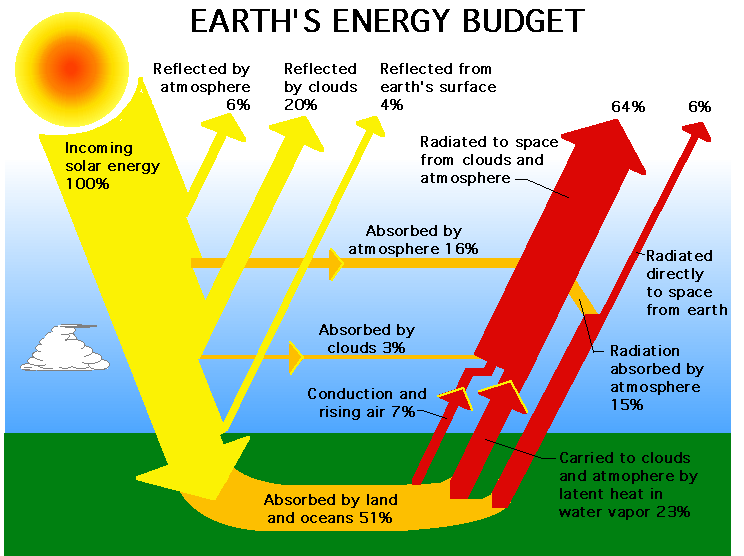
  • The Earth with atmosphere absorbs 240 W/m2 sunlight and emits 240 W/m2 IR.
  • The Earth surface temperature is 288 K.
  • By Stefan Boltzmann 240 W/m2 corresponds to an effective blackbody temperature of 255 K (with an albedo of 0.3). The difference 288 - 255 = 33 C can be seen as the total warming effect of the atmosphere.
  • 40 W/m2 is emitted directly from the Earth surface through an "atmospheric window".
  • The climate system acts as an air conditioner in a combined thermodynamic-radiation cycle processing the remaining 200 W/m2.
  • The effect of this process is to reduce the lapse from the base (dry adiabatic) value of 9.81 C/km to the observed 6.5 C/km, thus with a reduction of 3.5 C/km per 200 W/m2 or total cooling effect of 18 C, since the temperature is observed to be 255 K at a height of 5 km.
  • The reduction of the lapse results mainly from the thermodynamics by evaporation/condensation, which has a cooling effect by lowering the temperature at low altitudes by evaporation and increasing the temperature by condensation at higher altitudes.
  • Suppose now the atmospheric window is decreased by additional greenhouse gases by 4 W/m2, which are to be handled by the combined thermodynamic-radiation process.
  • Suppose the 4 W/m2 are splitted equally between thermodynamics and radiation.
  • Additional 2 W/m2 to be processed by thermodynamics means 1% reduction of the lapse rate with corresponding cooling effect of about 0.18 ~ 0.2 C.
  • Additional 2 W/m2 to radiation gives a warming effect of about 0.5 C by Stefan-Boltzmann.
  • The net is a warming effect of 0.3 C.
  • In other words, with standard terminology, we find a climate sensitivity of 0.3 C, to be compared with IPCC´s value in the range 1.5 - 4.5 C, which is 5 - 15 times bigger.
I believe this argument is the simplest possible combining thermodynamics with radiation and observations. It is possible that it contains an element of truth.


lördag 2 april 2011

Simplistic Climate Models: Warming or Cooling?

From Grant Petty (2006)

The above graph (in particular the top one) can be seen as the fundamental graph of CO2 alarmism. The dip in the top graph around the wavelength 15 mu, is the essence: We will come back to this below after a digression.

Roger Taguchi on Climate Etc points to the following important fact:
  • As I have stated, individual gas molecules cannot emit black body radiation,which is a continuous spectrum (N2 and O2 cannot emit any IR, black body or otherwise, and CO2 and other greenhouse gases can emit only over narrow bands, so their emission is by definition not continuous and therefore not black body).
  • Black body radiation can only be emitted by condensed states like solids and liquids (or by free electrons in the conduction bands of metallic solids, or in plasmas such as in the interior and photosphere of the Sun).
  • The reason is that in condensed states there are many, many weaker vibrations due to van der Waals' (intermolecular) forces, as well as stronger vibrations within molecules. Combinations of the weaker and stronger vibrations and their overtones allows for a continuous spectrum extending from low frequencies to high frequencies.
  • So the IR that escapes from the Earth to outer space, both in the daytime and at night, comes from the solid and liquid surface of the Earth, not some "emitting layer(s)" in the atmosphere.
Following up on the post Simple Model for Radiative Transfer, we collect the following facts:
  1. The blackbody temperature of the Earth at its viewing angle of 0.005^2 of the Sun at 5778 K, comes out by Stefan-Boltzmann's Law as 255 K. To be compared with the 288 K observed.
  2. Without an atmosphere the Earth surface temperature could thus be 255 K, and thus the total effect of the atmosphere is + 33 C.
  3. The observed lapse rate is 6.5 K/km with atmosphere, which means that the blackbody temperature of 255 K can be allocated to a height of about 5 km as if the Earth with a 5 km thick opaque atmospheric layer L was one blackbody with a transparent atmosphere above 5 km. The thicker L is the warmer the Earth surface will be through the lapse rate.
We now ask what the effect on the Earth surface temperature would be of changing the radiative properties of the atmospheric layer L assuming a radiation model of the form
  • (1) dT/dX + E T = - 6.5 for X in the interval (0,5),
where dT/dX models convective/radiative transport and A T(X) models radiation to outer space at height X with E a positive emission coefficient, with solution
  • T(X) = T(0)exp(-EX) - 6.5 (1 - exp(-EX))/E,
where T(0) is the surface temperature. With E tending to 0 corresponding to a fully opaque atmospheric layer L, we have T(X) = T(0) - 6.5 X, and thus T(0) = 288 K if T(5) = 255 K.

We now ask what the effect will be of increasing E from 0, corresponding to letting L become
increasingly transparent from fully opaque. Integration of (1) over (0,5) gives
  • (2) T(0) - T(5) - 33 = integral E T(X) dX = Q1 = total emission from L to outer space
Energy balance gives
  • (3) Q1 + sigma T(5)^4 = Q,
where sigma T(5)^4 is radiation from the top of L by Stefan-Boltzmann and Q is given total insolation. Differentiation of (2) with respect to E using (2) gives
  • dT(0)/dE - dT(5)/dE + 4 sigma T(5)^4/T(5) dT(5)/dE = 0
where with sigma T(5)^4 ~ 240 W/m2,
  • sigma T(5)^4/T(5) ~ 240/273 ~ 1
and thus
  • dT(0)/dE ~ - 3 dT(5)/dE
Now, if E increases from 0, T(5) will decrease since less radiation will have to be emitted at X = 5, and thus T(0) will increase. Or put differently, as E decreases T(0) will decrease, that is increasing opacity may cause cooling of the Earth surface.

The above argument should be compared with the standard "greenhouse effect" argument where increasing opacity would correspond to an increasing thickness of the opaque layer and thereby would correspond to surface warming. The determining factors are the lapse rate, and the thickness of the absorbing atmosphere, and the lapse rate is mainly determined by thermodynamics (forced by radiation).

We thus have two simplistic models giving different effects of increasing opacity: cooling or warming, as you like. The conclusion is that a simplistic model of a "greenhouse effect" should be viewed with skepticism: it may give a correct indication about reality or not. When you have several simplistic arguments with contradictory results, one of them may be correct, but you don't know which.

But it is possible that a more complete model combining thermodynamics and radiation can give meaningful results, most likely showing that increased CO2 has neglible warming/cooling effect.

Back to the top graph of

Outgoing Longwave Radiation as seen by a satellite at a height of 20 km:

We see a dip in the emission curve in a band around 15 mu m emitted at a temperature 220 K from a height of a bit less than 20 km, while outside the band the radiation is emitted from the Earth surface at about 270 K. The dip comes from the "greenhouse gases" (mainly water vapour and some CO2) which absorb radiation from the Earth surface emitted at 270 say and and re-emitting less radiation at 220 K and thus acting as a "warming blanket" causing the "radiative forcing" of the "greenhouse effect". The idea is that the "greenhouse effect" corresponds to the area of the dip shows the "greenhouse effect" as a combined effect of water vapor and CO2
capable of warming the Earth surface temperature by 33 C as compared to a fully transparent atmosphere.

But what does the satellite measure? The IR-meter of the satellite (presumably) measures the temperature of the closest emitting surface and the total radiance is probably computed by Stefan Boltzmann's Law as if all emission came from the top layer. This means that it is not straight away to connect the dip to "radiative forcing" in particular not from the trace gas CO2. In any case the top graph is of interest and it is important to make a correct interpretation of the instrument reading....this is also important as concerns the interpretation of the graph below supposedly depicting "downwelling longwave radiation" from the atmosphere...to be continued...

Pierrehumbert pumps out the CO2 radiation message in Physics Today without even mentioning the crucial role of the thermodynamic lapse rate:
  • Infrared radiative transfer theory, one of the most productive physical theories of the past century, has unlocked myriad secrets of the universe including that of planetary temperature and the connection between global warming and greenhouse gases.
As far I can see, this is stunning disinformation: planetary climate is complex thermodynamics with radiative forcing, not more or less trivial radiative transfer.

tisdag 1 februari 2011

Analysis of Greenhouse Effect Debate


The comments to the thread on Judy Curry's blog on my two articles in Slaying the Sky Dragon: Death of the Greenhouse Gas Theory show the following features:
  • Climate alarmism is based on "backradiation", but physicists do not want to tell if "backradiation" is real or not, although it must be their job.
  • Accordingly, skeptics like Spencer and Monckton have nothing to say, because they have to rely on what physicists say, and physicists say nothing. Climate alarmists use this vacuum to say anything that suits some preconceived agenda.
  • There are some people with open minds who get some of my message.
  • Many show little readiness to absorb anything and just repeat various mantras floating around in the lacuna of absent physicists.
  • Nobody claims that my mathematics is wrong.
The essence of my message is as follows
  • In radiative heat transfer, heat is transferred between bodies by electromagnetic waves and electromagnetic waves are described by Maxwell's wave equations. I derive Planck's radiation law from a version of Maxwell's equations subject to a dissipative effect from finite precision analog computation.
  • I show that "backradiation" would correspond to a negative dissipative effect, which is unstable and thus unphysical. Thus Maxwell's wave equations do not allow "backradiation". To me this is evidence that Nature neither does.
  • To describe atmospheric radiation by quantum mechanics is as meaningless as describing climate thermodynamics by quantum mechanics.
  • You cannot compute the lift and drag of an airplane by quantum mechanics, but you can do it by the Navier-Stokes equations, the analog of Maxwell's equations for fluid flow.
  • Maxwell and Navier-Stokes are continuum mechanics models describing macroscopics, but macroscopics cannot be described by microscopic quantum mechanics, because macroscopics emerges from interaction of multiple microscopics.
  • Climate results from thermodynamics with radiative forcing, and radiation alone cannot tell anything of real significance, such as the effect of changing the atmospheric radiative properties a little: It is not clear if more clouds or water vapour will cause global cooling or warming, or the effect of a small change of CO2. Climate CO2 alarmism is based on a postulate of a climate sensitivity of + 1 C which is a formality without known real significance.
I see very little discussion on these main points. Why? Because physicists say nothing which prevents non-physicists to even listen, because my credibility is unclear and all communication builds on some form of credibility (or prestige). Maybe I am a goofy crackpot as some people seem to believe, but maybe I am not.

But how are people going to tell, in particular if my message is expressed in mathematical terms?

So silence (intertvined with outbreaks of ridicule) from the ruling class, is quite effective. But to say nothing is not sign of strength and control and so the situation can quickly change...Mubarak is saying very little...

To my critics I would like to say:
  • I have shown you my equations, now show me your equations and we can have a discussion and compare.
I expect some of you to come with the following response: Consider two blackbodies 1 and 2 of temperatures T1 and T2 in radiative contact, described by the following Stefan-Boltzmann equations as the basic equations of radiative transfer :
  • Q1 = sigma T2^4 - sigma T1^4
  • Q2 = sigma T1^4 -sigma T2^4
where Q1 is the heat energy absorbed by 1 and Q2 that by 2. So 1 loses sigma T1^4 and gains sigma T2^4 by "backradiation" and 2 loses sigma T2^4 and gains sigma T1^4 by "backradiation". And so you say: "backradiation" exists because in my formulas there appear terms which I have given the name "backradiation".

But then I say that just because you have named something "backradiation", it does not follow that this something has a physical reality. If you believe that, you are either a child or great author but not a scientist. And then I ask you to motivate your equations, to derive them mathematically from some more elementary assumptions.

Then you probably say that this was what Planck did and then I say that he just considered one
body radiating to empty space, and that the above formulas are ad hoc formulas which cannot
be presented as evidence that "backradiation" is physical. And then you say?

måndag 31 januari 2011

Greenhouse Effect Debate

Judy Curry has opened a debate on the book Slaying the Sky Dragon: Death of the Greenhouse Gas Theory, focussing on my two chapters
I look forward to a hopefully constructive lively discussion. Science does not thrive under dead
silence. In particular, I hope that Spencer, Lord Monckton, Lindzen and other leading skeptics will give the debate some attention.

My perspective is mathematical including both mathematical modeling and computation. I believe that physics must be expressed in mathematical terms, typically as differential equations, to have a precise meaning, and that understanding physics basically boils down to understanding mathematical models of different physical real phenomena, in the spirit of Dijkstra.

I give different presentations of the underlying idea of computation of finite precision in posts on thermodynamics, blackbody radiation, greenhouse effect and climate on this blog and in My Book of Knols and under "books" on my home page.

I repeat that I do not say "that there is no greenhouse effect" since the "greenhouse effect" is not well described in the literature. So anyone preparing to accuse me of "denying the greenhouse effect" should also prepare to tell me what sort of "greenhouse effect" I am supposed to deny. "Greenhouse effect denier" has the same value as "climate change denier".

What I am saying is that there is no backradiation, because that would correspond to an unstable physical phenomenon, as unstable and unphysical as "backdiffusion" or "backconduction".

What I am saying is that radiation alone without thermodynamics cannot tell anything meaningful about climate. A no-feedback sensitivity of + 1 C is just a formality or definition without any connection to reality, as non-informative as the statement that there are 100 centimeters on a meter, with its nature of definition signified by the message that it is "unassailable". Anything "unassailable" is a definition and a definition carries no information about reality. This is important to understand for both CO2 alarmists and skeptics, since CO2 alarmism starts with the basic postulate of a no-feedback climate sensitivity of + 1 C, which is then jacked up to + 3 C by positive feedback. Without the + 1 to start from, CO2 alarmism has to start feedbacks from 0, which is a completely open game with not even the sign being known.

Review of the debate after 83 comments Jan 31:
  • None of the big skeptics has had anything to say. Only Judy Curry who agrees that something is wrong with the Kiehl-Trenberth energy budget, but does not want to tell what.
  • Of course Monckton and Spencer do not want to answer any of my questions, or Lindzen...
  • If you are a skeptic then you pose questions, and of course do not answer any, just like a professional journalist or Freudian therapist. But scientists need to answer questions.
  • Mostly confusing remarks as if my message has not be absorbed at all. Absorbitivity = 0.
  • The "greenhouse effect" is strong and healthy science, although the equations are missing.
  • Judy Curry clarifies and says that the KT budget with backradiation is basically correct.
Summary of my position Febr 1:
  1. Radiative heat transfer is carried by electromagnetic waves described by Maxwell's equations. The starting point of a scientific discussion of radiation should better start with Maxwell's equations than with some simplistic ad hoc model like the ones typically referred to in climate science with ad hoc invented "back radiation" of heat energy. If there is anything like "backradiation" it must be possible to find it in Maxwell's wave equations. In my analysis I use a version of Maxwell's wave equations and show that there is no backradiation, because that would correspond to an unstable phenomenon and unstable physics does not persist over time.
  2. Climate results from thermodynamics with radiative forcing, and radiation alone cannot tell anything of real significance, such as the effect of changing the atmospheric radiative properties a little: It is not clear if more clouds orwater vapour will cause global cooling or warming, or the effect of a small change of CO2. Climate CO2 alarmism is based on a postulate of a climate sensitivity of + 1 C which is a formality without known real significance.
  3. I welcome specific comments on these two points.

torsdag 27 januari 2011

Power of Language: "Refrigerator Effect" vs "Greenhouse Effect"

The Refrigerator Effect:


Lord Monckton, Judy Curry and Roy Spencer are critical to the critique in the new book Slaying the Sky Dragon: Death of the Greenhouse Gas Theory of the "greenhouse effect" underlying CO2 climate alarmism. My arguments that the standard conception of the "greenhouse effect" represents a scientific dead end, are summarized in my contributions to the book:
By double negation (critique of critique) Monckton, Curry and Spencer effectively come out as supporters of the claimed consensus of (alarming) global warming by a "greenhouse effect".

M, C and S claim that they do not have the time required to enter into the mathematics of the criticism in the articles, but nevertheless remain critical to the critique referring to a strong belief that the greenhouse gas theory with its "greenhouse effect" cannot be killed because it is strong, healthy and very much alive. A seemingly invincible Sky Dragon...

It is natural to ask how it is possible to be so sure about the existence of a "greenhouse effect",
which in fact is not well described in the scientific literature? The meaning of the term ranges
from the total effect of the atmosphere as an "atmosphere effect" to the absorption spectrum of the "greenhouse gas" CO2 with unknown warming effect.

Is it simply due to the folklore description of the "greenhouse effect" acting like a "blanket" or "sheet of glass" helping us to stay warm in a chilly Universe at 3 K? Even if the atmosphere does not act like a blanket or sheet of glass at all?

Is the power of language so strong that the "greenhouse effect" from a "blanket in the sky" is
so seducing for the soul that the body becomes convinced? Maybe.

Suppose then that we change vocabulary and describe the effect of the atmosphere as the
"refrigerator effect", which is in fact more logical than the "greenhouse effect", because what
the atmosphere does is to transport heat (from insolation) away from the Earth surface to the top of the atmosphere for radiation to outer space. In the same way as the cooling system
of a refrigerator transports heat from the inside of the refrigerator to the outside.

OK, so everybody can now understand the "refrigerator effect" and with this understanding comes the immediate threat of a too strong effect of global cooling. Like with alchohol the risk is a too strong effect, not a too small effect (unless you are completely addicted).

So, with a "greenhouse effect" the imminent risk is too much of the effect into global warming. While with the "refrigerator effect" the threat is instead global cooling.

We see that semantics can twist our brains into firm beliefs which may lack scientific rationale. Of course we are all too familiar with this phenomenon in politics.

So how would the debate change if "greenhouse effect" was changed to "refrigerator effect?
Such a change could get quick acceptance this winter.

Judy now signals that she is ready to initiate a discussion on her blog starting from the two
articles listed above. I look forward to this discussion. Science without discussion is dead immobile science, while science with discussion is live science which can move forward.

PS1 If you want to get to understand thermodynamics for the first time in your life, download the draft of my upcoming book Computational Thermodynamics and explore physics with confusing statistics replaced by
  • analog finite precision computation (reality)
  • modeled by digital finite precision computation (virtual reality).
The idea of finite precision computation also underlies the new analysis of blackbody radiation

PS2 Comparing the thermodynamics of global climate with that of a refrigerator should be done understanding the following important difference: The atmosphere transports heat from the Earth surface to a top of the atmosphere at lower temperature, while the cooling system of a refrigerator transports heat from the inside of the refrigerator to the outside at higher temperature. More precisely:

To transport heat in a system from a cold part to a warmer part (without chemistry) requires compression consuming external energy (driving the compressor in a refrigerator), while transport of heat from a warm part to a colder can be performed without external input of energy. The compression in a standard compressor refrigerator cycle is needed because expansion is used to create the temperature drop required to absorb heat from the interior of refrigerator to the circulating medium. In the atmosphere ascending air expands and cools and descending air warms as potential energy is exchanged to heat energy, without net input of energy, if turbulent dissipation is neglected.

PS3 As concerns Planck, his radiation law and his heroic (resultless) struggle to derive it mathematically from electrodynamics, and his final surrender in an "act of despair" to statistics, see Planck: The Reluctant Revolutionary.


onsdag 29 september 2010

Why Radiation before Thermodynamics?

What sets the lapse rate and thus the global Earth surface temperature? There are two competing ideas:
  1. thermodynamics with gravitation under radiative forcing
  2. radiative equilibrium with thermodynamics adjustment.
In short: 1. thermodynamics or 2. radiation?

The "greenhouse effect" of CO2 alarmism is based on 2, but the science of 2. is missing.

On the other hand 1. makes sense from a scientific mathematical point of view.

That politicians may believe in 2. is understandable, but how is it possible that scientists gathered in Royal Academies also buy 2. when it is very clear that science does not?

Why do scientists not buy 1. Because it is wrong? No. Because thermodynamics is feared by scientists as a subject beyond comprehension, with its 2nd Law about entropy which nobody
claims to understand.

But there is a version of thermodynamics without entropy which anyone with a bit of incentive can understand, presented in Basic Thermodynamics of the Atmosphere and in more detail in Computational Thermodynamics.

So with a proper understanding of thermodynamics 1. makes a lot of sense, and the more you
understand the more silly 2. appears.

Why buy something cheap and simple which does not work, when the real thing is there if you just open your mind to grab it?

tisdag 28 september 2010

Lapse Rate vs Radiative Forcing vs CO2 Alarmism


In Basic Thermodynamics of the Atmosphere I give an argument connecting lapse rate to radiative heat forcing, indicating that increased radiative forcing of the thermodynamics, e.g. from increased CO2, is compatible with a non-increased lapse rate and thus global non-warming.

The lapse rate is the drop in temperature with altitude, observed to be 6.5 C/km.

The argument is thus that more CO2 will not cause warming. If this is true CO2 alarmism collapses.

The atmosphere is a thermodynamic system subject to radiative heat forcing and thus
thermodynamics may have an answer:

  • dE = -W + D + Q, dP = W - D, (thus dE + dP = Q),
with (assuming the kinetic energy is small)
  • E = heat energy
  • P = potential energy = int Rho U g dx dt
  • Rho density, U convective velocity
  • W = work
  • D = turbulent dissipation
  • Q = heat forcing = 120 W/m2 (observation)
  • dE rate of change of E, dP sim.
We consider a column of (rising) air above a squaremeter at the Equator reaching to the top of the atmosphere (at 5 km). Let L be the lapse rate which can vary from 0 (isothermal atmosphere) to 10 C/km (isentropic). Balancing potential energy (increase of altitude of rising air) with loss of heat according to the lapse rate, we have dE/dP = - L/10 and thus recalling that dE + dP = Q,
  • dP x (1 - L/10) = Q
  • with Q = 120 and L = 6.5 we get dP = 350 (W/m2)
With Q = 0 (no heat forcing) it is natural to assume L = 10 and thus (1 - L/10) = 0 and dP is not determined. If now Q is increased to the observed 120 W/m2, then L decreases to an observed 6.5 C/km and dP settles at 350 W/m2.

The key question is what happens with the lapse rate L if Q is further increased reflecting increasing effective radiative forcing of the thermodynamics from the presence of more atmospheric CO2 (more heat to be transported by thermodynamics). We have
  • L = 10 x (1 - Q/dP )
1. We see that if dP stays constant, then increasing Q will decrease L and thus cause cooling.

2. If dP increases like Q (increasing rising velocity U) then L may stay constant without cooling or warming.

3. Including also phase change (evaporation/condensation), we have that increased forcing will
lead to increased evaporation/condensation which will tend to reduce the lapse rate by
lowering temperature at low altitudes and increasing temperature at high altitudes. The lapse rate will thus react to increased forcing in a battle between
  • possibly increasing dP by increasing vertical convection
  • decreasing L from phase change.
Case 1-2 gives no warming, while 3 may cause warming depending on the balance between
convection and phase change.

Observation indicates that out of a forcing of Q = 120 W/m2 the major part of 100 W/m2 gets allocated to phase change, which may give an indication of what sets the lapse rate: convection or phase change. Benchmark computations are on the way. Stay tuned...

Note that CO2 alarmism is based on a postulate of a "greenhouse effect" from radiation without thermodynamics, which by definition leads to warming by increased CO2. But science
by definition is empty science, and so is global climate without thermodynamics.

There is substantial evidence that the lapse rate is determined primarily by thermodynamics, not by radiation, and thus that the basic postulate of CO2 alarmism lacks scientific value.

The above connects to interesting observations of temperature (lapse rate) for regions
below sea level (The Dead Sea and deep in mines) brought to the light by Charles R. Anderson in NOAA's U.S: Standard Atmosphere Tables: Who Needs Greenhouse Gas Warming?
upon suggestion from Marty Hertzberg and Alan Siddons.

fredag 24 september 2010

Atmosphere: Boiling Pot Air Conditioner


In Basic Thermodynamics of the Atmosphere, I give mathematical evidence that the atmosphere acts as an air conditioner keeping the Earth surface at comfortable 15 C upon radiative forcing from the Sun.

Like a boiling pot of water the atmosphere reacts to increased heat forcing by increased vaporization and turbulent convection, while keeping the temperature constant.

I thus present mathematical evidence that the Earth surface temperature is determined by
thermodynamics rather than radiation, which indicates a small climate sensitivity to radiative forcing e.g. from increased CO2.

This is a main argument showing that the socalled "greenhouse effect" belongs to fiction and not science.

torsdag 16 september 2010

CO2: Warming or Cooling?

Ingemar Johansson vs Floyd Patterson Yankee Stadium 1959

The lapse rate (decrease of temperature with altitude) of 6.5 C/km sets the Earth surface temperature to 15 C from a top of the atmosphere TOA at -18 C (at an altitude of 5 km) with a total warming of 33 = 5 x 6.5 C.

The role of the atmosphere is to transport 180 W/m2 absorbed by the Earth surface from insolation, to the TOA for radiation to outer space. The atmosphere thus acts like an air conditioner keeping the Earth surface at 15 C under radiative forcing.

Since the TOA temperature of -18 C is determined by constant insolation, the lapse rate determines the Earth surface temperature: Increasing lapse rate means warming and decreasing lapse rate means cooling.

A basic question in climate science thus concerns what physics determines the lapse rate. There are two main candidates, both setting up an initial lapse rate of 10 C/km to be moderated to the observed 6.5 C/km:
  1. radiation according to Planck's Law
  2. thermodynamics: convection + evaporation/condensation + gravity according to the equations of fluid dynamics.

Radiation:
  • Radiation according to Planck's Law sets the lapse rate to 10 C/km (by dQ = 4 dT with dQ = 180 W/m2 and dT = 45 C)
  • thermodynamics enters to reduce the lapse rate to 6.5, because a lapse rate of 10 is unstable
  • radiation sets the main lapse rate with thermodynamics as secondary moderator.
Thermodynamics:
  • An isentropic (adiabatic) lapse rate of 9.8 C/km is determined by thermodynamics without convection (still air) and without radiative forcing and heat transfer
  • radiative forcing drives heat transfer by convection + evaporation/condensation which reduces the lapse rate to 6.5
  • thermodynamics without heat transfer sets the main lapse with radiatively forced convective thermodynamics as secondary moderator combined with radiation for residual heat transfer acting on the lapse rate set by thermodynamics.
The two main scenarios are thus:
  1. primal radiation + secondary thermodynamics = radiation
  2. primal thermodynamics + secondary radiation = thermodynamics.
Consider now the effect of increased atmospheric CO2:
  1. radiation: increased lapse rate: warming
  2. thermodynamics: more heat transfer by convection: decreased lapse rate: cooling.
Which scenario is closest to reality? Radiation or thermodynamics? Warming or cooling?
Stay tuned to get an answer or think for yourself, maybe with inspiration from Basic Thermodynamics of the Atmosphere.

The basic idea is thus that increased heat transfer causes
  • increased lapse rate - warming, if radiation dominates
  • more vigorous convection/phase change - decreased lapse rate - cooling, if thermodynamics dominates,
which expresses a fundamental difference between heat transfer by radiation/conduction and
by convection/phase change.

onsdag 15 september 2010

Why Radiation by Particles is Too Simple

In the updated Computational Blackbody Radiation I point to a basic difference between
  •   wave propagation
and 
  • propagation of energy by waves,
which comes out of an analysis of a vibrating resonant string subject to damping representing
radiation. This model displays 
  • two-way wave propagation 
together with 
  • one-way propagation of heat energy (from warm to cold).
In a particle model this distinction is not possible because heat energy is tied to particles. 
Since particles may travel two-ways, this leads into an idea of two-way propagation of heat energy. Radiative heat transfer between two bodies will then be described as a two-way stream of particles (photons) with the warmer body spitting out more energetic photons than the colder, thus winning a two-way heat transfer contest. 

This is the basic idea of climate alarmism with an absorbing atmospheric layer "backradiating" particles to the Earth surface in a two-way transfer of heat energy with a warming effect.

What to say about this? Is radiation waves or particles? Is there a two-way transfer of heat energy? 

Well, one may say that the particle model is simpler than the wave model, since a distinction is not made between propagation of waves and propagation of energy. Is it too simple?

Probably, because the wave equation model is as simple as possible, and according to Einstein in the previous post, one should reject a model which is simpler.    

An aspect of too simple, is that the particle model is unstable: Zero heat transfer between bodies of the same temperature would result from cancellation in heavy two-way transfer, which is not stable. 

The basic idea of CO2 climate alarmism is thus based on unstable physics, and unstable physics
will collapse under perturbation, as can now be observed in the aftermath of climategate now beyond the tipping point of climate alarmism...

Simplistic Climate Science


Climate science is a young science with a variety of contradictory simplistic theoretical arguments offering a wide range of predictions such as climate sensitivity (global warming from doubled CO2) anywhere between 0 and 5 C. Some of the simplistic arguments may capture some true essence of global climate, others are completely misleading, following the device by Einstein.

Consider now the following simplistic argument:

The Earth surface temperature is set by the lapse rate (decrease of temperature with height) since the effective top of the atmosphere TOA temperature is determined to -18 C. The observed lapse rate is 6.5 C/km corresponding a TOA at a height of 5 km and an Earth surface temperature of 15 C with a temperature drop of 33 = 5 x 6.5 C.

The lapse rate of an atmosphere in equilibrium without convective motion and phase change (evaporation/condensation) may range from 0 (isothermal) to 9.8 C/km (adiabatic). In such an
atmosphere (without also radiation) there would be no heat transport from the Earth surface to TOA.

Suppose we now view the observed lapse rate of 6.5 C/km as being obtained from the adiabatic rate 9.8 by adding effects of convection/phase change transporting an observed 180 W/m2 from the Earth surface to TOA (with 60 out a total of observed 240 transported by radiation).
This corresponds to giving thermodynamics the leading role as concerns the lapse rate, that is,
global warming/cooling.

We would then view the reduction of the lapse rate from 9.8 to 6.5 as an effect of the heat transport from the Earth surface to TOA by convection/phase change: Increased heat transport coupled to increased convection/phase change, would then correspond to a further reduction of the lapse rate and thus correspond to global cooling.

Now, increased CO2 would require more heat to be transported by convection/phase change (under constant insolation of 240 W/m2), which with the above argument could cause global cooling.

We have thus presented a simplistic argument suggesting that climate sensitivity may very well be negative: more CO2 could cause global cooling. Is this argument correct? Maybe. At least it appears to be as plausible as any other simplistic argument floating around suggesting a climate sensitivity in the range 0 - 5 C. Maybe even more plausible, if the lapse rate is determined by thermodynamics rather than radiation.

tisdag 14 september 2010

Lindzen-Spencer: Confused Skepticism

After giving support to "backradiation" as the physics behind "global warming" Roy Spencer now follows up by giving praise to the basic idea of climate alarmism of a "greenhouse effect" capable of warming the Earth surface to 30 C, if it was not curbed by convective effects reducing it to 15 C, an idea also propagated by Richard Lindzen.

The idea is thus that a lapse rate of about 10 C connecting the Earth surface at 30 C to the top of the atmosphere TOA at -18 C (at the height of 5 km) is determined by radiation alone, which then by convection is reduced to the observed 6.5 C.

The Earth surface is thus supposed to radiate 390 W/m2 of which 240 is radiated to outer space from TOA and 150 are absorbed by the atmosphere and then "backradiated" to the Earth surface contributing to global warming.

I have questioned the physics of "backradiation" as non-existing, and I argued that the lapse rate is not primarily determined by radiation, but by thermodynamics, with radiative heat transfer from the Earth surface to TOA acting passively on the thermodynamic lapse rate.

In this setting there is no "backradiation": Out of the total incoming 180 W/m2 to the Earth surface, 120 is transferred to TOA by convection and 60 by radiation acting on a lapse rate of 6.5 C/km (with 60 absorbed by the atmosphere out of total 240).

It is strange to see leading climate scientists, appearing as skeptics to climate alarmism, still propagating basic misconceptions of climate alarmism such as a powerful "greenhouse effect"
based on radiation alone.

Cannot Lindzen and Spencer understand that the lapse rate primarily must be determined by thermodynamics and not radiation? Why buy the basic argument of climate alarmism,
without subjecting it to scientific scrutiny? Why not scientific skepticism instead of confusion?