Visar inlägg med etikett cosmological model. Visa alla inlägg

torsdag 2 juli 2026

Proton-Electron Cosmology: Big from Small

RealQM opens a new perspective on large scale cosmology which is now further developed into the following scenario see also Gallery: 

  1. Gravitational and electric potentials in 3D Euclidean space together get a small-scale fluctuation as primal seed.
  2. By the inflating action of the Laplacian on small scales this generates a large small scale variation into positive and negative mass. Combined with a variation into positive and negative unit charge assumed to act only over positive mass with positive charge combining with large positive mass and negative charge combining with a small positive mass residual into net zero charge, this sets the stage on small scales.
  3. The result is a small scale variation into positive and negative mass accompanied by a variation over positive mass into positive charge with large positive mass (protons) and negative charge combined with small positive mass (electrons). 
  4. The small variation in mass with gravitational repulsion between mass of different sign generates large scale structures of positive mass (our Universe) against a background of negative mass without charge acting like dark energy, with a remaining small scale variation of charge over positive mass.  
  5. This represents a universe created from a small scale fluctuation of gravitational and electric potentials over Euclidean 3D space, with an asymmetry created by letting only positive mass be attributed with varying charge, and negative mass supplying dark energy. 
If you take this seriously you will find a model which combines large scale gravitational structure with small scale atomic structure created from small scale fluctuations of gravitational and electric potential, thus something Big created from something Small, which is the only realistic possibility as concerns creation and as such is a form of miracle. 

On the other hand to create something Big from something possibly even Bigger, like in a Big Bang BB connects to triviality.   

Do you find that the above is pretentious? To attempt to say anything about cosmology? Yes, of course, but after all what could be the ingredients, other than gravitational and electric potentials in 3D space? Any idea? 

Big Bang is the standard answer, evidenced by in particular the perfect blackbody spectrum of CMB as  remnant of BB, but with the caveat that a perfect blackbody spectrum necessarily is man-made. 

måndag 11 mars 2024

2nd Law for Cosmology

A mathematical model of the Universe can take the form of Euler's equations for a gas supplemented with Newton's law of gravitation as stated in Chap 32 Cosmology of Computational Thermodynamics.  

Computational solutions of these equations satisfy the following evolution equations as laws of thermodynamics depending on time $t$ 

  • $\dot K(t)=W(t)-D(t)-\dot\Phi (t)$     (1)
  • $\dot E(t)=-W(t)+D(t)$,                  (2)
where $K(t)$ is total kinetic energy, $E(t)$ total internal energy (heat energy), $W(t)$ is total work, $D(t)\ge 0$ is total turbulent dissipation, $\Phi (t)$ is total gravitational energy and the dot signifies differentiation with respect to time. Adding (1) and (2) gives the following total energy balance:
  • $K(t)+E(t)-\Phi(t)= constant.$          (3)
Further (1) and (2) express an irreversible transfer of energy from kinetic to internal energy with $D(t)>0$, and so serve as a 2nd Law for Cosmology giving time a direction. Recall that the theoretical challenge is to tell/show why turbulent dissipation is unavoidable. 

Computations may start from a hot dense state at $t=0$ which is seen to expand/cool (run code) (Big Bang) to maximal size and then contract/warm back to a hot dense state (Big Crunch) (run code) in an irreversible sequence of expansions/contractions until some final stationary equilibrium state with $E(\infty )=P(\infty )$. Compare with post from 2011.


fredag 10 februari 2023

New Newtonian Gravity vs Electromagnetism

Assignments of different capacities by the Creator 

Newtonian Gravity and Electromagnetism include the same mathematical model in the form $\rho (x)=\Delta\phi (x)$ with $\Delta$ the Laplacian with respect to a space coordinate $x$ with the following interpretations:

  • Gravitation: $\rho (x)$ mass density and $\phi (x)$ gravitational potential.
  • Electromagnetism: $\rho (x)$ charge density and $\phi (x)$ electric potential.
In New Newtonian Gravity we view $\phi$ to be primordial from which $\rho$ is assigned/created by differentiation as an instant local operation. It is natural to take the same view in electromagnetism with charge created from electric potential by differentiation. The corresponding force laws have opposite signs resulting in opposite attractive/repulsive forces between mass/charge (Newton's Law of Gravitation and Coulombs Law): 

  • Gravitational force $F(x)=-\nabla\phi (x)$: attraction/repulsion between mass of same/opposite sign.
  • Coulomb electrical force $F(x)=\nabla\phi (x)$: repulsion/attraction between charges of same/opposite sign.
Gravitational mass densities of different signs repel each other leaving a Universe with only positive mass density. Charge densities of different sign attract each other leaving a Universe with both positive and negative charges as protons and electrons. 

An important feature of an assignment process like $\rho (x)=\Delta\phi (x)$ is lack of self-gravitation in the sense that that there is no net gravitational force acting on a body from the gravitational mass assigned to the body by the gravitational potential as being primordial. A body cannot itself assign a net gravitational force acting on itself.  You cannot lift yourself in the hair. The Creator/Natural Selection gives life which cannot create itself all by itself. 

Another important feature of the New Newtonian Gravity translated to electromagnetism is that the attraction between positive and negative charges bringing protons and electrons into contact must be balanced by some mechanism maintaining separation and preventing annihilation. This is a core element of Real Quantum Mechanics including contact conditions between protons and electrons. 

lördag 14 januari 2023

Weird and Strange Modern Physics based on E=mc2 and E=hf

There is no sufficient reason for the Universe to not be Eternal without beginning and end.

Modern physics is built on the following two postulates formulated by Planck (1900) and Einstein (1905) as essence of quantum mechanics and theory of relativity:

  • $E=hf$ where $E$ is energy and $f$ light frequency mediated by Planck's constant $h$.
  • $E=mc^2$ expressing equivalence of energy $E$ with mass $m$ mediated by $c^2$ with $c$ the speed of light in vacuum.

In the 2019 SI standard of units the following values of $h$ and $c$ are set by definition:
  • $h=1.054571817\times 10^{–34}$ Joule per Herz.   (small)
  • $c=299 792 458$ meter per second.     (big)
Einstein's $E=mc^2$ is then used to define kilo as the unit of mass in terms of $h$ and $c$ with details in this post. 

Modern physicists all express that modern physics is strange or more precisely that nature is weird. 

It is strange to insist that energy has to be counted as integer multiples of a smallest chunk or quantum of energy $h$ of light. It is weird that light of frequency $f$ consists of streams of light particles named photons of size $hf$, when it is known that light is an electromagnetic wave phenomenon without smallest scale. 

It is strange to insist that energy as potential to do work can be equivalent to mass as gravitational/inertial mass as resistance to force/motion. It is like insisting that you eat energy/calories and not food. 

The most weird outcome of modern physics is the atomic bomb viewed as the ultimate demonstration of the correctness of Einstein's equivalence of energy and mass. The enormous energy released in the explosion of an atomic bomb from the enormous factor $c^2$ in Einstein's $E=mc^2$, has been exploited by physicists to show the weird power of modern physics thus suppressing any criticism or doubt that modern physics makes sense. But atomic bombs do not make sense...

A consequence of the equivalence of energy and mass, is that mass is lost in exothermic chemical reactions when molecules recombine to release energy, which however can be dismissed as something of no real importance because the loss of mass is so incredibly small, like the mass of the angels on a knives edge of the Scholastics.

But the release of energy in nuclear reactions is so big that a corresponding loss of mass must be made in the best case into an observable fact, when insisting on $E=mc^2$. To start with the loss of mass is referred to as a mass defect indicating something strange, which is computed according to $E=mc^2$ and then cleverly is used as evidence that mass defect is real even if strange, although only computed. Another thing is to measure the mass defect in nuclear reactions, which is not easy because nuclear reactions are delicate to handle and to weigh on a scale to determine gravitational mass. But of course the SI definition of mass in terms of energy can help to show that mass and energy are equivalent, then by definition. 

We have now identified why modern physics is viewed to be both strange and weird: Planck and Einstein.

But is it necessarily so that Nature is weird and modern physics is strange. What if Nature is not really weird, because something that is weird cannot exist over time, and then modern physics would not have to be strange.

The classical view is that both energy and mass is conserved. The number of protons of the Universe is then constant, which means that the Universe has no beginning and no end. This is a simple reasonable cosmological theory, which is hard to dispute, and in addition may be true. A reasonable Universe has a bigger chance of existing than a weird Universe, and also to be more understandable as not being strange. 
     
If you ask a contemporary physicist about the physics of $E=mc^2$ and $E=hf$, you will only get the answer that this is all "in the books" combined with a poodle : Sure,  it is strange and weird, but that is the way it is and everyone asking for some rationality is a crackpot. 

This was not the attitude of Planck, who was very unhappy with his breach from classical continuum physics introducing $h$ as smallest possible chunk of energy. It was Einstein who opened the door to strange and weird modern physics in his quest to trump Newton by opening the door to modernity. Einstein masterfully played the double game of confusing ontology and epistemology allowing strange ideas of human conception to be the same as reality.    


torsdag 5 oktober 2017

LIGO vs Neo-Newtonian Cosmology

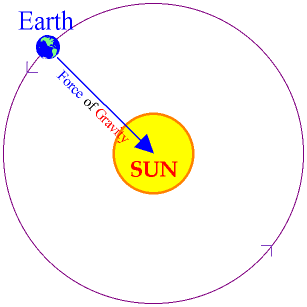
The Earth is pulled in the direction of the present position of the Sun at each  instant, right?


Let us continue our reflections on LIGO recalling my earlier post on Neo-Newtonian Cosmology as an alternative to Einstein's Cosmology based on Einstein's equations with related posts here and the discussion about The Hen and the Egg.

In Neo-Newtonian Cosmology a gravity potential $\phi (x,t)$ (depending on an Euclidean space coordinate $x$ and time $t$) is connected to mass distribution $\rho (x,t)$ through Poisson's equation
  • $\Delta\phi =\rho $
which is interpreted as creation of mass $\rho$ by the action of $\Delta$ upon the gravitational potential $\phi$ through a local instant operation of differentiation.  

This is different from the standard interpretation in Newtonian cosmology with instead the gravitational potential $\phi$ created from mass $\rho$ by instant action at distance corresponding to solving or integrating Poisson's equation, as if gravitational force/potential is propagated at infinite speed. We thus have: 
  • Neo-Newtonian Cosmology: matter created from gravitational potential by instant local action.
  • Newtonian Cosmology: gravitational potential created from mass by instant action at distance.
Now, the big mystery of Newtonian Gravitation/Cosmology is the instant action at distance, which with the optics of Neo-Newtonian Cosmology is a fictional problem, which thus can be replaced by local instant action, with the mystery of instant action at distance eliminated. 

The beauty with both Newtonian and Neo-Newtonian Cosmology, as compared with Einstein's, is that motion of the Earth around the Sun gets an theoretical explanation agreeing with the following observation:
  • The Earth accelerates at each instant of time in the direction of the present position of the Sun as if the action of the Sun is instant at distance.  
In particular, the Earth does not accelerate in the direction where the Sun is seen, since that position through the finite speed of light, has a delay of 8 minutes. The difference comes out in the thought experiment that the Sun suddenly disappears into nothing: In Neo-Newtonian Cosmology that would mean the instant disappearance of the gravitational field and thus leave the Earth instantly continuing in the tangent direction, while with finite speed of propagation of gravitational force created at distance by the mass of the Sun, that would take 8 minutes and the path would then be different.

In Einstein' Cosmology gravitation is propagated with the finite speed of light, but that does not seem to be the case for the Sun-Earth system.  Right?

Recall that Einstein was obsessed with choice of coordinates in both the special and general theory, as  if this choice has anything to do with physics, as if physics carries around coordinate systems imprinted in the "fabric of space-time" as the name of the game. But coordinate systems are inventions/conventions made by humans and not the Creator of the World, who had no need of such things when putting things together and letting it go...

måndag 23 maj 2016

Neo-Newtonian Cosmology: Progress!


We consider a Neo-Newtonian cosmological model in the form of Euler's equations for a compressible gas subject to Newtonian gravitation: Find $(\phi ,m, e,p)$ depending on a Euclidean space coordinate $x$ and time $t$, such that for all $(x,t)$:
  • $\Delta\dot\phi + \nabla\cdot m =0$                                                           (1)
  • $\dot m +\nabla\cdot (mu) +\nabla p + \rho\nabla\phi =0$                              (2)
  • $\dot e +\nabla\cdot (eu) +p\nabla\cdot u +\rho\nabla\cdot m=0$,                       (3)
where $\phi$ is gravitational potential, $\rho =\Delta\phi$ is mass density, $m$ is momentum, $u=\frac{m}{\rho}$ is matter velocity, $p$ is pressure, $e$ is internal energy as the sum of heat energy $\rho T$ with $T$ temperature and gravitational energy $\rho\phi$and the dot indicates time differentiation, see Many-Minds Relativity 20.3 and Computational Thermodynamics Chap 32. Here $x$ is space coordinate in a fixed Euclidean coordinate system, and $t$ is a local time coordinate which is not globally synchronized.

The primary variables in this model are the gravitational potential $\phi$ and the momentum $m$ connected through (2) expressing conservation of momentum or Newton's 2nd law. We view matter density $\rho =\Delta\phi$ as being derived by local action of the differential operator $\Delta$. The model is complemented by a constitutive equation for the pressure.

The essential components of this model are:
  1. Newton's law of gravitation $\rho =\Delta\phi$ connecting mass to gravitational potential
  2. $\nabla\phi$ as gravitational force 
  3. Newton's 2nd law (2) connecting motion to force,
  4. (1) expressing conservation of mass and (3) conservation of energy,
with the following features:
  • no action at distance with $\phi$ primordial and $\rho =\Delta\phi$ derived quantity
  • global clock synchronisation not needed because all action is local
  • equivalence of inertial and gravitational mass by (2)
  • $\Delta\phi$ of variable sign opens to positive and negative matter
  • no limit on matter speed
  • no electro-magnetics or nuclear physics so far included in the model.
It may well by that a model of this form is sufficient to describe the mechanics of the universe we can observe, a universe resulting from an interplay of gravitational force and motion of matter. You can test the model in the app Dark Energy at App Store. Try it!

Some form of starting values are needed for simulations using the model, but like in weather prediction initial values at a given global time are not known, but have to be constructed from observations over time possibly involving synchronisation of nearby clocks.  

The primordial quantity in this Newtonian model is the gravitational potential and gravitational force. It is the opposite of Einstein's model, where gravitational force is eliminated and replaced by "space-time" curvature. It is no wonder that Einstein expressed "Forgive me Newton!!" when taking this big extreme step.

A fundamental problem with modern physics is the incompatibility of Einstein's theory of gravitation in "curved space-time" and quantum mechanics in Euclidean space. This big obstacle would disappear if Einstein's gravitation was given up, and Newton's gravitation was resurrected in suitable form.  

What is the reason to not take this step and open for progress?

Recall that nobody understands what "curved space-time" is, while everybody can understand what a Euclidean coordinate system is and how to measure local time. If we follow Einstein's device of always seeking to "make things as simple as possible, but not simpler", then Newton would have to be preferred before Einstein, or what do you think?

The basic force of cosmology is gravitation, and thus it may appear from rationality point of view to be irrational to seek to eliminate gravitational force from the discussion altogether, which is what Einstein did and which maybe paradoxically gave him fame bigger than that of Newton.

PS1 What drove Einstein into his extremism? Well, the reception of the special theory of relativity Einstein presented in a short sketchy note in 1905, did not draw any attention the first years and when it did, the reaction was negative. The only thing left for Einstein before getting called and kicked out of academics, was to increase the bet by generalising the special theory, which did not cover gravitation, into a general theory of relativity including gravitation.  The only thing Einstein had in his scientific toolbox was the Lorentz transformation between non-accelerating inertial systems and the only way to bring that in contact with gravitation was to introduce coordinate systems in free fall, which in the presence of gravitation required strange transformations of space and time coordinates.

Einstein's "happiest thought" was when he realised that sitting in a freely falling elevator cannot be distinguished from sitting in an elevator at rest assuming no gravitation... until the freely falling elevator hits ground....It was this idea of free fall seemingly without gravitation, which allowed him to keep the Lorentz transformation with all its wonderful effects of the special theory without gravitation, when generalising to include gravitation...but the price was high...and the free fall is going on...Compare with Einstein's Pathway to General Relativity.

PS2 Another fact not to suppress is that the special theory of relativity was focussed on propagation of light with the same speed in all inertial coordinate systems if connected by the Lorentz transformation, which gave strange effects for the mechanics of matter (without gravitation) including dilation in time and contraction in space. But the Lorentz transformation was shaped for light propagation and not for  mechanics of matter and so it was no wonder that strange effects came out. Since the Lorentz transformation also underlies the general theory of relativity, it is even less wonder that strange effects come out when adding gravitation to the picture.

The lack of scientific logic is clear: If you apply a theory designed to describe a a certain phenomenon (light propagation) to a different type of phenomenon (mechanics of matter), then you must be prepared to get in trouble, even if your name is Einstein...