måndag 10 mars 2014

The Real Physical Meaning of Planck's Constant

The mystery of discrete lumps or quanta and the strange energy relation $E=h\nu$ with strange dimension of energy x time. 

Planck's constant $h = 6.626 \times 10^{-34} Js$ is supposed to represent a fundamental property of the Universe we happen to live in.

Prandtl introduced $h$ as a fictional mysterious quantity in his proof of Planck's radiation law in 1900 based on statistics with $h$ representing a smallest "quantum of action". Today 114 years later the fiction and mystery remains, and it is time to pass on to reality.  In the recent series of posts we have seen that $h$ enters into Planck's law in a high-frequency cut-off condition of the form
  • $\nu > \frac{kT}{h}=\frac{T}{\hat h}$ where $\hat h =\frac{h}{k}$,
$\nu$ is frequency, $T$ is temperature in Kelvin $K$ and $k = 1.3806488\times 10^{−23}\, J/K$. Here  
  • $\hat h =4.8\times 10^{-11}\, Ks$,
shows up as the real effective Planck constant in Planck's law. 

We see that $\frac{T}{\hat h}$ acts as a threshold value for frequency $\nu$, or equivalently $\hat h\frac{c}{T}$ acts as a threshold value for wave length $\lambda =\frac{c}{\nu}\, m$ with $c\, m/s$ the speed of light. The real effective Planck constant $\hat h$ thus has the form of a material parameter for a blackbody as a web of oscillators with a characteristic high-frequency cut-off  $\frac{T}{\hat h}$ or wave-length cut-off $\hat h\frac{c}{T}$, which expresses Wien's displacement law.

The mystery of $h$ as a "smallest quantum of action" thus can be deconstructed and the real meaning as $\hat h$ can be readily understood, all following Einstein's device to make everything as simple as possible, but not simpler. 

For the full story, see Computational Blackbody Radiation.

söndag 9 mars 2014

Newton's Laws vs Lagrange's Principle of Least Action

There is a firm belief among physicists that Nature somehow functions so as to find the least action, for example that light finds its way by choosing among all paths connecting two points the quickest path. There is good reason to question this idea on the ground that physics does not have any means to compute, store and compare action integrals, just because mathematicians can do that by writing symbols on a piece of paper.

There are two mathematically equivalent ways of describing a dynamical system of classical mechanics:
  1. Newton's laws expressing equilibrium of forces.
  2. Lagrange's principle of least action.
Here 1 expresses stationarity (or minimality) of the action integral
  • $\int_0^T (K(t) -V(t))\, dt$, 
where $K(t)$ and $V(t)$ are kinetic and potential energies as functions of time $t$ over a given time interval $[0,T]$. We see that the dimension of the action is energy x time.

While equilibrium of forces has a direct physical reality in the sense that a dynamical system directly reacts to forces according to Newton's laws, this is less clear for Lagrange's principle of least action since it requires evaluating and comparing different action integrals and then choosing the one statisfying stationarity or minimality as the physical one. 

While the kinetic and potential energies have physical representations, the action as the integral of kinetic and potential energies does not seem to have a physical representation. We are thus led to the conclusion that Lagrange's principle of least action does not describe physics, only mathematics, and confusion arises if least action nevertheless is believed to have a physical reality.

This directly connects to the definition of Planck's constant $h$ which has the dimension of energy x time as an integral of energy over time.  The physical meaning of Planck's constant $h$ was a mystery to Planck and the mystery remains today, if you give it a careful thought and not just accept that since so many are speaking about $h$, it must have a definite meaning as an "elementary quantum of action" or something like that…or something according to your own favorite idea...

fredag 7 mars 2014

Confessions by Planck: The Absolute of Relativity and Quantum of Action

       While an instructor in Munich, I waited for years in vain of an appointment to a professorship.

From the Scientific Autobiography of Max Planck we quote:
  • I have always looked upon the search of the absolute as the noblest and most worth while task of science.
  • The Theory of Relativity is based on something absolute, namely, the determination of the matrix of the space-time continuum; and it is an especially stimulating undertaking to discover the absolute which alone makes meaningful something given as relative.
  • In the first place, the Theory of Relativity  confers an absolute meaning on the magnitude which is classical theory has only a relative significance: the velocity of light.
  • The velocity of light is to the Theory of Relativity as the elementary quantum of action is to the Quantum Theory: it is absolute core.
  • I have satisfied my inner need for bearing witness, as fully as possible, both to the results of my scientific labors to the gradually crystallized attitude to general questions - such as the meaning of exact science, its relation to religion, the connection between causality and free will - by always complying with the ever increasing number of invitations to deliver lectures before Academies, Universities, learned societies and before the general public….
We read that Planck shares the experience of Einstein of being propelled to a fame beyond control and rationale. We read that Planck considers the Theory of Relativity (and Quantum Theory) to be a Theory of  the Absolute. The inner contradiction of modern physics cannot be more clearly expressed.

Absurdity of Small Planck Constant, Length and Time

                   
                       Absurdity of modern physics as quantum foam and strings of Planck length.

Starting from Planck's (reduced) constant $\bar h\approx 10^{-34}$, the Planck length $l_p$ and Planck time $t_p$ are defined by
  • $l_p =\sqrt{\frac{\bar hG}{c^3}}\approx 1.6\times 10^{-35}\, m$, 
  • $t_p = \sqrt{\frac{\bar hG}{c^5}}\approx 5.3\times 10^{−44} s$,
where $G$ is the gravitational constant and $c$ the speed of light. Wikipedia tells us the following limits of modern physics:
  • The Planck length is about $10^{-20}$ times the diameter of a proton, and thus is exceedingly small.
  • The Planck length sets the fundamental limits on the accuracy length measurement.
  • Planck time is the time it would take a photon traveling at the speed of light to cross a distance equal to one Planck length
  • Theoretically, this is the smallest time measurement that will ever be possible, roughly $10^{−43}$ seconds.
The relation of the Planck length to the size of the proton is about the same as the diameter of golf ball to the size of a galaxy. 

Planck length and time is the scale of string theory. The goal of string theory is to explain the origin of gravitation with a change of scale of $10^{60}$, and to explain the origin of the Universe starting from Big Bang at time $10^{-43}$. 

All this absurdity comes from an absurdly small Planck's constant $h = 6.626\times 10^{-34}$. To see clearly see the absurdity, recall that Planck's constant enters Planck's radiation law
  • $R_\nu (T)=\gamma\nu^2T\times \theta(\nu ,T)$,
where $R_\nu (T)$ is radiated energy per unit frequency, surface area, viewing angle and second, $\gamma =\frac{2k}{c^2}$ where $k = 1.3806488\times  10^{-23} m^2 kg/s^2 K$ is Boltzmann's constant and $c$ the speed of light in $m/s$, $T$ is temperature in Kelvin $K$, only in the high-frequency cut-off factor
  • $\theta (\nu ,T)=\frac{\alpha}{e^\alpha -1}$, 
  • $\alpha=\frac{h\nu}{kT}$,
where $\theta (\nu ,T)\approx 1$ for $\alpha < 1$ and  $\theta (\nu ,T)\approx 0$ for $\alpha > 10$. In other words, the relevant quantity in Planck's law is not the absurdly small $h$, but instead
  • $\hat h\equiv\frac{h}{k}= 4.8\times 10^{-11}$, 
which is to be compared with $\frac{T}{\nu}$ and thus with the dependence on $\nu$ connects to atomistic dimensions. The relevant Planck constant $\hat h\approx 10^{-10}$ thus has a physical meaning, while the conventional Planck constant $h\approx 10^{-33}$ can only represent fiction.

The idea of a quantum of energy as a smallest possible quantity (as well as particle) is absurd. The idea of a quantum of energy which is absurdly small, is doubly absurd.
  

Planck's Nobel Lecture: The Story of the Fictional Quantum


Planck received the 1918 Nobel Prize in Physics in 1919 "in recognition of the services he rendered to the advancement of Physics by his discovery of energy quanta". During the selection process in 1918, the Nobel Committee for Physics decided that none of the year's nominations met the criteria as outlined in the will of Alfred Nobel (because energy quanta did not meet the criteria?).  

Planck tells in his 1920 Nobel Lecture the story how he gave birth to the quantum mechanics of modern physics in fundamental break away from classical electromagnetic wave theory by resorting to probability arguments earlier used by Boltzmann in thermodynamics,  based on a smallest quantum of energy or quantum of action (Elementaren Wirkungsquantum) named Planck's constant $h =6.626\times 10^{-34}\, Jouleseconds$:
  • The duty imposed upon me today is to give you the story of the origin of the quantum theory in broad outlines and to couple with this, a picture in a small frame, of the development of this
    theory up to now, and its present-day significance for physics.
  • For many years, such an aim for me was to find the solution to the problem of the distribution of energy in the normal spectrum of radiating heat. 
  • For this reason, I busied myself, from then on, that is, from the day of its establishment, with the task of elucidating a true physical character for the formula, and this problem led me automatically to a consideration of the connection between entropy and probability, that is, Boltzmann's trend of ideas; until after some weeks of the most strenuous work of my life, light came into the darkness, and a new undreamed-of perspective opened up before me.
  • Nevertheless, the result meant no more than a preparatory step towards the initial onslaught on the particular problem which now towered with all its fearsome height even steeper before me.
  • The first attempt upon it went wrong, for my original secret hope that the radiation emitted from the resonator can be in some characteristic way or other distinguished from the absorbed radiation and thereby allow a differential equation to be set up, from the integration of which one could gain some special condition for the properties of stationary radiation, proved false. 
  • For the numerical treatment of the indicated consideration of probability, knowledge of two universal constants is required, both of which have an independent physical meaning, and whose subsequent evaluation from the law of radiation must provide proof as to whether the whole method is to be looked upon as a mere artifice for calculation, or whether it has an inherent real physical sense and interpretation. 
  • The first constant is of a more formal nature and is connected with the definition of temperature. This constant is often referred to as Boltzmann's constant, although, to my knowledge, Boltzmann himself never introduced it - a peculiar state of affairs, which can be explained by the fact that Boltzmann, as appears from his occasional utterances, never gave thought to the possibility of carrying out an exact measurement of the constant. 
  • The explanation of the second universal constant of the radiation law was not so easy. Because it represents the product of energy and time (according to the first calculation it was 6.55 x 10⁻²⁷ erg sec), I described it as the elementary quantum of action. 
  • Whilst it was completely indispensable for obtaining the correct expression for entropy - since only with its help could the magnitude of the "elementary regions" or "free rooms for action" of the probability, decisive for the assigned probability consideration, be determined - it proved elusive and resistant to all efforts to fit it into the framework of classical theory. 
  • Either the quantum of action was a fictional quantity, then the whole deduction of the radiation law was in the main illusory and represented nothing more than an empty non-significant play on formulae, or the derivation of the radiation law was based on a sound physical conception. In this case the quantum of action must play a fundamental role in physics, and here was something entirely new, never before heard of, which seemed called upon to basically revise all our physical thinking, built as this was, since the establishment of the infinitesimal calculus by Leibniz and Newton, upon the acceptance of the continuity of all causative connections.
  • Experiment has decided for the second alternative. That the decision could be made so soon and so definitely was due not to the proving of the energy distribution law of heat radiation, still less to the special derivation of that law devised by me, but rather should it be attributed to the restless forwardthrusting work of those research workers who used the quantum of action to help them in their own investigations and experiments. 
  • The first impact in this field was made by A. Einstein who, on the one hand, pointed out that the introduction of the energy quanta, determined by the quantum of action, appeared suitable for obtaining a simple explanation for a series of noteworthy observations during the action of light, such as Stokes' Law, electron emission, and gas ionization.
We see, that Planck recalls his original view from 1900 in his derivation of Planck's law of radiation of the quantum of action as a fictional quantity in a empty non-significant play with formula,  and then indicates that he eventually with pushes from Einstein and experiments changes view, but still does not consider his "special derivation" using the quantum as significant. 

In the previous post we saw that Planck's constant $h$ enters only in high-frequency cut-off of frequencies $\nu > \frac{T}{h}$ with $T$ temperature in Kelvin and then with a value of about  $4\times 10^{-11}$ which relates to frequencies in the visible range of about $10^{14}$ and temperatures around $4000$. As such, Planck's constant can be determined from macroscopic experiments and the high-frequency cut-off can be seen as an effect of finite precision wave mechanics explained as Computational Blackbody Radiation.

Today Planck's constant $h =6.626\times 10^{-34}\, Js$ remains as a smallest quantity of action used in Planck's derivation of Planck's law as an "artifice for calculation" and a physically non-significant fictional quantity.

In his lecture Planck struggles to convince himself seeking support in relativity theory and wild speculations:
  • After all these results, towards whose complete establishment still many reputable names ought essentially to have been mentioned here, there is no other decision left for a critic who does not intend to resist the facts, than to award to the quantum of action, which by each different process in the colourful show of processes, has ever-again yielded the same result, namely, 6.52 x 10⁻²⁷ erg sec, for its magnitude, full citizenship in the system of universal physical constants. 
  • It must certainly appear a unique coincidence that just in that time when the ideas of general relativity have broken through, and have led to fantastic results, Nature should have revealed an "absolute" in a place where it could be least expected, an invariable unit, in fact, by means of which the action quantity, contained in a space-time element, can be represented by a completely definite non-arbitrary number, and thereby divested itself of its (until now) relative character.
  • But numbers decide, and the result is that the roles, compared with earlier times, have gradually changed. What initially was a problem of fitting a new and strange element, with more or less gentle pressure, into what was generally regarded as a fixed frame has become a question of coping with an intruder who, after appropriating an assured place, has gone over to the offensive; and today it has become obvious that the old framework must somehow or other be burst asunder. It is merely a question of where and to what degree.
  •  If one may make a conjecture about the expected escape from this tight comer, then one could remark that all the signs suggest that the main principles of thermodynamics from the classical theory will not only rule unchallenged but will more probably become correspondingly extended. What the armchair experiments meant for the foundation of classical thermodynamics, the adiabatic hypothesis of P. Ehrenfest means, provisionally, to the quantum theory; and in the same way as R. Clausius, as a starting point for the measurement of entropy, introduced the principle that, when treated appropriately, any two states of a material system can, by a reversible process, undergo a transition from one to the other, now the new ideas of Bohr's open up a very similar path into the interior of a wonderland hitherto hidden from him.
  • Be that as it may, in any case no doubt can arise that science will master the dilemma, serious as it is, and that which appears today so unsatisfactory will in fact eventually, seen from a higher vantage point, be distinguished by its special harmony and simplicity. Until this aim is achieved, the problem of the quantum of action will not cease to inspire research and fructify it, and the greater the difficulties which oppose its solution, the more significant it finally will show itself to be for the broadening and deepening of our whole knowledge in physics.

torsdag 6 mars 2014

Journalisten: HFD Inbjuder till "Skuggförvaltning" med Oklart Skriven Dom

Journalisten rapporterar om Högsta Förvaltningsdomstolens (HDF) nedskrivning av Offentlighetsprincipen:
  • Högsta förvaltningsdomstolen slår fast att intern e-post som inte är del av ett formellt ärende inte är offentlig handling. Därmed blir en stor del av all kommunikation inom myndigheter omöjlig för media och allmänhet att granska, menar organisationen Academic Rights Watch.
  • Academic Rights Watch, en sammanslutning av forskare som bevakar akademiska friheter och som uppmärksammat Johnssons fall, menar att detta kraftigt minskar allmänhetens insyn.
  • Dessutom uppmuntras myndigheter att hantera känsliga frågor informellt, utan att upprätta och diarieföra formella ärenden i korrekt ordning.
  • Det underlättar en ”skuggförvaltning” där lagar och regler inte accepteras. Det kan exempelvis handla om inkvisitionsliknande interna utredningar av anställda som anses obekväma, säger Erik J Olsson från Academic Rights Watch.
  • Han menar också att domen är oklart skriven.
  • Domstolen säger väldigt lite om vad som krävs för att ett mail ska ingå i ett ”färdigställt” ärende.
  • Risken är att myndigheter i praktiken själva får välja vad de vill offentliggöra.
Nu väntar vi bara på att Uppdrag Granskning och Janne Josefsson skall vakna. 


Mystery of Planck's Constant h Uncovered


Planck introduced Planck's constant $h$ in his proof of Planck's law using statistics based on an ad hoc assumption that the "smallest packet of energy" or "quantum of action" of a wave of (spatial) frequency $\nu$ is equal to $h\nu$. Later $h$ appeared in Schrödinger's wave equation as a measure of the diameter of an atom. Planck's constant thus has two meanings and the connection has remained a mystery, well supported by a statistical interpretation of the wave function as solution to the wave equation and with the photon as a mysterious particle of energy $h\nu$.

To seek to resolve the mystery let us consider the wave mechanics without reference to statistics presented in Mathematical Physics of Blackbody Radiation and Computational Blackbody Radiation, which offers a New View of blackbody radiation based on a generic wave model of a blackbody (as a web of vibrating atoms) with the following radiation spectrum of the principal form of Planck's law:
  • $R_\nu (T) =\gamma T\nu^2$ for $\nu\le \frac{T}{h}$,
  • $R_\nu (T) = 0$ for $\nu > \frac{T}{h}$,
where $T$ is temperature, $\nu$ is frequency and $\gamma$ and $h$ are two parameters with $\nu > \frac{T}{h}$ representing a high-frequency cut-off. Radiative equilibrium between two such blackbodies defined by parameters with the same high frequency cut-off, shows that $\gamma h=C$ where $C$ is a universal constant. The generic wave model thus effectively depends on one parameter, which we take to be $h$ as a representation of Planck's constant. We here assume that Boltzmann's constant $k$ as a measure of energy per Kelvin is normalized to 1. 

We observe that the cut-off condition has the form
  • $h\nu > T$.
which gives the parameter $h$ in the a wave model in computational form the meaning of a finite precision mesh parameter which can be connected to the diameter of the atoms forming the web supporting the wave model. We thus have only one meaning of Planck's constant $h$ as a mesh size parameter.

In the New View based on wave mechanics there is no need to give $h\nu$ a different meaning as a mysterious smallest "packet of energy or action" of a wave of frequency $\nu$ and there is no need to speak about a particle named photon.  According to Ockham's razor this should be a step forward.

To view $h$ as a measure of the size of atoms is rational and thus not mysterious. To view $h\nu$ as a measure of "smallest packet of energy" of a wave of frequency $\nu$ is irrational and thus mysterious.

Observing the radiation spectrum from a peephole of a cavity with graphite walls, as a physical wave model of a backbody, allows $\gamma$ and $h$ to be determined experimentally. This makes it possible to determine the size of atomistic microscopics in a macroscopic experiment.

From the standard non-normalized values $h = 6.626\times 10^{-34}$ and $k = 1.381\times 10^{-23}$, we have with normalization to $k=1$ that $h = 4.8\times 10^{-11}$ which is of atomistic size. With $T = 480\, K$ we thus find a cut-off frequency of $10^{13}$ in the infrared visible range. 

tisdag 4 mars 2014

Direct Aeroacoustical Simulation in Weakly Compressible Flow


Human speech is generated in fluid-structure interaction of a stream of air with the vocal folds generating a pulsating pressure  which is modulated in the vocal tract into a sound wave from the mouth to reach an ear at some distance, studied e.g. in the EUNISON project. Lighthill derived a model from the compressible Navier-Stokes equations of the form
  • $\square\rho =\sum_{i,j}\frac{\partial^2}{\partial x_i\partial_j}(\rho u_iu_j)$,
where $\rho$ is air density, $u=(u_1,u_2,u_3)$ flow velocity depending on space coordinates $x=(x_1,x_2,x_3)$ and time $t$, 
  • $\square =\frac{\partial^2}{\partial t^2} -c^2\Delta$,
is the wave operator and $c$ the speed of sound. Here the underlying turbulent flow as source enters the wave equation for a density fluctuation, with simulation proceeding in two steps solving first Navier-Stokes equations for the flow velocity and then a wave equation for the density fluctuation.

Since in speech the flow velocity is much smaller than the speed of sound and thus compressibility effects are small, it is natural so consider the Navier-Stokes equations for a weakly compressible fluid (omitting viscosity effects):
  1. $\frac{\partial u}{\partial t} +u\cdot\nabla u +\nabla p = 0$,
  2. $\alpha^2\frac{\partial p}{\partial t} - \delta\Delta p = - \nabla\cdot u$,  
which with $\alpha =0$ is the model used in Computational Turbulent Incompressible Flow with $\delta\sim h$ with $h$ a computational mesh parameter. We thus consider a pressure equation augmented by a time derivative as a relaxation of Poisson's equation into a heat equation.

Splitting now $u=\bar u +U$ and $P=\bar p + P$ into components with slow and fast time variation suggests that the model 1-2 contains the following equations for the fast components:
  • $\frac{\partial U}{\partial t} +\nabla P = 0$,
  • $\alpha^2\frac{\partial P}{\partial t}= - \nabla\cdot U$,  
which corresponds to a homogeneous wave equation for the pressure variation $P$:
  • $\square P =0$
with $c=\frac{1}{\alpha}$. The model 1-2 thus emerges as a one-step  alternative to the two-step Lighthill model for direct simulation of aeroacoustics of turbulent flow by solving Navier-Stokes equations for weakly compressible flow.  

lördag 1 mars 2014

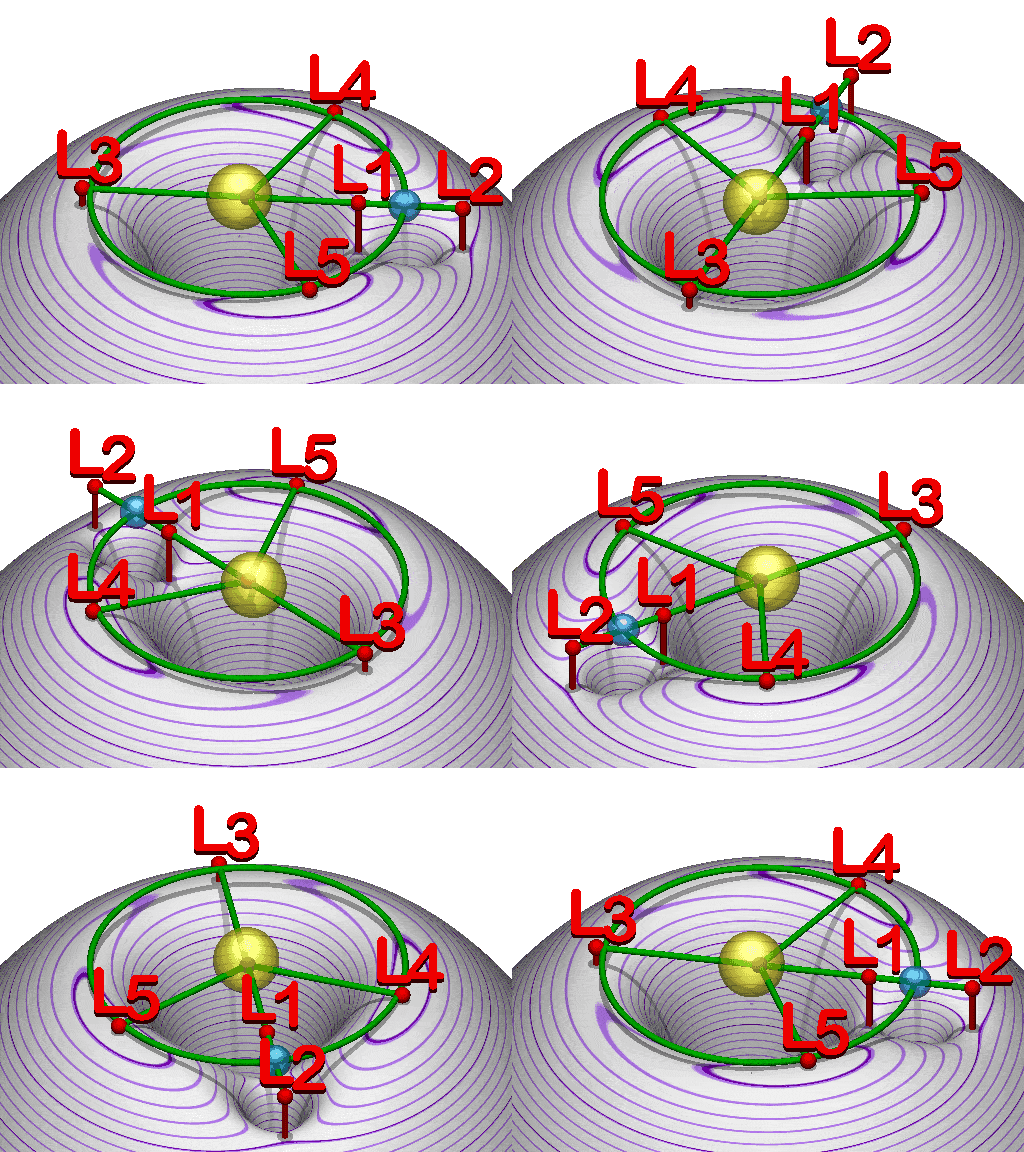
More on New View of Motion under Gravitation

        Combined gravitational potential $\phi (x(t),t)$ for Earth--Moon system with Lagrange points.

Motion under gravitation is according to the New View described by the following set of equations in terms of the gravitational potential $\phi (x,t)$ and immaterial free fall trajectories $x(t)$;
  1. $\Delta\dot\phi +\nabla\cdot (u\Delta\phi ) = 0$,                         (mass conservation)
  2. $u(x(t),t)=\dot x(t)$,
  3. $\ddot x(t) +\nabla\phi (x(t),t) = 0$,                          (Newton's 2nd Law)
where the mass density $\rho (x,t)$ does not appear, but is instead tied to $\phi (x,t)$ by the relation $\rho (x,t)=\Delta\phi (x,t)$ by differentiation as instant local action in space.  Notice that the immaterial trajectories cover space even where $\Delta\phi (x,t)=0$ expressing absence of matter. The differential equations 1-3 are complemented by initial conditions $\phi (x,0)$ and $x(0)$ and $\dot x(0)$.

To avoid local gravitational collapse from the tendency of gravitational motion to concentrate matter, a pressure force $-\nabla p$ with $p$ a pressure is needed to balance the gravitational force $\rho\nabla\phi$ locally. With such a pressure force present the basic case to consider is a two-body problem as the motion of two bodies 1 and 2 as solid spheres of mass $m_1$ and $m_2$ under gravitation. The corresponding gravitational potential can be expressed as a smoothed version of the potential of the corresponding point masses (in normalized form):
  • $\phi (x,t) =\phi_1(x,t) +\phi_2(x,t)\equiv \frac{m_1}{\vert x - x_1(t)\vert} + \frac{m_2}{\vert x - x_2(t)\vert}$
where $x_1(t)$ is the position of the center of body 1 at time $t$ and $x_2(t)$ that of body 2. The net gravitational force $F_{12}(t)$ acting on body 1 will then be given by
  • $F_{12}(t)=m_1\nabla\phi_2(x_1(t),t) = \frac{m_1m_2}{\vert x_1(t) - x_2(t)\vert^2}e_{12}$,
where $e_{12}$ is a unit vector in the direction $x_2(t) - x_1(t)$, because the the force from $\phi_1$ will be balanced by a local pressure. Likewise the net gravitational force $F_{21}$ acting on body 2 is given by
  • $F_{21}(t)=m_2\nabla\phi_1(x_2(t),t) = \frac{m_1m_2}{\vert x_2(t) - x_1(t)\vert^2}e_{21}= -F_{12}(t)$.
We thus recover Newton's law of gravitation, which is no surprise of course, but the important aspect is that the full gravitational potential $\phi (x,t)$ is the sum of the gravitational potentials $\phi_1(x,t)$ and $\phi_2(x,t)$, both changing with time, and that the self-gravitational force with $\nabla\phi_1$ acting on body 1 is balanced by a local pressure and thus effectively is canceled. This means that the trajectory $x_1(t)$ is determined by Newton's 2nd law with $\phi =\phi_2$.

The whole mystery of motion under gravitation is now expressed in the equation $\Delta\dot\phi +\nabla\cdot (u\Delta\phi ) = 0$, which is no mystery since it expresses  mass conservation.

End is Near for UK Royal Society and US National Academy

        The END IS NEAR for the science of the UK Royal Society and US National Academy. 

The U.S. National Academies of Science and the U.K. Royal Society have issued a joint report Climate Change Evidence and Causes. The Royal Society introduces the report with:
  • Climate change is one of the defining issues of our time. 
  • It is now more certain than ever, based on many lines of evidence, that humans are changing Earth’s climate. 
  • The atmosphere and oceans have warmed, accompanied by sea-level rise, a strong decline in Arctic sea ice, and other climate-related changes.
The report is framed around 20 questions starting out with the following fundaments:
  1. Is the climate warming?
  2. How do scientists know that recent climate change is largely caused by human activities?
The answer to Question 1 gives the scientific observation in a nutshell:
  • Yes. Earth’s average surface air temperature has increased by about 0.8 °C since 1900, with much of this increase taking place since the mid-1970s. 
The answer to Question 2 describes the theoretical science in a nutshell:
  • Scientists know that recent climate change is largely caused by human activities from an understanding of basic physics, comparing observations with models, and fingerprinting the detailed patterns of climate change caused by different human and natural influences. 
  • The expected changes in climate are based on our understanding of how greenhouse gases trap heat. 
  • Since the mid-1800s, scientists have known that CO2 is one of the main greenhouse gases of importance to Earth’s energy balance. 
  • Both this fundamental understanding of the physics of greenhouse gases and fingerprint studies show that natural causes alone 
We read that observations show a warming since 1900 of 0.8 C out of which 0.4 C is viewed as an effect of human induced CO2 since 1970, while the 0.4 C occuring before 1940 is unexplicable.

We read that the theory is basic physics understanding from 1850 that CO2 traps heat. We read that other causes than heat trapping CO2 are inadequate to explain the recent observed changes in climate. We read that human CO2 leaves theoretical fingerprint.

We see that the combined science in the US and UK is nothing but Penguin Logic of Penguin Science:
  • The less you know, there more sure you can be that you are right. The evidence is clear.
No wonder that the END IS NEAR, for Western civilization.

The central concept of the science propagated by the RS and NA is:
  • More CO2 will cause the Earth to warm by trapping (absorbing) more of the heat (infrared radiation) emitted from Earth's surface.
But trapping as absorption without emission is not something described in physics literature, because absorption comes together with emission as expressed by Kirchhoff's law stating that emisssion = absorption. The RS and NA as scientific societies thus are feeding the people disinformation, which cannot be within legal boundaries of a democratic open society. The RS and NA have trapped themselves into free fall of science and scientific credibility. To Newton at Trinity College in Cambridge as once the President of the RS, this is unthinkable:
  •  I can calculate the motion of heavenly bodies, but not the madness of people.

               Truth is ever to be found in simplicity, and not in the multiplicity and confusion of things.