Visar inlägg med etikett Standard Caculus. Visa alla inlägg

tisdag 26 november 2013

A History of BodyandSoul at Chalmers

Some of the history of the BodyandSoul mathematics education reform project at Chalmers 2000-2007 is documented in the following conference presentations by Stig Larsson, who participated in the project:
  1. Stig Larsson,
    A reformed mathematics education at Chalmers,
    Högskoleverkets kvalitetskonferens, Norrköping, September 25-27, 2001.
    (abstract, amslatex, dvi, pdf)
  2. K. Eriksson, N. Ericsson and S. Larsson,
    Integration of chemistry in math courses,
    Chalmers Strategic Effort on Learning and Teaching C-SELT,
    Conference at Lingatan, August 13-15, 2002.
    (amslatex, pdf)
  3. C. Niklasson, M. Christie, S. Larsson, L. Öhrström, and J. Bowden,
    Integration of Mathematics/Numerical Analysis with Chemistry/Chemical Engineering,
    preprint 2003.
    (pdf)
  4. L. Öhrström, G. Svensson, S. Larsson, M. Christie, and C. Niklasson,
    The pedagogical implications of using Matlab in integrated chemistry and mathematics courses,
    Int. J. Engrg. Education 21 (2005), no. 4, 683-691. (abstract, pdf)
  5. M. Enelund and S. Larsson,
    Development of a new computational mathematics education for the mechanical engineering program at Chalmers University of Technology,
    Second International CDIO Conference, Linköping University, June 13-14, 2006.
    (pdf)
  6. M. Enelund and S. Larsson,
    A computational mathematics education for students of mechanical engineering,
    World Transactions on Engineering and Technology Education 5 (2006), no. 2, 329-332.
    (word, pdf)
  7. M. Enelund, H. Johansson och S. Larsson,
    Beräkningsinriktad matematikutbildning för maskinteknikprogrammet på Chalmers,
    Utvecklingskonferensen för ingenjörsutbildning 2008, KTH, Stockholm, 26-27 november 2008.
    (amslatex, pdf)
  8. M. Enelund, S. Larsson, and J. Malmqvist,
    Integration of a computational mathematics education in the mechanical engineering curriculum,
    Proceedings of the 7th International CDIO Conference, Technical University of Denmark, Copenhagen, June 20 - 23, 2011.
    (pdf)
Here are some key quotations from 1. - 8. describing in particular the presence and absence of the BodyandSoul book:

1.(2001):
  • A full program for a new reformed engineering mathematics education has been developed by K. Eriksson, C. Johnson, Chalmers University of Technology, and D. Estep, Colorado State University. The program includes the books Computational Differential Equations, Cambridge University Press 1996, and Applied Mathematics — Body and Soul, to appear at Springer-Verlag, and various pieces of supporting software. 
  • The full program covering the basic mathematics courses of 25–30 credit points has been implemented at Chalmers since 1999 for a group of 90 students in the “Bio Engineering” (Kb) and “Chemical Engineering with Engineering Physics”  (Kf) programs and has been extended to include also the “Chemical Engineering” (K) program with a total of 160 students 2001. 
  • The implementation of the reform program... is carried out in a cooperative effort of the mathematicians M. Asadzadeh, K. Eriksson, C. Johnson, S. Larsson, M. Larson, K. Samuelsson, and N. Svanstedt at Chalmers University of Technology. 
2.(2002):
  • A basic idea of the reformed math program, delivered by the Department of Computational Mathematics at Chalmers, is a full integration of the “body” and “soul” aspects of mathematics, that is of the concrete/computational/numerical parts representing the “body”, including programming, and the abstract/analytical/symbolic aspects representing the “soul”.
  • (Remark: No reference to the upcoming BodyandSoul book)
3.(2003):
  • In this paper, we examine how changes in mathematics education with integration into engineering subjects influence the different teaching and learning methods for subsequent subjects in the chemical engineering programs at Chalmers. 
  • Material for the first courses has been developed in a new textbook (BodyandSoul).
4.(2005):
  • The last years the undergraduate chemistry and mathematics courses at Chalmers University of Technology has undergone a major curriculum reform.
  • As textbook in mathematics we use a new book (BodyandSoul) written especially for this approach to teaching and learning mathematics at a technical university.
5. and 6.(2006):
  • .... new mathematics courses for the engineering education have been developed at Chalmers and implemented in the Chemical Engineering and Bioengineering programs since 1999. These courses emphasize mathematical modeling, simulation, the use of modern computational tools, and interaction with courses in chemistry and chemical engineering. This is achieved by taking a computational (constructive) approach to the teaching of mathematics.
  • This approach is based on the textbook Applied Mathematics BodyandSoul and has been implemented since 1999 in the Chemical Engineering and Bioengineering programs at Chalmers University [2]. However, the book (BodyandSoul) has proved to be somewhat too difficult for the students and we plan to use traditional textbooks complemented by lecture notes.
7.(2008):
  • Här presenterar vi en reformerad matematik-utbildning. I den reformerade matematikutbildningen integreras traditionell symbolisk matematik med numeriska beräkningar och datorn används som ett verktyg. 
  • Erfarenheterna är mycket positiva. 
  • (Remark: No reference to BodyandSoul)
8.(2011):
  • Here we present the integration of a computationally oriented mathematics education into the CDIO-based MSc program in mechanical engineering at Chalmers. We found that the CDIO-approach was beneficial when designing a reformed mathematics education and integrating the mathematics in the curriculum. 
  • In the reform of the mathematics education, traditional symbolic mathematics is integrated with numerical calculations and the computer is used as a tool. 
  • The experience is very positive. 
  • (Remark: No reference to BodyandSoul)
We see that the BodyandSoul book was used 2000-2006 as the basic text defining a new reformed mathematics program, which is presented to the world at several national and international conferences.  We know that BodyandSoul was replaced 2007 by a traditional book (Calculus: A Complete Course by Adams and Essex) not connected to the reform, complemented by lecture notes in the form of Beräkningsmekanik, which is a translation into Swedish of a couple of introductory chapters of BodyandSoul with reference reduced to a source of "inspiration". 

We see that the experience of the reform is very positive and that the reason BodyandSoul was replaced by a traditional book with no connection to reform, is stated to be that BodyandSoul  "proved to be somewhat too difficult for the students".

PS1  For his reform work Stig Larsson has been awarded several prizes at Chalmers:
  • Ansvarig matematiklärare, professor Stig Larsson, tilldelades Maskinteknikprogrammets pedagogiska pris för sina insatser för utvecklandet och genomförandet av matematikkurserna. Priset baseras på en omröstning bland studenterna. Stig erhöll även Chalmers pedagogiska pris 2008 för sitt arbete med att integrera matematikämnet i ingenjörsämnet”. Pristagarna utses av en jury. Studenternas sammanfattande betyg på matematikkurserna har för alla kurser legat över fyra på en femgradig skala och slutsatsen är att studenterna är mycket positiva till kurserna och genomförandet.

I have asked Stig Larsson if a "somewhat less difficult" version of BodyandSoul according to specification by Chalmers might be of interest as a possible replacement of the traditional text book by Adams, which has little connection to reform, which I could deliver free of charge and save the students  some couple of hundred dollars. I will report the reaction from Stig when (if) it arrives.

PS2 Mikael Enelund is main responsible for the Engineering Mechanics program at Chalmers "buying" the math reform program from the Math Department and Stig Larsson. Enelund says that he relies 100% on the judgement of the Math Department selling/delivering the courses of the reform program, and then voices the widely spread conviction among non-professional mathematicians, that mathematics can only be understood by professional mathematicians, as an effect of traditional mathematics education. Enelund is thus in principle main responsible as buyer, but has translated the responsibility entirely to the math department as seller.

It is thus impossible for Enelund to ask himself how it is possible to use a fully traditional text book like Adams as basic text in a reform program with a fundamentally non-traditional scope and approach? If Enelund had only taken the reform program he would have understood that mathematics can be understood also by non-professional mathematicians and then he would have had the courage to ask the question.  But....

PS3 But why bother? Are we not discussing trivialities? Who cares about basic math eduction, really? Not professors of mathematics anyway, since they consider teaching Calculus to be a triviality better left to underpaid instructors ordered to use some traditional American text book, year after year delivering a steady income to the professors.

But basic math education at a technical university like Chalmers sets the standard for the whole education, and if the math education is antiquated so will the entire engineering education be. So math education is important but the debate is dead and the progress is zero. Or backwards, as when BodyandSoul was replaced by Adams at Chalmers in 2007.   

lördag 23 november 2013

Constructive Calculus in Finite Precision


The Constructive Calculus of BodyandSoul essentially consists of constructing solutions to algebraic and differential equations by computational numerical methods and thus must take into account the finite precision representation as single, double or multiple precision used by computers when performing computations with real numbers using round-off.

The basic concepts of (Lipschitz) continuity and differentiability are introduced in BodyandSoul without reference to the difficult concept of limit and therefore naturally generalize to include finite precision, while the heavy use of limits in Standard Calculus does not.

It is thus natural to define a real-valued function $f(t)$ of a real variable $t$ to be Lipschitz continuous with Lipschitz constant $L$ in finite precision $\epsilon > 0$, if for all $t$ and $\Delta t$
  • $\vert f(t+\Delta t) - f(t)\vert\le L(\vert\Delta t\vert + \epsilon)$.  
We see that here $\Delta t$ will effectively be bounded below by $\epsilon$.

Further, it is natural to define a real-valued function $t\rightarrow f(t)$ of a real variable $t$ to be differentiable with derivative $Df(t)$ in finite precision $\epsilon$, if there is a constant $K$ such that for all $t$ and $\Delta t$
  • $\vert f(t+\Delta t) - f(t) - Df(t)\Delta t\vert\le K(\vert\Delta t\vert^2 + \epsilon )$. 
In this case $\Delta t$ will effectively be bounded below by $\sqrt{\epsilon}$.

We compare with the limit definition of continuity:
  •  f(t) = $\lim_{\vert\Delta t\vert\rightarrow 0}f(t+\Delta t)$,
which requires infinite precision to make sense.

Even more importantly, we compare with the limit definition of the derivative:
  •  Df(t) = $\lim_{\vert\Delta t\vert\rightarrow 0}\frac{f(t+\Delta t) - f(t)}{\Delta t}$,
with division by the infinitely small (but non-zero) quantity $\Delta t$, which requires infinite precision and even so is difficult to grasp, in particular for the student.

The limit definitions can be (and are) used in Symbolic Calculus with derivatives determined by symbolic and not numerical computation, but present severe difficulties in Constructive Calculus in finite precision. The definitions without limits of Constructive Calculus can also be used in Symbolic Calculus by setting $\epsilon =0$, and thus are more versatile.

The essence of Constructive Calculus is to compute solutions to differential equations involving derivatives, thus essentially to compute integrals numerically in finite precision by time stepping as a well-posed numerically stable process, while derivatives may be computed symbolically on restricted classes of functions such as the piecewise polynomials of finite element methods thus circumventing the ill-posedness of numerical differentiation.  

fredag 22 november 2013

What is $\pi$ and $e$?


There are two numbers with a special stature in mathematics:
where $\exp(t)$ is the exponential function usually defined by 
  • $\exp(t)=\lim_{n\rightarrow\infty}(1+\frac{t}{n})^n.$     (*)
The geometric definition of $\pi$ does not give direct information about its numerical value and the definition of $e$ may appear to be ad hoc without connection to either geometry or physics.

In BodyandSoul as Constructive Calculus both $\pi$ and $e$ are constructively defined through solutions of basic initial value problems solved by time stepping. More precisely, $\pi$ is defined as the smallest positive root of the equation $\sin(t)=0$, where $u(t)=\sin(t)$ and $v(t)=cos(t)$ is the solution to the initial value problem modeling a harmonic oscillator: 
  • $\frac{du}{dt} -  v =0$ and $\frac{dv}{dt} + u=0$ for $t > 0$, $u(0)=0$ and $v(0)=1$.  (**) 
Further $u(t)=\exp(t)$ is the solution to the basic initial value problem (expressing "exponential growth" with the growth rate $\frac{du}{dt}$ equal to $u$ itself):
  • $\frac{du}{dt}=u$ for $t > 0$ and $u(0)=1$.   (***)
In particular, 
  • $(1+\frac{t}{n})^n$ 
is the result of solving (***) by time stepping with time step $\frac{t}{n}$ with
  • $u(t+\frac{t}{n})=u(t)+\frac{t}{n}u(t) = (1+\frac{t}{n})u(t)$, 
which converges to $\exp(t)$ as the time step $\frac{t}{n}$ goes to zero with $n$ tending to infinity.

Introducing and defining the numbers $\pi$ and $e$ this way, gives both an understanding why they are so fundamental (by expressing basic properties of solutions to basic mathematical equations connecting to basic physics) and also shows how the (decimal expansions of the) numbers can effectively be computed.

PS1 Notice that once $\sin(t)$ and $\cos(t)$ have been defined as solutions of (**), it follows that $(\cos(t),\sin(t))$ can be geometrically interpreted as the coordinates of a point moving along a unit circle with unit speed and thus $t$ a measure of angle as arc length. The geometric interpretation of $\pi$ thus follows from numerical algebra and not the other way around as in Standard Calculus.

PS2 In Standard Calculus $\sin(t)$ and $\cos(t)$ are defined geometrically as quotients of the lengths of the sides of right-angled triangles again without access to the numerical values except for a few special values of the angle $t$.

BodyandSoul vs Standard Calculus 2

Einstein presenting his equation of general relativity $R_{ik}=0$ supposedly(?) describing the world. Simple and general. 

A Standard Calculus text book, like Calculus: A Complete Course by Adams and Essex, is filled with symbolic formulas covering more than 1000 small print pages and is difficult for the student to digest and heavy to carry along.

The objective of a Standard Calculus text book appears to be to convince the student of the usefulness of Calculus through mass demonstration by presenting so many specific problems, which can be solved with pen and paper using Symbolic Calculus, that there can be only a few left which cannot be solved this way. In short, the objective is to show that Symbolic Calculus works by presenting very many specific examples. But the massiveness is misleading since in fact very few problems can be solved symbolically with pen and paper.

The essence of the BodyandSoul approach as Constructive Calculus is the opposite: Instead of many specific problems solved by symbolic mathematics with pen and paper, one general problem containing all the specific problems of Standard Calculus and many more, is considered. The essence of the theory is then to show how and why any given instance of the general problem can be solved by the computer, as expressed in a Fundamental Theorem of Calculus.

The one general problem of Constructive Calculus, in one variable to start with, is the Initial Value Problem (IVP): Construct a function $u(t)$ of time $t$ such that
  • $\frac{du}{dt} = f$ for $t > 0$ with $u(0)=u_0$,         (*) 
where $f=f(u,t)$ is a given function of $u$ and $t$ and $u_0$ a given initial value, by successive time stepping according to
  • $u(t+\Delta t)$ = $u(t) + f(u(t),t)\Delta t$ with $u(0)=u_0$, 
with $\Delta t >0$ small. This is formally a finite time step version of $du = fdt$ or $\frac{du}{dt}=f$ with vanishingly small time step $dt$, and $du \approx u(t+\Delta t) - u(t) =f\Delta t\approx fdt$.

If $f$ depends only on $t$, the solution $u(t)$ is the integral
  • $\int_0^t f(s)\, ds + x_0$.
If $f=u$ and $u_0=1$, the solution is $u(t)=\exp(t)$. 

More generally, with simple dependencies of $u$ and $t$ all elementary functions (exponential, trigonometric, Bessel, ...) are constructed this way and their properties follow from the specifics of the IPV they solve.Calculus in one variable can thus be reduced to a study of the IVP (*). 

Similarly, Calculus in several variables can essentially be reduced to an IVP of a generalization of (*) with $u=u(t,x)$ and $x$ a multi-dimensional space coordinate and $f$ depending on partial derivatives of $u$ with respect to space coordinates, which is solved by time stepping after finite element discretization in space. 

Constructive Calculus can thus be summarized as $\frac{du}{dt} = f$ solved by time stepping $du=fdt$. Constructive Calculus combines simplicity with generality, which is a prime goal of (computer) science and mathematics, to be compared with the difficulty of all the specific cases of Symbolic Calculus.

PS We may summarize as follows:
  • Constructive Caculus is simple and general.
  • Symbolic Calculus is difficult and special.


                                     Mass demonstration for (or against?) Symbolic Calculus


onsdag 20 november 2013

10 Reasons Why Standard Calculus is Wrong Today

In recent posts I have argued that Calculus in its standard symbolic mathematics form,  in the computer era of our time should be given a new form as constructive mathematics, where symbols are supported by numerical algorithms. Let me here list 10 reasons why the standard text Calculus: A Complete Course by Adams and Essex, is no good today:
  1. Real numbers are introduced with geometric reference as points on a number line.
  2. Completeness of the set of real numbers is identified as a geometric property of the number line to "have no holes", which as a pretentious triviality can only be mystifying to the student.   
  3. The derivative is introduced through a limit process with division by infinitely small quantities, which is numerically ill-posed.
  4. The integral is introduced with geometric reference to area defined by equality of sup of lower sums and inf of upper sums, which can only be mystifying to the student. The Fundamental Theorem is expressed as differentiation of area, which misses the esssence of the Fundamental Theorem with the integral arising as the solution to a basic initial value problem.
  5. The exponential function is introduced as the inverse of the logarithm with the basic differential equation satisfied by the exponential arising as a strange mystifying surprise at the end.
  6. Trigonometric functions are defined geometrically and not constructively as solutions to certain basic initial value problems computable by time stepping. This is wrong from mathematical point of view.
  7. The central Fixed Point Theorem is not proved in the text, but left as an exercise for students to skip.
  8. The proof of existence of solutions to the basic initial value problem is not given, just vaguely hinted at.
  9. The presentation of calculus of several variables uses an awkward notation, and is severely limited with very little about the basic field of partial differential equations. Implicit function theorem not proved. Inverse function theorem not even stated.
  10. The scope of Calculus today as constructive mathematics designed by human minds performed by computers, is missing.      
BodyandSoul contains corrections of these errors of Standard Calculus, and much more...

PS1 The mission of Calculus: A Complete Course is stated in its Preface to be:
  • Of course it is not true that computers can contain all of mathematics; so one challenge (of a new edition) is to ensure that no one imagines that they can.
PS2 The authors of Calculus: A Complete Course want to impress the reader by using a "mathematical style" with DEFINITION, THEOREM, PROOF and EXAMPLE displayed in very big letters, but then in reality offer little, since proofs of important results are generally omitted and the proofs actually offered are mostly pretentious trivialities. BodyandSoul (BS) was written in order to replace the emptiness of a standard calculus text. Seeing BS by teachers at Chalmers with experience of BS, being replaced by Calculus: A Complete Course, makes me sad or angry, or both.

måndag 18 november 2013

BodyandSoul vs Standard Calculus 1

                                                  Symbols as signs on a blackboard.

The basic principle of the BodyandSoul mathematics education reform program is unification of symbolic and computational mathematic where symbols are given meaning by computational algorithms. The symbol (or sign) $\sqrt{2}$ thus is assigned to the real number with decimal expansion generated by Newton's method for computing a (positive) root of the equation $x^2 = 2$. Further, the symbol 
  • $\int_0^t v(s)\, ds$,   
denotes the function $x(t)$ for $t > 0$ satisfying $Dx(t)=v(t)$ for $t > 0$ and $x(0)=0$, where $Dx=\frac{dx}{dt}$ is the derivative of $x(t)$ with respect to $t$, which is constructed by time stepping according to $dx = vdt$. 

Each symbol as a form of soul, thus is carried by a body in the form of a constructive algorithm defining the meaning or numerical value of the symbol.

On the other hand, in a standard presentation of Calculus, symbols are not defined by constructive processes. For example, the symbol $\sqrt{2}$ denotes an object (some form of number) with the property that $\sqrt{2}\times\sqrt{2}=2$, without however carrying any information about its numerical value. Neither does the symbol $\int_0^t v(s)\, ds$ itself carry information about its value.

Standard Calculus mainly consists of symbolic mathematics as symbol manipulation according to given rules, which is what makes Calculus books so thick, while constructive mathematics and numerical algorithms are used only in (the "few exceptional") cases when symbolics fails.

Unification of soul and body can be seen as an expression science, in contrast to religion separating holy soul (symbol) from sinful body (numerical value).

Discussing these aspects with a Standard Calculus teacher is as easy as discussing realities of immaculate conception with a catholic priest. An example is given by the fruitless discussion with teachers at Chalmers claiming to be "inspired by BodyandSoul" while delivering Standard Calculus, as if the central message of BodyandSoul was missed.


onsdag 13 november 2013

Svar från Mikael Enelund Programansvarig Matematik - Maskinteknik

Här är svar från Mikael Enelund programansvarig för den nya utbildningen i Beräkningsorienterad Matematik för Maskintekniker vid Chalmers, på min fråga om han har några kommentarer till de senaste posterna på min blogg:

Hej Claes.

Som ansvarig för maskinteknikprogrammet litar jag helt och hållet på att Stig och Anders mfl utvecklar och genomför en genomtänkt och anpassad matematikutbildning för maskinteknikstudenterna. Kurserna fungerar bra, de får fina omdömen av studenterna, andelen studenter som klarar kurserna är bra (i jämförelse med övriga kurser i programmet) och kunskaperna verkar vara tillräckliga för kurser i programmet som tillämpar matematik. Lärare på masternivå och industrin har också påpekat att studenterna har blivit mycket bättre på att använda beräkningsmatematik (såväl industriella programvaror som egenutvecklade program) för att lösa öppna, komplexa och ofta olinjära problem.

Det sker också en ständig kursutveckling och anpassning till programmets behov. Speciellt trevligt för mig som också är lärare i hållfasthetslära är att grunderna till finita-elementmetoden undervisas i grundkursen Matematisk analys i flera variabler, detta är faktiskt unikt för Chalmers maskinteknik. Så vitt jag förstår är matematikkurserna i varierande omfattning inspirerade av BodyandSoul och dina tidigare gärningar på Chalmers. Utan ditt pionjärarbete skulle det vara mycket mindre beräkningsmatematik i både matematiken och de mer tillämpade kurserna.

Som sagt, när det gäller val av läromedel och pedagogik så lämnar jag det åt kursernas lärare.

Vänliga hälsningar


Mikael


Mitt svar var följande:

Tack för svar Mikael.

Som programansvarig tycker jag Du borde tänka själv och inte bara blint lita på leverantörer. Du skulle kunna få ett mycket bättre program för M om Du bara efterfrågade detta. Det första vore att begära att den särdeles traditionella amerikanska kurslitteraturen ersattes av något som passar vår IT värld av idag och imorgon. Varför inte pröva att ställa detta krav?

Vänliga hälsningar

Claes


tisdag 12 november 2013

More on the Fundamental Theorem of Calculus: Standard vs BodyandSoul

In recent posts we have compared the Standard Calculus approach with the BodyandSoul approach to the Fundamental Theorem as expressed in the corresponding proofs of the theorem, which concerns the relation between primitive function/integral $x(t)$, derivative $Dx = \frac{dx}{dt}$ and integrand $v(t)$ connected by the equations:
  1. $Dx(t) = v(t)$
  2. $x(t)=\int_0^t v(s)\, ds$.
We have noticed that in Standard Calculus as presented in e.g. the standard text book Calculus: A Complete Course by Adams and Essex, the integral $x(t)$ as an area under the graph $t\rightarrow v(t)$ is the primary given object (possibly somehow constructed as a limit of piecewise rectangular approximating areas), and the proof of the Fundamental Theorem consists of showing that $x(t)$ satisfies the differential equation $Dx = v$. 

In the BodyandSoul approach the primary given object is the differential equation $Dx=v$ with $v$ given data and $x$ unknown solution to determine, and the proof of the Fundamental theorem consists of showing that this equation can be solved by constructing approximate solutions by time-stepping
according to 
  • $x(t+\Delta t)=x(t)+v(t)\Delta t$ with $\Delta t$ a time step tending to zero. 
In this approach $x(t)$ satisfies the differential equation $Dx(t)=v(t)$ by construction, because 
  • $Dx(t)\approx \frac{x(t+\Delta t) - x(t)}{\Delta t}=v(t)$.
In the Standard approach the construction is hidden and the proof thus consists in verifying that the integral $x(t)$ satisfies the equation $Dx(t)=v(t)$. Now, this is cumbersome because computation of a derivative in principle is an ill-posed unstable process, which has to be regularized to be computationally meaningful in finite precision with the presence of perturbations of $x(t)$. In the Standard approach this is circumvented by performing symbolic exact differentiation. 

For example, it is verified by symbolic differentiation in infinite precision that e.g. $D t^3 = 3t^2$, which allows computation of the area under the function $3t^2$ from $t=0$ to $t=1$, as a form of magic seemingly without summation:
  • $\int_0^13t^2 = 1^3 - 0^3 = 1$.   
The full picture is hidden to the student of Standard Calculus, presenting primarily the non-constructive magic of exact symbolic differentiation and less the constructive non-magic of time-stepping. BodyandSoul presents both aspects and opens to a deeper and more useful constructive understanding.

PS1 To define as in Standard Calculus the integral as an area follows the same non-constructive geometric approach as defining trigonometric functions through the lengths of the sides of rectilinear triangles (used in e.g. Adams). In BodyandSoul the integral and elementary functions such as trigonometric functions are constructed as solutions to elementary differential equations. Properties of elementary functions then come out as consequences of defining elementary differential equations and not from possibly far-fetched geometry.

The step from the (difficult) symbolic geometry of Euclide to the (easy) constructive analytic geometry of Descartes, marked the beginning of the scientific and industrial revolution and was thus not a small step for humanity. A modern Calculus course should reflect this step.

PS2 In BodyandSoul the trigonometric functions $x(t)=\sin(t)$ and $y(t)=\cos(t)$ are defined as solutions of the system describing a harmonic oscillator:
  • $Dx(t) = y(t)  and Dy(t) = - x(t)$ for $t > 0$ with initial values $x(0)=0$ and $y(0)=1$,
and solutions are computed by time-stepping. 

The familiar relations $D\sin(t) = \cos(t)$ and $D\cos(t)= - \sin(t)$, thus result from the constructive time-stepping of the system where these relations are encoded. This is readily understood by the general student.

In Standard Calculus, $\sin(t)$ and $\cos(t)$ are defined geometrically and the relations $D\sin(t) = \cos(t)$ and $D\cos(t)= - \sin(t)$ have to be discovered and proved by tricky trigonometry, which the teacher may love, but the general student finds difficult.

Again, presenting this argument to a Standard Calculus teacher will lead nowhere.

måndag 11 november 2013

Beräkningsinriktad Matematikutbildning för Maskinteknikprogrammet på Chalmers vs BodyandSoul

Efter att ha först ha deltagit i BodyandSoul (BS) programmet 2000 - 2005  för kemistudenter och sedan lagt ner detsamma 2006 i samband med att jag flyttade till KTH, flyttade Stig Larsson över sina reformerfarenheter till maskinteknik och lanserade där en ny Beräkningsinriktad Matematikutbildning presenterad i en artikel författad tillsammans med programansvarige Mikael Enelund vid Utvecklingskonferensen KTH 2008 med informationen (som forfarande är aktuell):
  • Kurslitteraturen är två traditionella läroböcker, kompletterade med ett kompendium i  Beräkningsmatematik.  
Den nya Beräkningsinriktade Matematikutbildningen beskrivs i artikeln precis som om den vore BS, dock utan minsta referens till BS. Kompendiet är kopia av några inledande kapitel i BS och innehåller en referens till BS som "inspiration" och artikeln avslutas med
  • Ansvarig matematiklärare, professor Stig Larsson, tilldelades Maskinteknikprogrammets pedagogiska pris för sina insatser för utvecklandet och genomförandet av matematikkurserna. Priset baseras på en omrröstning bland studenterna. Stig erhöll även Chalmers pedagogiska pris 2008 för sitt arbete med att integrera matematikämnet i ingenjörsämnet”. Pristagarna utses av en jury. Studenternas sammanfattande betyg på matematikkurserna har för alla kurser legat över fyra på en femgradig skala och slutsatsen är att studenterna är mycket positiva till kurserna och genomförandet.
Idag 5 år senare ser allt ser likadant ut och reformaktiviteten verkar ha avstannat: samma "traditionella läroböcker" (Adams och Lay) och samma lilla kompendium i Beräkningmatematik, samma programansvarig, samma revolutionerande reformmatematik värdig pedagogiska priser, men naturligtvis fortfarande utan synbar närvaro av BS. Verkligheten ter sig ibland konstig, men allt torde ha en rationell förklaring som så småningom kan uppenbaras.

PS1 För den fortsatta lanseringen av maskinteknikprogrammet, som beskrivs som Sveriges bästa och prisats av Teknikföretagen som Årets Teknikutbildning Högskola 2012, se:
Webbaserad läobok/undervisningsmaterial i matematik listas som önskvärd framtida utveckling. När jag meddelar Enelund och Larsson att sådan finns i form av webversionen MST av BS, möts jag av kalla handen. Planen verkar vara att expandera kompendiet i Beräkningsmekanik att fylla detta syfte, möjligtvis med BS/MST som "inspiration" enligt tidigare mall, men att denna utveckling får anstå eftersom "orken inte räcker".

Larsson säger att den traditionella läroboken av Adams avses avvecklas "på sikt" men att BS/MST inte kommer att användas som ersättning, eftersom "BS/MST inte går att använda som kurslitteratur" (även om det gick bra under 6 år med BS för kemistudenter), utan bara som "inspiration", för läraren och kursboksförfattaren, men inte för studenten eller priskommitten.

PS2 När Larsson 2006 presenterade sin plan för den nya Beräkningsorienterad Matematikutbildningen utformad helt enligt BS inför CDIO, fanns en vag antydan av BS i texten i följande ordalag:
  • The Mechanical Engineering program at Chalmers University of Technology has taken part in the development of the CDIO model of engineering education since 2000. 
  • At the same time, new mathematics courses for the engineering education have been developed at Chalmers and implemented in the Chemical Engineering and Bioengineering programs since 1999. These courses emphasize mathematical modeling, simulation, the use of modern computational tools, and interaction with courses in chemistry and chemical engineering. This is achieved by taking a computational (constructive) approach to the teaching of mathematics. 
Vid nästa presentation 2008 efter det att det nya epokgörande programmet startat på maskinteknik, var BS fullständigt utrensat, som om det aldrig funnits, som om det inte var väl dokumenterat i form av 3 böcker hos Springer och omfattande websida med extramaterial, som om Larsson aldrig hade undervisat enligt BS i 6 år.

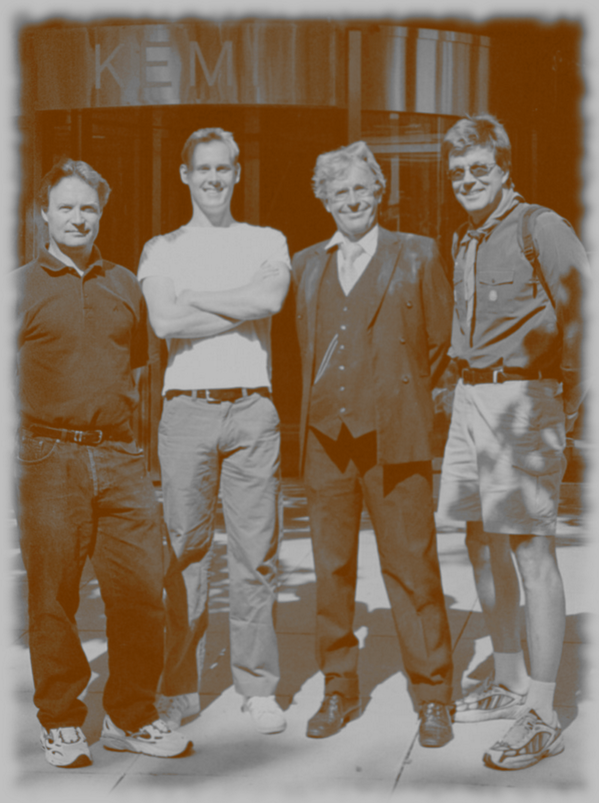
PS3 Se följande legendariska foto av BodyandSoul-teamet som drev matteutbildningen på kemiteknik 2000-2006. Kan personerna identifieras?

Klassiskt foto runt sekelskiftet från Prof. Leibschnitzels (3 fr v) gästföreläsning om Lipschitz-kontinuitet.


PS4 Jag leddes till denna undersökning av sakernas tillstånd (som jag var lyckligen ovetande om) då Anders Logg, efter att ha avslutat den inledande första kursen ht 2013 i reformprogrammet för Beräkningsorienterad Matematikutbildning vid Maskinteknik Chalmers, frågade mig om det fanns någon som ville ta över websidan för BodyandSoul, som Anders haft hand om sedan 2000, eftersom Anders inte längre såg att websidan fyllde någon funktion för utbildningen på Chalmers och eftersom Anders nu tillträtt sin professur på Chalmers.

PS5 Jag har bett Mikael Enelund, programansvarig för maskinteknik, om kommentar, men det verkar inte som Mikael vill kommentera. Att tiga verkar vara guld för ansvariga vid högskolan, men håller det i längden?

PS6 Anders har på mitt förslag lagt upp en länk till MST samt några relevanta kapitel ur BS på hemsidan för den inledande kurs som Anders givit, detta efter det kursen avslutats och eftersom Anders ansett det vara korrekt. Mitt förslag till Stig att göra detsamma för andra kurser i programmet har inte tillmötesgåtts, förmodligen följdriktigt.

PS7 Den intresserade kan jämföra utdraget ur BS enligt ovan med Stig Larssons kompendium Beräkningsmatematik och kanske då förstå varför "BS inte passar som kursbok" medan den svenska översättningen av Stig passar jättebra, eller inte förstå det. Kan problemet vara att BS är på engelska?

Under tiden 2007 - 2013 är det bara detta kompendium i Beräkningsmatematik på 49 sidor som "nyskrivits" av Stig som översättning till svenska av några kapitel ur BS. Att översätta hela BS på 2048 sidor  i samma takt skulle ta 7 x 41 = 287 år! Men många priser och utmärkelser skulle det bli.

PS8 Det sorgliga i sammanhanget är inte att BS kopierats utan korrekt referens, det sker hela tiden i den akademiska världen, och det får man ju se som ett tecken på att BS är tillräckligt intressant för att attrahera kopiering,  utan att så lite av BS har kopierats under falska förespeglingar av att leverera detsamma som BS. Det är ju därför priserna har inhöstats, inte för att en traditionell amerikansk standard Calculusbok som Adams har använts. 

Standard Calculus as Ill-Posed Unstable Backward Magic

        Jacques Hadamard (1865-1963) was a gentle man with strong opinions on mathematics.

Previous posts on the Fundamental Theorem of Calculus have exposed two approaches to the connection between primitive function/integral $x(t)$, derivative $Dx = \frac{dx}{dt}$ and integrand $v(t)$ connected by the equations:
  1. $Dx(t) = v(t)$
  2. $x(t)=\int_0^t v(s)\, ds$.
In the standard approach as presented in e.g. the standard text book Calculus: A Complete Course by Adams and Essex, the integral $x(t)$ as an area under the graph $t\rightarrow v(t)$ is the primary given object and the proof of the Fundamental Theorem consists of showing that $x(t)$ satisfies the differential equation $Dx = v$. 

In the BodyandSoul approach the primary given object is the differential equation $Dx=v$ with $v$ given data and $x$ unknown to determine, and the proof of the Fundamental theorem consists of showing that this equation can be solved by time stepping producing the integral $x(t)$ as the solution. The process from input data $v(t)$ to output solution $x(t)$ by solving $Dx=v$ by time stepping, is well-posed or stable in the sense that small perturbations of data or solution process results in small perturbations of the solution $x(t)$.  

The mathematician Hadamard identified well-posedness and stability to be a necessary requirement in order for a mathematical problem to be meaningful, in the sense that a meaningful solution can be found. The process of integration from integrand $v(t)$ to integral $x(t)$ is well-posed and meaningful.

On the other hand, the process from integral/primitive function $x(t)$ to derivative $Dx(t)$, is ill-posed and unstable, in the sense that small perturbations in $x(t)$ may give rise to large perturbations in the derivative, because
  • $Dx(t)=\lim_{\Delta t\rightarrow 0}\frac{x(t+\Delta t)-x(t)}{\Delta t}$
and a small perturbation in $x(t+\Delta t)$ or $x(t)$ gets divided by the quantity $\Delta t$ tending to zero and thus gets amplified by the large factor $1/\Delta t$. The standard approach to the Fundamental Theorem puts the emphasis on the ill-posed or unstable process of differentiation. 

We sum up as follows: 
  1. The standard approach to the Fundamental Theorem is ill-posed, unstable and of questionable meaning. As illposed problem it rests on symbolic mathematics of infinite precision, which appears as magics.
  2. The approach in BodyandSoul is well-posed, stable and clearly meaningful. As well-posed problem it can be solved by numerical mathematics in finite precision, which is reasonable and not magics.
These aspects would be possible to discuss constructively with the man on the street, but may be very difficult to present to a teacher of standard Calculus for which Adams' book is the bible.

BodyandSoul Not Back at Chalmers


The previous post BodyandSoul Back at Chalmers showed upon closer inspection to not represent reality.

The reality is that the BodyandSoul mathematics education reform program, which had been successfully run during 2001 - 2005 for chemistry students, was dismantled in the Fall 2006 and replaced by a standard Calculus program based on the standard text book Calculus: A Complete Course by Adams and Essex. This happened at the very moment I moved from Chalmers to KTH.

There is a narrative propagated by the department of Mathematics at Chalmers, that BodyandSoul has resurfaced as an important "inspiration" for the current mathematics program for mechanical engineers, for sure based on Adams standard book but still presented as an innovative reform program.

When I look at this program I see 90% standard Adams and 10% BodyandSoul "inspiration". To say that BodyandSoul is back at Chalmers thus does not seem to represent reality, only fiction. Unfortunately, in many cases, reality is more true than fiction.

söndag 10 november 2013

More on Standard Calculus as Backward Magic

                                                       Riemann sum from MST.

The Backward Magic aspect of Standard Calculus is expressed by the fact that a main role of the Fundamental Theorem is to compute the area $A(a,b)$ under the graph of a real-valued function $v:[a,b]\rightarrow R$ defined on an interval $[a,b]$, by finding a primitive function $x(t)$ of $v(t)$ satisfying $\frac{dx}{dt} = v$, and then computing
  • $A(a,b) = x(b) - x(a)$.
Here $v(t)$ can be momentary velocity and $x(t)$ traveled distance from some position. The laborious work of computing the area $A(a,b)$ by summing the contributions over a partition of $[a,b]$ into many small intervals, that is computing a Riemann sum, is thus avoided and magically replaced by simply evaluating the difference $x(b) - x(a)$. This was the magic which could be performed by Leibniz and Newton in front of a stunned audience at the end of the 17th century, and this is the trick each standard Calculus teacher performs today in front of a mystified class of students.

But the magic was based on somehow analytically finding a primitive function, that is by solving the differential equation $\frac{dx}{dt} =v$ analytically. This could and can be done for certain functions $v$, but the analytical machinery may be very involved and often simply impossible. The natural generalization to $v$ depending on $x$ is even more difficult analytically.

Today the computer can solve the equation $\frac{dx}{dt}=v$ by time-stepping corresponding to computing a Riemann sum as an approximation of the area, and there is no need to resort to the magics of finding a primitive function analytically. The generalization to $v$ depending on $x$ is direct and easy by time-stepping with computer. What was difficult to Leibniz and Newton, and largely motivated Calculus, is easy for the student today. This gives Calculus a different meaning as Forward Rational time-stepping, which is not the Backward Magic offered students of standard Calculus.  

Standard Proof of Fundamental Theorem of Calculus as (Backward) Magics

Here is a copy of the standard proof of the Fundamental Theorem of Calculus from the standard test book Calculus: A Complete Course, by Adams and Essex, which represents Backward Magics and not Forward Reason:


We see that Adams starts with the primitive function $F(x)=\int_a^xf(t)\, dt$ and proves that it satisfies the differential equation $F^{\,\prime} (x) = f(x)$, which is Backward Magic.

BodyandSoul vs Standard Calculus 0

BodyandSoul is Constructive or Computational Calculus while Standard Calculus as presented in the standard text book Calculus: A Complete Course by Adams and Essex, can be described as Analytic or Symbolic Calculus. I gave a basic example of the difference between a constructive and symbolic approach in the post
about the Fundamental Theorem of Calculus. Let me here supplement by exhibiting the difference in the approaches as concerns the basic concepts of continuous function and derivate. 

In Analytical/Symbolic Calculus, a real-valued function $s\rightarrow f(s)$ with $s$ a real variable, is said to be continuous at $t$ if
  • $f(t) = \lim_{\Delta t\rightarrow 0}f(t+\Delta t)$, 
  and to have derivative $Df(t)$ at $t$ if
  • $Df(t) = \lim_{\Delta t\rightarrow 0}\frac{f(t+\Delta t) -f(t)}{\Delta t}$. 
In Constructive/Computational Calculus a real-valued function $s\rightarrow f(s)$ with $s$ a real variable, is said to be Lipschitz continuous with Lipschitz constant $L$ if for all $t$ and $\Delta t$
  • $\vert f(t+\Delta t) - f(t)\vert\le L\vert \Delta t\vert$
and differentiable with derivative $Df(t)$ if for a positive constant $K$, for all $t$ and $\Delta t$
  • $\vert f(t+\Delta t) - f(t) - Df(t)\Delta t\vert\le K\vert \Delta t^2\vert$.
We see that Analytical/Symbolic Calculus uses the concept of limit which is a difficult concept involving the mysterious process of $\Delta t$ tending to zero or becoming infinitessimally small, but holy God, not zero!

We see that Constructive/Computational Calculus does not use the difficult concept of limit, only the more basic and easy to grasp concept of local change, with a function being Lipschitz continuous if it is locally constant and differentiable if is locally linear with specified deviations.   

lördag 9 november 2013

Why Calculus Reform Is So Difficult (But So Needed)

              Education of Calculus teachers:  Reading Calculus: A Complete Course.

The computer has given Calculus new meaning, tools and power, but Calculus education is today basically the same as when I studied at Chalmers 50 years ago, which was the same as the Calculus education 100 years ago untouched by the computer, and so on...

Real life experience shows that Calculus education resists all forces of reform. The situation is well described in the Preface to the standard text book Calculus: A Complete Course by Adams and Essex:
  • Calculus is in many respects a classical subject.
  • It is much older than the memories of anyone alive.
  • It is taught in every institution of higher learning in the world.
  • If it is so universal why do we not just reprint old text books from, say, the nineteenth century?
  • The mathematics is the same isn't it?
  • Of course , it is.
  • If your great great grandparents had studied Calcukus in their time, there would be much that they would recognize in modern texts.
  • The text books have grown larger, with many more examples, applications and exercises. Colorful ink and elaborate diagrams burst from the pages.
  • The mathematics is the same but the audience is not.
  • One unprecedented change began to take place more than a decade ago - a mere wink in the of the eye in the history of Calculus.
  • Computer code began to appear in text books to respond to the growing awareness, access, and dependence of the audience on computers. 
But isn't it possible to question the standard dogma that Calculus is the same today as in the 17th-18th century, when it was developed by the great mathematicians of that time? 

No, the Calculus canon represented by Adams cannot be questioned because teachers of Calculus have been thoroughly trained during their studies to believe and confess to the Calculus canon and therefore are unable to go outside the cage and question the canon. And the rest of the world has nothing to say, because the only people who understand Calculus are teachers of Calculus. 

MST/BodyandSoul questions the Calculus canon, not just superficially, but on the fundamental level concerning the basic concepts of real number, continuity, derivative, the Fundamental Theorem of Calculus and more generally about the very meaning and use of Calculus. 

Accordingly, MST/BodyandSoul is banned by KTH, and to get a link put up on a Calculus course web page at Chalmers,  as supplementary material questioning Adams, has shown to be very difficult if not impossible.  

But the "unprecedented change" of the appearance of the computer will eventually push reform...because of "growing dependence of the audience (not teachers) on computers"...    

fredag 8 november 2013

Mathematics: Backward Magics or Forward Reason

                A primitive function magically pulled out of a hat as an area under a function graph.


There are two approaches to mathematics:
  1. Symbolic mathematics: magics: objects pulled out of hats. 
  2. Constructive mathematics: reason: objects constructed in stepwise computation.  
Let me give two examples:

The Fundamental Theorem of Calculus

The presentation of the Fundamental Theorem of Calculus in standard text books of Calculus, is the following: Consider the integral
  • $u(t) =\int_0^t f(s)\, ds$  for $t > 0$,
defined as the area under the curve determined by the function $s\rightarrow f(s)$ for $s\in [0,t]$.

Compute the derivate $\dot u=\frac{du}{dt}$ of the function $t\rightarrow u(t)$ with respect to $t$, to find that, assuming some suitable continuity property of $s\rightarrow f(s)$:
  • $\dot u (t) = \lim_{\Delta t\rightarrow 0}\frac{u(t+\Delta t) - u(t)}{\Delta t}= \lim_{\Delta t\rightarrow 0}\frac{1}{\Delta t}\int_t^{t+\Delta t} f(s)\, ds = f(t)$ for $t >0$. 
In short, the key argument is to show that the integral $u(t)$, defined as an area, satisfies a differential equation
  • $\dot u(t) = f(t)$ for $t > 0$
or solves an initial value problem
  • $\dot u(t) = f(t)$ for $t > 0$ with $u(0)=0$.        (*)
We thus start with a given function, the integral $u(t)$, which is shown to be the solution of a certain initial value problem. The process leads from solution to equation satisified by the solution. The equation appears as magics without reason, since the reason is put into the specification of the solution or integral $u(t)$, with appeal to a concept of area which has to be defined, and not into the equation.

But this is backwards: The more reasonable forward procedure is to start with the initial value problem (*) expressing that the rate of change $\dot u$ of $u$ is equal to $f$ as balance equation expressing some basic physics, and then proceed to the integral $u(t)$ as the solution to the balance equation constructed by time stepping. This is the approach followed in BodyandSoul. We sum up as follows
  • To proceed from solution to equation is backwards magical. 
  • To proceed from equation to solution by forward time-stepping is reasonable and not magical. 
There are many specific examples of this form including trigonometric and exponential functions and more generally elementary functions all better constructed by time stepping basic differential equations than magically being picked out of hats.

For example, the trigonometric functions $\sin(t)$ and $\cos(t)$ are better defined as solutions to $\ddot u + u =0$, which can be constructed by time stepping, rather than geometrically as in standard calculus as ratios of the lengths of sides of a right-angled triangle, which is not computationally constructive.

Quantum Mechanics

The same situation is met in quantum mechanics:

The backward magical process is to start from a wave function solution and discover an equation satisfied by the solution, a magical Schrödinger equation without physical basis which is a mystery to all physicists.

The more natural procedure is to start from the Schrödinger equation, which can be formulated as a rational balance equation of smoothed particle dynamics, and then construct the solution (the wave function) by forward time stepping.

Concluding Remark: In the discussion of the mathematics program at Chalmers, the standard text book by Adams represents backwards magics, while BodyandSoul represents forward reason. Pick what you think is best. But after all, who cares?

Computational vs Analytical Calculus (at Chalmers)


In connection with the apparent return to Chalmers of (a bit of) the BodyandSoul mathematics education reform project, which was run at Chalmers 1998 - 2006 but was disrupted in 2007 when I moved to KTH, it may be of some interest to compare BodyandSoul as Computational or Constructive Calculus with the current standard of Analytical Calculus as presented by e.g. the standard text book Calculus: A Complete Course by Adams and Essex, a standard which found its form 100 years ago.

Standard Analytical Calculus:
  • symbolic analytical solution of a limited variety of specific algebraic and differential allowing analytical solution
  • as many analytical formulas and tricks as possible = thick book with many examples
  • limited generality as large collection of special cases
  • elementary functions picked from a hat
  • solution work done by symbolic manipulation on paper
  • maximal number of formulas and tricks to convince student of generality, which is illusion,
  • mastery of the many analytical tricks difficult for the ordinary student
  • the general problem cannot be tackled, not even by teacher
  • conceptual difficulty: tricky symbolic manipulations, existence unclear and properties magic
  • in short: many difficult special cases = powerless mathematics.  
Computational or Constructive Calculus:
  • constructive solution of general algebraic and differential equations (by time stepping)
  • focus on a few basic analytical formulas and tricks
  • focus on a few basic constructive algorithms (fixed point iteration, Newton's method)
  • generality by computation
  • elementary functions constructed by solving differential equations by time stepping
  • solution work done by computer
  • few basic analytical formulas and computational algorithms can be mastered by the ordinary student
  • student can tackle the general problem
  • conceptual simplicity:  construction by basic algorithms gives existence and properties without magics
  • in short: a few simple general cases = powerful mathematics.    
As you can see, the two approaches give very different weights to Complete Calculus as the union of Analytical and Computational or Constructive Calculus.

The fact the basic text at Chalmers is Adams, shows that the weights still are those of a standard course, and that BS in more complete form is still waiting to return to Chalmers.  As long as the text book is Adams, the standard since 100 years will continue to control (and limit) young minds, at Chalmers and elsewhere. It is a tragedy.

PS For more comparison between analytical and computational math, see next post.

torsdag 7 november 2013

BodyandSoul Tillbaka på Chalmers

BodyandSoul (BS) som reformerad matematikutbildning initierades och drevs vid Chalmers 1998 - 2006, men lades ner då jag flyttade till KTH 2007.  BS återuppväcks nu på Chalmers i form av delar rekommenderade som "fördjupningstext" inom M-programmet hämtade ur web-versionen Mathematical Simulation Technology (MST).

Chalmers teknologer välkomnas till MST, som ger Chalmers en konkurrensfördel jämfört med KTH, där MST är förbjudet.

PS1 Mina synnerligen motiverade frågor till Anders och Stig enligt nedan möts med kompakt tystnad. Kanske finns det inga svar som tål ljuset.

PS2 Jämför med de senare posterna