 Eddinton's plate superimposed on a comparison plate showing outward displacements of stars near the sun during an eclipse.
Einstein's general theory of relativity is believed to be confirmed by an observed apparent shift of position of a star appearing in the sky close to the Sun, claimed to coincide with a bending of light ray by the gravitation from the Sun predicted by relativity theory of size:
- 1.75" x R/D
where R is the radius of the Sun and D the minimal distance of the light ray from the center of the Sun. For a light ray passing close to the Sun the bending would thus be 1.75".
Since it is difficult to observe a star close to the Sun in the sky, because the Sun light is very much stronger than the light from the star, observations have been made during a full eclipse when the Sun light is shaded by the Moon. The first such observation was made in 1919 by Eddington, who claimed to observe precisely the predicted 1.75" and thereby rocketed Einstein to world fame. Later eclipse observations are claimed to confirm Eddington's results.
Let us now subject the eclipse observations as confirmation of general relativity, to scientific scrutiny. The following questions present themselves:
- Why use only eclipse observations with R = D, when the bending effect should present also for say D = 10 R in which case the star may be visible without eclipse shading?
- Are there confirming such observations without eclipse?
- Is it possible that light rays passing close to the Sun are subject to aberration from other effects than gravitation, like strong magnetic fields?
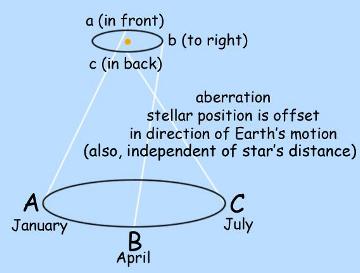
- Is it possible that during an eclipse the phenomenon of stellar aberration varying between 0 and 20" (as discussed in a previous post), disappears because the motion of the Earth with respect to the Sun in the case of no Sun light has no effect?
To use eclipse observations as confirmation of general relativity, it seems as if the answers to the above questions would have to be: 2 Yes, 3 No, 4 No. Is this so?



 Inlägg


