Visar inlägg med etikett stability of matter. Visa alla inlägg

tisdag 29 april 2025

Stability of Matter: Basic Math vs Miracle

  1. Recent posts have discussed the fundamental problem of Stability of Matter SM, including stability of single atoms and collections of atoms as bulk matter, maybe the most fundamental problem of all of physics. 

With the help of chatGPT I have learned about the heroic work by Dyson-Lenard and Lieb-Thirring to mathematically prove SM within Standard Quantum Mechanics StdQM and Density Functional Theory DFT, which boils down to very intricate book-keeping to prevent collapse of potential energy to minus infinity by local accumulation of electron charge densities. The main difficulty to handle is the overlap in StdQM/DFT of electron wave functions with global support. The proof is lengthy and complicated and not easy to follow. It is not part of text books/courses in QM, even if completely fundamental. 

It is natural to ask how it can be so difficult to prove SM within StdQM/DFT, when SM is such a basic property of the physics modled by StdQM? Does real physics also have to handle intricate bookkeeping to avoid collapse?

Or is the proof difficulty of SM within StdQM/DFT yet another indication that there is something seriously unphysical with StdQM connecting to the difficulty of giving StdQM a physical meaning? Seems so.

On the other hand SM within RealQM directly follows from the stability of the Hydrogen atom with potential energy dominated by kinetic energy using the additive form of RealQM with a global wave function as a sum over one-electron wave functions with local non-overlapping supports. 

RealQM is a physical model with SM safely mathematically built in. StdQM is an unphysical model with SM basically a mathematical miracle. SM with RealQM could be essential part of even introductory texts/courses in QM.

According the chatGPT, SM is by physicists viewed as "settled" once and for all by Dyson et al, and it is not meaningful to teach the proof since it is so difficult and and non-illuminating. The advice to students appears to be to just accept SM and not ask about any justification. Seems a bit strange...

Summary:

  1. StdQM in 1926 faces a fundamental problem: Prove Stability of Matter.
  2. No progress towards solution until 1966 when Dyson-Lenard gives a dense 26-article page proof in the form of "awful mathematics" according to Dyson. 
  3. Lieb-Thirring compresses the proof into a 3-page article 1975, which is then expanded into the 300 page book Stability of Matter in 2005.
  4. The problem is viewed to be "settled" and there is nothing more to say according to chatGPT in 2025. The proof is not part of text-books on QM.   

This is a typical progression as concerns fundamental problems in StdQM: 1. State problem as fundamental (interpretation, measurement, complementarity...). 2 Realise that the problem cannot resolved. 3. Claim that there are solutions, but very difficult to understand. 4 Decide that the fundamental problem as been "settled" and that there is noting more to say. 5. Declare that it is sufficient to know that the problem has been solved and that asking for why is not part of physics education. 

söndag 27 april 2025

Stability of Bulk Matter by RealQM


This is a condensation of the preceding sequence of posts with a clear and simple message.

Stability of bulk matter as a collection of a large number $N$ of atoms, is on a basis of Standard Quantum Mechanics StdQM considered to be very difficult to prove mathematically, as evidenced in the work by Dyson-Lenard and Lieb-Thirring. Stability is expressed by a lower bound on total energy scaling with $N$, making total energy an extensive quantity. 

The difficulty is that electrons in StdQM have global support and so in principle can interact with many kernels to give a lower bound scaling with a power of $N$ possibly bigger than 1 with then total energy tending to minus infinity.

On the other hand with RealQM as an alternative to StdQM, stability of bulk matter directly follows from atomic stability which is a simple consequence of a the Hardy inequality: (see this post):

  • $\int\frac{\psi^2(x)}{\vert x\vert}dx\le (\int\psi^2(x)dx)^{\frac{1}{2}}(\int\vert\nabla\psi (x)\vert^2dx)^{\frac{1}{2}}$ for all $\psi\in H^1(R^3)$, 
used by Kato in his analysis of Schrödinger's equation as the foundation of StdQM. This easy-to-prove inequality gives a bound on potential energy in terms of kinetic energy proving stability. 

The wave function $\Psi (x)$ of RealQM for an atomic system is a sum
  • $\Psi (x)= \sum_{n=1}^N\Psi_n(x)$
of atomic electronic wave functions $\Psi_n(x)$ depending on common 3d variable $x$ with non-overlapping supports of electrons meeting at a Bernoulli free boundary with continuity and zero normal derivative. This means  that $\Psi\in H^1(R^3)$ and so satisfies the Hardy inequality bounding total potential energy by kinetic energy with extensivity directly following from the fact that the $\Psi_n(x)$ are sums of electronic wave functions with non-overlapping support and so then also $\Psi (x)$.

The structure of RealQM thus gives a lower bound on the total energy $E$ of a system of $N$ atoms each with kernel charge $Z$ of the form 
  • $E\ge -CNZ^2$
with $C$ an absolute constant expressing stability of the 2nd kind according to Dyson-Lenard-Lieb-Thirring. 

RealQM is a deterministic continuum model in 3d based on Coulomb physics combined with a form of electronic "kinetic energy" measured by $\vert\nabla\psi (x)\vert^2$ with Pauli Exclusion Principle safely built in by non-overlap of electronic wave functions. 

RealQM is a physical computable model to be compared with StdQM which is non-physical and uncomputable. The fact that stability of matter is safely built into the structure of RealQM, but much less so in StdQM, can be seen as a major additional advantage of RealQM. 


fredag 25 april 2025

Stability of Matter: $E(Z)\sim -Z^2$

This is a follow up of previous posts on the basic problem of Stability of Matter.

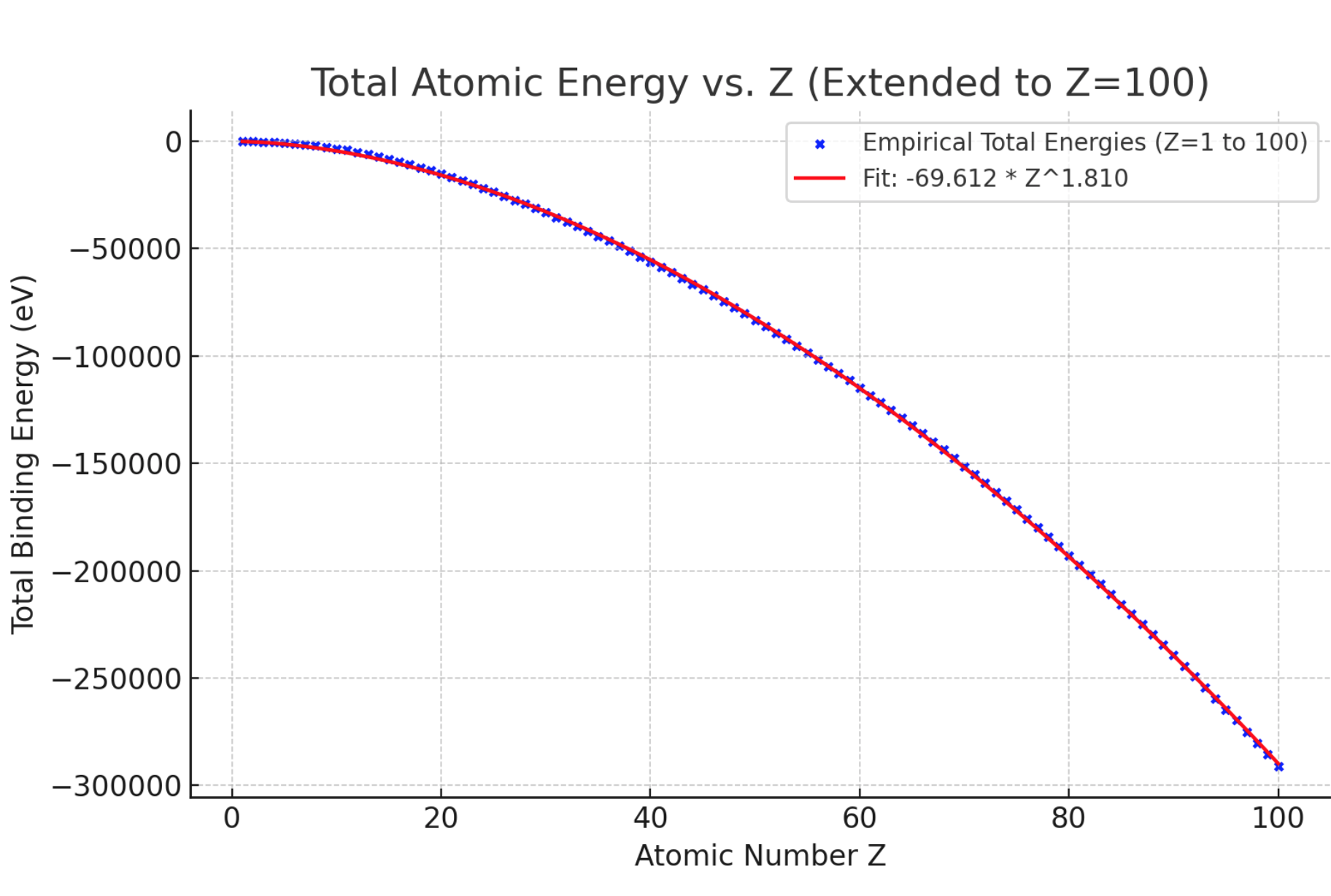
The Lieb-Thirring/Dyson-Lenard proof of the scaling $E(Z) \sim -Z^{\frac{7}{3}}$ of the ground state energy $E(Z)$ of an atom with kernel charge $Z$, is viewed to be a master-piece of rigorous mathematics revealing a deep truth of quantum mechanics. 

But empirical observations of total energies of atoms show a slower scaling of $-Z^\alpha$ with $\alpha \approx 1.81$ according to the following compilation by chatGPT:

The Lieb-Thirring proof is based on the Thomas-Fermi model and not the Schrödinger equation of Standard Quantum Mechanics StdQM, suggesting that the Thomas-Fermi model does not capture physics. But there is no theoretical proof based on StdQM as the canonical model. 

Let us see what RealQM can deliver. We then recall the scaling emerging from RealQM computations of atoms in spherical symmetry recorded in this post showing $E(Z)\sim -log(Z)Z^2$ thus essentially $E(Z)\sim -Z^2$ in much better agreement with observation than the Lieb-Thirring result $-Z^{\frac{7}{3}}$.

A heuristic proof of the RealQM estimate $E(Z)\sim -log(Z)Z^2$ is given in the post starting from an observation that the charge density roughly scales with $\frac{Z}{r^2}$ with $r$ distance to the kernel. 
 

torsdag 24 april 2025

Stability of Matter: RealQM 3

This is a complement to two previous posts. 

According to the Bohr model a Hydrogen atom consisting of an electron orbiting a proton kernel, does not have stable existence over time, because a moving electron radiates energy and so looses kinetic energy and falls into the Coulomb potential well of the proton and ceases to exist.  

But the orbit of planet around a Sun can have stable existence with negative gravitational potential energy balanced by positive kinetic energy, because the planet is not radiating.  

In 1926 Schrödinger invented a new model in terms of a wave function $\Psi (x)$ depending on a 3d space coordinate $x$ with a new form of energy measured by $\vert\nabla\Phi (x)\vert^2$ referred to as "kinetic energy" although spatial gradients without reference to motion was involved. The Hydrogen atom was then represented by a wave function $\Psi (x)$ minimising total energy as Coulomb potential energy + "kinetic energy" with $\Psi^2(x)$ representing electron charge density. Basic Calculus showed the existence of a minimiser as a stable ground state.  

Schrödinger's model can alternatively be interpreted in terms of classical continuum mechanics as the equilibrium configuration of a (spherically symmetric) elastic substance in a central potential minimising total energy as potential energy + elastic energy.

Schrödinger's model thus showed existence of a stable ground state of the Hydrogen atom and was greeted as the start of modern physics in the form of quantum mechanics with a first challenge to extend Schrödinger's model to atoms with $N>1$ electrons.

But here history took a strange turn and settled for a wave function depending on $N$ 3d variables thus in total $3N$ spatial variables, thus forming the Standard Quantum Mechanics StdQM as the foundation of modern physics. The more natural extension into $N$ wave functions in a common 3d variable, was thus missed and has been explored only recently in the form of RealQM. See comment by Lieb and Seiringer in this post.

In RealQM stability of atoms with $N>1$ is guaranteed in the same way as in the case $N=1$ by the presence of "kinetic/elastic energy" measured by $\vert\nabla\Phi (x)\vert^2$. 

Naming the spatial gradient measure $\vert\nabla\Phi (x)\vert^2$ "kinetic energy", has caused a lot of confusion by suggesting that somehow electrons are moving around the kernel as if Bohr's model was in fact functional, although they cannot do that without radiating into collapse. The electron charge density of the ground state of an atom is stationary in space.

Note that the "kinetic energy" with density $\vert\nabla\Phi (x)\vert^2$ originating from the presence of the Laplacian differential operator in Schrödinger's equation representing a regularisation scaling with Planck's constant, coming with added stability as a familiar tool in the mathematical theory of differential equations, where the specifics of the regularisation does not have larger scales effects. The Schrödinger equation thus expresses a regularised form of Coulomb interaction with independence of the absolute scale of Planck's constant: The World would look the same with a different Planck constant. 


Stability of Matter with RealQM 2

A basic task of theoretical physics is to prove stability of matter in the sense that the total energy $E$ of the ground state of an atom is bounded below, which signifies that the electrons surrounding the atomic kernel do not collapse into the kernel with energy going to minus infinity. 

In Standard Quantum Mechanics StdQM this is viewed to be difficult to prove with a first 100-page proof by Dyson and Lenard in 1967 followed by a somewhat shorter proof by Lieb and Thirring in 1975 showing a lower bound scaling with $-Z^{\frac{7}{3}}$ for an atom with kernel charge $Z>1$. 

For $Z=1$ the proof is straight-forward as recalled in the previous post.  

In RealQM the proof for $Z>1$ is essentially the same as for $Z=1$ and so gives a lower bound scaling with $-Z^2$, which is to be expected by a simple dimensional analysis, and also is observed. 

In RealQM an atom has a shell structure with stability established successively from innermost shell with the kernel to the next shell with reduced kernel charge and so on. Further, the stability of molecules in the sense of non-collapse naturally follows from stability of atoms.    

The fact that stability of matter is so far-fetched in StdQM ($-Z^{\frac{7}{3}}$) and so direct in RealQM ($-Z^2$) gives evidence that RealQM may be closer to real physics than StdQM. 

The Lieb-Thirring proof extends to many kernels with total charge Z, while we here think of just one atom or molecule. 

Stability of large collections of atoms or molecules ($Z=10^{23}$) is studied in thermodynamics, then without quantum mechanics because it does not make sense,