Visar inlägg med etikett radiating atom. Visa alla inlägg

lördag 18 oktober 2025

Quantum Restart 2026 from Hydrogen Atom 1926

This year has been designated as the International Year of Quantum Science and Technology (IYQ2025) by the United Nations as the 100th anniversary of the development of Quantum Mechanics. 

Quantum Mechanics was kick-started fin 1926 with formulation Schrödinger's Equation SE for the Hydrogen atom with one electron,  followed by a swift generalisation to many electrons by Born-Heisenberg-Dirac to form the text book Copenhagen Interpretation CI of Standard QM of today.

StdQM is generally viewed as a formidable success underlying all of modern technology of microscopics, but none of the foundational problems behind the CI have been resolved. StdQM is viewed to "always work perfectly well" but "nobody understands why". 

The previous post recalled the critical moment in 1926 when SE was generalised to many electrons by Born-Heisenberg-Dirac into StdQM under heavy protests from Schrödinger, who took the first step with a SE in a wave function $\Psi (x)$ depending on a 3d space coordinated $x$ with $\rho (x)=\Psi^2 (x)$ representing charge density in a classical sense. 

Recall that RealQM is a generalisation to many electrons different from StdQM by staying within a framework of classical continuum mechanics in the spirit of Schrödinger. The basic assumption is that an atom with $N$ electrons is represented by a nucleus surrounded by a collection of electrons as    

  • non-overlapping unit charge densities $\rho_i(x)$ for $i=1,....,N$, 
  • free of self-interaction,
  • indivisible in space. 
Let us now compare RealQM and StdQM in the case of Hydrogen. For stationary ground states and excited states so called eigenstates, they share formally the same SE but with different interpretations of the wave function:

  1. $\rho (x)$ is charge density in classical sense. (RealQM)
  2. $\rho (x)$ is probability density in StdQM sense. (StdQM) 

Recall that QM was formed from a perceived difficulty of capturing the spectrum of Hydrogen within classical physics with the spectrum arising from interaction of the atom with an exterior forcing electromagnetic field in so called stimulated radiation. 

Schrödinger resolved this problem by extending SE to a time-dependent form where the frequencies of the spectrum appeared as differences of stationary energy levels, thus with a linear relation between atomic energy levels and resonance frequencies in stimulated radiation. The discrete frequencies appeared as 

  • beat frequencies of wave functions in superposition. 
This became the mantra of StdQM which has ruled for 100 years, with superposition signifying the break with classical physics, where superposition in spatial sense is impossible.

If we stay within RealQM, then superposition is impossible because charge densities do not overlap. We now ask the key question:
  • Is it possible to capture the spectrum of Hydrogen within RealQM thus without superposition? 
The discrete stationary eigenstates are the same, and so we ask about the time-dependent form of RealQM? Is it the same as that of StdQM? Not in general because RealQM is non-linear and StdQM linear. For Hydrogen RealQM is linear so in this case the same time-dependence as in StdQM is possible.

But this may not be most natural from a classical point of view without superposition in mind. Instead it is natural to think of the radiating electron oscillating back and forth between two energy levels with different charge densities as a classical oscillating dipole. We can thus extend RealQM to a classical dynamical system swinging back and forth between energy levels with different charge distributions. This would describe the radiating Hydrogen atom in terms of classical physics with a continuous transition between different configurations. This would answer Schrödinger's basic question without answer in STdQM about "electron jumps": The electron does not jump but changes charge density continuously in space and time. 

The only thing to explain in this scenario is the linear relation between (difference of) energy and frequency, not from beat frequency and superposition, but from the basic relation between energy and frequency appearing in Planck's Law discussed in this post. 

Summary: It seems possible to capture atomic radiation by RealQM within a classical continuum mechanics framework and so avoid taking the step out of classical physics along the dream of Schrödinger. In particular, superposition is not required and probably not present. Quantum computers built on superposition will not work. Superposition may be superstition rather than reality.  

fredag 29 juli 2016

Secret of Laser vs Secret of Piano

There is a connection between the action of a piano as presented in the sequence of posts The Secret of the Piano  and a laser (Light Amplification by Stimulated Emission of Radiation), which is remarkable as an expression of a fundamental resonance phenomenon.

To see the connection we start with the following quote from Principles of Lasers by Orazio Svelto:
  • There is a fundamental difference between spontaneous and stimulated emission processes. 
  • In the case of spontaneous emission, the atoms emit e.m waves that has no definite phase relation with that emitted by another atom... 
  • In the case of stimulated emission, since the process is forced by the incident e.m. wave, the emission of any atom adds in phase to that of the incoming wave...
A laser hus emits coherent light as electromagnetic waves all in-phase, and thereby can transmit intense energy over distance. 

The question is how the emission/radiation can be coordinated so that the e.m. waves from many/all atoms are kept in-phase. Without coordination the emission will become more or less out-of-phase resulting in weak radiation. 

The Secret of the Piano reveals that the emission from the three strings for each note in the middle register, which may have a frequency spread of about half a Herz, are kept in phase by interacting with a common soundboard through a common bridge in a "breathing mode" with the soundboard/bridge vibrating with half a period phase lag with respect to the strings. The breathing mode is initiated when the hammer feeds energy into the strings by a hard hit.

In the breathing mode strings and soundboard act together to generate an outgoing sound from the soundboard fed by energy from the strings, which has a long sustain/duration in time, as the miracle of the piano. 

If we translate the experience from the piano to the laser, we understand that laser emission/radiation is (probably) kept in phase by interaction with a stabilising half a period out-of-phase forcing corresponding to the soundboard, while leaving part of the emission to strong in-phase action on a target.

An alternative to quick hammer initiation is in-phase forcing over time, which requires a switch from input to output by half a period shift of the forcing. 

We are also led to the idea that black body radiation, which is partially coherent, is kept in phase by interaction with a receiver/soundboard. Without receiver/soundboard there will be no radiation. It is thus meaningless to speak about black body radiation into some vacuous nothingness, which is often done based on a fiction of "photon" particles being spitted out from a body even without receiver, as physically meaningless as speaking into the desert.    

fredag 20 februari 2015

Physical Quantum Mechanics 9: Big Lie More Convincing


In this sequence we argue that a second order real-valued form of Schrödinger's equation:
  • $\ddot\psi + H^2\psi =0$       (1) 
may be to prefer before the standard first order complex-valued form:
  • $i\dot\psi + H\psi =0$,            (2)
where $H$ is a Hamiltonian depending on a space variable $x$, the dot signifies differentiation with respect to time $t$, and $\psi =\psi (x,t)$ is a wave function. 

This is because (1) can be given a physical interpretation as a force balance, while the interpretation of (2) has baffled physicists since it was introduced by Schrödinger in 1926.  

Formally, (2) appears as the "square-root" of (1) and it is not strange that if (2) has a physical meaning then (1) as a "square-root" may lack physical meaning. 

The non-physical aspect of (2), first formulated for the Hydrogen atom with one electron and $x$ a 3d space variable, in the extension to an atom with $N>1$ electrons the space variable, is expanded to $3N$ dimensions with a 3d independent space variable for each electron. 

The standard Schrödinger wave function for an atom with $N$ electrons thus depends on $3N$ space variables, which makes direct physical interpretation impossible, and the only interpretation that physicists could come up with was in terms of a probability distribution, without physical meaning. 

This made Schrödinger very unhappy, as well as Einstein. But the newly born so promising modern physics could not be allowed to die in its infancy and so following the strong leadership by Born-Bohr-Heisenberg, the non-physical aspect of the standard Schrödinger equation was turned from catastrophe into a virtue as an expression of a deep mystical uncertain stochastic nature of atomistic physics beyond any form of human comprehension, yet discovered by clever physicists as something very new and modern and very Big.  

In this process, the non-physical aspect of (2) was helpful: If (2) already for a Hydrogen atom with one 3d space variable was deeply mystical as a "square-root" without physical interpretation, expansion to non-physical multi-d $3N$ space variables was just an expansion of the mystery and as such could only be more functional following a well-known device: The great masses (of physicists) will be more easily convinced by a Big Lie than a small one.

To the non-physical aspect of (2) could then be added non-computbality as an equation in $3N$ space dimensions asking for impossible a $googol=10^{100}$ flops already for small $N$. But it did not matter that (2) was uncomputable, since (2) anyway was unphysical and as such of no scientific interest and value, although very Big.

On the other hand, sticking to physics with (1) as a physical force balance, an atom with $N>1$ electrons may naturally be described as a system of $N$ wave functions each one depending on a 3d space variable, which can be given a direct physical meaning including extensions to radiation, and is computable as a system in 3d.

One may compare with another Big Lie, that of dangerous global warming by back radiation evidenced by a pyrgeometer from human emission of CO2, which is threating to send Western civilization back to stone-age. Physicists in charge of the basic physics of global climate including radiative heat transfer in the atmosphere, do not tell the truth to politicians and the people. One Big Lie thus appears to be compatible with another Big Lie and even demand it. The reckoning in the history of science to be written will be harsh, even if as of now nobody seems to care.

Another thing is that questioning a Big Lie may not be a small thing and may draw a big cost. But if Humpty Dumpty falls, then the Fall may be great.


tisdag 27 januari 2015

Physical Quantum Mechanics 6: Interpretation of Ground State

Ground state wave function of Hydrogen (surface plot of 2d section) as minimizer of potential energy under Laplacian regularization.

The ground state wave function $\psi (x)$ of a Hydrogen atom is the minimizer of the (normalized) energy cost functional
  • $E(\psi ) =\int \frac{1}{2}\vert\nabla\psi\vert^2dx -\int\frac{\psi^2(x)}{\vert x\vert}dx$,
under the normalization
  • $\int\psi^2dx =1$.                                  (1)
The ground state wave function thus emerges as the minimizer of potential energy  
  • $PE(\psi ) = -\int\frac{\psi^2(x)}{\vert x\vert}dx$
under Laplacian regularization expressed by the cost functional
  • $RE(\psi )=\int\frac{1}{2}\vert\nabla\psi\vert^2dx$.
From the form of the potential energy $PE(\psi )$ we understand that the physical meaning of $\psi^2(x)$ must be charge distribution with (1) setting the total charge. This is a key element of the new formulation of Schrödinger's equation as a real-valued second order equation , which we are exploring in this sequence of posts.

Minimization of energy distributes the electronic charge around the proton kernel with grading monitored by the Laplacian regularization. There is nothing left to chance in this process. All Hydrogen ground states look the same, as well as excited states emerging as stationary points of $E(\psi )$. 

We compare with the standard formulation as a complex-valued first order equation, in which $\vert\psi\vert^2$ is not interpreted as charge distribution but as a probability distribution of particle position.   

The key point is that charge distribution has a direct real physical meaning in connection to a potential in a classical continuum mechanical sense, while a probability distribution of particle position has no direct real physical meaning, and thus (probably) is meaningless.   

måndag 26 januari 2015

Physical Quantum Mechanics 5: Does the Scientific Method Need Revision?


Niels Bohr brainwashed a whole generation of theorists into thinking that the job of interpreting quantum theory was done 50 years ago. (1969 Nobel Laureate Murray Gell-Mann)


Sabine Hossenfelder asks Does The Scientific Method Need Revision? motivated by the following observations and reflections:
  • Theoretical physics has problems. 
  • It is our lacking understanding of space, time, matter, and their quantum behavior that prevents us from better using what nature has given us. 
  • And it is this frustration that lead people inside and outside the community to argue we’re doing something wrong, that the social dynamics in the field is troubled, that we’ve lost our path, that we are not making progress because we keep working on unscientific theories.
  • Somewhere along the line many physicists have come to believe that it must be possible to formulate a theory without observational input, based on pure logic and some sense of aesthetics. 
  • They must believe their brains have a mystical connection to the universe and pure power of thought will tell them the laws of nature. But the only logical requirement to choose axioms for a theory is that the axioms not be in conflict with each other. 
  • You can thus never arrive at a theory that describes our universe without taking into account observations, period. The attempt to reduce axioms too much just leads to a whole “multiverse” of predictions, most of which don’t describe anything we will ever see.
  • See, in practice the origin of the problem is senior researchers not teaching their students that physics is all about describing nature. Instead, the students are taught by example that you can publish and live from outright bizarre speculations as long as you wrap them into enough math.
  • I cringe every time a string theorist starts talking about beauty and elegance. Whatever made them think that the human sense for beauty has any relevance for the fundamental laws of 
    nature?
  • There isn’t any one scientific method. The only thing that matters is that you honestly assess the use of a theory to describe nature. If it’s useful, keep it. If not, try something else. This method doesn’t have to be changed, it has to be more consistently applied. You can’t assess the use of a scientific theory without comparing it to observation.
  • Theories might have other uses than describing nature...but if they don’t describe nature don’t call  them science.
I agree: Modern physics is not pursued according to a scientific method. How can that be, when classical physics represents the highest incarnation of the scientific method? Why is modern physics irrational and without contact to observation, when physics if anything should be rationalization of observations? 

The answer is simple:  The diversion or Fall away from the Paradise of rational classical physics, happened in the 1920s with Born's interpretation of Schrödinger's wave function $\psi$ in statistical terms with $\vert\psi\vert^2$ as a probability distribution of particle position, against the scientific principles of Schrödinger,  which in the merciless hands of Bohr crushed Schrödinger and along with that the scientific method. 

To insist like Bohr that the ground state of a Hydrogen atom is the result of a microscopic game of roulette with a large variability, instead of a fully determinstic interplay of forces without variability making the ground state the same for all Hydrogen atoms,  is to make physics into a crazy casino or zoo of an inifinite variety of Hydrogen atoms all different. 

In the present series of posts on Physical Quantum Mechanics I return to Schrödinger's original second order wave equation, which can be given a deterministic interpretation without statistics, and thus may open a possibility of returning to the Paradise of rationality of classical physics.

Of course Lubos Motl, as a represenative of the generation of physicists brainwashed by Bohr, opposes to everything Sabine says.    

Physical Quantum Mechanics 4: Interpretation of the Wave Function


We are exploring a second order alternative formulation of Schrödinger's wave equation as the basic model of quantum mechanics, which for a Hydrogen atom takes the form
  • $h^2\ddot\psi +H^2\psi =0$,        (1) 
for all $(x,t)$, where $\psi =\psi (x,t)$ is a real-valued function of a 3d space coordinate $x$ and time coordinate $t$, $\dot\psi =\frac{\partial\psi}{\partial t}$, and $H=-\frac{h^2}{2m}\Delta +V$ is the standard Hamiltonian with $\Delta$ the Laplacian differential operator, $h$ Planck's constant, $m$ the mass of the electron, and $V=V(x)=-\frac{e^2}{4\pi\epsilon_0\vert x\vert}$ is the kernel potential with $\epsilon_0$ the dielectric constant of vacuum and $e$ the charge of the electron. We view (1) as a generalized harmonic oscillator.

We introduce the eigenfunctions $\psi_j$ and corresponding real eigenvalues $E_j$ of the Hamiltonian $H$ satisfying
  • $H\psi_j = E_j\psi$ for $j=1,2,3...$ with $E_1\leq E_2\leq E_3,...$
We then redefine $H$ into $H-E_1$ and $E_j$ into $E_j-E_1$, so that $H\psi_1 =0$ and $E_1=0$ and we consider $\psi_1=\psi_1(x)$ to be the ground state. 

The solution $\psi (x,t)$ of (1) can then be expressed as a real-valued linear combination of eigen-modes
  • $\exp(i\frac{E_j}{h}t)\psi_j(x)$ for $j=1,2,3,...$
What may here be the physical meaning of the wave function $\psi (x,t)$ as a scalar real-valued function?

We seek guidance comparing with the equation for a vibrating thin 2d elastic plate with plane stress-free ground configuration, which may take the form
  • $\ddot\phi +\Delta^2\phi =0$,      (2)
where $\phi (x,t)$ is the transversal displacement of the plate at a position $x$ in the 2d plane of the pale at time $t$. 

We are thus led to interpret the wave function $\psi (x,t)$ of (1) as a "transversal displacement" of a 3d "elastic body" at a position $x$ in 3d and time $t$, with the "transversal displacement" acting so to speak into a "virtual 4th dimension" as a measure of change away from a "stress-free ground configuration".  We may then view (1) to express force balance according to Newton's 2nd law with $h^2\ddot\psi$ rate of change of momentum $h^2\dot\psi$ and $H^2\psi$ a corresponding force.

We seek further guidance in the following conserved quantities of (1) as different forms of energy: 
  • $OE= \frac{1}{2}\int (H\psi )^2 + h^2\dot\psi^2)dx$,                                               (3)
  • $AE= \frac{1}{2}\int (\psi H\psi+h^2\dot\psi H^{-1}\dot\psi )dx$                           (4)
  • $Q=\frac{1}{2}\int (\psi^2+h^2(H^{-1}\dot\psi )^2dx$                                            (5)
as results of multiplication (modulo the ground state) of (1) by  $\dot\psi$,  $H^{-1}\dot\psi$ and $H^{-2}\dot\psi$,  respectively, and integrating in space.

It is here natural to view $OE$ as total oscillator energy, $AE$ as total atomic energy, and it may also be natural to view $Q$ as total charge, viewing thus charge as a form of energy.  We are thus led to define 
  • $\frac{1}{2}(H\psi )^2 + h^2\dot\psi^2) = $ local oscillator energy                                               
  • $\frac{1}{2}(\psi H\psi +h^2\dot\psi H^{-1}\dot\psi ) =$ local atomic energy                    
  • $\frac{1}{2}(\psi^2+h^2(H^{-1}\dot\psi )^2) =$  local charge.                                           
We thus view the wave function $\psi (x,t)$ to represent (scalar) displacement away from a static ground state $\psi_1$ satisfying $H\psi_1=0$, and we view $\psi^2$ to describe charge distribution.

Note that
  • $\int \psi H\psi dx =\frac{h^2}{2m}\int\nabla\psi\vert^2dx +\int V(x)\psi^2(x)dx$,   (6)
with the appearance of $\psi^2$ in the kernel potential directly connection to an interpretation as charge. In particular, the ground state $\psi_1(x)$ emerges as the minimizer of (6) with minimal
potential energy under Laplacian space regularization.

This is radically different from the standard interpretation with $\vert\psi\vert^2$ as a probability distribution of particle position with $\psi$ complex-valued. 

Let us thus compare the two interpretations of (i) $\psi^2$ as charge distribution and (ii) $\vert\psi\vert^2$ as probability distribution of particle position:

1. A function value $\vert\psi\vert^2(x,t)$ is a non-negative number and as such cannot represent a 3d position coordinate, while $\psi^2 (x,t)$ may naturally directly represent a scalar quantity like charge (or mass).

2. The scalar function $\psi^2(x,t)$ generates a 3d charge distribution through the dependence on $x$ and thus has a 3d quality, which gets expressed in radiation from oscillating charges.

3. The only way to connect the scalar $\vert\psi\vert^2$ to 3d space is to interpret
 it as a probability distribution in space, but a probability is not a direct physical quantity.

The conclusion is that connecting the scalar $\vert\psi\vert^2$ to 3d particle position, as in standard quantum mechanics, is both irrational and unneccessary.

We will next extend to radiation summarizing previous posts on the radiating atom.

Then we will extend to atoms/ions with more than one electron. With the wave function $\psi (x,t)$
connecting to charge distribution $\psi^2(x,t)$, we will not be misl(led) to introduce a multi-dimensional wave function $\psi (x1,x2,...,xN,t)$ depending on $N$ 3d space coordinates $x1,x2,...xN$ as in the standard formulation (which makes the Schrödinger equation uncomputable for several electrons) because such a function does not connect to a physical many-electron charge distribution, only to a probability distribution of many-particle positions without direct physical interpretation. Instead we will be led to a system of one-electron Schrödinger equations with direct physical meaning.


söndag 25 januari 2015

Physical Quantum Mechanics 3: Back to Continuum Mechanics

We are exploring a second order alternative formulation of Schrödinger's wave equation as the basic model of quantum mechanics, which for a Hydrogen atom takes the form
  • $\ddot\psi +H^2\psi =0$,        (1) 
for all $(x,t)$, where $\psi =\psi (x,t)$ is a real-valued function of a 3d space coordinate $x$ and time coordinate $t$, $\dot\psi =\frac{\partial\psi}{\partial t}$, and $H=-\frac{h^2}{2m}\Delta +V$ is the standard Hamiltonian with $\Delta$ the Laplacian differential operator with respect to $x$, $h$ Planck's constant, $m$ the mass of the electron, and $V=V(x)=-\frac{1}{\vert x\vert}$ is the (normalized) kernel potential.

We observe that (1) upon multiplication by $m$ takes the form
  • $m\ddot\psi +(-\frac{h^2}{2}\Delta +mV)^2\psi =0$    (2) 
with the electron mass $m$ appearing as if $m\dot\psi$ represents momentum and (2) expresses force balance according to Newton's 2nd law.  We observe that the scaling of the Laplacian conforms with an interpretation as space regularization. 

We further observe that in the limit with $h=0$, (2) decouples into a set of ordinary differential equations indexed by $x$:
  • $\ddot\psi (x,t)+\frac{1}{\vert x\vert^2}\psi (x,t) =0$,   
which reflects Newton's 2nd law with a gravitational force scaling with $\frac{1}{\vert x\vert^2}$.

In the case $V=0$, (2) reduces to (with normalization)
  • $m\ddot\psi +\Delta^2\psi =0$,
which can be viewed as a model of a vibrating elastic solid. 

We thus find that it is possible to interprete the atomic model (2) in classical continuum mechanical terms. Of particular interest is then the conserved quantities of (2), and of course the physical meaning of the wave function, which is not the standard one with $\vert\psi\vert^2$ a particle position probability, to which we return in the next post. 

fredag 23 januari 2015

Physical Quantum Mechanics (Based on Second Order Schrödinger Equation) 1

                                              String vibration as deterministic physics.

The founding pillars of modern physics are (i) quantum mechanics of small scale atomistic physics and (ii) relativity theory of large scale physics. Unfortunately (i) and (ii) have shown to be incompatible, which gives modern physics a shaky foundation loaded with mysteries. In particular, quantum mechanics is viewed to be fundamentally different from classical continuum mechanics, and so beyond human comprehension.

Quantum mechanics describes the atomistic world in terms of wave functions $\psi$ satisfying Schrödinger's equation, which for the basic case of the Hydrogen atom takes the (normalized) form
  • $i\dot\psi \pm H\psi =0$,        (1) 
where $\psi =\psi (x,t)$ is a complex-valued function of a 3d space coordinate $x$ and time coordinate $t$, $\dot\psi =\frac{\partial\psi}{\partial t}$, and $H=-\frac{1}{2}\Delta +V$ is a Hamiltonian with $\Delta$ the Laplacian differential operator and $V=V(x)=-\frac{1}{\vert x\vert}$ is the kernel potential. The mystery of the wave function $\psi (x,t)$ and the equation (1), is that $\psi$ has no direct physical meaning, only an indirect unphysical meaning with $\vert\psi (x,t)\vert^2$ viewed as a probability distribution of particle position.  

Schrödinger obtained (1) in 1926 starting from a second-order wave equation    
  • $\ddot\phi +  H^2\phi =0$,      (2)
in terms of a real-valued wave function $\phi (x,t)$, by a formal decomposition  
  • $\frac{\partial^2}{\partial t^2} +  H^2 = -(i\frac{\partial}{\partial t}+H)(i\frac{\partial}{\partial t}-H)$,
thus viewing formally the complex-valued first order equation (1) as the "square root" of the real-valued second order equation (2). 

This decomposition is analogous to the decomposition of the second order wave equation 
  • $\frac{\partial^2\phi}{\partial t^2}-\frac{\partial^2\phi}{\partial x^2}=0$,   (3) 
in a 1d space coordinate $x$, into the first order equations
  • $\frac{\partial\psi}{\partial t}\pm\frac{\partial\psi}{\partial x}=0$.           (4)
We want to compare the physics expressed by (1) and (2), and then start comparing the physics of (3) and (4). 

We know that the function $\phi (x,t)$ in (3) can be interpreted as the transversal displacement of a vibrating elastic string at $(x,t)$ with (3) expressing a balance of inertial and elastic forces according to Newton's law.  

We know that (4) expresses constancy along characteristics $x\pm t=constant$ describing convection or translation of a quantity with speed 1 in the positive or negative $x$-direction. 

We know that the second order wave equation (3) admits waves traveling in both positive and negative $x$-direction, while each of the two equations (4) admits waves traveling in only one direction. We conclude that the physics described by (3) and (4) is different: the elastic string of (3) is not present in (4) and the physics of the translation in (4) is unknown or unspecified. 

We now understand that also (1) and (2) may describe different physics, or no physics. 

Our conclusion is that the second order real-valued form (2), which is close to (3), may describe physics similar to that of a vibrating string as a form of vibrating electron with again (2) expressing force balance, while the physics of the first order complex-valued conventional form (1) has remained a mystery since 1926.

The meaning of the wave function $\phi$ of (2) is "displacement in space" with $\phi^2+(H^{-1}\dot\phi )^2$ representing charge carried as a concrete physical phenomenon. We compare with the accepted meaning of the wave function $\psi$ in (1) with $\vert\psi\vert^2$ a probability distribution of particle position, which is not carried as a physical phenomenon, only as a phantasm in the mind of a physicist.

The difference between (1) and (2) thus appears to be most essential, if external physical reality is maintained to be what makes physics different from mathematics and philosophy, which do not require an external world to exist. 

The unfortunate result is that insisting to take (1) as the basic equation of quantum mechanics while lacking direct physical meaning, has led generations of physicists following Max Born to attribute a non-physical meaning to the wave function $\psi (x,t)$  as a probability distribution $\vert\psi (x,t)\vert^2$ of particle position. 

The result is a collapse of determinism and casuality and thus scientific rationality, which could have been avoided if instead, along with Schrödinger's original thoughts, (2) had been chosen as the basic equation of quantum mechanics. This is the line of thought I would like to explore further with the hope of finding a deterministic rational physical quantum mechanics as a form of classical continuum mechanics, which can replace probabilistic irrational unphysical quantum mechanics as atomistic physics. It is then encouraging to note that the present highest form of modern physics of string theory, connects to (2) rather than (1).

                                        Atomic vibration as deterministic physics.

  • There is nothing more deterministic and with less free will than the ground state of a Hydrogen atom.  (Nietzsche)
  • The assumption of an absolute determinism is the essential foundation of every scientific enquiry. (Planck)
PS Compare with Physicists debate whether quantum math is as real as atoms discussing the difference between ontic (what is) and epistemic (what we know) aspects of quantum mechanics. 
The most clever among us like Motl Lubos insists that the wave function is neither ontic nor epistemic:
  • However, Nature around us doesn't work in either way. Just like the electron in Nature is neither a classical particle nor a classical wave, the wave function is neither "ontic" nor "epistemic". The world is simply described neither by classical physics evolving a point in the phase space; nor by classical statistical physics.
This is so clever: By removing what physics is not, what remains must be what physics is! Right?

tisdag 20 januari 2015

New Physical Quantum Mechanics

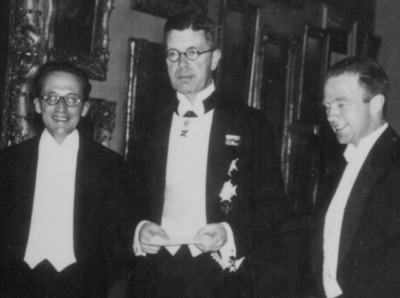
Schrödinger (left, laughing) and Heisenberg (right, also laughing) together with a (taller) representative of Swedish Kingdom quantum mechanics (middle, serious).

In the recent sequence of posts on The Radiating Atom 1-11, I have been led to a formulation of Schrödinger's equation as the basic equation of quantum mechanics, as a scalar second order wave equation in terms of a real-valued wave function $\psi (x,t)$ of space-time $(x,t)$ of the form (for a one-electron atom/ion to start with):
  • $\ddot\psi (x,t) + H^2\psi (x,t) = 0$,  for all $(x,t)$,              (1)
where the dot denotes differentation with respect to time and thus $\ddot\psi =\frac{\partial^2\psi}{\partial t^2}$, and $H$ is a Hamiltonian. We have observed that (1) is closely related to the standard formulation of Schrödinger's equation in complex form (normalizing to $h=1$)
  • $i\dot\psi \pm H\psi =0$              (2)
which appears as a form of "square-root of (1)". Or the other way around, (1) appears as the "square of (2)".

We have argued that (1) lends itself better to physical interpretation and extension to radiation than (2), and we recalled that (1) was the original starting point for Schrödinger in 1926.

We have observed that solutions of (1) satisfy conservation of
  • total charge = $\frac{1}{2}\int (\psi^2+(H^{-1}\dot\psi )^2dx$
  • total atomic energy = $\frac{1}{2}\int (\psi H\psi+\dot\psi H^{-1}\dot\psi )^2dx$ 
  • total oscillator energy = $\frac{1}{2}\int (H\psi )^2+\dot\psi^2)dx$,    
as results of multiplication of (1) by $H^{-2}\dot\psi$, $H^{-1}\dot\psi$ and $\dot\psi$, respectively, and integrating in space.

We have seen that (1) naturally extends to radiation and forcing in the form:
  • $\ddot\psi  + H^2\psi -\gamma\dddot\psi = f$,           
with $f=f(x,t)$ scalar forcing and and $\gamma\ge 0$ a small radiation coefficient, and we have observed the following basic energy balance in the case of near resonant forcing:
  • total outgoing radiation = $\int \gamma\ddot\psi^2dxdt\approx\int f^2dxdt$ = total incoming radiation.
We have argued that (1) can be interpreted as a force balance with the wave function $\psi$ as a form of "scalar virtual displacement" connecting to classical mechanics with the Hamiltonian involving "internal elastic forces" connected to the presence of the Laplacian and to elastic spring forces from kernel potential, and $\gamma\dddot\psi$ connecting to the Abraham-Lorentz radiation recoil force. We have then noted that the wave function $\psi$ as "scalar virtual displacement" is given a physical realization as 3d local charge displacement.

The wave function of $\psi$ of (1) can thus be given a deterministic physical meaning, as an alternative to the standard interpretation of the wave function of (2) as probabilistic particle position.
Physical conservation of total charge in (1) will then replace unphysical conservation of total probability in (2).

We thus have compared with (2), which is viewed to be an ad hoc model without physical interpretation; if (1) has a physical meaning, it does not follow that (2) as a "square-root of (1)" must have a physical meaning.

We expect that (1) to extend in a natural way to the case of several atoms as a system of one-electron equations expressing force balance of a collection of wave functions depending on $(x,t)$, which is computable. We compare with the standard extension of (2) into a complex equation for a wave function depending on $3N$ spatial coordinates for $N$ electrons, which leads to an uncomputable model.

In short, there is evidence that (1) may offer a better foundation of quantum mechanics than the standard (2), in accordance with the original thoughts of Schrödinger, which unfortunately became muddled by the later declared success of (2) in the Copenhagen Interpretation by Bohr and Heisenberg.

In short: (1) appears to be deterministic, physical and computable, while (2) appears to be probabilistic, unphysical and uncomputable. Further study will show if the expectations for (1) can be met.

onsdag 14 januari 2015

The Radiating Atom 11: Connection to String Theory

Michio Kaku: In string theory, all particles are vibrations on a tiny rubber band; physics is the harmonies on the string; chemistry is the melodies we play on vibrating strings; the universe is a symphony of strings, and the 'Mind of God' is cosmic music resonating in 11-dimensional hyperspace.


We have been led to a alternative formulation of Schrödinger's equation as a second order wave equation in terms of a real-valued wave function $\psi =\psi (x,t)$ depending on a space coordinate $x$ and time $t$ (here for a one electron atom or ion):
  • $\frac{\partial^2\psi}{\partial t^2} + H^2\psi =0$,          (1)
where $H = -\frac{1}{2}\Delta + V(x)$ is a Hamiltonian with $\Delta$ the Laplacian and $V(x)$ a potential (with $V(x)=-\frac{1}{\vert x\vert}$ in the basic case of the Hydrogen atom and normalizing to atomic units).  

In the model case of one space dimension and $V(x) = 0$,  Schrödinger's equation (1) takes the form
  • $\frac{\partial^2\psi}{\partial t^2} + \frac{1}{4}\frac{\partial^4\psi}{\partial x^4} =0$,  
which can be interpreted as a model of a vibrating thin elastic beam. We compare with the basic model of a vibrating elastic string:
  • $\frac{\partial^2\psi}{\partial t^2} - \frac{\partial^2\psi}{\partial x^2} =0$,  
This is also the basic model of string theory (cf. (3.31) here or here) as modern fundamental physics supposedly describing a subatomic world on Planck scales of $10^{-35}$ m.

We thus find a second order in time wave equation to be a basic model of physics on all scales, from macroscopic, over atomic to extremely subatomic scales. 

We know that a macroscopic wave equation expresses a force balance, a balance of 
  • inertial forces proportional to $\frac{\partial^2\psi}{\partial t^2}$ with $\psi (x,t)$ interpreted as a displacement at position $x$ at time $t$,
  • elastic forces proportional to $\frac{\partial^2\psi}{\partial x^2}$ or $\frac{\partial^4\psi}{\partial x^4}$. 
It is natural to interpret also an atomic and subatomic wave equation as a force balance. This opens to interpret Schrödinger's equation in the form (1) as a force balance. In the previous post we saw that this naturally opens to extension to atomic radiative absorption and emission under forcing.  We compare with the standard complex first oder form of Schrödinger's equation $i\frac{\partial\psi}{\partial t}+H\psi =0$,  for which a physical interpretation is missing.

We know that a wave equation can be viewed to express in mathematical terms stationarity of an action integral as an integral in space and time of a Lagrangian $L(\psi )$, which for an elastic string takes the form
  • $L(\psi )=\frac{1}{2}(\frac{\partial^2\psi}{\partial t^2})^2-\frac{1}{2}(\frac{\partial^2\psi}{\partial x^2})^2$.
Force balance can thus in mathematical terms be viewed to express stationarity of an action integral, but unfortunately physicists have become so impressed by this mathematical equivalence as to elevate stationarity of action to be the basic principle of physics, and then so before force balance. But stationarity of an action integral is not physics, only mathematics, because there is no physical process computing action integrals and finding stationarity, while force balance is the essence of physics, as expressed by Newton's law in terms of intertial force.  

Unfortunately, confusion of physics with mathematics has led physicists to search for Lagrangians irrespective of possible lack of physical meaning, rather than seeking wave equations expressing force balance. The formulation of Schrödinger's equation as the second order wave equation (1) is a step in the other direction towards physical meaning, understanding that mathematics is not always physics.

We are then led to interpret the wave function $\psi (x,t)$ in (1) as a displacement in space at  position $x$ and time $t$, and thus $\frac{\partial\psi}{\partial t}=\dot\psi$ as a displacement velocity. From the force balance (1) then follows conservation of the following physical entities
  1. total charge = $\frac{1}{2}\int (\psi^2+(H^{-1}\dot\psi )^2dx$
  2. total atomic energy = $\frac{1}{2}\int (\psi H\psi+\dot\psi H^{-1}\dot\psi )^2dx$ 
  3. total oscillator energy = $\frac{1}{2}\int (H\psi )^2+\dot\psi^2)dx$,    
from multiplication of (1) by $H^{-2}\dot\psi$, $H^{-1}\dot\psi$ and $\dot\psi$, respectively, and integrating in space. Note that 3. naturally connects to radiation scaling with $\nu^4$ with $\nu$ frequency, with $f\dot\psi$ representing work by forcing $f$ acting on displacement velocity $\dot\psi$, with (1) extended to forcing and radiation as in the previous post.

We are thus led interpret charge as a form of energy, and the wave function $\psi$ as a measure of charge displacement, like the displacement of an elastic string, or rather a 3d elastic body.

A true physicist would probably say that (1) is no good since since it is not Lorentz invariant and thus not relativistically correct. But is this true? Well, the speed of light is $c = 3\times 10^{18}$ m/s and, a typical frequency may be $10^{15}$ Hz, the radius of an atom typically smaller than $3\times 10^{10}$ m and so the speed $v=\vert\dot\psi\vert$ will satisfy $\frac{v}{c}\le 10^{-3}$ and thus relativistic effects appear to be very small, if any.

PS Note that in this setting there is no reason to interprete $\psi^2(x,t)$ as a probability of the presence at $(x,t)$ of the electron as particle, since $\psi^2(x,t)$ is not conserved, but instead it is $\psi^2 +(H^{-1}\dot\psi )^2$ as charge, which is conserved. The scientific gamble of viewing atom physics as microscopic roulette physics with inevitable major losses, as in the textbook version of quantum mechanics, can thus possibly be avoided, and much be gained. 

måndag 12 januari 2015

The Radiating Atom 10: Restart from Schrödinger IV 1926


Schrödinger in Quantization and Proper Values IV, 1926:
Meantime, there is no doubt a certain crudness in the use of a complex wave function. If it were unavoidable in principle, and not merely a faciliation of the calculation, this would mean that there are in principle two wave functions, which must be used together in oder to obtain information on the state of the system. This somewhat unacceptable inference admits, I believe, of the very much more congenial interpretation that the state of the system is given by a real function and its time derivative. Our inability to give more accurate information about this is intimately connected with the fact that we have before us only the substitute, extraordinarily convenient for the calculation, to be sure, for a real wave equation of probably fourth order, which, however, I have not succeeded in forming in the non-conservative case.

In the present series of posts on the radiating atom, I have restarted from the last of Schrödinger's four legendary 1926 articles formulating Schrödinger's equation, for Hydrogen to start with:
  • $i\dot\Psi + H\Psi =0$         (1) 
where $\Psi (x,t)=\psi +i\phi$ is a complex-valued electronic wave function of a space coordinate $x=(x_1,x_2,x_3)$ and time $t$, with real-valued real and imaginary parts $\psi (x,t)$ and $\phi (x,t)$, $H$ is the Hamiltonian defined by
  • $H =-\frac{h^2}{2m}\Delta + V$,
where $\Delta$ is the Laplacian with respect to $x$, $V(x)=-\frac{1}{\vert x\vert}$ is the kernel potential, $m$ the electron mass, $h$ Planck's constant and the dot signifies differentiation with respect to time $t$.

Before ending up with (1) Schrödinger considered the following second-order equation in terms of a real-valued wave function $\psi (x,t)$, which can be the real or imaginary part of $\Psi (x,t)$:
  • $\ddot\psi +H^2\psi = 0$      (2)
which formally follows by writing (1) as the first order system
  • $\dot\psi -  H\phi =0$         (3)
  • $\dot\phi + H\psi =0$          (4)
and then eliminating $\phi$ by differentating (3) with respect to time and replacing $H\dot\phi$ by
$-H^2\psi$ after application of $H$ to (4).

Schrödinger thus considered both (1) and (2), but then decided to choose the complex first order form (1), while regretting that the real-valued second-order form (2) in principle was to prefer, because of its very much more congenial interpretation

What Schrödinger referred to was that (2) could be given a physical interpretation as force balance pretty much as in classical mechanics, while the physical meaning of (1) was mysterious to Schrödinger and has so remained to all physicists into our time:

The accepted wisdom, presented in all books, is that (1) arises from classical Hamiltonian mechanics by formally representing momentum by the differential operator $-ih\nabla$ acting in space and energy by the differential operator $ih\frac{\partial}{\partial t}$ in time, which is however ad hoc and without physical reason as expressed by Schrödinger himself and acknowledged by all physicists into our time.

The lack of physical interpretation of (1) means that modern physics as the foundation and model of modern science rests on a quantum foam of mystery, which is the opposite of scientific enligthenment.

Schrödinger stated that his choice of (1) before (2) came from a perceived difficulty of generalizing (2) to a non-conservative case including radiation. But maybe Schrödinger dismissed (2) too quickly.

To check this out, let us consider the following natural generalization of (2) to include radiation as a direct generalization of the classical mechanical or electromagnetic wave equation with (small) radiative damping under near-resonant forcing considered in Mathematical Physics of Black Body Radiation (and Computational Black Body Radiation):
  • $\ddot\psi +H^2\psi -\gamma\dddot\psi = f$      (5)
where $f(x,t)$ is external forcing,  and $\gamma =\gamma (\psi )$ is a (small) positive radiation damping coefficient. The equation (5) has the physical meaning of force balance with
  • $\ddot\psi +H^2\psi$ out-of-balance force of an electronic resonator 
  • $-\gamma\dddot\psi$ the Abraham-Lorentz radiation recoil force
  • $f$ component of an electrical field force. 
Let us now subject the model (5) to a basic study:  First we observe that if $f=0$ and  $\gamma =0$,  then conservation of total charge expressed as
  • $\frac{d}{dt}\int\rho (x,t)dx =0$,                   (6)
with $\rho =\psi^2+(H^{-1}\dot\psi )^2$ the charge intensity, is obtained by multiplying (5) with $H^{-2}\dot\psi$ and integrating in space.

Next, letting $\{\Psi_1,\Psi_2,\Psi_3....\}$ be an orthonormal basis of eigenfunctions $\Psi_k=\Psi_k(x)$ of the Hamiltonian $H$ satisfying $H\Psi_k =E_k\Psi_k$ with corresponding sequence of eigenvalues $E_1\le E_2\le E_3 ...$ , we spectrally decompose $\psi (x,t) =\sum\psi_k(t)\Psi_k(x)$ and $f(x,t)=\sum f_k(t)\Psi_k(x)$  and obtain after multiplication of (5) by $\Psi_k$ and integrating in space, for $k=1,2,..$ and for all $t$ :
  • $\ddot\psi_k(t) +E_k^2\psi_k(t) -\gamma\dddot\psi_k(t) = f_k(t)$   (7)
which is a set of harmonic oscillators with damping under forcing, each one which can be analyzed as in Mathematical Physics of Black Body Radiation.

Let us now consider the basic case $\psi (x,t) = \psi_1(t)\Psi_1(x) +\psi_2(t)\Psi_2(x)$ with $\Psi_1$ the ground state eigenfunction with smallest eigenvalue $E_1$ and $\Psi_2$ an eigenfunction of the next eigenvalue $E_2 > E_1$ with non-vanishing $f_2(t)$ (assuming $f_k=0$ for $k>2$). By a shift of the Hamiltonian by $E_1$, we may assume that $E_1=0$ and then also that $f_1=0$. We thus have the system
  • $\ddot\psi_1(t)  -\gamma\dddot\psi_1(t) = 0$,  thus $\psi_1(t)=\psi_1=constant$, 
  • $\ddot\psi_2(t) +E_2^2\psi_2(t) -\gamma\dddot\psi_2(t) = f_2(t)$,   
and conclude under an assumption of near-resonant forcing $f_2(t)\sim \cos(\nu t)$ with $\nu\approx E_2/h$ and small damping as in Mathematical Physics of Black Body Radiation:
  • $\int\gamma\ddot\psi_2^2dt \approx \int f_2^2(t)dt$   (8)
or in terms of the wave function $\psi$ and the forcing $f$ 
  • $\int\gamma\ddot\psi^2dxdt \approx\int f^2dxdt$       (9)
which expresses that in periodic equilibrium state:
  • outgoing radiation = incoming radiation.        (10)
We now recall the basic energy balance of (5) obtained by multiplying (5) by $\dot\psi$ and integrating in space:
  • $\dot A(t) +R(t) = W(t)$, 
  • $A(t)=\frac{1}{2}(\int\dot\psi^2dx+\int (H\psi )^2dx)$ = internal oscillator energy
  • $R(t)=\int\gamma\ddot\psi_2^2dt$ = outgoing radiation (per unit of time)
  • $W(t) = \int f(x,t)\dot\psi dx$ = work by incoming radiation (per unit of time),
with in equilibrium periodic state, $\dot A(t)=0$ and $R(t)=W(t)$ effectively expressing (9) or (10).  

Of particular concern is now the charge conservation in (5). We note that the internal oscillator energy $A(t)$ may increase under forcing with $W(t)>R(t)$, or decrease if $W(t) < R(t)$,
reflecting a change of balance of the spectral weights $\psi_k(t)$. The question is then if such a change of internal oscillator energy may take place under conservation of total charge, and we 
are then led to compare the work $f_k\dot\psi_k$ connected to energy and $f_kE_k^{-2}\dot\psi_k$ connected to charge with the corresponding coefficient $E_k^{-2}$ for $k>1$. 

Now, in typical cases, $E_k\approx 10^{15}$ and thus $E_k^{-2}\approx 10^{-30}$, which signifies that in the model (5) energy may change under almost perfect charge conservation.

Note that (8) can be expressed as
  • $\gamma \nu_2^4\int\psi_2^2dt\approx \int f_2^2dt$,
thus connecting the amplitude of the excited component $\psi_2\Psi_2$ to the forcing $f_2^2$, which itself may be of the form $\gamma\nu_2^4$ with a possibly different $\gamma$. The radiation balance (10) can thus be viewed to express radiative equilbrium of a collection of atoms under mutual radiative absorption/emission.  

We sum up the virtues of (5) as a semi-classical continuum wave model of a radiating atom subject to forcing,
  1. (5) lends itself to physical interpretation as force balance in a classical sense with the Laplacian representing some form of elastic energy, and the value of wave function $\psi (x,t)$ at position $(x,t)$  representing the "displacement" of the electron at $(x,t)$ from a ground state. 
  2. The Abraham-Lorentz recoil force is small compared to forcing and oscillator imbalance,  because $\gamma$ is very small, which means that self-interaction is avoided and the forcing $f$ can be viewed to be independent of the wave function $\psi$.
  3. (5) lends itself to mathematical analysis as energy balance under charge conservation. 
  4. (5) has a natural extension to a model for a many-electron atom as a system of one-electron equations, which is computable and thus potentially useful. 
  5. (5) coincides in the case $f=0$ and $\gamma =0$ with the standard model (1) and thus with experiments.
  6. (5) admits the ground state to be independent of time as a stable solution without radiation and forcing.
  7. (5) fits with observed radiation of frequency $\nu =(E_k-E_1)/h$ under near-resonant forcing.
  8. Outgoing and incoming radiation can be shifted in (10), which allows (5) to model both absorption of radiation and stimulated or spontaneous emission of radiation. 
Our conclusion is that maybe (5) is the basic model of quantum mechanics asking for thorough analysis and waiting for extensive practical use, rather than (1), corresponding to a restart from the original idea of Schrödinger as the true father of quantum mechanics.

It appears that the advantage of (5) allowing natural extension to radiation and forcing, was (paradoxically so) by Schrödinger perceived instead as a disadvantage making him prefer (1). Too bad that Schrödinger is not around anymore, so that he could have clarified the reason for his choice.

The above virtues 1-8 of (5) may be compared to the following acknowledged deficiencies/difficulties of (1):
  1. The physical meaning of (1) as a strange ad hoc "square-root" of (5) is unknown.
  2. Extension to radiation of (1) is typically accomplished through a time-dependent potential representing forcing, which does not include the Abraham-Lorentz recoil force and thus appears to miss essential physics. 
  3. The attribution of kinetic energy to $\vert\nabla\psi\vert^2$, resulting form formally replacing classical momentum by the differential operator $-ih\nabla$, is irrational from physics point of view.
  4. The generalization of (1) to include radiation under forcing is commonly viewed to require extensions to QED which is further away from classical mechanics, and thus loaded with difficulties. 
  5. Extension of (1) to many electrons introduces a multi-dimensional wave function, which makes (1) uncomputable and thus useless.
PS Note that the wave equation $\ddot\psi +H^2\psi -\gamma\dddot\psi = f$ is a scalar equation in a real-valued function $\psi (x,t)$ with scalar forcing $f(x,t)$, which may be any component of the electrical field, with non-zero $f_k(t)$ in near-resonant interaction with an eigenmode $\psi_k(t)\Psi_k (x)$. It is thus the multiplicity of eigenvalues with in particular 3 independent $2p_{x1}$, $2p_{x2}$ and $2p_{x3}$ eigenstates oriented in the coordinate directions $x =(x1,x2,x3), which in the basic case of resonant radiation connects the scalar wave equation to the  vector $E=(E_{x1},E_{x2},E_{x3})$ of the electrical field, see The Radiating Atom 9.

Interpreting the scalar wave function $\psi$ as an (oscillating) virtual "displacement" connects to a corresponding (oscillating) real physical displacement of charge in 3d space, as the connection between the scalar $\psi (x,t)$ and the vectors of charge displacement and related electrical field.   

söndag 28 december 2014

The Radiating Atom 9: Hydrogen and Beyond

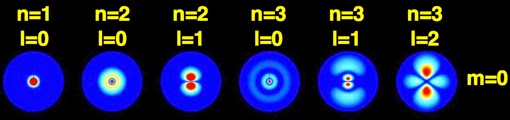
A plane electrical field $E_z$ acting in the $z$-direction and progressing in the $x$-direction, will interact with the $2p_z$ eigenstate of a Hydrogen atom pictured above corresponding to a charge oscillating in the $z$-direction in parallel with $E_z$.  Note that $E_z$ will not interact with the $2p_x$ and $2p_y$ eigenstates.

As a sum-up of the present series of posts on the radiating atom, we consider Schrödinger's equation for a radiating Hydrogen atom subject to forcing in the form of a second order wave equation
  • $\ddot\psi +H^2\psi -\gamma\dddot\psi = f$      (1)
where $\psi (x,t)$ is a real-valued electronic wave function of a space coordinate $x=(x_1,x_2,x_3)$ and time $t$, $H$ is the Hamiltonian defined by 
  • $H =-\frac{h^2}{2m}\Delta + V$,
where $\Delta$ is the Laplacian with respect to $x$, $V(x)=-\frac{1}{\vert x\vert}$ is the kernel potential, $m$ the electron mass, $h$ Planck's constant, the dot signifies differentiation with respect to time $t$, $f$ is external forcing, and $\gamma =\gamma (\psi )$ is a non-negative radiation damping coefficient.

The formulation of Schrödinger's equation as a second order wave equation in terms of a real-valued wave function was considered by Schrödinger in 1926 as an alternative to the standard formulation as a 1st order complex-valued equation. In the homogeneous case with $f=0$ and  $\gamma =0$,  the two formulations are equivalent: In particular, conservation of total charge as
  • $\frac{d}{dt}\int\rho (x,t)dx =0$,
with $\rho =\psi^2+(H^{-1}\dot\psi )^2$ the charge intensity, is obtained by multiplying (1) with $H^{-2}\dot\psi$ and integrating in space. In the non-homogeneous case (1) may be more natural as an expression of a force balance with $-\gamma\dddot\psi$ the Abraham-Lorentz radiation recoil force and $f$ an electrical field component, while the physical meaning of the standard formulation baffled the creators of modern physicists and followers and led into unphysical interpretations as particle statistics.  

We consider radiation of frequency $\nu =(E_2-E_1)/h$ where $E_1$ is the energy of the ground state as an eigenfunction $\Psi_1 (x)$ of $H$ with minimal eigenvalue $E_1$ and $E_2$ is a larger eigenvalue with eigenfunction $\Psi_2(x)$. We reformulate (1) in the form
  • $\ddot\psi +H_1^2\psi -\gamma\dddot\psi = f$,      (2)
where $H_1 = H - E_1$ and note that $H_1\Psi_1=0$ and $H_1\Psi_2=(E_2-E_1)\Psi$. 

We assume that the forcing is given as a linear combination of plane electromagnetic waves $(0,0,\cos(\omega (x_1-ct))$ of frequencies $\omega\approx\nu =(E_2-E_1)/h$ progressing in the $x_1$-direction with the speed of light $c$. We seek a solution $\psi (x,t)$ of (2) of as a linear combination of $\Psi_1$ and $\Psi_2$ of the form
  • $\psi (x,t) =c_1(t)\Psi_1(x) + c_2(t)\Psi_2(x)$
with time dependent coefficients $c_1(t)$ and $c_2(t)$. Inserting this Ansatz into (2), multiplying by $\Psi_1$ and $\Psi_2$ and integrating with respect to $x$, we obtain assuming orthonormality of $\Phi_1$ and $\Psi_2$, time-periodicity and normalizing to $c=1$ and $h=1$:
  • $\ddot c_1(t) -\gamma\dddot c_1(t) = f_1(t)\equiv\int f(x,t)\Psi_1(x)dx$ for all $t$,
  • $\ddot c_2(t) +\nu^2c_2(t)-\gamma\dddot c_2(t) =f_2(t)\equiv\int f(x,t)\Psi_2(x)dx$ for all $t$.
By $x_1$-symmetry of $\Psi_1(x)$ it follows that $f_1(t)=0$ with the effect that $c_1(t)=c_1$ is constant. Further, if $\Psi_2(x)$ is a $(2,1,0)$ p-state oriented in the $x_3$-direction, see above figure, then $f_2(t)$ is a non-zero linear combination of $\cos(\omega t)$, and by the analysis of Mathematical Physics of Black Body Radiation  and Computational Black Body Radiation,
  • $\int\gamma\ddot\psi^2(x,t)dxdt = \int\gamma\ddot c_2^2(t)dt\approx \int f_2^2(t)dt$,  (3)
which expresses that output = input as a fundamental aspect of radiation in time-periodic equilibrium as a phenomenon of near-resonance under small damping. The setting can be generalized to other eigenstates. The essence is the output = input balance, which can express both excitation into eigenstates of larger energy and radiation from such states.

The value of the radiation damping coefficient $\gamma (\psi )$ is set so that conservation of charge is maintained under forcing with the radiation balance (3). If $f=0$ and $\psi$ is a pure eigenstate, then $\gamma = 0$.

Notice that the above argument can be shifted by replacing the ground-state $\Psi_1(x)$ as a time-independent and non-radiating pure eigenstate by an eigenfunction $\Psi_j(x)$ of $H$ with larger energy, again viewed as a time-independent and non-radiating pure eigenstate. This reflects that the time-dependence of pure eigenstates is not observable and thus up to the imagination of an observer. This is not evident in the standard formulation of Schrödinger's equation.

We sum up the virtues of (1) as a semi-classical continuum wave model of a radiating atom subject to forcing, as compared to QED as a non-classical quantum particle model:
  1. (1) lends itself to physical interpretation as force balance.
  2. (1) lends itself to mathematical analysis. 
  3. The term $\ddot\psi$ connects to kinetic energy in classical mechanics and suggests that the common terminology of quantum mechanics of connecting $\Delta\psi$ to kinetic energy, is not natural; a connection to a form of elastic energy may have better physical meaning.
  4. (1) has a natural extension to a model for a many-electron atom as a system of one-electron equations, which is computable and thus potentially useful, in contrast to the standard multi-dimensional Schrödinger equation, which is uncomputable and thus potentially useless. 
  5. The incoming wave is represented as forcing independent of the wave function $\psi$, which faciliates mathematical analysis and understanding, and not as in QED through a time-dependent contribution to the Hamiltonian, which opens to troublesome self-interaction. 

onsdag 17 december 2014

The Radiating Atom 8: Towards Resolution of the Riddle


Let us now collect the experience from previous posts in this series: We start recalling Schrödinger's equation for the one electron Hydrogen atom in standard form:
  • $ih\dot\Psi +H\Psi =0$,            (1)  
where $\Psi =\psi +i\phi$ is a complex-valued function of space-time $(x,t)$ with real part $\psi$ and imaginary part $\phi$ as real-valued functions, and $H$ is the Hamiltonian defined by 
  • $H =-\frac{h^2}{2m}\Delta + V$
where $\Delta$ is the Laplacian with respect to $x$, $V(x)=-\frac{1}{\vert x\vert}$ is the kernel potential, $m$ the electron mass, $h$ Planck's constant, and the dot signifying differentiation with respect to time $t$. The wave function $\Psi$ is normalized with
  • $\int\rho (x,t)dx =1$ for all $t$
  • $\rho =\vert\Psi\vert^2 =\psi^2 +\phi^2$,
where $\rho (x,t)$ is a measure of the charge intensity with total charge equal to one.  

Schrödinger's equation takes the following real-valued system form:
  • $\dot\psi + H\phi =0$
  • $\dot\phi -H\psi =0$,   
which upon differentiation with respect to time and recombination gives the following same second-order equation for both $\psi$ and $\phi$:
  • $\ddot\psi + H^2\psi =0$, 
  • $\ddot\phi + H^2\phi =0$, 
or the same equation in complex form with $\Psi =\psi +i\phi$ as a second-order Schrödinger equation:
  • $\ddot\Psi + H^2\Psi =0$.       (2)
Let now $\psi_1(x)$ be the wave function of the ground state as an eigenfunction of $H$ with corresponding minimal eigenvalue $E_1$ satisfying $H\psi_1=E_1\psi_1$, that is $H_1\psi_1=0$ with $H_1=H-E_1$.

Let us then consider the following generalization of (2) into model of a radiating Hydrogen atom subject to external forcing:
  • $\ddot\Psi +H_1^2\Psi -\gamma\dddot\Psi =f$,      (3)
where $-\gamma\dddot\Psi$ represents radiative damping with  $\gamma =\gamma (\Psi )$ a small non-negative radiation coefficient and corresponding radiation energy
  • $R(\Psi ,t)=\int\gamma\vert\ddot\Psi (x,t)\vert^2dx$.
We see that $\Psi_1=\psi_1$ solves (3) with $f=0$. More generally, if $\psi_j$ is an eigen-function of the Hamiltonian with eigenvalue $E_j\gt E_1$, then $\Psi_j=\exp(i(E_j-E_1)t/h)\psi_j$ solves (3) with $\gamma =0$ and $f=0$ and represents a pure eigenstate of frequency in time $\nu =(E_j-E_1)/h$.

More generally, a superposition $\Psi =c_1\Psi_1+c_j\Psi_j$ of the ground state $\Psi_1$ and an excited eigen state $\Psi_j$ of frequency $\nu =(E_j-E_1)/h$ with non-zero coefficients $c_1$ and $c_j$ generates a charge
  • $\rho (x,t)=\vert\Psi\vert^2=c_1^2\psi_1(x)^2+c_2^2\psi_j(x)^2+2\cos(\nu t)c_1c_j\psi_1(x)\psi_j(x)$,  
which varies in time, and thus may generate radiation.

In the spirit of Computational Physics of Black Body Radiation we are thus led to an analysis of (3) with a forcing $f$ in near-resonance and small radiative damping with eigenfrequencies $(E_j-E_1)/h$, or more generally $(E_j-E_k)/h$ with $E_j\gt E_k$, which as main result  proves the basic energy balance equation
  • $\int R(\Psi ,t)dxdt \approx \int f^2(x,t)dxdt$, 
expressing that in stationary state output = input.

The following questions present themselves:
  1. Which model, first order (1) or second-order (2), extends most naturally to radiation under forcing?
  2. Is (3) to be viewed as a force balance with $-\gamma\dddot\psi$ as a Abraham-Lorentz radiation recoil force?
  3. Which condition on $f$ guarantees that a pure eigenstate $\Psi_j$ is neither absorbing nor emitting, thus with $\gamma (\Psi_j)=0$? 
Remark 1. Note that the time dependence of an eigenstate $\Psi_j$ in superposition with an eigenstate $\Psi_k$ has frequency $(E_j-E_k)/h\gt 0$. The customary association of $\Psi_j$ 
to a frequency $E_j/h$, which can have either sign, is not needed and nor natural from physical point of view. The energy $E_j$ of an eigen-state has a physical meaning, but not $E_j/h$ as a frequency. This is a main of point of confusion in standard presentations of quantum mechanics supposedly being based on Einstein's relation $E=h\nu$ with $E$ energy and $\nu$ frequency.

Remark 2. Normalisation of wave functions under forcing and radiative damping, can be maintained by adjustment of the coefficient $\gamma (\Psi )$.

Remark 3. The energy balance in the form output = input or input = output, determines radiative equilibrium of an assembly of atoms, just as the corresponding relation in black body radiation expressed as Universality.

Remark 4. Schrödinger in the 4th and last of his 1926 articles first came up with (2) as an atomic wave equation, and then settled on (1) with the argument that a time-dependent Hamiltonian would cause problems in a transition from (1) to (2). The question is if Schrödinger gave up on (2) too easily? Maybe (2) is a better physical model than (1)?

Remark 5. Notice that (3) with an Ansatz of the form $\Psi (x,t)=c_1\Psi_1(x)+c_2\Phi (x,t)$ translates (3) into the wave equation in $\Phi$:
  • $\ddot\Phi +H_1^2\Phi -\gamma\dddot\Phi =f$,
which is open to the analysis of Computational Physics of Black Body Radiation. What remains is to identify the forcing $f(x,t)$ resulting from an incoming electric or magnetic field. The basic case concerns the interaction between a $(2,1,0)$ p-state $\Phi_2(x)$ of eigenvalue $E_2$ with axis parallel to a plane-wave electrical field $E=(E_1,0,0)$ with $f = E_1$ in near-resonance with $\nu =(E_1-E_2)/h$.


onsdag 10 december 2014

The Radiating Atom 7: Quantum Electro Dynamics Without Infinities?


The interaction between matter in the form of an atom and light as electro-magnetic wave is supposedly described by Quantum Electro Dynamics QED as a generalization of quantum mechanics into the "jewel of physics" according to Feynman as main creator.  However QED was from start loaded with infinities requiring  "renormalization", which made the value of the jewel as a "strange theory" questionable according to Feynman himself:
  • But no matter how clever the word, it is what I call a dippy process! Having to resort to such hocus pocus has prevented us from proving that the theory of quantum electrodynamics is mathematically self consistent. ... I suspect that renormalization is not mathematically legitimate. 
Let us see what we can say from the experience of the present series of posts on The Radiating Atom leading to the following Schrödinger equation for a radiating Hydrogen atom subject to exterior forcing:
  • $\dot\psi + H\phi -\gamma\dddot\phi = f$,       (1)
  • $-\dot\phi + H\psi -\gamma\dddot\psi = g$,      (2)
where $\psi = \psi (x,t)$ and $\phi = \phi (x,t)$ are real-valued functions of space-time coordinates $(x,t)$ (as the real and imaginary parts of Schrödinger's complex-valued electronic wave function $\psi +i\phi$), $\dot\psi =\frac{\partial\psi}{\partial t}$,
  • $H=-\frac{h^2}{2m}\Delta + V(x)$
is  the Hamiltonian with $\Delta$ the Laplacian with respect to $x$, $V(x)=-\frac{1}{\vert x\vert}$ the kernel potential, $m$ the electron mass and $h$ Planck's constant,  $-\gamma\dddot\phi$ is a Abraham-Lorentz radiation recoil force with corresponding radiation energy $\gamma\ddot\phi^2$ with $\gamma$ a small positive radiation coefficient and $f=f(x,t)$ and $g=g(x,t)$ express exterior forcing. Note that here the electron wave function is coupled to radiation and forcing through a radiative damping modeled by $(-\gamma\dddot\phi ,-\gamma\dddot\psi )$ and the right hand side $(f,g)$, and not through a time-dependent potential connecting an incoming electric field to an electronic dipole moment, which is a common alternative. An advantage of the above more phenomenological model is simpler mathematical analysis since the potential is kept independent of time.

The system (1)-(2) can be viewed as a generalized harmonic oscillator with small radiative damping subject to exterior forcing similar to the system analyzed in Mathematical Physics of Black Body Radiation. The essence of this analysis is a balance of forcing and radiation (cf. PS5 below):
  • $R \equiv\int\gamma (\ddot\psi^2 +\ddot\phi^2)dxdt\approx \int (f^2 + g^2)dxdt$,
which can be viewed to express that $output \approx input$.

A radiating atom with wave function $(\psi ,\phi )$ can be viewed to interact with an electromagnetic $(E,B)$ through the charge density
  • $\rho (x,t) =\psi^2(x,t) + \phi^2(x,t)$,
according to Maxwell's equations:
  • $\dot B + \nabla\times E = 0$, $\nabla\cdot B =0$,
  • $-\dot E + \nabla\times B = J$, $\nabla\cdot E =\rho$,
with $J$ a corresponding current. For a superposition of two pure eigen-states with eigenvalues $E_1$ and $E_2$ the charge density varies in time with frequency $\omega =(E_2 -E_1)/h$ and then as an electrical dipole generates outgoing radiation
  • $P\sim\omega^4$,   
which is balanced by the radiation damping in Schrödinger's equation
  • $R=\int\gamma (\ddot\psi^2 +\ddot\phi^2)dxdt\sim\omega^4$.
The above QED model combining Schrödinger's equation for an atom with Maxwell's equations for an electro-magnetic field, thus explains the physics of 
  1. an electron configuration as a superposition of two pure eigen-states of different energies, 
  2. which generates a time variable charge/electrical dipole, 
  3. which generates an electro-magnetic field, 
  4. which generates outgoing radiation,
  5. under exterior forcing.
The analysis in Mathematical Physics of Black Body Radiation shows that in this system 
  • $P \approx R\approx \int (f^2 + g^2)dxdt$, that is,
  • outgoing radiation $\approx$ radiative damping $\approx$ exterior forcing.  
The fact that outgoing radiation $\approx$ exterior forcing makes it possible to reverse the physics (1) from an atom generating outgoing radiation as an electromagnetic field (emission) into (2) a model of the reaction of an atom subject to an incoming electro-magnetic field (absorption). This is the same reversal that can be made to use a loadspeaker as a microphone (or that an antenna reradiates about half what it absorbs allowing Swedish Television agents to detect individual watchers and check if the TV-license has been paid).

Note that the physics of (1) may be easier to explain/understand than (2), since outgoing radiation/emission can be observed, while atomic absorption of incoming electro-magnetic waves is hidden to inspection.  On the other hand if (2) is just the other side of (1), then explaining/understanding (1) may be sufficient.

The analysis thus offers an explanation of self-interaction without a catastrophy of acoustic feedback between loadspeaker and microphone, which may be at the origin of the infinities troubling Feynman's jewel of physics QED with photons being emitted and possibly directly being reabsorbed in a form of catastrophical photonic feedback.

PS1 The radiation damping $-\gamma\dddot\psi$ may alternatively take the form
$\gamma \vert\dot\rho\vert^2\dot\psi$, with again $R\sim \omega^4$ for a superposition of eigen-states, and $R=0$ for a pure eigen-state with $\dot\rho =0$. Compare PS5 below.

PS2 The basic conservation laws built into (1)-(2) with $f=g=0$ are (with PS1)
  • $\frac{d}{dt}\int\rho (x,t)dx =0$   (conservation of charge), 
  • $\frac{d}{dt}\int (\psi H\psi +\phi H\phi)dx = -\int(\gamma\vert\dot\rho\vert^2(\dot\psi^2+\dot\phi^2)dx$  (radiative damping of energy).
PS3 Feynman states in the above book: 
  • It is very important to know that light behaves like particles, especially for those of you who have gone to school, where you were probably told something about light behaving like waves. I am telling you the way does behave - like particles. ...every instrument (photomultiplier) that has been designed to be sensitive enough to detect weak light has always ended up discovering the same thing: light is made of particles.
We read that Feynman concludes that because the output of a light detector/photo-multiplier under decreasingly weak light input, changes from a continuous signal to an intermittent signal to no signal, light must also be intermittent as if composed of a stream of isolated particles.  But this is a weak argument because it draws a general conclusion about the normal nature of light from an extreme situation where blips on a screen or sound clicks are taken as evidence that what causes the blips also must be blip-like, that is must be particles. But to draw conclusions about normality by only observing extremity or non-normality, is to stretch normal scientific methodology beyond reason. In particular, the infinities troubling QED seems to originate from particle self-interaction. With light and atom instead in the form of waves and their interaction consisting of interference of waves, self-interaction does not seem to be an issue.


PS4 The book Atoms and Light Interactions presents what its author by J. D. Dodd refers to as a semi-classical view of the interaction of electromagnetic radiation and atoms, thus as waves and not particles (which is also my view):
  • It may well be that the semiclassical view falls down at some stage and is unable to predict correctly certain phenomena; my own view is that it succeeds much more widely than it is given credit for. Even if it is not justified from the point of view of many physicists, i is still useful for another reason. Even if the quantum nature of radiation (QED) is required, the underlying physics needs a firm understanding of its classical basis.  
Yes, it may well by that also atomistic physics is a form of wave mechanics and thus a form of classical continuum physics, as expressed by Zeh:
  • There are no quantum jumps and nor are there any particles.
PS5 The analysis of Mathematical Physics of Black Body Radiation is more readily applicable if (1)-(2) is formulated as a second order in time wave equation of the form
  • $\ddot\psi +H^2\psi + \gamma\dot\rho^2\dot\psi = F$,
with the following tentative main result as an extension of the analysis from radiative damping $-\gamma\dddot\psi$ to $\gamma\dot\rho^2\dot\psi$ (with $\gamma >0$ constant):
  • $\int\gamma\dot\rho^2\dot\psi^2dxdt\approx\int F^2dxdt$.
Here $\gamma$ may have a dependence on $\psi$ to guarantee charge conservation under forcing.

onsdag 3 december 2014

The Radiating Atom 5: Summary


A summary of the experience gathered in the recent posts on radiating atoms is as follows:

1. Schrödinger's equation in standard multi-dimensional form is uncomputable and unphysical. 

Schrödinger's wave equation in multi-dimensional linear form commonly viewed as the basis of quantum mechanics, is uncomputable and hence unphysical. To insist that atom physics is well described by a model which is uncomputable lacks scientific rational, since a model without output cannot be compared with observation. Instead a computable model as a nonlinear system of one-electron wave equations in the spirit of Hartree, should be sought.

2. Schrödinger's equation for a non-radiating atom has a fictional time-dependence.

Schrödinger's equation in standard time-dependent form
  • $ih\frac{\partial\psi}{\partial t} + H\psi =0$
with $H$ a Hamiltonian and $t$ time, supposedly describes the dynamics of an atom which is not interacting with any exterior electromagnetic field, that is, is not absorbing or emitting radiation. But such an atom cannot be observed and thus the model cannot be compared to reality. This is reflected by the fact that the charge density $\vert\psi\vert^2$ of the ground state or an excited state as a pure eigen-state of the form
  • $\psi (x,t)=\exp(iE/h)\Psi(x)$ 
with $\Psi =\Psi (x)$ an eigenfunction of the Hamiltonian  $H\Psi =E\Psi$ with corresponding real eigenvalue $E$, is not changing with time. Thus the time-dependence in Schrödinger's standard form is fictional in the sense that it cannot be observed. What can be observed is the difference between eigenvalues, as shown in the next section.

3. A radiating atom can be modeled as a forced resonator with small damping.

The standard Schrödinger equation in above complex form can alternatively be formulated in real form as a second order wave equation for a resonator build from $H^2$:
  • $\frac{\partial^2\phi}{\partial t^2}+H^2\phi =0$,
which can naturally be extended to include exterior forcing and radiative damping, as shown in Computational Physics of Black Body Radiation. In this setting the frequency $\nu$ of observable absorption/emission of radiation resulting from interference between two pure eigen-states with eigenvalues $E_2>E_1$, satisfies  $h\nu =E_2 - E_1$, while the forcing may have different frequency matching the resonance frequencies $E_2/h$ and $E_1/h$ and not (necessarily) $\nu =E_2/h -E_1/h$.

As above the eigen-states are determined from eigenfunctions $\Psi$ of the Hamiltonian $H$ as stationary values of the energy as the sum of kinetic and potential energies under normalization of $\Psi$. The damping term to be added to the second order wave equation can take the form $\gamma\dot\phi$ with $\gamma >0$ a damping coefficient and corresponding dissipation rate $\gamma\dot\phi^2$ balancing outgoing radiation.

The extended wave equation for a radiating atom may thus take the form
  • $\frac{\partial^2\phi}{\partial t^2}+H^2\phi +\gamma\dot\phi =f$,
expressing a balance between forcing $f=f(x,t)$ and the sum of an out-of-balance atomic resonator reaction $\frac{\partial^2\phi}{\partial t^2}+H^2\phi$ and dissipation reaction $\gamma\dot\phi$.  What can here be observed is the radiation generated by a time dependent charge density $\phi^2 (t)$, and not the internal dynamics described by the wave equation, which remains hidden to inspection.

4. Conclusion 

Schrödinger's equation in standard multi-dimensional complex form is not a useful model as a basis of atom physics, because 
  • The model is ad hoc and is not derived from basic physics principles.
  • Multi-dimensionality makes the model uncomputable. 
  • Multi-dimensionality defies physical interpretation of wave functions as solutions.
  • The complex form is mystical and lacks physics rationale. 
  • Introducing kinetic energy by connecting momentum to $ih\frac{\partial}{\partial x}$ represents a deep formal mysticism.     
5. Towards a more useful wave equation.

It may well be possible to construct a more useful more physical less mysterious model as a system of one-electron second order wave equations expressing a balance of attractive/repulsive Coulomb forces, Abraham-Lorentz radiation forces and forces from regularization of wave solutions.  The first step in such a process is to bring the deficiencies of Schrödinger's standard equation from obscurity and mysticism into scientific light.

Here is a reference into such work: Damping Effect of Electromagnetic Radiation and Time-Dependent Schrödinger Equation by Ji Luo.

6. Reflections on the second-order Schrödinger equation

The second order wave equation $\frac{\partial^2\phi}{\partial t^2}+H^2\phi =0$ was formulated in the 4th of Schrödinger's 1926 articles, but was then dismissed on the ground that a time dependent potential from exterior forcing would give a complicated equation. However, it may well be possible to introduce forcing instead as a time-dependent right hand side $f(x,t)$ in a non-homogeneous wave equation
  • $\frac{\partial^2\phi}{\partial t^2}+H^2\phi =f$ 
including the classical ingredients of acceleration $\frac{\partial^2\phi}{\partial t^2}$ connected to kinetic energy $(\frac{\partial\phi}{\partial t})^2$, and with $H=\Delta + V$ connected to a form of "elastic" energy $\vert\nabla\phi\vert^2$ (and thus not kinetic energy) and potential energy $V\phi^2$. This model would bring quantum mechanics into a setting of classical continuum mechanics, which could remove the mysteries of standard quantum mechanics as something fundamentally different from classical continuum mechanics.

Feynman's statement that nobody understands (standard) quantum mechanics, should not be viewed as a joke but as serious criticism: A theory which cannot be understood by any human being is not a scientific theory.