måndag 13 augusti 2012

Non-Physical Principles of Winged Flight


Gale M. Craig informs us in Physical Principles of Winged Flight that:
  • Popular explanations of how wings work are often erroneous and scientifically unsound. Wrong explanations may be given by well-meaning teachers and others, but false teaching may sometimes be just for convenience. 
  • Many years ago, a famous aerodynamicist, Dr. Theodore Von Karman, instructed his assistant: When you are talking to technically illiterate people you must resort to the plausible falsehood instead of the difficult truth. 
  • Falsehood, whether intentional or not, is still being taught. 
  • Curvature of flow and resulting pressure gradients is the source of lift for heavier than air aerodynamic flight. Description of lift as due to pressure gradients in curvature of above-wing and below-wing flows was given by Otto Lilienthal in his 1889 book titled Birdflight as the Basis of Aviation. 
  • Unfortunately that has been neglected for well over a century in favor of pseudoscientific descriptions. 
  • The recirculation around an airfoil or wing is termed circulation, and is, in classical theory, the cause of faster above-wing flow as compared to below-wing flow. As described by Lanchester (1868-1945) in his 1907 book, Aerodynamics, circulation is essential to lift. 
  • The concept of superimposed circulation may seem a bit abstract but circulation is a real rotational movement that travels through the air with the wings of an airplane in flight. 
This is the classical Kutta-Zhukovsky circulation theory which Craig recounts in Stop Abusing Bernoulli - How Airplanes Really Fly sold by
  • Fallacies of popular aerodynamic teachings based on misapplication of Bernoulli's law are revealed, and more appropriate description of wing operation is presented in terms of Newton's laws.
Falsehood, whether intentional or not, is still being taught, also by Craig, as revealed on The Secret of Flight.

See How It Does Not Fly


See How It Flies: A New Spin on the Perceptions, Procedures and Principle of Flight by John S. Denker sells the the old Kutta-Zhukovsky circulation theory of lift:
  • In real flight situations, precisely enough circulation will be established so that the rear stagnation line is right at the trailing edge, so no air needs to turn the corner there. 
  • The general rule — called the Kutta condition — is that the air hates to turn the corner at a sharp trailing edge. 
  • To a first approxmation, the air hates to turn the corner at anysharp edge, because the high velocity there creates a lot of friction. 
  • For ordinary wings, that’s all we need to know, because the trailing edge is the only sharp edge.
  • The funny thing is that if the trailing edge is sharp, an airfoil will work even if the leading edge is sharp, too. This explains why dime-store balsa-wood gliders work, even with sharp leading edges.
  • It is a bit of a mystery why the air hates turning a corner at the trailing edge, and doesn’t mind so much turning a sharp corner at the leading edge — but that’s the way it is.
  • In any case, the rule is:The air wants to flow cleanly off the trailing edge.
We see the Kutta condition being motivated by viscosity. Yet another piece of evidence of collapsed aerodynamics science and education. 


Science2.0 Tells How Airplanes Fly - The Non-Real Story

                                                           The vision of Science2.0

Science2.0 tells How Airplanes Fly - The Real Story:
  • Wings are simple and straightforward devices, yet misconceptions abound on how they work, and many people carry wrong perceptions on their lift-creating mechanism. The 'equal transit time' fallacy being the most prominent misconception in this area. 
  • The physics of flight is well understood and straightforward. Airplanes and earth gravitationally attract each other. Newton's laws of motion tell us that to defy gravity and keep the airplane and earth at constant separation requires exchange of momentum between both bodies. This exchange of momentum is realized by the wings of the airplane directing air to earth, and earth reversing this airstream back up. 
  • That's it folks. Circulating air. That is how an airplanes fly, how helicopters fly, and how birds fly.
  • The wings of the airplane divert up-moving air down. A large portion of this diverted air is located above the airplane. How do the airplane wings manage to divert all this air from far above? 
  • This is because air consists of erratically moving molecules that tend to spread over the full volume available. When the air in the layer just above the wing is pushed down, it allows the air molecules above this layer to get in. As a result higher air layers get accelerated down. This creates room for air molecules in still higher layers to move in, and so on. 
  • All of this pulling in of air molecules causes the pressure to become lower above the wing. This is nothing more than a direct manifestation of Newton's laws of motion applied to the accelerated air. 
  • It is referred to as Bernoulli's principle: the downward acceleration of the air circulating above the wing generates lift. 
  • This picture of air circulation as the direct cause of lift dates back more than a century. At that time, the German mathematician Martin Wilhelm Kutta and the Russian scientist Nikolai Zhukovsky independently developed the mathematics of circulating flows that allows us to predict the lift of wings.  
  • But you don't need this particular shape to keep you in the air. An upside-down airfoil works as well, and so does a tilted barn door. All of these create circulation by diverting air in a downward direction. Perhaps the cleanest manner to generate a backspin air flow is a rotating cylinder. And yes, these make a viable, albeit inefficient and impractical, wing design.
Science2.0 struggles to make sense out of the Kutta-Zhukovsky circulation theory, but fails because it does not make sense, as shown on The Secret of Flight. Yet another evidence that aerodynamics education has collapsed.

WikiAnswers How Do Airplanes Fly? by Fooling

Wiki Answers the question How Do Airplanes Fly? by
  • The top of the wing is more curved than that of the bottom of the wing. The reasoning behind this is that the increased curvature on top of the wing will take advantage of something called magnus effect. 
  • So we know the top of the wing is more curved than the bottom. But how does that have anything to do with magnus effect? 
  • Basically, the shaping of the wing "fools" the air around it into thinking it is a long rotation cylinder, and forces the air to travel faster over the top of the wing than that of the bottom. 
  • And according to Bernoulli's Principle, faster moving air = lower pressure. If we have lower pressure on top of the wing than we do on the bottom of the wing, we now have an inequality of pressures acting on the wing. 
  • There is more pressure pushing up on the bottom of the wing than there is on the top pushing down, which means we now have a total net force pushing UP. And voila.. we have LIFT. 
This is an attempt to make sense of the Kutta-Zhukovsky circulation theory of lift, which however doesn't make sense as shown on The Secret of Flight, and so not only the air around the wing is "fooled" but also the curious reader posing the question.

Aerodynamics Education Collapsed


Virtual Aircraft Museum by Aviastar describes the generation of lift of an airplane wing as follows:

Lift occurs because air flows both over and under the surface of the wing. The wing is designed so that the top surface is "longer" than the bottom surface in any given crosssection. In other words, the distance between points A to B is greater along the top of the wing than under it. The air moving over the wing must travel from A to B in the same amount of time. Therefore, the air is moving faster along the top of the wing.
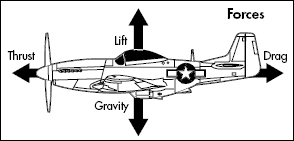
Forces
This creates a difference in air pressure above and below—a phenomenon called the Bernoulli effect. The pressure pushing up is greater than the downward pressure, and lift is created. If you're banking, lift occurs in a slightly sideways direction. If you're inverted, lift actually pulls you downward toward the ground. Note that lift occurs perpendicular to a line drawn parallel to the centerline of the wing and occurs at a slightly backward angle.

All aerodynamicists know that that this is all wrong. Compare with the Aviastar Vision&Mission:
  • AVIASTAR aims to be the aviation operator that commit to safety and provide customers safe and comfortable air charter service satisfaction. Optimistically, the high commitment of Board of Directors may lead us to be a credible, trustworthy, and accountable aviation operator, yet to have the integrity of being the best.
The explanation can only be that aerodynamics education has collapsed.  

How Things Don't Work at U of South Carolina

Physics 101 How Things Work at University of South Carolina
  • emphasizes the physics that you encounter in your everyday life. Most classes will include vivid demonstrations of the phenomena being discussed. In addition, the Physics theory problems will be worked to obtain more practical insights.
In How Airplanes Fly the curious student eager to understand the everyday experience of airplane flight is fed with:
  • Before their first powered flight in December 1903, the Wright brothers tested many different wing shapes in a wind tunnel to find the shape that produced the most lifting force. This shape is often called an airfoil. 
  • The fluid moving over the top travels a greater distance than that moving just under the bottom of the wing. Consequently, the fluid moving over the top must travel faster in order to conform with the shape of the wing and still maintain the natural streamline. 
  • The shape of the wing also crowds the streamlines together above the wing, just as in the case of a constricting pipe. The result is that the region immediately above the wing experiences reduced pressure relative to the region immediately below the wing. 
  • Because the downward force on the top of the wing is less than the upward force on the bottom, a net upward force, or lift, arises from the air flow. (Beyond the airfoil the flowing air has a downward component of velocity. By Newton's third law, the reaction force to the net downward force exerted on the air is the lift.) 
  • Note that for lift to occur, a flow of air is required relative to the wing. The lift occurs equally well for a wing moving through stationary air or for air moving past a stationary wing.
  • You can demonstrate this effect with a small piece of paper, about 10x15 cm. Hold the short edge close below your lower lip and blow vigorously across the top of the paper. The motion of the air above the paper will cause it to rise. This same effect helps to lift a plane into the air.
We see a hopeless mess of trivial or nonsensical incorrect physics. U of South Carolina is presented as 
  • Faculty generated $218.8 million in funding for research, outreach and training programs in fiscal year 2010. Carolina is one of only 63 public universities listed by the Carnegie Foundation in the highest tier of research institutions in the U.S.

Teaching Teachers to Not Understand Flight


Jefferson Lab educates teachers about How Airplanes Fly in a video-lecture by Scott Eberhardt, Associate Fellow of AIAA, introduced as follows
  • Did you ever wonder how a Boeing 747, weighing 910,000 lbs at takeoff can possibly get off the ground? 
  • What makes a wing efficient? 
  • These questions can be answered when lift is developed in terms of Newton's laws. 
  • A Newtonian description of lift gives an intuitive feel for how airplanes fly, without the need for complicated analysis or approximations. 
  • Through the application of Newton's three laws, we will develop the role of the angle of attack, the power curve and an understanding of wing efficiency. 
  • You will gain insight into conclusions of classical aerodynamics without the need for analysis.
  • The next time you are on an airplane, you will understand how and why the wing is able to carry such a large load.
Eberhardt tells the teachers/students (with my comments in parenthesis): 
  • I am using a Newtonian description of flight? (What else?)
  • There are things you learned that might be wrong. (What about the present message?)
  • There are different explanations of flight:
  • 1. Mathematical, taught to aeronautical engineers.
  • 2. Popular, taught at flight schools, NASA, in many cases fine but wrong.
  • 3. Physical, presented by myself in this lecture. (Why different explanations if there is one correct?)
  • Lift is a reaction force, single most important thing to remember from this lecture. (Triviality.)
  • The wing pulls air down: downwash. 
  • Why does the air follow the top surface of the wing?
  • What if it didn't? Vaccum!
  • Can't have vacuum. Air is pulled down to fill the vacuum. (Separation? Stall?)
  • Take a cup, stick it under the faucet, se how it sticks to the surface. (So-called Coanda effect?)
This description is as empty as saying that lift comes from lower pressure on top without explaining why the pressure is lower. Here lift is supposed to come from pushing air down, without explaining why air is pushed down except by a vacuous statement about Natures Abhorrence of Vacuum.

If this is the highest scientific insight of a Fellow of AIAA, no wonder that AIAA cannot understand the correct explanation of generation we present in the New Theory of Flight, and thus rejects it.

Compare with my 2009 Interview with Eberhardt. Notice that Eberhardt does not in the above lecture repeat the 2009 message that the air follows the top surface by "stickiness" from viscosity, also referred to
in the 2001 Discover article The Physics of ... Airplanes:
  • Eberhardt stresses that there is no new physics in the book. To understand lift you need only Newton's three laws and something called the Coanda effect. The Coanda effect is just the tendency of air or any even slightly viscous fluid to stick to a surface it is flowing over, and thus to follow the surface as it bends. As air follows the upper surface of a wing, it gets bent downward— because the surface is curved but also because the leading edge is tilted up (especially when ascending) at what is called the angle of attack. The air that is bent downward pulls on the air above it, distending it and creating a low-pressure zone. 
I questioned the "stickiness by viscosity" in the interview, and so Eberhardt maybe picked up something...

söndag 12 augusti 2012

Why is Yale Supporting Nonsense Teaching?

The Yale-New Haven Teachers Institute is an
  • educational partnership between Yale University and the New Haven Public Schools designed to strengthen teaching and learning in local schools and, by example, in high-needs schools across the country.
The Institute wants to lead young minds (in particular from non-academic families) into science:
  • The excitement of flying, though not as novel today as compared to the early 1900's, is not lost on any child. 
  • This natural enthusiasm to learn about the question, "How do airplanes fly?" that undoubtedly all children have asked at one point or another, will motivate students throughout the unit. 
  • By making this a fully interdisciplinary unit, there should be a way for all types of learners to feel connected to and inspired by the content of the unit.
This is what is offered as The Physics of Flight
  • Planes fly because they are lifted off the ground by a force called "lift." 
  • Lift happens because the pressure is greater below the wing of the airplane than it is above the wing. 
  • Air pressure is lower when the air travels faster, and air pressure is higher when the air travels more slowly. 
  • This can happen because of the shape of the wing. 
  • The wing of an airplane is usually flat along the bottom and curved on the top, and tapers to a point at the back end of the wing. 
  • Since the top of the wing is curved, the air has further to travel than on the bottom of the wing.
  • The same amount of air goes above the wing as below the wing, the air on top is spread out more and traveling faster, creating lower pressure above the wing. 
  • The air below the wing has a shorter distance to travel and travels more slowly, this air has a higher density, so this creates a higher pressure below the wing. 
  • When an airplane travels faster, the pressure difference becomes greater. In order for the plane to actually come off the ground and into flight, the lift force must be greater than the weight of the plane.
But this is all nonsense presented as science. Why is a major academic institution like Yale University supporting the teaching of nonsense science to meet the "natural enthusiasm to learn about how do airplanes fly"? 

No wonder that many children, in particular from non-academic families, lose interest in mathematics and physics. 

ALLSTAR Network: How Airplanes Fly: Incorrect


The Aeronautics Learning Laboratory for Science, Technology and Research funded in part by NASA describes How Airplanes Fly Level 3 for teachers of high school / lower division college students as follows in an article by David Anderson and Scott Eberhardt, authors of the book Understanding Flight: 
  • Almost everyone today has flown in an airplane. Many ask the simple question "what makes an airplane fly"? The answer one frequently gets is misleading and often just plain wrong. 
  • We hope that the answers provided here will clarify many misconceptions about lift and that you will adopt our explanation when explaining lift to others. 
  • So, how does a wing generate lift? To begin to understand lift we must return to high school physics and review Newton’s first and third laws.
  • The lift of a wing is equal to the rate of change in momentum of the air it is diverting down.
  • The amount of air pumped down for a Boeing 747 to create lift for its roughly 800,000 pounds takeoff weight is incredible indeed.
  • Pumping, or diverting, so much air down is a strong argument against lift being just a surface effect as implied by the popular explanation.
  • So how does a thin wing divert so much air? When the air is bent around the top of the wing, it pulls on the air above it accelerating that air down, otherwise there would be voids in the air left above the wing. Air is pulled from above to prevent voids. 
  • The natural question is "how does the wing divert the air down?" 
  • Why should a fluid follow a curved surface? 
  • The answer is viscosity; the resistance to flow which also gives the air a kind of "stickiness". 
  • Viscosity in air is very small but it is enough for the air molecules to want to stick to the surface.
  • At the surface the relative velocity between the surface and the nearest air molecules is exactly zero. 
  • Because the fluid near the surface has a change in velocity, the fluid flow is bent towards the surface. Unless the bend is too tight, the fluid will follow the surface. This volume of air around the wing that appears to be partially stuck to the wing is called the "boundary layer".
The message is that lift is generated by air being diverted down (which is a trivially correct), and air is diverted down because of some kind of "stickiness" of air (which is definitely not correct), as made clear on Text Book: Not Understanding Flight and on The Secret of Flight.

The teachers of high school/lower division college students are thus led by scientific expertise to present  trivialities and nonsense. 

I will now inform ALLSTAR about the New Theory of Flight and report the reaction. 

lördag 11 augusti 2012

Theories of Flight and CO2 Global Warming: Similarities


The scientific theories of (i) flight and of (ii) CO2 global warming, share several qualities:
  1. Both were conceived more than 100 years ago by scientists using simplistic mathematics and physics: (i) Kutta-Zhukovsky-Prandtl and (ii) Tyndall-Arrhenius.
  2. Both have evolved little over 100 years and the original sources have been forgotten.
  3. Both are supported by shaky science.
  4. Both are contradicted by substantial scientific evidence.
  5. Both are backed by major governmental institutions: (i) NASA, MIT, (ii) IPCC, Academies,... 
  6. Both involve aero/thermo-dynamics of the atmosphere.
  7. Both handle criticism by classifying skeptics as cranks or deniers.
  8. Both are important to humanity.
I have come to these conclusions by a careful study of both theories including their histories, as recorded on this blog.

IPCC is now collapsing because the theory of CO2 global warming is not convincing. What will happen to NASA when it is understood that their theory of flight is incorrect?