måndag 1 april 2013

KVA Varnar för Ny Istid


Kungliga Vetenskapsakademien KVA (med uppgift "att främja vetenskaperna och stärka deras inflytande i samhället"),  säger idag i ett pressmeddelande att det nu är vetenskapligt bevisat att det kalla vårvädret beror på att en ny istid inletts. KVA varnar för att istäcket över Riddarholmsfjärden kommer att ligga kvar över sommaren och att färjetrafiken därför kommer att inskränkas.

Den teori för jordens klimat som formulerades av akademiledamoten Svante Arrhenius (Nobelpriset i Kemi 1903) i det banbrytande arbetet Über den Einfluss des atmosfärischen Kohlensäuregehalts auf die Temperatur der Erdoberfläche (1896), har således (tyvärr) visat sig vara (förvånansvärt) korrekt.

KVA meddelar samtidigt att Akademiens tidigare Uttalande: Den vetenskapliga grunden för klimatförändringar , som ger vetenskapligt stöd till den av IPCC och DN/SvD framförda teorien om alarmerande global uppvärmning pga av "Einfluss des atmosfärischen Kohlensäuregehalts auf die Temperatur der Erdoberfläche", nu har ersatts med sin kompletta motsats av global nedkylning.

Det nya Uttalandet, som alltså varnar för global nedkylning istället för uppvärmning, är (i likhet med det gamla) författat av Sveriges främste klimatvetenskapsexpert Lennart Bengtsson, som alltså fått kalla fötter.

Lennart Bengtsson bortförklarar Akademiens tidigare Uttalande: Den vetenskapliga grunden för klimatförändringar från 1 april 2009 (som varnade för alarmerande global uppvärmning), med att  det naturligtvis bara var ett skämt.

Det nya Uttalandet kan ses som ett svar på mitt Brev till KVA: Grunden för Svensk Klimatpolitik? 

PS1 Kopia av nytt brev till KVA med upprepning av samma fråga i avsaknad av svar:

KVA
Staffan Normark

Jag upprepar min fråga till KVA ställd den 19 mars 2013 angående KVAs Uttalande: Den Vetenskapliga Grunden för Klimatförändringar: Avser KVA att revidera detta uttalande eftersom huvudförfattaren Lennart Bengtsson i ljuset av stationär/fallande global medeltemperatur de senaste 17 åren under ökande utsläpp av koldioxid i atmosfären, i media (http://notrickszone.com/2013/03/27/the-climate-science-caricatures-jylland-posten-features-massive-4-full-pages-of-climate-science-skepticism/) säger sig inte längre anse att begränsning av koldioxidutsläpp kan motiveras på vetenskaplig grund?

Frågan är avgörande för svensk klimatpolitik och kan inte lämnas obesvarad.

Hälsningar,

Claes Johnson
prof em i tillämpad matematik KTH


PS2 KVA förtydligar i ett nytt pressmeddelande:
  • En fördubbling av koldioxidutsläppen i atmosfären skulle kunna begränsa den kommande globala nedkylningen till 2 grader (minus). 
Effekten på svensk klimatpolitik av detta nya budskap blev omeldebar: Inatt enades M, MP och VP om ett gemensamt Moment 22 med målet att begränsa den globala nedkylningen till 2 grader (minus) med hjälp av fördubblade (faktor 2) koldioxidutsläpp. 

tisdag 26 mars 2013

Einsteinian Contradictions 4


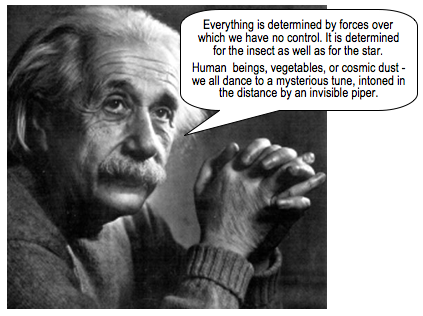
Einstein handled the many paradoxes or contradictions of his relativity theory by carefully designed sentences intended to pull the carpet under his critics by mixing illusion with reality, insanity with rationality, imagination with observation/experienec, and humbleness with megalomania, exemplified in the following Einstein quotes:      
  • Time is an illusion. 
  • If you can't explain it to a six year old, you don't understand it yourself.
  • You do not really understand something unless you can explain it to your grandmother. 
  • Reality is merely an illusion, albeit a very persistent one. 
  • The only reason for time is so that everything doesn’t happen at once. 
  • I never made one of my discoveries through the process of rational thinking.
  • Look deep into nature, and then you will understand everything better. 
  • Time and space are modes by which we think and not conditions in which we live. 
  • Imagination is the highest form of research. 
  • Am I, or the others crazy? 
  • The only real valuable thing is intuition. 
  • If at first the idea is not absurd, then there is no hope for it. 
  • For an idea that does not first seem insane, there is no hope. 
  • When I examine myself and my methods of thought, I come to the conclusion that the gift of fantasy has meant more to me than any talent for abstract, positive thinking. 
  • I believe in intuitions and inspirations...I sometimes FEEL that I am right. I do not KNOW that I am. 
  • A man should look for what is, and not for what he thinks should be. 
  • A true genius admits that he/she knows nothing.
  • The only source of knowledge is experience. 
  • The true sign of intelligence is not knowledge but imagination.
  • Truth is what stands the test of experience.  
  • If I could do it all again, I'd be a plumber. 
  • Imagination is more important than Knowledge. 
  • I asked myself childish questions and proceeded to answer them. 
  • I don't pretend to understand the universe — it's much bigger than I am. 
  • I know quite certainly that I myself have no special talent; curiosity, obsession and dogged endurance, combined with self-criticism, have brought me to my ideas. 
  • I am not a genius, I am just curious. I ask many questions. and when the answer is simple, then God is answering. 
  • Imagination is more important than knowledge. Knowledge is limited. Imagination encircles the world.
  • The man with the greatest soul will always face the greatest war with the low minded person. 
  • I am neither especially clever nor especially gifted. I am only very, very curious. 
  • I didn't arrive at my understanding of the fundamental laws of the universe through my rational mind. 
  • Something deeply hidden had to be behind things. 
  • Why is it that no one understands me and everybody likes me
  • The gift of fantasy has meant more to me than my talent for absorbing positive knowledge. 
  • To invent something, all you need is imagination and a big pile of junk. 
  • In the matter of physics, the first lessons should contain nothing but what is experimental and interesting to see. A pretty experiment is in itself often more valuable than twenty formulae extracted from our minds.
  • The most beautiful thing we can experience is the mysterious. It is the source of all true art and all science. 
  • Beyond the realms of what we see, into the regions or the unexplored limited only by our imaginations. 
  • Nonsense, seems to sum up everything. 
  • In my view, it is the most important function of art and science to awaken this religious feeling and keep it alive in those who are receptive to it. 
  • Equations are more important to me, because politics is for the present, but an equation is something for eternity. 
  • In scientific thinking are always present elements of poetry. Science and music requires a thought homogeneous.
  • Logic will get you from A to B, but imagination will take you anywhere. 
  • If you can't explain something simply, you don't understand it. 

måndag 25 mars 2013

Einsteinian Contradictions 3

Einstein delivering his Nobel Lecture in Gothenburg in 1923, on his theory of relativity, which was not awarded any Nobel Prize. In the front row King Gustav V listening with surprise.

Einstein's theory of relativity is viewed as the basis of modern physics together with quantum mechanics. While the scientists behind quantum mechanics have been richly awarded Nobel Prizes,  Einstein's theory of relativity has not been acknowledged by a single one.

In 1922 the Nobel Prize in Physics was awarded to Bohr and at the same time with a one-year delay the 1921 Prize was given to Einstein. The pressure to give Einstein the Prize had mounted in the aftermath of the First World War with Einstein rising as a symbol for German-British reconciliation, but relativity theory skeptics had been dominating the Nobel Committee, until in 1922 two of them (Hasselberg and Granquist) passed away and were replaced the strong proponents of modern physics Oseen and Siegbahn. The 1922 Prize came out from a battle between to following key actors:
  • Gullstrand (against Einstein),
  • Arrhenius (against Einstein),
  • Oseen (for Einstein), new member of the Committee 1922. 
Gullstrand had consistently blocked giving the Prize to Einstein despite many nominations during 1910-21, including one by Bohr in 1920, based on his harsh criticism of Einstein’s relativity theory:
  • Time and space can be described variously, but even if absolute time can- not be measured, thereof one cannot deduce that that time in its essence is relative, or even that it is advantageous to describe time a relative.
  • (Einstein’s thought experiments concern)...relativity that lies entirely outside the realm of experience and can therefore only be embraced by belief. 
  • Relativity theory has the character of an article of faith rather than a scien- tific hypothesis, and in accordance with the doctrine’s own needs Nature is rearranged so that any falsification is unthinkable.
Gullstrand thus had demolished Einstein’s relativity theory and Einstein’s 1905 work on the photoelectric effect was by Arrhenius put into perspective as follows:
  • It cannot be denied that Einstein’s idea (the law of the photoelectric effect) was a stroke of genius. However, it was natural and lay close to hand after the results of Leonard’s, J-J- Thompson’s and Planck’s great contributions. When it was formulated it was only a tentatively poorly developed hunch, based on qualitative and partially correct observations. It would look peculiar if a prize was awarded to this particular work. 
The negative attitude to Einstein changed with the report by the new member of the Committee Oseen entitled Einstein’s law of the photoelectric effect plus a second report that also landed Bohr a prize:
  • Convincing the other three members that Einstein’s “law” was a fundamental law of Nature, and that Bohr’s atomic theory directly rested on it, he managed to pilot the two cases through unproven waters into a new and safe harbor where fundamental laws and constants still counted as benchmarks.
  • It was formally decided that an official clarification should be inserted into Einstein’s diploma saying that the prize had nothing to do with his special and general theories of relativity.
In his report to the committee, Oseen argues as follows:
  • The one who pulled the theory of heat radiation out of that isolation (black- body radiation), the first one to show that the magnitude of (Planck’s constant) h has a radical significance for the whole of atomic physics, is Einstein. 
  • This, the very first of his contributions to quantum theory is the one that reaches deepest, his proposition that the emission and absorption of light occurs in such a way that light quanta with energy hν are emitted and ab- sorbed. The law of the photoelectric effect was an immediate application of this proposition...an analysis which in its originality and penetrating mind has few equals in theoretical physics. 
  • The validity of Einstein’s original proposition regarding the quantum character of absorption and emission of light (at its microphysical interface with matter) quantitatively expressed in his law of the photoelectric effect was one of the prerequisite conditions on which Bohr built his atomic theory. Almost all confirmations of Bohr’s theory and with it all spectroscopic confirmations are at the same time confirmation’s of Einstein’s law. 
  • The Einsteinian proposition and Bohr’s content-wise identical frequency conditions are currently one of the most certain laws that obtain in physics. 
The Einstein Prize motivation found the thin edge between plus and minus infinity:
  • For his services to theoretical physics, in particular for his discovery of the law of the photoelectric effect (P + W = hν). 
  • ...without taking into account the value which will be accorded your relativity and gravitation after these are confirmed in the future (in a cover letter). 
In short: Einstein’s derivation of the law of the photoelectric effect and his relativity theory were rejected and what remained was only a “discovery” of a physical law (which in fact had been “discovered” before by Hertz), which was then boosted as the foundation of modern physics.

Swedish physicists kept a skeptical attitude to Einstein’s relativity well into the second half of the 20th century as expressed by Hannes Alfven (1908-1995), Nobel Prize in Physics 1970:
  • Many people probably felt relieved when told that the true nature of the world could not be understood except by Einstein and a few other geniuses who were able to think in four dimensions. They had tried to understand science, but now it was evident that science was something to believe in, not something which should be understood. 

fredag 22 mars 2013

Einsteinian Contradictions 2


Einstein expressed his relation to mathematics as follows:
  • Do not worry too much about your difficulties in mathematics, I can assure you that mine are still greater.
  • So far as the theories of mathematics are about reality, they are not certain; so far as they are certain, they are not about reality.
  • Since the mathematicians have invaded the theory of relativity, I do not understand it myself any more.
Despite his difficulties with mathematics, Einstein's tool as physicist was mathematics, with his general theory of relativity based on the difficult mathematics of differential geometry with its tensors, metrics, invariants, mappings and coordinates.

Einstein's math teacher the great mathematician Minkowski called him a "lazy dog", and Einstein had to rely on the help of his friend Grossmann, mathematician but not physicist.

The mystery, or greatness, or contradiction, of Einstein's work is captured in the second quote with its comparison between mathematics and physics. Einstein here refers to the fact that he is 100% sure that his special and general theories of relativity "are certain" since they "are not about reality", only about a postulated Einsteinan view of reality, which cannot be false by definition.

The basic example is the Lorentz transformation as the basis of the special theory of relativity, postulating how to measure space and time depending on observer velocity. As acknowledged by Einstein's friend Max Born, special relativity has no physical model and thus is not about reality:
  • Length contraction and and time dilation (of special relativity) are ways of regarding things and do not correspond to reality.
Einstein made a free mix of physics about reality with mathematics not about reality, which gave him world fame time based on contradictions, as developed in more detail in Dr Faustus of Physics.
But did Einstein ever understand general relativity?

PS An example of the confusion created by Einstein with definitions being mixed up with statements about physics, is given in a recent post by Lubos, who after a lengthy response to a comment by me refuses further discussion. 

onsdag 20 mars 2013

The Alarmist-Skeptic-Denier Hierarchy


In the scientific discussion on global warming by a CO2 "greenhouse gas effect", we find the following main positions:
  • Alarmist: Doubled CO2 will cause warming of an alarming 3 C.
  • Skeptic: The effect of doubled CO2 is much smaller than 3 C, probably so small that it cannot be observed.
  • Denier: There is no real evidence indicating that doubled CO2 can caused any observable warming. 
The discussion is carried by strong feelings in a hierarchy with alarmists being so upset with skeptics that they refuse to discuss with skeptics, and skeptics being so upset with deniers that they refuse to speak with deniers, and deniers being upset because nobody at all is willing to listen to their message.

But the real dividing line is between alarmists and skeptics/deniers with the difference between skeptic and denier more semantic than real: 

In science, an effect which cannot be observed may be considered to be non-existing, that is the effect is denied existence until detection. It is also possible to argue that the effect in principle is there, but is too small to be detected by instruments available today, that is the effect is allowed existence before actual detection. The net result in both cases is an effect beyond present experimental detection, and it is a question of vocabulary whether or not such an effect can be attributed existence. 

Maybe this could help to make skeptics less upset with deniers and direct their frustration instead to alarmists.  

tisdag 19 mars 2013

Scientific Principles of Climate Science?


The scientific method is the basis of modern society with the basic requirement that a scientific theory as an expression of the scientific method, must allow making observable predictions.

The theory stating that the Earth rests on the backs of four invisible turtles the presence of which cannot be observed, is not a scientific theory. Controling an airplane by throwing dice is not a scientific approach and will not work, because the outcome a dice throw is not predictable.

The requirement of prediction connects to the mathematical concept of wellposedness formulated by the French mathematician Jean Leray in the 1930s: A mathematical model with certain output from certain input data, is said to be wellposed if small changes in input data result in small changes in output. The model is said to be illposed  if small changes in input can result in large changes in output.

The rationale is that output from an illposed model in general carries no relevant information, since small changes in input, which cannot be controlled,  can give widely different outputs making prediction impossible.  An illposed mathematical model therefore does not represent a scientific theory.

In principle, climate science can be viewed as a mathematical model of the thermodynamics of the Earth-atmosphere system, in the form of the Navier-Stokes equations. It was this model that led Leray to his study of wellposedness, motivated by the fact that the Navier-Stokes equations in general have turbulent solutions with pointwise values being very sensitive to small perturbations, thus being pointwise illposed. But meanvalues show to be insensitive and thus the Navier-Stokes equations show to be wellposed in an appropriate meanvalue sense, as developed in Computational Turbulent Incompressible Flow.

Climate science based on the NS equations may thus be capable of making predictions, although the computational technology required to model the whole Earth-atmosphere, lies far into the future.

Climate science is obsessed by a task of finding evidence of catastrophic anthropogenic global warming CAGW from CO2 emissions, which means finding a large effect of global warming of 3 C from the small change of an increase of the concentration of atmospheric CO2 from the present 390 ppm to 600 ppm. CAGW is thus based on an illposed model and as such cannot be viewed to have scientific support.  To be able to predict the effect of a change of 0.02% CO2, a very high precision climate model must be used, and such a model is not foreseeable.  


Brev till KVA: Grunden för Svensk Klimatpolitik?

Jag har idag skickat följande brev till KVA:

Kungliga Vetenskapsakademien
Sekr Staffan Normark

Lennart Bengtsson, som är huvudansvarig (Ref 1) för KVAs Uttalande: Den Vetenskapliga Grunden för Klimatförändringar 22 sept 2009, har nyligen i media (Ref 2) uttryckt en ändrad hållning från stöd till skepticism vad gäller den CO2 alarmism som IPCC framför.

Svensk klimatpolitik vilar ytterst på KVAs uttalande i linje med IPCC, och skulle se annorlunda ut om KVA i likhet med Lennart Bengtsson ändrade sitt uttalande från stöd till IPCC till skepticism.

Min fråga till KVA är nu: Avser KVA att revidera sitt uttalande i linje med Lennart Bengtssons ändrade hållning, eller kommer uttalandet att kvarstå, som grunden för svensk klimatpolitik.

Hälsningar,

Claes Johnson
prof em i tillämpad matematik KTH
 
Ref 1 http://www.theclimatescam.se/2013/03/18/vad-ar-det-som-pagar/#comment-327981
Ref 2 http://klimazwiebel.blogspot.se/2013/03/lennart-bengtsson-global-climate-change.html

Svar meddelas när det inkommer.

The Fabrication of CO2 Alarmism Decoded 4


The scientific evidence behind CO2 alarmism consists of OLR spectra produced by a combination of modeling and measurement (Modtran/Hitran/IRIS) predicting a radiative forcing of 3.7 W/m2 by doubling the concentration of atmospheric CO2 from a preindustrial level of 300 ppm to 600 ppm (with 390 ppm the present level) with an estimated warming effect of 1 C. 

The OLR spectra are computed by radiative transfer models based on models of spectral emissivity of atmospheric CO2 determined by line spectra combined with line broadening models, which determine a  warming effect of 3.7 W/m2 from doubled CO2 resulting from an increase of the effective altitude of emission on the "shoulders" of the line spectrum of CO2 around the main resonance at wave number 667 forming a ditch in the spectrum between 550 and 800 with a total area representing a warming of about 20 W/m2, about one tenth of a total of about 200 W/m2 as shown in a previous post.

This effect can be studied more closely by the online Gas-Cell Simulator by Spectral Calc, which gives the following absorptivity for an atmosphere at 0.5 bar with 300 and 600 ppm of CO2 at a path length of 2000 m: 


The Gas-Cell Simulator shows an absorptivity increasing with p x L, where p is the partial pressure of CO2 and L the path length, with a switch to absorptivity greater than 0.5 (defining an effective emission altitude) occurring between 300 and 600 ppm CO2 at a path length of 2000 m (with full saturation between wave numbers 640 and 700).

The effective altitude of OLR emission for wave numbers 580 - 620 on the left shoulder may thus be estimated to increase by 2000 m upon doubling of CO2 until the tropopause is reached, which could mean a temperature drop of 13 C. With a shoulder width of 80 out of a total width of 250 the CO2 ditch between 550 and 800 and 13 C about one fifth of the total temperature drop in the ditch of about 65 C, this gives a warming effect of about 0.3 x 0.2 x 20 = 1.2 W/m2 for one shoulder.

We thus arrive at a warming effect of about 2 - 3 W/m2  from an increase of CO2 from 300 to 600 ppm, which gives an insight into the background of the crucial 3.7 W/m2 as the starting point of climate alarmism. 

We see that the effect comes from a simple model of line broadening of the weak spectral real lines on the shoulders of the CO2 spectrum around the main resonance at 667. The model is simplistic and the effect is so small that it cannot be measured, and so from scientific point of view it can only be viewed as a speculation which could as well be half or twice as big, thus without much substance. 

Yet this is the main scientific evidence put forward in support of CO2 alarmism. Note that the fact that the number 3.7 W/m2 cannot be trusted as scientific evidence, does not itself give reason to restrictions on CO2 emissions putting more burdens on humanity. Lack of evidence is not a reason to put someone in jail. What would be needed is positive scientific evidence that CO2 can cause global warming with observable negative effects, but that is missing.

PS  When climate skeptics state that for sure they understand very well that there is a CO2 greenhouse effect, as any knowledgable scientist must do,  they refer to the radiative forcing of 3.7 W/m2 with 1 C warming from doubled concentration, but then forget that this effect has very weak scientific support. They seem to get caught in an argument stating that even if the effect is too small to ever be detected, the effect is undeniably real as an expression of the line spectrum of CO2.

But this means violating the essential principle of science to not give a negligible effect a major role, which is required in order to be able to make meaningful predictions as the goal of science.         

måndag 18 mars 2013

Einsteinian Contradictions 1


To get perspective on the state of physics today it is instructive to recall the beginning of modern physics marked by the special theory of relativity presented by the young Einstein in 1905 as a revolution away from the absolute space and time of Newtonian mechanics shared by all observers, into relativistic mechanics with each observer carrying his own space-time under an assumption of a common constant speed of light.

Many-Minds Relativity argues that special relativity is a formal mathematical theory without physical interpretation defined by the Lorentz transformation connecting measurements of space and time by different observers in motion, as opposed to the Galilean transformation of Newtonian mechanics.

The argument is that the Lorentz transformation has no physical realization, as pointed out by Lorentz and Born among others, while the Galilean transformation describes real physics. The fact that special relativity is a non-physical theory comes out as contradictions such as the twin paradox and the ladder paradox.

In Newtonian mechanics based on Galilean transformation different observers share a common perception of space and time (absolute space and time), but have different perceptions depending on motion (e.g. Doppler effect). Newtonian mechanics is thus relativistic as a many-minds theory on a shared basis of absolute space and time, with the possibility of using different coordinate systems connected by Galilean transformation.
  • Newtonian mechanics is like a democratic society with citizens sharing common values while being allowed to have different opinions.
In Einsteinian mechanics based on Lorentz transformation different observers are demanded to measure the same speed of light and have perceptions of space and time depending on motion postulated by the Lorentz transformation. Einsteinian mechanics is thus absolute in the sense of  requiring all observers to observe according to the Lorentz transformation while measuring the same speed of light.
  • Relativistic Einsteinian mechanics is like a dictatorship with citizens sharing nothing while being required to have opinions dictated by the dictator.  
More Einsteinian contradictions in upcoming posts and in Dr Faustus of Modern Physics.

lördag 16 mars 2013

The Fabrication of CO2 Alarmism Decoded 3


We are now ready to take the final step in the evaluation of the main scientific evidence underlying  CO2 alarmism, which consists of outgoing long wave radiation OLR spectra produced by a combination of mathematical software (Modtran)  and measurement of the line spectrum of atmospheric CO2 (IRIS interferometer).

The warming effect or "radiative forcing" of CO2 is seen as the area of the ditch in the OLR spectrum in the wave number band 550 - 800 containing the line spectrum of CO2 around the main resonance 667, which by Modtran is predicted to increase by 3.7 W/m2 upon doubling of the concentration of CO2 to 600 ppm from preindustrial level of 300 ppm, which is commonly translated to a global warming of 1 C.  Starting from the present level of 395 ppm Modtran predicts a global warming of 0.5 C from radiative forcing of 2 W/m2.

Global warming of 0.5 C is too small to be observed and thus cannot give rise to alarm. In any case CO2 alarmism starts from 1 C warming from doubled CO2, which is then inflated to 3 C by postulated feedback effects for which scientific evidence is missing.

The scientific evidence of the warming effect of CO2 thus boils down to the Modtran prediction of 3.7 W/m2 upon doubling to 600 ppm as the increase of the ditch area. Inspection of the OLR spectrum produced by Modtran shows that bottom of the ditch is connected to temperature 220 K which is the minimum temperature of the troposphere with top at 10 km and the constant temperature in the tropopause between 10 and 20 km. The increase in ditch area is thus seen to come from the shoulders of the spectrum around wave number 600 and 800 containing weak spectral lines of CO2.

This effect can be studied by the Gas-Cell Simulator by Spectral Calc with a free version online, which is similar to Modtran. Spectral Calc shows to produce atmospheric CO2 spectra with a simple dependence on the parameter p x L, where p is the partial pressure of CO2 (bar) and L is the path length (m).  The switch from transparency to opaqueness shows to occur for p x L ~ 1, which indicates that the effective emission altitude on the shoulders could increase by 1000 m upon doubling of CO2. With a lapse rate of 6 C/km and a width of the shoulders of 100, this can be estimated to a radiative forcing of the same size as the 3.7 W/m2 by Modtran.

We have now decoded the radiative forcing of 3.7 W/m2 from doubled CO2 predicted by Modtran as the result of a very simple model of line broadening of the weak spectral lines of CO2 on the shoulders of the line spectrum around the main resonance 667. The effect could as well be 2 W/m2, or 1 W/m2, in which case CO2 alarmism would have nothing to start from.

Increasing CO2 beyond 600 ppm lifts the effective emission altitude of the main resonance of CO2 at 667 into the warmer stratosphere with a cooling effect, which may dominate the warming effect from the shoulders. The same evidence in the form of Modtran predicting 1 C warming by an increase from 300 ppm to 600 ppm, thus may give cooling under further increase.  

It is mind-boggling to realize that the scientific basis of CO2 alarmism asking for a complete transformation of human civilization into a carbon-free society, consists of simple ad hoc model of broadening of a CO2 line spectrum predicting global warming of 1 C from radiative forcing of 3.7 W/m2 by doubled CO2, which could as well be instead 0.5 C, too small to be observed.

The mantra of 3.7 W/m2 will certainly be repeated in the upcoming IPCC 5th report as the foundation of the house of cards of CO2 alarmism.  The time of reckoning is here as soon as leading climate skeptics (finally) realize and articulate the weakness of the 3.7 W/m2 card.

PS1 World Leading Swedish Meteorologist Lennart Bengtsson is now switching from warmist to skeptic and will have to retract his support to IPCC expressed in a statement by the Royal Swedish Academy of Sciences, which will change Swedish climate politics.

PS2 The falling house of cards is now creating head lines in the press.