Visar inlägg med etikett Glenn Research Center. Visa alla inlägg

onsdag 26 september 2012

Incorrect Fundamentals of Aviation


The book Fundamentals of Aviation and Space Technology, published by University of Illinois/Urbana in 1962, is presented as follows:
  • The reception accorded the first edition of this book under its present title was very gratifying. It appealed especially to teachers and students, as well as to the  air transportation industry for orientation courses. 
  • The continued success of the book has again exhausted the supply, and a new printing is necessary only two years after the previous revision.
As an apparently very successful example of a university level educational text, let us check how the Theory of Flight is presented in Chapter 3. It starts out
  • Whenever, in casual conversation, a group of people start to discuss airplanes, someone is almost certain to exclaim, "Why, some of those airplanes weigh tons. I don't see how they stay in the air." Very few people understand the forces that control an airplane in flight. 
  • For many years engineers have studied the motion of air over airplane parts in order to learn how a change in the shape of the part affects the force created on it by the moving air. Although a large amount of information is presently available on this subject, the desire to make airplanes go higher, faster, farther, and carry greater loads requires continuous research.
Then follows the "equal transit time" theory = Incorrect theory #1 identified by NASA:
  • If we move the wing through the air at a relatively high speed with the rounded or leading edge forward, the following things happen: The blunt and thick leading edge pushes the air out of the way. Part of this displaced air flows rapidly (the speed is important) over the wing and part of it flows under the wing. The layers of air, after going over and under the wing, join again behind the trailing edge. 
  • The important thing to remember is that due to the curved upper surface the air that flowed over the wing had to go farther than the air that went under the wing. 
  • Consequently, air that flowed over the wing had to travel faster than the air that went under the more or less flat bottom surface. 
  • The air which had to travel farther across the top of the wing is stretched out and becomes thinner, creating a reduced pressure on the upper surface. 
  • The air traveling along the bottom of the airfoil is slightly compressed, and consequently develops increased pressure. 
  • The difference in pressure between the air on the upper and lower surfaces of the wing, when exerted on the entire wing area, produces lift. 
But this was 50 years ago, you may say: It cannot be true that books of today continue to teach theories of flight which are known to be incorrect.

But then you are wrong! There is no current text-book which teaches a correct theory of flight. It is now time  to rewrite text-books to teach the New Theory of Flight.

PS Checking pageview statistics of this blog I see that the interest in understanding what keeps airplanes in the air appears to be close to nil. Can it be that 100 years of incorrect theories has ruined the subject? If so, it is now high time for revival of the keen interest 100 years ago from the pioneers of aviation.

Letter to NASA Glenn Research Center

Thomas Benson
Glenn Research Center

Hi again Tom:

I hope you are willing to continue the interview from 2009. Since then we have completed our New Theory of Flight which is presented on the web site The Secret of Flight.

The New Theory is now under review by AIAA with communication recorded here.

In your Beginners Guide to Aeronautics you still write:
  • The real details of how an object generates lift are very complex and do not lend themselves to simplification. 
  • To truly understand the details of the generation of lift, one has to have a good working knowledge of the Euler Equations.
My questions:

1. Do you have the required "working knowledge of the Euler Equations" and do you "truly understand the details of the generation of lift"?

2. If not, can you direct me to a person at NASA or outside with this knowledge?

3. Since 2009 you have added circulation theory, with starting vortex et cet, to the Beginners Guide.
Is this supposed to be the knowledge asked for in 1?

I hope you will answer my questions, and also take up the New Theory of Flight to discussion/evaluation at NASA.

We have massive evidence from mathematics, computation and experiment supporting the New Theory and we are confident that we have something new of genuine interest to NASA.

Best regards,

Claes

tisdag 25 september 2012

NASA: What Keeps Planes in the Air?

                                             Dad, what keeps the airplane in the air?

To check if someone understands a physical phenomenon it is often instructive to study how it is presented to young innocent minds. As an example, let us see how NASA Glenn Research Center in its Beginners Guide to Aeronautics, explains how an airplane is kept in the air by an upward lift force generated by the wings balancing gravitation:
  • How is lift generated? 
  • There are many explanations for the generation of lift found in encyclopedias, in basic physics textbooks, and on Web sites. 
  • Unfortunately, many of the explanations are misleading and incorrect. 
  • Theories on the generation of lift have become a source of great controversy and a topic for heated arguments for many years.
  • The proponents of the arguments usually fall into two camps: (1) those who support the "Bernoulli" position that lift is generated by a pressure difference across the wing, and (2) those who support the "Newton" position that lift is the reaction force on a body caused by deflecting a flow of gas.
  • Which camp is correct? How is lift generated?
After this challenging start NASA disappoints the curious young mind by:
  • The real details of how an object generates lift are very complex and do not lend themselves to simplification.  
  • To truly understand the details of the generation of lift, one has to have a good working knowledge of the Euler Equations.
NASA thus has no explanation of lift to offer, only a mathematical Euler Equation mystification, and so in a desperate move to maintain scientific authority and credibility resorts to presenting, instead of any correct theory, three incorrect theories: "equal transit time", "Venturi" and "skipping stone".

But if NASA would learn about the New Theory of Flight then NASA would be able to fill its mission to reach young minds with essential science, instead of as now delivering only mystical or incorrect science.

I have tried before to get the attention of NASA (see Interview with Glenn Research Center from  2009) and will now make a new try and report...

PS In a last attempt to save face NASA throws in circulation theory:
  • From a Newtonian perspective, lift is generated by turning a flow of air. 
  • The flow turning that occurs in the creation of lift also creates bound vorticity within the airfoil.
  • The existence of the bound vortex (or vortices) within the airfoil created an important theoretical problem when it was first proposed.
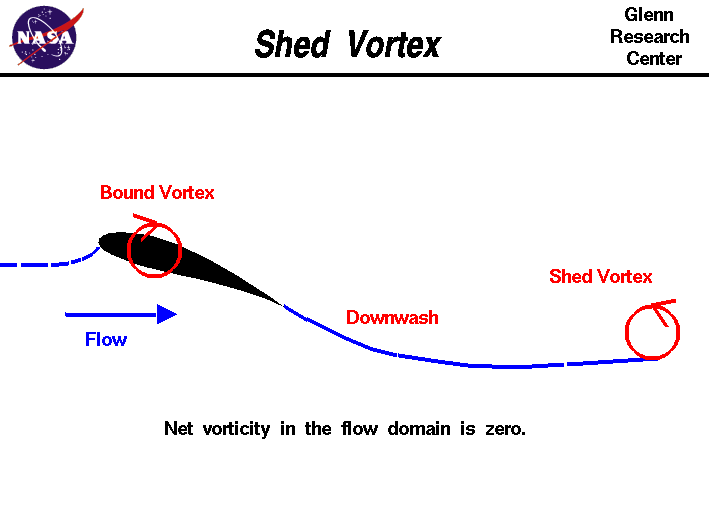
  • With a bound vortex within the object, there would then have to be another vortex of opposite strength present within the flow domain.
  • It took some very careful experimental work by Ludwig Prandtl to actually "catch" the other vortex on film (the so-called starting vortex)
Computer drawing of an airfoil showing the bound vortex
 and the shed vortex.
The New Theory of Flight shows that this 2d picture does not describe actual real 3d physics, only fictional physics which only Prandtl could "catch" in his mind, as a mystery to generations of aerodynamicists flocking at NASA.


fredag 24 juli 2009

Interview with Glenn Research Center


Interview with Glenn Research Center.


CJ: On your aeronautics educational site Beginners Guide to Aerodynamics you present three incorrect theories for lift of a wing, but no theory claimed to be correct. Is the correct theory classified, or is GRC not aware of any correct theory? 

GRCHi Claes: The correct theory of lift is fairly complex.  We mention on the page about Newton and Bernoulli that the real of theory of lift is included in the work of Bernoulli's student, Euler: http://www.grc.nasa.gov/WWW/K-12/airplane/bernnew.html

The generation of lift occurs because of the pressure variation around the airfoil. When you integrate the pressure times the area times the local normal base vector around the entire surface, you obtain a single aerodynamic force. The component of that force perpendicular to the flight direction is the lift.
http://www.grc.nasa.gov/WWW/K-12/airplane/presar.html

Now why does the pressure vary? Because the velocity around the airfoil varies and pressure and velocity are related along a streamline by Bernoulli's equation.
http://www.grc.nasa.gov/WWW/K-12/airplane/bern.html

Why does the velocity vary? Because the flow can't go through the surface of the airfoil. In an ideal flow situation, the flow is tangent to the surface of the airfoil. In reality, the flow at the surface sticks to the surface and the velocity is zero, but the external flow reacts to the edge of the boundary layer from the surface to free stream. The free stream flow must simultaneously conserve mass, momentum and energy (that's where the Euler equations come in)
http://www.grc.nasa.gov/WWW/K-12/airplane/eulereqs.html

Solutions of the Euler equations introduce the theory of bound vorticity within a lifting airfoil

http://www.grc.nasa.gov/WWW/K-12/airplane/cyl.html
http://www.grc.nasa.gov/WWW/K-12/airplane/map.html
http://www.grc.nasa.gov/WWW/K-12/airplane/shed.html

Extensions of the bound vorticity theory to three dimensions leads to the Prandtl lifting line theory and the vortex lattice method.

None of this is classified; it is just complex. Undergraduate aero engineering students learn all of this and how to derive the necessary equations that describe flow around an airfoil.

Tom Benson, Editor.


CJ: Thanks for the information. Saying that the correct theory is complex, is another way of saying that GRC/you does/do not know how a wing generates lift, only that it does, right?

GRC/TB: No ... saying that the answer is complex means just that ... it is complex, it isn't simple. But we know what it is.

Many people look for simple answers to questions, when the answer may not be simple. When the answer is really complex, people make simplifying assumptions so that they can get a simple answer. Unfortunately, with fluid mechanics, when you make simplifying assumptions you can get the wrong answer.  That's what has happened with the incorrect theories and their inability to produce meaningful results.
Fluid mechanics comes down to satisfying the conservation laws for mass, momentum and energy. That's what the Euler equations (and the more complete Navier-Stokes equations) express. There are some limited solutions to the Euler equations and the bound vortex / Prandtl lifting line theory are some of them. These solutions correctly predict observed flow phenomenon.

CJ: I hear you say that you know, but I don't think you do. If you want to know, take a look at Why It Is Possible to Fly showing in particular that Kutta-Zhukovsky's circulation theory for lift, which you refer to, is un-physical: An airplane does not take off by shedding transversal vorticity as indicated in GRCs picture. This is a common misconception which GRC unfortunately contributes to transmit to the young generation. Often a 2d bathtub foam surface experiment is used to support the circulation theory, but this is misleading since an airplane wing acts in 3d. In fact, 2d flight is impossible. There are no pictures of shed transversal vorticity from airplane wings, because they don't exist. 3d streamwise vorticity: Yes! 2d transversal vorticity: No! Right?