Visar inlägg med etikett physics. Visa alla inlägg

lördag 28 maj 2016

Aristotle's Logical Fallacy of Affirming the Consequent in Physics


One can find many examples in physics, both classical and modern, of Aristotle's logical fallacy of Affirming the Consequent (confirming an assumption by observing a consequence of the assumption):
  1. Assume the Earth rests on 4 turtles, which keeps the Earth from "falling down". Observe that the Earth does not "fall down". Conclude that the Earth rests on 4 turtles.
  2. Observe a photoelectric effect in accordance with a simple (in Einstein's terminology "heuristic") argument assuming light can be thought of as a stream of particles named "photons" . Conclude that light is a stream of particles named photons. 
  3. Assume light is affected by gravitation according the general theory of relativity as described by Einstein's equations. Observe apparent slight bending of light as it passes near the Sun in accordance with an extremely simplified use of Einstein's equations. Conclude universal validity of Einstein's equations.
  4. Observe lift of a wing profile in accordance with a prediction from potential flow modified by large scale circulation around the wing. Conclude that there is large scale circulation around the wing. 
  5. Assume that predictions from solving Schrödinger's equation always are in perfect agreement with observation. Observe good agreement in some special cases for which the Schrödinger equation happens to be solvable, like in the case of Hydrogen with one electron. Conclude universal validity of Schrödinger's equation, in particular for atoms with many electrons for which solutions cannot be computed with assessment of accuracy.
  6. Assume there was a Big Bang and observe a distribution of galaxy positions/velocities, which is very very roughly in accordance with the assumption of a Big Bang. Conclude that there was a Big Bang.
  7. Assume that doubled CO2 in the atmosphere from burning of fossil fuel will cause catastrophic global warming of 2.5 - 6 C. Observe global warming of 1 C since 1870. Conclude that doubled CO2 in the atmosphere from burning of fossil fuel will cause catastrophic global warming of 4 - 8 C.
  8. Assume that two massive black holes merged about 1.3 billion years ago and thereby sent a shudder through the universe as ripples in the fabric of space and time called gravitational waves and five months ago washed past Earth and stretched space making the entire Earth expand and contract by 1/100,000 of a nanometer, about the width of an atomic nucleus. Observe a wiggle of an atom in an instrument and conclude that two massive black holes merged about 1.3 billion years ago which sent a shudder through the universe as ripples in the fabric of space and time called gravitational waves...
  9. Observe experimental agreement of the anomalous magnetic dipole moment of the electron within 10 decimals to a prediction by Quantum Electro Dynamics (QED). Conclude that QED is universally valid for any number of electrons as the most accurate theory of physics. Note that the extremely high accuracy for the specific case of the anomalous magnetic dipole moment of the electron, compensates for the impossibility of testing in more general cases,  because the equations of QED are even more impossible to solve with assessment of accuracy than Schrödinger's equation.
The logic fallacy is so widely practiced that for many it may be difficult to see the arguments as fallacies. Test yourself!

PS1. Observe that if a theoretical prediction agrees with observation to a very high precision, as is the case concerning the Equivalence Principle stating equality of inertial and gravitational (heavy) mass, then it is possible that what you are testing experimentally in fact is the validity of a definition, like testing experimentally if there are 100 centimeters on a meter (which would be absurd).

PS2 Books on quantum mechanics usually claim the there is no experiment showing any discrepancy whatsoever with solutions of the Schrödinger equation (in the proper setting), which is strong evidence that the Schrödinger equation gives an exact  description of all of atom physics (in a proper setting). The credibility of this argument is weakened by the fact that solutions can be computed only in very simple cases. 

torsdag 17 april 2014

Extremism of Modern Physics as Bluff Poker Physics


Modern physics has been driven into an increasingly extremist position with focus on extremely small or large spatial or temporal scales or extremely large energies. When problems were met on a certain (extreme) scale, the study was directed to yet more extreme scales and energies, as in a steadily increasing bet in a game of poker with little on hand to never get called. When LHC does not deliver, then the bet is raised to a new bigger more powerful LHC...

When Einstein was pressed about the meaning of his special theory of relativity, he increased the bet to general relativity and when pressed about the meaning of general relativity he jumped the bet to cosmology...

When physicists after the introduction of quantum mechanics faced questions about the electronic structure of atoms and molecules, they turned to the three orders of magnitude smaller proton and neutron forming atomic kernels, and then to the quarks forming the proton and neutron and then ultimately to string theory on scales 15 orders of magnitude smaller than the proton in an ulitmate attempt to find the origin of gravitation acting on cosmological scales. In each case the problems met on one scale were met by resort to smaller or larger scales, steadily increasing the bet and preventing a call.

Today cosmology is directed to multiversa and inflation after Big Bang as the next step after Einstein's cosmology of general relativity supposedly all originating from string theory.  But this may be the last possible bet and a call is approaching anticipated as a crisis in physics.

torsdag 13 februari 2014

Zeno's Arrow Paradox Still Unresolved after 2500 Years

Russell's "resolution" of Zeno's Arrow Paradox says that an arrow with position $f(t)$ changing continuously with time $t$, is moving. This not a true resolution but only an empty tautology.

Zeno's Arrow Paradox has haunted physicists and philosophers of physics since its formulation by Zeno around 450 BC:
  • How can an arrow be moving in space from one point to another,  if at each instant of time the arrow is still and is not moving?
In Stanford Encyclopedia of Philosophy the paradox is described as follows:
  • The third is … that the flying arrow is at rest, which result follows from the assumption that time is composed of moments … . he says that if everything when it occupies an equal space is at rest, and if that which is in locomotion is always in a now, the flying arrow is therefore motionless. (Aristotle Physics, 239b.30)
  • Zeno abolishes motion, saying “What is in motion moves neither in the place it is nor in one in which it is not”. (Diogenes Laertius Lives of Famous Philosophers, ix.72)
  • This argument against motion explicitly turns on a particular kind of assumption of plurality: that time is composed of moments (or ‘nows’) and nothing else. Consider an arrow, apparently in motion, at any instant. First, Zeno assumes that it travels no distance during that moment—‘it occupies an equal space’ for the whole instant. But the entire period of its motion contains only instants, all of which contain an arrow at rest, and so, Zeno concludes, the arrow cannot be moving.
Zeno was so clever in formulating his arrow paradox that it has resisted convincing resolution into our days. The commonly accepted "resolution" is the "at-at" theory put forward by Bertrand Russell, which simply says that the motion of an arrow appearing at different positions at different times can be described by a continuous function $f(t)$ where $f(t)$ is the position at time $t$. With a non-constant continuous function $f(t)$ of the real variable $t$, the arrow is thus changing position with increasing time and thus is moving. Russell writes in The Principles of Mathematics in the chapter on motion
  • Motion consists merely in the occupation of different places at different times, subject to continuity as explained in Part V. There is no transition from place to place, no consecutive moment or consecutive position, no such thing as velocity except in the sense of a real number which is the limit of a certain set of quotients. The rejection of velocity and acceleration as physical facts (i.e. as properties belonging at each instant to a moving point, and not merely real numbers expressing limits of certain ratios) involves, as we shall see, some difficulties in the statement of the laws of motion; but the reform introduced by Weierstrass in the infinitesimal calculus has rendered this rejection imperative. 
The recent survey Can Continuos Motion be an Illusion? by Shan Gao (2013) points to the hollowness of Russell's view:
  • According to the “at-at” theory, it is fallacious to conclude from the fact that the arrow does not travel any distance in an instant that it is at rest. Motion has nothing at all to do with what happens during instants; it has instead to do with what happens between instants. In short, motion is merely being in different locations at different times, and that is that. If an object has the same location at the instants immediately neighboring, then we say it is at rest; otherwise it is in motion. Therefore, since the arrow in flight has different positions at different instants, it is surely moving. 
  • The “at-at” theory is a static theory of motion. In Henri Bergson’s cynical words, “movement is composed of immobilities.” (Bergson 1911, p.308) Continuous motion is simply the occupation, by an object, of a continuous series of places at a continuous series of times. There are no states of motion at an instant, and no instantaneous properties indicate that an object is moving or not. 
We understand that the "at-at" theory is no theory, just a tautological play with words: To say that an arrow is moving because its position is changing with time is simply a truism or tautology and thus is empty of physical content. To disguise the emptiness, a reference is often made to Calculus and the definition of a continuous function through the concept of limit, but the physics is still lacking. Another form of hand-waving is to say the motion of an arrow is explained by the theory of relativity.

The net result is that Zeno's arrow paradox still after 2500 year lacks a real physical resolution. An attempt to such resolution was made in the previous post.

söndag 2 februari 2014

Reality vs Illusion in Physics

                     Relativity accountant busy computing time dilation (between different galaxies).  

There are different approaches to physics:
  1. Insurance Company Physics: statistical mechanics.
  2. Accountant Physics: relativity theory.
  3. Accountant Physics: quantum mechanics in Copenhagen Interpretation.
  4. Realistic Physics: physics as computation, constructive physics.
In 1-3 the emphasis is put on the perception of the physicist as observing and recording real phenomena.

In 2 the physicist in thought experiments is worrying about the absolute simultaneity of events in different galaxies, but does not ask if this is of any interest to anybody. It is like Georg Cantor worrying about his transfinite numbers of counting different levels of infinities believing his theory had been communicated to him by God but suffering from doubts and depression. In his later years Einstein expressed similar sentiments concerning his grand scale relativity theory.

In 4 the emphasis is put on simulating real phenomena left to evolve according to their own logic without any need of human observation, with understanding required to write computer programs.

In 1 the physicist computing mean-values over projected ensembles of atom velocities, is like an insurance mathematician computing mean-values over projected ensembles of peoples life lengths.

In 1-3 the physicist is active and in 4 passive, vs the reality under study.

In 3 only what is observed by the physicist is said to exist and is then affected by the physicist and so involves self-observation.

In 2-3 the emphasis is put on what can be accounted for, like the expenditures of a company covered by receits, which can leave out much of reality. The objective is to set up a correct accounting book according to some form of business law.

In 4 computational simulation and observation can be done without any interference from the physicist.

4 seeks to simulate reality, while 1-3 supports illusion. 

tisdag 14 januari 2014

What Science is Ready for Retirement?

The Edge web site hosts a collection of 173 articles on the theme What Science is Ready for Retirement? including the following highlights in my view:
  • Anton Zeilinger: There is No Reality in the Quantum World
  • Alan Gut: The Universe Began In A State Of Extraodinarily Low Entropy
  • Kai Krause: The Uncertainty Principle
  • Bruce Parker: Entropy
  • Frank Tipler: String Theory
  • David Deutsch: Quantum Jumps
  • Andrew Lih: Calculus
  • Matt Ridley: Malthusianism
  • Lee Smolin: The Big Bang was the First Moment of Time
  • Freean Dyson: The Collapse of the Wave Function
  • Haim Hariri: The Discovery of the Higgs particle Closes a Chapter in Particle Physics
  • Max Tegmark: Infinity
  • Frank Wilczek: Mind versus Matter
What I could add is for example
  • relativity theory
  • multidimensional linear Schrödinger equation
  • statistical mechanics
  • statistical interpretation of quantum mechanics
  • Kutta-Zhukovsky lift theory for flight
  • Prandtl boundary layer theory for drag.
  • Contemporary physics has lost contact with physical reality. Mysticism and fancy has resulted in quite irrational notions being proposed to account for the physical Universe. This conference is a return to rational physics in terms that are comprehensible to any educated person, not just a small group of specialists.
See further Kritische Stimmen zur Relativitätstheori where some of my own critical work is presented. 

onsdag 9 oktober 2013

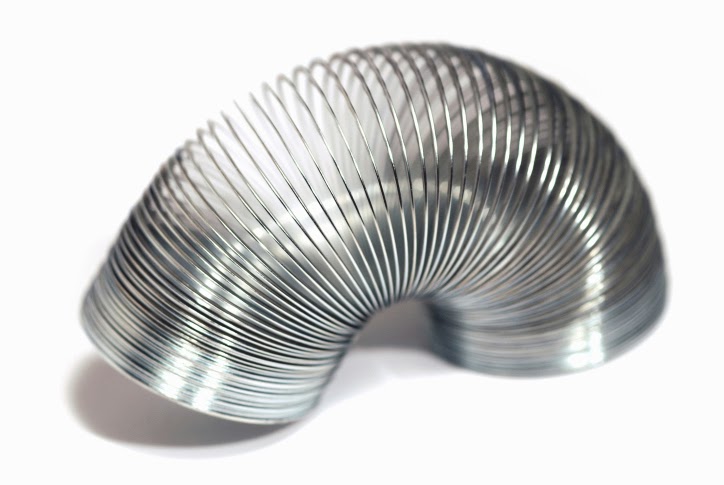
Slinky as Alternative to Higgs Mechanism of Giving Mass to a Body

The popular description of Higgs' mechanism supplying mass to a body awarded the 2013 Noble Prize in Physics, goes as follows:  Imagine a celebrity (e.g. Brad Pitt) moving through a crowd of people drawing attention from inescapable interaction with the crowd, which can be imagined to generate some kind of resistance to the motion of the celebrity connecting to the amount of fame, or mass, of the star:


A more technical description from Wikipedia goes as follows:


The idea is evidently that a body acquires mass from interaction with some form of background field or crowd.Is this credible? Maybe. Maybe not. 

In any case, here is a reprint of a different mechanism that I reflected on some time ago as a possible resolution of Zeno's paradox of the impossibility of motion with a Slinky as mental image:


The basic idea is that the slinky moves so to speak by itself and not by interacting with a background field. The kinetic energy of the slinky = 1/2 x mass x velocity^2 equals the energy invested to compress or extend the slinky before letting it go. Mass can then be defined in terms of velocity and invested energy stored as kinetic energy through the motion. Mass is then something carried by the slinky through motion related to the stored energy, which can be released by letting the slinky run into a wall. Is this credible? Maybe. Maybe not.  Will Slinky get a Nobel Prize? Maybe not. 

The motion of a slinky suggests a resolution of Zeno’s Arrow Paradox as a combination of compression-release and switch of stability, where the the slinky appears as a soliton wave, which itself generates the medium through which it propagates.

Zeno of Elea (490-430 BC), member of the pre-Socratic Eliatic School founded by Parmenides, questioned the concept of change and motion in his famous arrow paradoxHow can it be that an arrow is moving, when at each time instant it is still?

In Resolution of Zeno’s Paradox of Particle Motion I argued that the paradox still after 2.500 years lacks a convincing resolution, and suggested a resolution based on wave motion.

A fundamental question of wave propagation is the nature of the medium through which the wave propagates: Is it material as in the case of sound waves in air, or is it immaterial as in the case of light waves in vacuum? If the flying arrow is a wave, which is the medium through which it propagates? It is not enough to say that it is air, because an arrow can fly also in vacuum.

We are led to the following basic question: can a wave itself act as the medium through which it propagates?

It turns out that a slinky can serve as an answer! To see this take a look at this movie . We see that the motion of a slinky can be described as follows:
  • oscillation between two forms of energy: elastic energy and kinetic energy compression stores elastic energy 
  • elastic energy is transformed into kinetic energy when the slinky expands
  • there is a critical moment with the slinky fully compressed in which the downward forward motion of the top ring is reflected in upward forward (and not upward backward motion which would lead to motion on the spot) 
  • the slinky forms itself the medium through which it as a wave propagates
  • the slinky acts like a soliton wave.
We understand that the slinky offers a model for resolution Zeno’s paradox as a wave which itself generates the medium through which it propagates.

What is Mass?

You can take this model one step further, and view the work required to compress the slinky from an uncompressed rest state, as an investment into kinetic energy of motion, just as a body can be accellerated from rest by the action of a force and gain kinetic energy.

This would mean that the slinky has inertial mass and that it can move with different velocities depending on the amount of work invested in the initial compression. We may compare with the propagation of massless electromagnetic waves with given fixed speed of light. This connects to the question Does the Earth Rotate? suggesting to define mass as inertial mass M in terms of kinetic energy K and velocity V from the formula K = 1/2 x M x V x V.

PS1 The difference between Higgs and Slinky is a bit like the difference between environment and genetics for living body, with Higgs only exterior environment and Slinky only interior genetics.

PS2 There is a connection to Wittengenstein's ladder which the user successively pulls up behind as the  climbing advances.


PS3 The Higgs mechanism is described in the above picture to "slow down" the motion of an electron as an effect of some kind of viscosity. This seems strange since electrons are not "slowed down" by the mere fact that they have mass. Acceleration is "slowed down" by mass but not velocity.

söndag 3 februari 2013

Politicised Nobel Laureate Science


An Open Letter to the American People signed by 68 Nobel Lauerates endorsed reelection of Obama
in 2012 with the following motivation (repeated in a political speech after the Nobel dinner by Chemistry Awardee Lefkowitz, see PS below):
  • President Obama understands the key role science has played in building a prosperous America, has delivered on his promise to renew our faith in science-based decision making and has championed investment in science and technology research that is the engine of our economy. 
  • He has built strong programs to educate young Americans in Science, Technology, Engineering and Mathematics and programs to provide Americans the training they need to keep pace with a technology-driven economy. 
  • His opponent supports a budget that, if implemented, would devastate a long tradition of support for depends, as never before, on innovation. He has also taken positions that privilege ideology over clear scientific evidence on climate change. 
  • As a nation we must continue the investments that revolutionized agriculture, invented the Internet, gave us modern medicine and enabled a strong national defense. 
  • Abandoning this tradition would be ways to science and innovation, we urge you to join us in working to ensure the reelection of President Obama.
We read that Obama is to be preferred before His Opponent because Obama would not (like His Opponent) take positions that: 
  • privilege ideology over clear scientific evidence on climate change. 
But this statement contradicts observation: Everyone knows that in Obama's climate politics ideology privileges over clear scientific evidence, something which is questioned by His Opponent. 

The 68 Laureates thus let ideology, obviously with expectations of continued generous Democratic support to basic physics and chemistry in particular, privilege over clear scientific evidence. It is a collapse of scientific values which tells us something about our post-modern society.

The Open Letter can be seen as a shameless support of the BIG BLUFF of CO2 alarmism. And who can question the combined wisdom of 68 Nobel Lauraetes?

Compare with Science must be seen to bridge the political divide.

PS Nobel Laureate Lefkowitz told the Swedish King (starting at 3 min 50 sec) in his speech:
  • We just had a presidential election in the US. One of the fought-lines in the campaign was the role of science plays in shaping public policy decisions. 
  • A clear anti-science bias was apparent in many who sought the presidential nomination of one of our major political parties. 
  • This was manifest as a refusal to accept, for example, the theory of evolution, the existence of global warming much less the role of humans in this process, the value of vaccines or ... stem cell research. 
  • Each of us Laureates aspires in our own way to do what we can to counter this.... anti-science.     
The King was comforted by the message that all scientists (and they are many) who do not see clear evidence of anthropogenic global warming, represent anti-science and will be blocked from government science grants by Lefkowitz and his Laureate buddies acting through Obama, because this was the same message the King had from the Royal Swedish Academy of Sciences.

torsdag 20 september 2012

Is Scientific Truth Determined by Politicians?


Politicians deciding a scientific truth of CO2 global warming at the 2009 Copenhagen Conference. Notice that our Prime Minister (3) is skeptical but keeps quite.


Science and politics/society is closely intertwined, but is it even so that scientific truth is determined by politicians?

Yes of course you say: Just look at the climate science of CO2 global warming determined by the politicians of IPCC: Continuing burning fossil fuel will raise global temperature by catastrophical 3 C and thus has to be reduced to zero by 2050.

The real scientific evidence for the CO2 alarm is however nil.

But is this an exceptional case? Is truth in more fundamental areas of physics determined by science and scientists and not by politics and politicians?

You may, probably correctly, argue that Newton's 2nd Law is not determined by politicians, but what about quantum mechanics and relativity theory forming the foundations of modern physics?

Well, we know that Planck as an expression of the ambitions of the emerging German Empire in 1900 took on the task of solving the main open problem of classical physics of blackbody radiation, and knowing that a solution had to be delivered "at any price", gave up the most holy of all principles of physics of determinism in his resolution based on statistics. The emerging German Empire had to deliver a solution and it did, however at the price of giving up holy principles of physics. This was practical politics rather than true science.

We also know that Einstein was elevated to be the God of modern physics by Eddington in a grand gesture of reconciliation between England and Germany after the 1st Word War, which was further enforced by an enthusiastic reception in the US with relativity as the ultimate expression of modernity.  France remained skeptical to Einstein' science until the 1950s, joined by USSR, but with Einstein in the team the US could win the Cold War and so finally confirm the truth of relativity theory, as well as the statistical interpretation of quantum mechanics going back to Planck.

But few physicists of today claim to understand relativity theory, and less the 50% say that they believe in the statistical Copenhagen interpretation of quantum mechanics.

The 1st World War is known as The Chemist's war and the 2nd as The Physicist's War, both won by better science, some of which was actually true. What will science be without a war?

PS And what about the theory of flight? Was it determined by Germany in cooperation with US in the 1920s that the Kutta-Zhukovsky circulation theory explains the generation of lift under heavy protests from UK? Yes, that is the truth which is still valid.
   

Strindberg om Skapelsens Matematik


Den Bortglömde August Strindberg grävs förtjänstfullt fram i dagens Svd i en intressant artikel av författare Bo Gustavsson, som nära kopplar till The World as Computation:
  • De centrala texterna i ”Ordalek och småkonst” är de båda tankedikterna ”Rosa mystica” och ”Skapelsens tal och lagar”
  • De representerar en höjdpunkt i Strindbergs lyriska författarskap. 
  • Det är märkliga texter där han förenar matematik och mystik, naturvetenskap och spekulativ filosofi. 
  • Grundidén är att universum styrs av matematiska lagar, vilket ju även utgör premissen för modern vetenskap. 
  • Strindberg skulle kunna instämma i Einsteins uttalande att Gud inte kastar tärning.
  • Slumpen existerar inte i vårt ordnade kosmos utan där gäller matematiska talförhållanden både på mikro- och makronivå.
  • "Skapelsens tal och lagar" inleds med ett citat ur Leibniz ”Teodicé”: 
  • Calculat Deus et mundus fit (Gud planerar och världen skapas). 
  • Inspirerad av pythagoreiska tankegångar gör Strindberg Skaparen till en matematiker och geometriker som likt kabbalans Gud tänker universums grundstruktur:
Calculat Deus et mundus fit!; det är
uttolkat: Varde!
Varde med tal och med mått; så börjar
Skapelseverket.
Punkten är vila; den rör sig framåt, och
linjen är skapad.
Linjen s’en med sig själv den alstrar en
täckande yta.
Ytorna avla, och straxt den rummet
fyllande kroppen
Blivit en verklighet, försedd med tyngd och
med dragning.
Kropparne draga varann, de större de
draga de smärre;
Detta är kraft, den dragande kraft, som rör
Universum.
Kärleken kallas den ock, som håller Alltet
tillsammans;
Hatet det stöter ifrån; det söndrar, löser och
dödar. –
Rörelse alltså i tal och i skönmått är början
till livet.
  • Här anspelas på Newtons gravitationslag och Empedokles idé att två krafter styr tillvaron: kärleken och hatet. 
  • Det är en mäktig upptakt till en modern lärodikt. Utifrån ”Zohar”, kabbalans urkund, låter Strindberg talmystik bli ordningsprincipen i universum. Ett är Skaparens tal, oföränderligt och evigt detsamma. 
  • Två är fördelningens tal och tre är familjens, statens och rikenas tal. Sedan för han ett intrikat resonemang om matematiska relationer mellan avstånden från planeterna till solen i ”sfärernas harmoni”. 
  • Även materien styrs av talförhållanden och en ömsesidig dragningskraft mellan grundämnena som Strindberg i alkemisk anda uppfattar som erotisk-mystisk.
Läs och begrunda. Notera särskilt att statistik och tärningskast inte ingår i Skapelsen.


måndag 23 juli 2012

Feynman's Logical Fallacy


This clip shows that even Richard Feynman has fallen into the trap of the logical fallacy of confirming a hypothesis by observing consequences of the hypothesis. Or rather the other way around: Feynman in the role of the great scientist takes a firm grip of the audience by the trivial information that if a consequence of the hypothesis is at variance with observation, then something must be wrong with the hypothesis.  But by lifting this triviality to a deep insight by a great scientist, Feynman opens to the fallacy of confirming a hypothesis by observing consequences.

Feynman thrills the audience by revealing that a physicist starts out by simply guessing a law/hypothesis (which makes the audience laugh) and then seeks confirmation by observing consequences. Feynman does not say that a physicist starts by giving some direct rational reason why the hypothesis should hold. Simply guessing is the physicists method. No wonder that modern physics is so strange.

A longer clip is here. Feynman continues with a discussion about preferring hypotheses which are more likely, that is hypotheses with some rationality and not just wild guesses as he started out with. Feynman thus blurs a most essential aspect of science and causes confusing rather than enlightenment.

måndag 23 april 2012

Ignorance as Science


The new book Ignorance: How it Drives Science by Stuart Firestein gives an interesting report from the inner secret life of scientists well hidden to the public:
  • Scientists don’t concentrate on what they know, which is considerable but minuscule, but rather on what they don’t know…. Science traffics in ignorance, cultivates it, and is driven by it. Mucking about in the unknown is an adventure; doing it for a living is something most scientists consider a privilege.
This is contrary to the facade of science as a temple of knowledge solidly built stone by stone from the foundation to the top by using logical deduction, mathematics and careful experimental observation according to the model of physics as the King of Sciences assisted by mathematics as the Queen.

But is it true that physicists and mathematicians cultivate ignorance as an expression of their royal stature?  

Yes, I think so. A physicist/mathematician may say that in principle the World is governed by Newton's laws of motion and thus a physicist/mathematician in a certain sense "knows everything" by knowing the  equations expressing Newton's laws. On the other hand, Newton's laws of motion cannot be solved by analytical mathematics, not even for three interacting bodies, and if the equations cannot be solved the physicist/mathematician cannot make any prediction and in this sense "knows nothing". 

This is the clash between a facade of knowing everything and a truth of knowing nothing which the physicist/mathematician has to handle somehow every day. 

If you still believe that a physicist/mathematician knows if not everything for sure a lot, ask about the physics of the CO2 greenhouse effect which is supposed,  to determine the future of humanity, and if you get a sensible answer, send it to me. I have tried myself many times without success.

Another example is Calculus: The mission of a Calculus course/book is to convince the student that all problems can be solved by a proper use of Calculus, for example that all integrals can be computed analytically by a proper combination of tricks, by forcing the student to compute so many integrals that there hardly could be any left which could not also be computed. A Calculus teacher would thus be expected to give the impression to "know everything" while at the same time knowing that there are many more analytically uncomputable integrals than computable.

Similarly, as pointed out by Firestein, the standard academic course seeks to overwhelm the student with facts in order to convince the student that with so much known not much unknown can remain.

Elementary school mathematics fills the student with simple reguladetri problems to give the impression that all problems can be solved if not reguladetri by proper mathematics. Teachers are not used to be confronted with unsolvable problems and thus tend to stick to reguladetri problems all solvable.   

söndag 22 april 2012

Crisis of Physics as Big Science


Nobel Laurate physicist Steven Weinberg gives witness that physics in a state of crisis in The Crisis of Big Science:
  • The discovery (at LHC) of the Higgs boson would be a gratifying verification of present theory, but it will not point the way to a more comprehensive future theory.
  • The most exciting thing to be discovered at the LHC will be something quite unexpected.
  • That is going to be a very hard sell. 
  • So in the next decade we may see the search for the laws of nature slow to a halt, not to be resumed again in our lifetimes.
  • It seems to me that what is really needed... is to unite in restoring higher and more progressive tax rates, especially on investment income. 
  • Government spending stimulates the economy more than tax cuts. 
  • It is simply a fallacy to say that we cannot afford increased government spending. 
  • This is the real crisis, and not just for science.
What Weinberg is saying has that even if physics = big science does not deliver anything to society, it is meaningful for Government to spend lots of money on physics = big science, because there is lots of money to spend and spending on physics = big science would give a much need stimulus to the economy.

But Weinberg seems to feel that there is something in his argument which is not fully convincing and seeks to counter expected criticism by
  • I am not an economist.
In any case Weinberg bears witness of a state of crisis in modern physics. 

onsdag 28 december 2011

Clue to Puzzle: God's Equation

There is a new post on The World As Computation about about the connection between matter/antimatter/dark-matter and gravitation/dark-energy.

lördag 24 december 2011

Christmas and New Year Puzzle


The World as Computation presents a Christmas and New Year Puzzle.

Many thanks to the Readers of this blog for this year!

måndag 19 december 2011

lördag 10 december 2011

Dark Age of Physics?

To celebrate the 2011 Nobel Prize in Physics I have written the post Accelerating Expansion Without Dark Energy? on the new home at The World as Computation of My Book of Knols.

More about the dark age of physics as presented by the Nobel Laureates here.

tisdag 28 juni 2011

The Hen and the Egg of Gravitation


As summer holidays are coming up and string theorists gather in Uppsala, it may be time to reflect in the hammock about the origin of gravitation and then recall the knol The Hen and Egg of Gravitation reporting on the following idea exposed in Many-Minds Relativity:

The gravitational potential P is related to distribution of mass M by the differential equation
  • - Laplace P = M
where Laplace is the Laplace operator. This equation can be read in two ways:
  1. Given M, the potential P is obtained by solving the differential equation - Laplace P = M.
  2. Given P, the mass distribution M is obtained by applying - Laplace to P.
Here 1 is a non-local operation (solving a differential equation) reflecting action at distance, while 2 is a local operation (differentiation) without action at distance.

While in the hammock the reader is invited to reflect about 1 vs 2: Which comes first, the potential (the hen) or the mass (the egg)?

måndag 4 april 2011

Dr Faustus of Modern Physics

Front page of a play by Christopher Marlowe, stabbed to death in 1593 at the age of 29.

I have now completed (more or less) the new book
The theme is the birth of modern physics in the late 19th and 20th century in the work of
  • Boltzmann: statistical mechanics
  • Planck: blackbody radiation
  • Einstein: relativity
  • Bohr: quantum mechanics
with the conception being forced by the following problems which seemed unsolvable within classical deterministic continuum physics:
  • 2nd law of thermodynamics and irreverisbility
  • ultraviolet catastrophy of radiation
  • Michelson-Morley experiment indicating constancy of speed of light independent of observer motion
  • interpretation of the wave function of the Schr\"odinger equation.
These problems had to be solved to save the science of physics from collapse, but solutions could only be obtained by abandoning the most holy of principles of classical science:
  • reality of space and time
  • determinism
  • cause-effect.
This confronted the scientists taking on the challenge with a Faustian dilemma: To succeed it was was necessary to sell their classical scientific souls and make a deal with the Devil. The book describes this drama in the form of a trial with the reader as jury. Confessions, witnessing and background materials is presented to allow the reader to make a verdict.

The effect of the deal with the Devil is a despair today of ``end of physics" or more generally as a crisis in science, in particular climate science, and science education.

At the end a door is opened to resolutions without nya deal with the Devil.

torsdag 13 januari 2011

Isaac Asimov and his Science Fiction of the Greenhouse Effect


In 1977 the famous physicist (biochemist) and science fiction writer Isaac Asimov explains in very calm voice and convincing words in the CBS Radio program Quirks and Quarks, the "greenhouse effect", that the atmosphere acts like a sheet of glass, which "traps radiation" from the Earth surface and keeps it warm.

Asimov convinces the listeners that an increase of CO2 from burning fossil fuels, may cause a rise of the sea level of 200 feet and even trigger a scary "run away greenhouse effect like that on Venus". This is an early example of CO2 climate alarmism at its best.

We now know that the atmosphere does not act like a sheet of glass (preventing convection thus keeping the inside of a usual greenhouse warm), and that the "greenhouse effect" is science fiction without reality, as explained in the new book Slaying the Sky Dragon: Death to the Greenhouse Gas Theory.

But it is instructive to listen to Asimov's arguments, because these arguments represent a widely spread folklore of science (fiction) confusing the minds of people, politicians and in particular physicists, responsible for not debunking the science fiction and disinformation of the "greenhouse effect", of Asimov. This blind spot may show to be one of the most remarkable aspects of modern physics.

Compare with greenhouse doomsday propaganda from 1959 and a little more aged Asimov with even bigger whiskers from 1989, telling us that
  • the most interesting scientific event in 1988 was that everyone started to speak about the "greenhouse effect" just because it was a hot summer, when I had been speaking about it for 20 years.
We understand that physicists have invented the "greenhouse effect". It is now their responsibility to show that the invention is as much science fiction as cold fusion. But physicists say nothing expecting that this will not disturb the flow of money to Big Physics, forgetting that this money will be redirected to stop a "greenhouse effect" they have invented, away from strings of dark matter and dark energy.

But maybe physicists are happy with this telling themselves that also the "greenhouse effect" is physics and so it will be well spent money.

tisdag 26 oktober 2010

Science Poker


In poker you can stay in the game even if you have lousy cards by continuing raising the bet.
As long as your bet is not called, you are in the game and have not lost. 

In science this strategy is practiced a lot: If your theory cannot explain anything and is questioned because it is absurd and contradictory and does not fit with observations, raise the bet to an even more absurd and contradictory theory claiming that it might explain something, and so on....Some examples:

Physics: 
  • If you cannot explain what an atom is, claim you work on a theory for protons and electrons.
  • If you cannot explain what protons and electrons are, claim you work on a theory for quarks.
  • If you cannot explain what quarks are, claim you work on string theory.
  • If you cannot explain what strings is, claim you work on superstring theory.. 
  • If you cannot explain what superstrings are, claim you work on ???
Astronomy:
  • If you cannot explain how the Solar system was created, work on a theory for galaxies.
  • If you cannot explain what a galaxy is, work on a theory for the Universe.
  • If you cannot explain what the Universe is, work on a theory for a Multiverse.
  • If you cannot explain what a Multiverse is, work on a theory for ???
Mechanics:
  • If you cannot explain why an airplane can fly, claim that you work on a boundary layer theory which can explain why an airplane can fly.
  • If the boundary layer theory does not explain why an airplane can fly, claim that the boundary layer is not thin enough because the viscosity is not small enough.
  • If you still cannot explain, claim that making the viscosity even smaller will give an explanation.
  • If it still does not work, claim that it will if only the viscosity is made small enough...
Climate Science: 
  • If you cannot explain variations in global temperature, claim that you work on a theory explaining global warming by carbondoxide.
  • If carbondioxide does not explain anything, claim that global warming comes from methane.
  • If methane does not explain anything, claim that global warming comes from human metabolism or ???
But there is always an upper limit to the bet you can make, and it seems as if this upper limit is near in the above examples ???