Visar inlägg som sorterats efter relevans för sökningen lapse rate cooling. Sortera efter datum Visa alla inlägg

torsdag 16 september 2010

CO2: Warming or Cooling?

Ingemar Johansson vs Floyd Patterson Yankee Stadium 1959

The lapse rate (decrease of temperature with altitude) of 6.5 C/km sets the Earth surface temperature to 15 C from a top of the atmosphere TOA at -18 C (at an altitude of 5 km) with a total warming of 33 = 5 x 6.5 C.

The role of the atmosphere is to transport 180 W/m2 absorbed by the Earth surface from insolation, to the TOA for radiation to outer space. The atmosphere thus acts like an air conditioner keeping the Earth surface at 15 C under radiative forcing.

Since the TOA temperature of -18 C is determined by constant insolation, the lapse rate determines the Earth surface temperature: Increasing lapse rate means warming and decreasing lapse rate means cooling.

A basic question in climate science thus concerns what physics determines the lapse rate. There are two main candidates, both setting up an initial lapse rate of 10 C/km to be moderated to the observed 6.5 C/km:
  1. radiation according to Planck's Law
  2. thermodynamics: convection + evaporation/condensation + gravity according to the equations of fluid dynamics.

Radiation:
  • Radiation according to Planck's Law sets the lapse rate to 10 C/km (by dQ = 4 dT with dQ = 180 W/m2 and dT = 45 C)
  • thermodynamics enters to reduce the lapse rate to 6.5, because a lapse rate of 10 is unstable
  • radiation sets the main lapse rate with thermodynamics as secondary moderator.
Thermodynamics:
  • An isentropic (adiabatic) lapse rate of 9.8 C/km is determined by thermodynamics without convection (still air) and without radiative forcing and heat transfer
  • radiative forcing drives heat transfer by convection + evaporation/condensation which reduces the lapse rate to 6.5
  • thermodynamics without heat transfer sets the main lapse with radiatively forced convective thermodynamics as secondary moderator combined with radiation for residual heat transfer acting on the lapse rate set by thermodynamics.
The two main scenarios are thus:
  1. primal radiation + secondary thermodynamics = radiation
  2. primal thermodynamics + secondary radiation = thermodynamics.
Consider now the effect of increased atmospheric CO2:
  1. radiation: increased lapse rate: warming
  2. thermodynamics: more heat transfer by convection: decreased lapse rate: cooling.
Which scenario is closest to reality? Radiation or thermodynamics? Warming or cooling?
Stay tuned to get an answer or think for yourself, maybe with inspiration from Basic Thermodynamics of the Atmosphere.

The basic idea is thus that increased heat transfer causes
  • increased lapse rate - warming, if radiation dominates
  • more vigorous convection/phase change - decreased lapse rate - cooling, if thermodynamics dominates,
which expresses a fundamental difference between heat transfer by radiation/conduction and
by convection/phase change.

tisdag 28 september 2010

Lapse Rate vs Radiative Forcing vs CO2 Alarmism


In Basic Thermodynamics of the Atmosphere I give an argument connecting lapse rate to radiative heat forcing, indicating that increased radiative forcing of the thermodynamics, e.g. from increased CO2, is compatible with a non-increased lapse rate and thus global non-warming.

The lapse rate is the drop in temperature with altitude, observed to be 6.5 C/km.

The argument is thus that more CO2 will not cause warming. If this is true CO2 alarmism collapses.

The atmosphere is a thermodynamic system subject to radiative heat forcing and thus
thermodynamics may have an answer:

  • dE = -W + D + Q, dP = W - D, (thus dE + dP = Q),
with (assuming the kinetic energy is small)
  • E = heat energy
  • P = potential energy = int Rho U g dx dt
  • Rho density, U convective velocity
  • W = work
  • D = turbulent dissipation
  • Q = heat forcing = 120 W/m2 (observation)
  • dE rate of change of E, dP sim.
We consider a column of (rising) air above a squaremeter at the Equator reaching to the top of the atmosphere (at 5 km). Let L be the lapse rate which can vary from 0 (isothermal atmosphere) to 10 C/km (isentropic). Balancing potential energy (increase of altitude of rising air) with loss of heat according to the lapse rate, we have dE/dP = - L/10 and thus recalling that dE + dP = Q,
  • dP x (1 - L/10) = Q
  • with Q = 120 and L = 6.5 we get dP = 350 (W/m2)
With Q = 0 (no heat forcing) it is natural to assume L = 10 and thus (1 - L/10) = 0 and dP is not determined. If now Q is increased to the observed 120 W/m2, then L decreases to an observed 6.5 C/km and dP settles at 350 W/m2.

The key question is what happens with the lapse rate L if Q is further increased reflecting increasing effective radiative forcing of the thermodynamics from the presence of more atmospheric CO2 (more heat to be transported by thermodynamics). We have
  • L = 10 x (1 - Q/dP )
1. We see that if dP stays constant, then increasing Q will decrease L and thus cause cooling.

2. If dP increases like Q (increasing rising velocity U) then L may stay constant without cooling or warming.

3. Including also phase change (evaporation/condensation), we have that increased forcing will
lead to increased evaporation/condensation which will tend to reduce the lapse rate by
lowering temperature at low altitudes and increasing temperature at high altitudes. The lapse rate will thus react to increased forcing in a battle between
  • possibly increasing dP by increasing vertical convection
  • decreasing L from phase change.
Case 1-2 gives no warming, while 3 may cause warming depending on the balance between
convection and phase change.

Observation indicates that out of a forcing of Q = 120 W/m2 the major part of 100 W/m2 gets allocated to phase change, which may give an indication of what sets the lapse rate: convection or phase change. Benchmark computations are on the way. Stay tuned...

Note that CO2 alarmism is based on a postulate of a "greenhouse effect" from radiation without thermodynamics, which by definition leads to warming by increased CO2. But science
by definition is empty science, and so is global climate without thermodynamics.

There is substantial evidence that the lapse rate is determined primarily by thermodynamics, not by radiation, and thus that the basic postulate of CO2 alarmism lacks scientific value.

The above connects to interesting observations of temperature (lapse rate) for regions
below sea level (The Dead Sea and deep in mines) brought to the light by Charles R. Anderson in NOAA's U.S: Standard Atmosphere Tables: Who Needs Greenhouse Gas Warming?
upon suggestion from Marty Hertzberg and Alan Siddons.

lördag 19 mars 2011

Simple Model for Radiative Heat Transfer: Cooling


Loschmidt against Maxwell and Boltzmann in a match about the lapse rate: Who won? Or who had the longest beard?

Anders of Skeptic's Guide to the Greenhouse Effect has posed the following question:
  • What is the effect of more atmospheric greenhouse gases: Warming or cooling of the Earth surface temperature?
To seek an answer consider the following simple model for radiative heat transfer through the atmosphere with X a height coordinate in say the interval (0,1), may take the form of the transport equation
  • A U + B dU/dX - C d^2U/dX^2 = F for X in (0,1),
where
  • U(X) is heat energy/temperature at height X,
  • A U(X) represents energy radiated to outer space from height X,
  • B dU/dX represents heat energy radiated as convection,
  • - C d^2U/dX^2 represents heat energy radiated as diffusion,
with the transport equation complemented by boundary conditions at X = 0 (ground) and
X = 1 (top of the atmosphere) and A, B, C are nonnegative coefficients, and to start with F = 0.

In the case C = 0, B = 1 the solution is given (with proper boundary conditions) as the exponential
  • U(X) = exp (- A X),
and in the case B = 0, C = 1,
  • U(X) = exp (- a X) with a^2 = A .
In both cases we see that the temperature profile flattens when A decreases, decreasing lapse rate, which means cooling.

The model thus predicts
  • cooling effect of more greenhouse gases
  • opposite of basic postulate of climate alarmism.
The related question of the lapse rate in an atmosphere under gravitation, was hotly debated at the end of the 19th century with Boltzmann and Maxwell on one side and Johann Josef Loschmidt on the other side. Boltzmann and Maxwell claimed that the lapse rate would be zero, while Loschmidt claimed that gravitation alone would cause a positive lapse rate = decreasing temperature with height. Who was right?

We know today that Loschmidt was right. Nevertheless, climate alarmism seeks its roots in the incorrect theory of Boltzmann and Maxwell in its basic postulate that the lapse rate is largely determined by radiation (and not gravitation).

The story is told in the upcoming scientific thriller: Dr Faustus of Modern Physics.

PS1 As suggested by Anders, the model can be augumented by an integral term modeling atmospheric absorption of the form
  • - D W (X) with dW/dX = U
where D is a positive coefficient which is now increasing with increasing absorption. The analysis is now different, and will be addressed in a upcoming post.

PS2 Adding a non-zero force F = -1 models a constant lapse rate. The same conclusion as above in the case C = 0 and B = 1: decreasing lapse rate as A tends to zero corresponding to increasing absorption = cooling.

PS3: Consider the case B=1, C=0, F constant: We have the heat balance
  • Q = U0 - U1 + sigma U1^4 = Q
where Uo temperature at X = 0, U1 temp at X = 1, and U0 - U1 the total heat energy lost towards space from the atmosphere, sigma U1^4 the heat energy radiated at x = 1 to space and Q is the given forcing. Differentiation with respect to A, assuming Q is constant, gives
  • 0 = dU0/dA - dU1/dA + 4 sigma U1^4/U1 dU1/dA ~ dU0 + 3 dU1/dA
since sigma U1^4/U1 ~ 240/255 ~ 1. We conclude that
  • dU0/dA ~ - 3dU1/dA
Increasing A (from 0 say ) means that U1 decreases, that is dU1/dA is negative, that is U0 is increasing. Increasing A means decreasing opacity, and thus increasing opacity means decreasing U0. In other words,
  • More of absorbing greenhouse gases mean cooling. The greenhouse effect is a cooling effect.

söndag 23 maj 2010

Thermodynamics of Global Climate

The atmosphere of the Earth transports the heat energy absorbed by the Earth surface (and lower levels of the atmosphere) from insolation, to higher levels where it is radiated back into space.

The 2nd Law of Thermodynamics  for a gas subject to gravitation but without external heat sources, as formulated in Computational Thermodynamics, takes the form 

                                  dK + dP = W - D,          dE = - W + D,

where dK, dP and dE is the rate of change of kinetic energy K, potential energy P and internal (heat) energy E, W is rate of work and D is the rate of turbulent dissipation. See The Atmosphere as Air Conditioner.

We identify two extreme cases:
  • D = 0: isentropic expansion/contraction: dK + dP = W, dE= - W: lapse rate = -10 C/km
  • D=W: maximal turbulent dissipation: dK + dP =0, dE =0: lapse rate = 0,
where lapse rate is vertical temperature gradient. The case D = 0 represents a lossless cyclic motion of ascending/expanding/cooling and descending/contracting/warming flow. The case D = W represents a motionless isothermal state maintained by maximal turbulent dissipation. 

The observed lapse rate - 6 C/km rate lies between these extreme cases, connecting 15 C at the Earth surface with - 57 C at the tropopause over a height of 12 km.

In this analysis there is no external heat source and the non-zero lapse rate results from internal  thermodynamics of bouyancy-driven light hot air at the Earth surface which rises under expansion and cooling, combined with cold denser air which descends under compression and heating.  

In particular this analysis shows that a vertical temperature gradient can be maintained without both incoming and outgoing radiation, in particular without any effect of socalled greenhouse gases. 

The above model is compatible with radiative heat transfer with the Earth surface radiating
all incoming radiation into space without interaction with the atmosphere, in particular without interaction with socalled greenhouse gases. 

The model may also be combined with partial heat transfer by evaporation/condensation.

Note that conduction as well as radiation is compatible with a constant lapse rate, without however determining the magnitude of the lapse rate, which can be anything from zero to 
minus inifinity. This is because both conduction and radiation in a layered atmosphere satisfies a heat flow balance law of the form (in a basic case):  

                                         E(z-h) - 2 E(z) + E(z+h) =0,

with  E(z) heat energy  at height z and h is a layer thickness. The effective lapse rate is then determined  by a boundary condition of the form    - c (E(h) - E(0))= Q with c a coefficient of 
conduction/radiation and Q a heat source. Typically  c  would be small, which would define
much more negative lapse rate than observed. 

We learn from this analysis that the 15 C at the Earth surface is not necessarily related to the presence of any socalled greenhouse gases in the atmosphere. Similar conclusions have been drawn in The Thermodynamic Atmosphere Effect, by Heinz Thieme.

Note that scientific evidence (experimental or theoretical) of major effects of greenhouse gases on the Earth surface temperature, seems to be lacking. The evidence put forward consists of differentiating Stefan-Boltzmann's Radiation Law which connects  socalled "radiative forcing" dQ to surface temperature change dT by the simple relation dQ = 4 dT.

However, this evidence is not convincing, to me at least, because  Stefan-Boltzmann's Radiation Law concerns a simple system (one black-body) and not a coupled system of planet + atmosphere with internal temperature gradient.

It is surprising to see large parts of the scientific community including academies of sciences embracing a hypothesis of global warming from atmospheric CO2, without any convincing scientific support. It appears that the mere mentioning of Stefan-Boltzmann's Radiation Law has been enough to annihilate any further demands of scientific evidence. 

This may be a result a 2oth century physics education with both the Radiation Law and  the 2nd Law of Thermodynamics being based on statistical mechanics not understood by anybody. In any case, the acceptance by the scientific community of CO2 climate alarmism without physical basis, needs to be understood and corrected.

I agree with Roy Spencer in The Missing Climate Projections:
  • It is time to return to the scientific method before those who pay us to do science — the public — lose all trust of scientists.
Compare with IPCC's description of the "greenhouse effect" in FAQ 1.3:
  • Much of this thermal radiation emitted by the land and ocean is absorbed by the atmosphere, including clouds, and reradiated back to Earth. This is called the greenhouse effect. The glass walls in a greenhouse reduce airflow and increase the temperature of the air inside. Analogously, but through a different physical process, the Earth’s greenhouse effect warms the surface of the planet. Without the natural greenhouse effect, the average temperature at Earth’s surface would be below the freezing point of water. 
The different physical process is thus described as reradiation back to Earth.
But what is the physics of this reradiation, and how big is it? Physics books do not seem to 
give any clue, so where is then the evidence?

tisdag 1 januari 2013

Negative Climate Sensitivity: Global Cooling 2

Here is a remark connecting to the previous posts Negative Climate Sensitivity: Global Cooling 1 and  Leaked Climate Sensitivity of 0.3 C.

Climate sensitivity as the effect on the Earth surface temperature of doubled atmospheric CO2,  is by IPCC estimated to an alarming + 3 C. The idea is that CO2 by acting like a "greenhouse gas" blocks radiation from the Earth and thus causes warming. This is a very primitive idea and as such it may well be wrong.

Let us see what basic thermodynamics says:
  1. The Earth surface is heated by incoming energy from the Sun, and the Earth-atmosphere system radiates an equal amount of energy from an outer boundary or top of the atmosphere TOA at the tropopause at a pressure of 0.2 - 0.3 bar.
  2. The surface temperature is determined by the lapse rate from the temperature at TOA.  
  3. In an atmosphere without thermodynamics of advection (still air) energy would be transported from the Earth surface to TOA by a combined process of conduction and radiation, which would require a linear temperature profile with constant lapse rate equal to the dry adiabatic lapse rate of 10 C/km as the maximal rate of a stable atmosphere without advective overturning (thus establishing the Loschmidt gravito-thermal effect).
  4. The observed lapse rate in the real atmosphere with thermodynamics of advection is 6.5 C/km.
  5. Increasing thermodynamics would thus tend to decrease the lapse rate and with a temperature of TOA unchanged, would thus cause global cooling.
  6. The logic is that more vigorous thermodynamics would transport energy more efficiently from the Earth surface and thus cause cooling.
Doubled CO2 could increase the temperature of TOA, by decreasing the direct radiation to outer space from the Earth surface, but would also demand a more vigorous thermodynamics reducing the lapse rate.

The rationale is that conduction/radiation passively operates on a temperature gradient/lapse rate maintained by exterior forcing, while thermodynamics/advection actively works to decrease the gradient/lapse rate. To see the active part dominate the passive would not be surprising.

Climate sensitivity would thus come out by subtracting effects of radiation and thermodynamics, and not as suggested by IPCC by adding these effects. This may explain why the  +3 C by IPCC is not what is observed, and that what is observed is close to 0 or even negative.   

onsdag 15 september 2010

Simplistic Climate Science


Climate science is a young science with a variety of contradictory simplistic theoretical arguments offering a wide range of predictions such as climate sensitivity (global warming from doubled CO2) anywhere between 0 and 5 C. Some of the simplistic arguments may capture some true essence of global climate, others are completely misleading, following the device by Einstein.

Consider now the following simplistic argument:

The Earth surface temperature is set by the lapse rate (decrease of temperature with height) since the effective top of the atmosphere TOA temperature is determined to -18 C. The observed lapse rate is 6.5 C/km corresponding a TOA at a height of 5 km and an Earth surface temperature of 15 C with a temperature drop of 33 = 5 x 6.5 C.

The lapse rate of an atmosphere in equilibrium without convective motion and phase change (evaporation/condensation) may range from 0 (isothermal) to 9.8 C/km (adiabatic). In such an
atmosphere (without also radiation) there would be no heat transport from the Earth surface to TOA.

Suppose we now view the observed lapse rate of 6.5 C/km as being obtained from the adiabatic rate 9.8 by adding effects of convection/phase change transporting an observed 180 W/m2 from the Earth surface to TOA (with 60 out a total of observed 240 transported by radiation).
This corresponds to giving thermodynamics the leading role as concerns the lapse rate, that is,
global warming/cooling.

We would then view the reduction of the lapse rate from 9.8 to 6.5 as an effect of the heat transport from the Earth surface to TOA by convection/phase change: Increased heat transport coupled to increased convection/phase change, would then correspond to a further reduction of the lapse rate and thus correspond to global cooling.

Now, increased CO2 would require more heat to be transported by convection/phase change (under constant insolation of 240 W/m2), which with the above argument could cause global cooling.

We have thus presented a simplistic argument suggesting that climate sensitivity may very well be negative: more CO2 could cause global cooling. Is this argument correct? Maybe. At least it appears to be as plausible as any other simplistic argument floating around suggesting a climate sensitivity in the range 0 - 5 C. Maybe even more plausible, if the lapse rate is determined by thermodynamics rather than radiation.

måndag 9 augusti 2010

Energy Budgets Without Backradiation


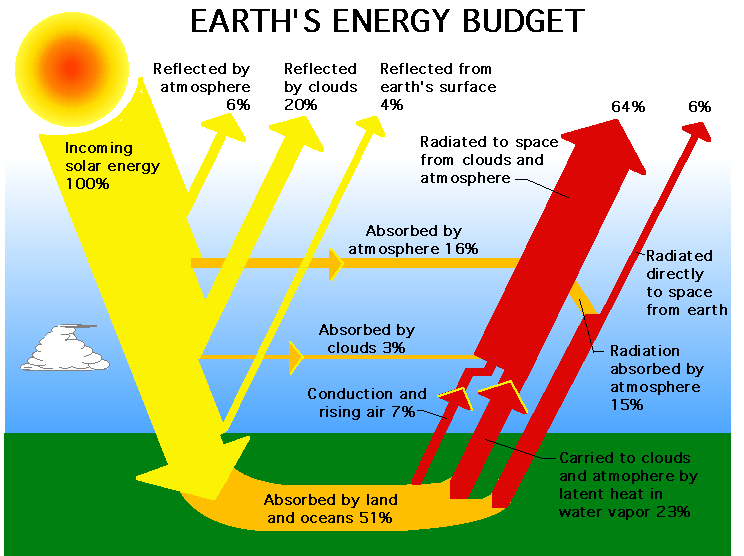
The Hockeyschtick displays 4 similar Earth Energy Budgets without backradiation from different sources including the above from NASA Langley Research Center. 

What do we see? Out of 51% absorbed by the Earth from incoming 100%, 
  • 30% is transported to the Atmosphere by convection/latent heat = thermodynamics
  • 15% is radiated to the Atmosphere = radiation
  • 6% is radiated directly to outer space.
The 45% transported from the Earth to the Atmosphere is radiated to outer space together 
with the 19% of incoming absorbed by the Atmosphere = 64%.

The Atmosphere acts an air conditioner cooling/warming the Earth by combination of thermodynamics and radiation,  with the following basic specifications:
  • Earth temperature T_E = 15 C 
  • Atmosphere temperature T_A = -18 C (at 5 km altitude)
  • lapse rate = 6.5 C/km.
Here T_A = -18 C is the Stefan-Boltzmann temperature required to radiate 64%. The lapse rate is set by the thermodynamics, and the lapse rate determines T_E = + 15 C. The temperature drop from + 15 C to -18 C determines the 15 % radiated from Earth to Atmosphere. 

Thermodynamics and radiation thus together act as an air conditioner, with thermodynamics setting the lapse rate and T_E which determines the cooling by radiation. 

We see that in this analysis "backradiation" does not appear, and thus can be dismissed to 
the realm of fiction, without any role to play in climate science nor at NASA.  

Suppose now that absorption properties of the Atmosphere changes so that instead of 6% 
only 5% is radiated directly, that is a 20% change of Atmosphere absorption by some 
"greenhouse gas", a large change. To compensate, either thermodynamics or radiation, or a combination thereof, will have to take care of that extra 1% to be transported away from the Earth, with the following basic options:

Increasing thermodynamics from 30% to 31%:
  • more convection/latent heat
  • tends to decrease the lapse rate and thus T_E
  • decreasing T_E decreases radiation.  
Increasing radiation from 15% to 16%:
  • requires increasing lapse rate
  • increasing lapse rate = less/more convection/latent heat
  • less/more convection/latent heat decreases/increases thermodynamics,
where increasing T_E may correspond to both decreasing (bigger lapse rate) and increasing (more vigorous) thermodynamics.

We thus see a dynamics of competing forces to balance the extra 1%: 
  • more thermodynamics with decreasing T_E and decreasing radiation
  • more radiation with increasing T_E and decreasing/increasing thermodynamics.
Which mechanism will win? Will T_E decrease or increase? Cooling or warming?  Only a more careful analysis can tell. 

As a first guess, it is tempting to put the money on thermodynamics with little/no increase of T_E , because of the starting point with 30% thermodynamics and 15% radiation, and the fact that increasing T_E may stimulate compensating more vigorous thermodynamics.

Again: radiation-only cannot give any scientifically based indication of global warming (or cooling) from a marginal increase of "greenhouse gases". CO2 alarmism is based on radiation-only including "backradiation" and thus lacks scientific rationale.

lördag 10 maj 2014

Basic Atmospheric Thermodynamics as 2nd Law

The debate on the temperature distribution in the atmosphere is going around in never-ending circulation just like the air in the atmosphere. Let us here recall the basic statements of my chapter Climate Thermodynamics in a famous book, which is condensed as the 2nd law of thermodynamics expressed in the following form with the dot signifying time differentiation:
  • $\dot K+\dot P = W-D$
  • $\dot E = -W + D$,  
where $K$ is kinetic energy, $P$ potential energy, $W$ work, $E$ heat energy and $D\ge 0$ is turbulent dissipation with $W > 0$ under expansion and $W < 0$ under compression. The sign of $D$ sets the direction of time with always transfer of energy from $K+P$ to $E$.

There are two basic temperature distributions with linear decrease with height as lapse rate (assuming zero heat conductivity): 
  • Isothermal atmosphere with zero lapse rate: $D$ maximal with $W=D$.
  • Maximal (dry adiabatic) lapse rate $=9.8\, C/km$ with $D=0$ minimal.
The observed lapse rate (of about 6.5 C/km) is somewhere between maximal and minimal. We note:
  1. Lapse rate may increase by slow laminar vertical circulation with ascending air cooling and descending air warming with $D=0$.
  2. Lapse rate may decrease by turbulent dissipation $D>0$ heating upper layers.
  3. A (partially) transparent atmosphere (like on Earth) heated from below may naturally develop a positive lapse rate by 1. 
  4. An opaque atmosphere (like on Venus) heated from above may become isothermal by heat conduction and may then develop a positive lapse rate by 1.  
The lapse rate is basic to planetary climate since it determines the surface temperature from the temperature at the top of the troposphere, and its dependence on the radiative properties of the atmosphere is a key question in global climate science.

Compare with the previous post Lapse Rate by Gravitation: Loschmidt or Boltzmann/Maxwell?

onsdag 16 juni 2010

Elementary Climate Mathematics: CO2 Cooling

We condense the previous post into:
  • The atmosphere of the Earth acts like a cooling system by transporting heat absorbed from the Sun to the top of the atmosphere TOA from where it is radiated to outer space.
  • 240 Watts/m2 is radiated from a TOA at 5 km altitude at a blackbody temperature of 255 K.
  • The heat absorbed by the Earth surface is transported to TOA mainly by thermodynamics (convection including evaporation/condensation) and partly by radiation.
  • The theoretical isentropic thermodynamical lapse rate is 10 K/km. 
  • The observed lapse rate is about 7 K/km.
  • The 3K reduction of lapse rate is a result of evaporation at the ocean surface (subtracting heat)  and condensation towards TOA (adding heat).
  • The effective lapse rate of 7 K/ km sets the Earth surface temperature to 288 ~  255 + 7 x 5 K.
  • Increasing evaporation decreases the lapse rate, and thus the surface temperature.
  • Increasing greenhouse gases GHG  = reduced heat transport by radiation = increased evaporation/condensation required to keep heat balance.
  • Ergo: Increasing GHG reduce surface temperature = global cooling.
  • More CO2 = Global Cooling!
Do you believe it?

To help reaching a conclusion, note that the above argument combines thermodynamics and radiation, while the claimed GHG global warming is based on radiation only. You may also recall that a refrigerator/air conditioner works by thermodynamics of expansion-evaporation-cooling + compression-condensation-warming just like in the above model of the atmosphere. 
A refrigerator working by radiation only would be wonderful, but nobody has been able to 
construct such a device.
 

måndag 14 juni 2010

Elementary Climate Mathematics

Let us collect some basic facts about global climate:
  • temperature of stratopause: 273 K
  • temperature of tropopause: 218  K 
  • temperature at Earth surface: 288 K
  • observed lapse rate in troposphere: 7 K drop per km 
  • total temperature drop in troposphere: 288 - 218 = 70 K = 7 x 10 km 
  • isentropic thermodynamic theoretical lapse rate: 10 K/km 
  • 180 Watts/m2 absorbed by Earth surface
  • 120 Watts/m2 returned by convection/latent heat
  • 60 Watts/m2 returned by radiation 
  • Earth-atmosphere effective blackbody temperature: 273 K = temperature at stratopause.
We observe:
  • Convective heat transport in the troposphere decreases the theoretical isentropic lapse rate by 3 K/km (from 10 K to 7 K), by evaporation at the Earth surface removing heat and condensation a higher altitudes adding heat.
  • Stratopause temperature of 273 K fixed by blackbody radiation at given insolation.
  • Tropopause temperature determined by temperature distribution in the stratosphere.
  • Surface temperature is determined by troposphere lapse rate and tropopause temperature.
  • It is natural to compute temperatures outside in, starting at the stratopause at 273 K and ending at the Earth surface at 288 K.
  • 60 Watts of radiation dQ is consistent with the relation dQ ~ 4 dT (differentiated SB Stefan-Boltzmann radiation law) with a temperature drop dT of 15 K (from Earth surface to stratopause).
  • Observations indicate a climate sensitivity of dQ ~ 6 dT (negative feedback from dQ =4 dT).
Main question:
  • Suppose the heat transport in the troposphere changes so that less heat is radiated and more heat is transported by convection from the Earth surface, at a constant total, for example to 124 Watts by convection and 56 Watts by radiation.  Will then the Earth surface temperature increase or decrease? Warming or cooling?
Tentative answer:
  • The temperature will drop as the intensity of evaporation/condensation increases and the troposphere lapse rate is further decreased, assuming that the tropopause temperature stays constant (assuming the stratosphere temperature does not change). The change in temperature could come from a change of lapse rate of 4/120 x 3 = 0.3 K/km resulting in a 3 K drop of surface temperature.
  • A shift from radiative to convective heat transfer in the troposphere can be expected by by increasing the effect of GHG greenhouse gases (mainly water vapour). 
  • This could correspond to a decrease of surface temperature under increased cloud cover from increased GHG.
Conclusion:
  • IPCC predicts an increase of surface temperature of 1.5 - 4. 5 C, from 1 C basic greenhouse effect/doubled CO2 based on SB plus assumed ad hoc positive feedbacks.
  • The above argument indicates instead a decrease of surface temperature from increased greenhouse effect, under constant insolation.
  • An increase of insolation by 4 Watts can by SB by expected to give an overall increase of 1 C.
The above argument uses more physics and more data than a direct application of SB argued by IPCC. Both arguments are simplistic. Which one is more realistic? Or none?

It is remarkable that not even the sign of climate sensitivity (warming or cooling by adding greenhouse gases) can be convincingly predicted by some form of mathematical analysis of the thermodynamics of an atmosphere. Or maybe it can, by a correct analysis based on computing turbulent solutions of the Navier-Stokes equations...stay tuned...

Compare with the canonized description of the greenhouse effect:
  • The greenhouse effect is a process by which radiative energy leaving a planetary surface is absorbed by some atmospheric gases, called greenhouse gases. They transfer this energy to other components of the atmosphere, and it is re-radiated in all directions, including back down towards the surface. This transfers energy to the surface and lower atmosphere, so the temperature there is higher than it would be if direct heating by
  • solar radiation were the only warming mechanism.
  • The Earth receives energy from the sun in the form of visible light. This light is absorbed at the Earth's surface, and re-radiated as thermal radiation. Some of this thermal radiation is absorbed by the atmosphere, and re-radiated both upwards and downwards; that radiated downwards is absorbed by the Earth's surface. Thus the presence of the atmosphere results in the surface receiving more radiation than it would were the atmosphere absent; and it is thus warmer than it would otherwise be.
  • This highly simplified picture of the basic mechanism needs to be qualified in a number of ways, none of which affect the fundamental process.
  • This mechanism is fundamentally different from that of an actual greenhouse, which works by isolating warm air inside the structure so that heat is not lost by convection.
We see that the lapse rate with an elevated surface temperature is viewed to come from radiation only, more precisely from atmospheric "re-radiation in all directions". We also see that the term "greenhouse gas" is admitted to be a (deliberately) misleading misnomer.  Like the Democratic People's Republic of North Korea.

Nevertheless, this is the essence of the scientific basis of climate alarmism: Re-radiation in all directions without any thermodynamics. Convincing science? Convincing to you?
 
What is the physics of 
  • the fundamental process, fundamentally different from that of a greenhouse, which results in the surface receiving more radiation? 

What physics books describe this fundamental process? I would like to learn about this phenomenon!

Note that the "fundamental process" referred to (probably) is "photons emitted by the Earth surface" which are "being trappedb y greenhouse gases in the atmosphere" and then "re-emitted back to the Earth". 

But is this the real physics of radiation as an electromagnetic wave phenomenon?
I don't think so. The idea of photons being trapped like fish in a net, is too simple. I would rather think of the situation as "dominance of the stronger over the weaker" as a flow of heat energy from higher to lower temperatures, instead of flows in both directions (at different strengths).

fredag 21 maj 2010

The Atmosphere as Air Conditioner


In Atmosphere as Air Conditioner we argue than a planetary atmosphere partly acts like an air conditioner or refrigerator, transporting heat from the  planet surface to the top of the atmosphere in a cyclic thermodynamic process of air rising-expanding-cooling  and descending-compressing-warming. The "engine" driving this process is gravitational bouyancy forcing hot light air to rise and cool dense air to descend. Ocean circulation is driven similarly.

We identify two extreme hydrostatic base solutions depending on height, one isentropic with 
zero turbulent dissipation and with constant maximal temperature gradient/lapse rate, and one with maximal turbulent dissipation and with constant temperature/zero lapse rate. 

We observe that the real lapse rate of - 6 C/km lies between these extremes of -10 (dry adiabatic lapse rate) and 0.

This analysis indicates that the main aspect of global climate of a temperate Earth surface
of 15 C connected to a tropopause at  - 55 C, results from thermodynamics and 
not radiation. 

The lapse rate in the troposhere is - 6 C/km, and changes sign in the stratosphere to reach 
0 C at the stratopause thus with a climb of 55 C, with the stratosphere being heated by ozon absorbing radiation from the Sun. Without this effect the Earth surface temperature might have been 55 + 15 = 70 C. The ozon in the stratosphere thus may have a cooling effect on the Earth surface.

The 0 C in the stratopause fits with blackbody radiation, which is also the effective blackbody temperature of  an Earth without an atmosphere. 

An Earth with atmosphere without radiation can thus be expected to be at 70 C. The absorption in the stratosphere by the ozon appears to have a major cooling effect, while the warming effect of a small amount of CO2 in the troposphere may be small.

We make a connection to the Joule experiment of a gas expanding-cooling under warming from turbulent dissipation, which we analyze in Mathematical Simulation Technology, Chap 166 The Secret of Thermodynamics. 


fredag 18 juni 2010

The Atmosphere as Refrigerator 2

The previous posts lead us into the following basic scenarios of global climate with top of the atmosphere TOA temperature always - 18 C:
  • isothermal opaque atmosphere: surface temp: - 18 C
  • isothermal transparent atmosphere: surface temp: - 18 C
  • isentropic opaque atmosphere: surface temp: + 32 C
  • thermodynamic semitransparent real atmosphere: surface temp:  + 15 C.
We understand that an isothermal atmosphere at - 18 C is possible both in the case of a fully transparent atmosphere without greenhouse gases GHG  and fully opaque atmosphere filled by GHG. The real case at 15 C is somewhere between these extremes with a semi-transparent atmosphere with thermodynamics including latent heat/evaporation/condensation. 

Isothermal (lapse rate = 0) and isentropic (lapse rate = 10 K/km) thermodynamic equilibrium states are possible without heat transport from the Earth surface to TOA. Convective heat transport tends to reduce the lapse rate. A reduced lapse rate connects to decreased radiative heat transport.

A simple calculation based on observed incoming = outgoing radiation = 240 W/m2 and a temperature drop dT of say 30 K from the Earth surface to TOA, gives heat transport by radiation = 4 x 30 = 120 Watts (by dQ = 4 dT), which fits with observed heat transport of 120 W by convection-evaporation/condensation (reducing the lapse rate by observed 3 K/km). This corresponds to a semi-opaque atmosphere absorbing 60 W and letting through 180 W to the Earth surface, and transporting back 120 W by convection and 120 W by radiation to TOA for radiation of 240 W to outer space at - 18 C.

We observe that in this model, increase of convective heat transport may reduce the lapse rate further and thus decrease the surface temperature. A balancing decrease of radiative heat transport fits with a smaller dT and a decrease of surface temperature. Less radiative heat transport may thus fit with increasing GHG. As noted in previous posts, the net result could be global cooling by more GHG!

Thus, not even the sign of climate sensitivity is clear, warming or cooling, not to speak of its magnitude: Whether increasing GHG will increase or decrease surface temperature will depend on the effect on incoming surface radiation and the thermodynamical heat transport including evaporation/condensation. In particular, the common belief that  doubled CO2 will cause a basic global warming of 1 C, may lack scientific rationale.

Compare with Basic Thermodynamics of the Atmosphere derived from basic properties of turbulent solutions of the Navier-Stokes equations.

Also compare with Roy Spencer's dicussion of the role of PDO in global temperature variations based on the simplest possible thermodynamic model. Spencer shows that even such a simplest model can be made to fit with observations quite well, and then indicates much smaller climate sensitivity that the simple radiative model used by IPCC to predict a basic climate sensitivity of 1 C upon doubling of atmospheric CO2 (augmented  to 1.5 - 4.5 C by various feedbacks).

The conclusion is that any climate model must include thermodynamics, and the natural model is then the Navier-Stokes equations with gravitation and radiation. 

lördag 3 mars 2012

Can The "Greenhouse Effect" Be Detected?


The recent exhange with Roy Spencer and Fred Singer concerning the "greenhouse effect" and "backradiation" identifies three groups in the climate debate with the following standpoints:
  1. Alarmists: There is a greenhouse effect and it threatens to overheat the globe.
  2. Skeptics: There is a greenhouse effect, but it is so small that it cannot be detected.
  3. Deniers: As long as no greenhouse effect has been identified, one can act as if there is no greenhouse effect.
Roy and Fred belong to 2. and myself to 3. The discussion gets complicated by the fact that "the greenhouse effect" is not clearly described in the literature, but it is somehow connected to the radiative properties of the atmosphere:

Both alarmists and skeptics assume as a starting point that doubled CO2 will cause global warming by 1 C, which is referred to as no-feedback climate sensitivity. Alarmists then inflate it to 3 C with positive feedback and skeptics to about 0.5 C with negative feedback.

Both alarmists and skeptics thus firmly believe that science says that increasing the absorptivity of the atmosphere a little by doubling CO2, will cause warming.

Deniers are not so sure about that referring to the following argument:
  • Earth surface temperature is determined by the lapse rate.
  • Lapse rate is determined by thermodynamics with radiative forcing.
  • Fully transparent atmosphere may be isothermal with zero lapse rate.
  • Fully opaque atmosphere may be isothermal with zero lapse rate.
  • Reality is somewhere in between with a certain lapse rate.
  • It is not clear if more CO2 will increase or decrease the lapse rate.
  • It is thus not clear if more CO2 will cause warming or cooling.
  • There is no convincing evidence that any effect of doubled CO2 can be detected.
The dividing line goes between alarmists on one hand and skeptics/deniers on the other hand.

The quarrel between skeptics and deniers, about the existence of an effect which cannot be detected, seems to be of minor scientific importance compared to the main question of significant global warming or not.

lördag 2 april 2011

Simplistic Climate Models: Warming or Cooling?

From Grant Petty (2006)

The above graph (in particular the top one) can be seen as the fundamental graph of CO2 alarmism. The dip in the top graph around the wavelength 15 mu, is the essence: We will come back to this below after a digression.

Roger Taguchi on Climate Etc points to the following important fact:
  • As I have stated, individual gas molecules cannot emit black body radiation,which is a continuous spectrum (N2 and O2 cannot emit any IR, black body or otherwise, and CO2 and other greenhouse gases can emit only over narrow bands, so their emission is by definition not continuous and therefore not black body).
  • Black body radiation can only be emitted by condensed states like solids and liquids (or by free electrons in the conduction bands of metallic solids, or in plasmas such as in the interior and photosphere of the Sun).
  • The reason is that in condensed states there are many, many weaker vibrations due to van der Waals' (intermolecular) forces, as well as stronger vibrations within molecules. Combinations of the weaker and stronger vibrations and their overtones allows for a continuous spectrum extending from low frequencies to high frequencies.
  • So the IR that escapes from the Earth to outer space, both in the daytime and at night, comes from the solid and liquid surface of the Earth, not some "emitting layer(s)" in the atmosphere.
Following up on the post Simple Model for Radiative Transfer, we collect the following facts:
  1. The blackbody temperature of the Earth at its viewing angle of 0.005^2 of the Sun at 5778 K, comes out by Stefan-Boltzmann's Law as 255 K. To be compared with the 288 K observed.
  2. Without an atmosphere the Earth surface temperature could thus be 255 K, and thus the total effect of the atmosphere is + 33 C.
  3. The observed lapse rate is 6.5 K/km with atmosphere, which means that the blackbody temperature of 255 K can be allocated to a height of about 5 km as if the Earth with a 5 km thick opaque atmospheric layer L was one blackbody with a transparent atmosphere above 5 km. The thicker L is the warmer the Earth surface will be through the lapse rate.
We now ask what the effect on the Earth surface temperature would be of changing the radiative properties of the atmospheric layer L assuming a radiation model of the form
  • (1) dT/dX + E T = - 6.5 for X in the interval (0,5),
where dT/dX models convective/radiative transport and A T(X) models radiation to outer space at height X with E a positive emission coefficient, with solution
  • T(X) = T(0)exp(-EX) - 6.5 (1 - exp(-EX))/E,
where T(0) is the surface temperature. With E tending to 0 corresponding to a fully opaque atmospheric layer L, we have T(X) = T(0) - 6.5 X, and thus T(0) = 288 K if T(5) = 255 K.

We now ask what the effect will be of increasing E from 0, corresponding to letting L become
increasingly transparent from fully opaque. Integration of (1) over (0,5) gives
  • (2) T(0) - T(5) - 33 = integral E T(X) dX = Q1 = total emission from L to outer space
Energy balance gives
  • (3) Q1 + sigma T(5)^4 = Q,
where sigma T(5)^4 is radiation from the top of L by Stefan-Boltzmann and Q is given total insolation. Differentiation of (2) with respect to E using (2) gives
  • dT(0)/dE - dT(5)/dE + 4 sigma T(5)^4/T(5) dT(5)/dE = 0
where with sigma T(5)^4 ~ 240 W/m2,
  • sigma T(5)^4/T(5) ~ 240/273 ~ 1
and thus
  • dT(0)/dE ~ - 3 dT(5)/dE
Now, if E increases from 0, T(5) will decrease since less radiation will have to be emitted at X = 5, and thus T(0) will increase. Or put differently, as E decreases T(0) will decrease, that is increasing opacity may cause cooling of the Earth surface.

The above argument should be compared with the standard "greenhouse effect" argument where increasing opacity would correspond to an increasing thickness of the opaque layer and thereby would correspond to surface warming. The determining factors are the lapse rate, and the thickness of the absorbing atmosphere, and the lapse rate is mainly determined by thermodynamics (forced by radiation).

We thus have two simplistic models giving different effects of increasing opacity: cooling or warming, as you like. The conclusion is that a simplistic model of a "greenhouse effect" should be viewed with skepticism: it may give a correct indication about reality or not. When you have several simplistic arguments with contradictory results, one of them may be correct, but you don't know which.

But it is possible that a more complete model combining thermodynamics and radiation can give meaningful results, most likely showing that increased CO2 has neglible warming/cooling effect.

Back to the top graph of

Outgoing Longwave Radiation as seen by a satellite at a height of 20 km:

We see a dip in the emission curve in a band around 15 mu m emitted at a temperature 220 K from a height of a bit less than 20 km, while outside the band the radiation is emitted from the Earth surface at about 270 K. The dip comes from the "greenhouse gases" (mainly water vapour and some CO2) which absorb radiation from the Earth surface emitted at 270 say and and re-emitting less radiation at 220 K and thus acting as a "warming blanket" causing the "radiative forcing" of the "greenhouse effect". The idea is that the "greenhouse effect" corresponds to the area of the dip shows the "greenhouse effect" as a combined effect of water vapor and CO2
capable of warming the Earth surface temperature by 33 C as compared to a fully transparent atmosphere.

But what does the satellite measure? The IR-meter of the satellite (presumably) measures the temperature of the closest emitting surface and the total radiance is probably computed by Stefan Boltzmann's Law as if all emission came from the top layer. This means that it is not straight away to connect the dip to "radiative forcing" in particular not from the trace gas CO2. In any case the top graph is of interest and it is important to make a correct interpretation of the instrument reading....this is also important as concerns the interpretation of the graph below supposedly depicting "downwelling longwave radiation" from the atmosphere...to be continued...

Pierrehumbert pumps out the CO2 radiation message in Physics Today without even mentioning the crucial role of the thermodynamic lapse rate:
  • Infrared radiative transfer theory, one of the most productive physical theories of the past century, has unlocked myriad secrets of the universe including that of planetary temperature and the connection between global warming and greenhouse gases.
As far I can see, this is stunning disinformation: planetary climate is complex thermodynamics with radiative forcing, not more or less trivial radiative transfer.

söndag 30 december 2012

Negative Climate Sensitivity: Global Cooling 1


The preceding posts lead to the conclusion that the Earth (and Venus) including atmosphere up to a pressure of 0.2 - 0.3 bar have a TOA temperature at the tropopause equal to the bolometric temperature determined by the distance to the Sun, as a minimal temperature.

The surface temperature would then be determined by a lapse rate observed to be 6.5 C/km resulting from atmospheric thermodynamics driven by radiative forcing of the Earth surface,  to be compared with the dry adiabatic lapse rate of g/c_p = 9.8 C/km with g gravitational acceleration and c_p the heat capacity of air at constant pressure.

The thermodynamics in the atmosphere would thus have the effect of reducing the dry adiabatic lapse representing a possible state without radiative forcing and thermodynamics, and thus an effect of reducing the surface temperature.

Doubling the atmospheric CO2 is by IPCC estimated to correspond to a radiative forcing of 2- 4 W/m2, to be added to the 180 - 40 = 140 W/m2 effectively absorbed by the Earth surface with 180 incoming and 40 directly outgoing through the atmospheric window.  The effect on the surface temperature would then be determined by the lapse rate with the bolometric temperature of TOA at the tropopause  unchanged because the distance to the Sun is unchanged.

The effect of additional effective radiative forcing of the Earth surface would be more active thermodynamics which would tend to further reduce the lapse rate and thus the Earth surface temperature.

Climate sensitivity as the increase of the Earth surface temperature upon doubling of CO2, would thus be negative: More CO2 would tend to be cooling rather than warming, but the effect would probably be so small that it could not be observed. Climate sensitivity would thus seem to be non-positive and the risk of global warming would (very likely) be small (with a most likely value of 0).

(This insight is now quickly eating its way into the minds of both people and politicians and global warming hysteria is already history).

Compare with the climate sensitivity of + 3 C by IPCC, which is obtained by a combination (i) radiative forcing increasing the bolometric temperature, as if the Earth was moved closer to the Sun and (ii) positive thermodynamics feedback, as if thermodynamics could slow down by additional forcing.

The IPCC view is presented by its Swedish representative Lennart Bengtsson with the following key argument:
  • .... the Earth energy balance can temporarily be changed by reduced radiation to outer space by increased concentration of greenhouse gases. 
We see here the idea of heating (less outgoing radiation) with necessarily a warming effect by greenhouse gases, which is the key of global warming propaganda. But LB eliminates the warming effect by stating that it is only temporary, and thus seems to say that the effect in the end is zero.

PS Notice that in the IPCC and LB greenhouse gas argument, the TOA would be put at 5 km at a bolometric temperature of - 18 C corresponding to 240 W/m2 outgoing radiation, and would then be shifted upwards to cooler levels under increased concentration of greenhouse gases and then eventually cause surface warming.  But there is no TOA other than the tropopause (as concerns thermodynamics), and shifting an artificial TOA up or down would lack physical meaning.

lördag 28 augusti 2010

Sauna, Sweating and Global Warming


The World Sauna Championship 2010 in Finland ended in tragedy with one finalist dead and another hospitalized after serious burns apparently caused by adding too much water to the stove giving a wet sauna.  

Everybody with some sauna experience knows that it is possible to survive a higher temperature in a dry sauna than in a wet sauna saturated with water vapour. Why?

Because, in a dry sauna the sweat on your skin can vaporize and thereby consume heat energy. But in a wet sauna the sweat cannot vaporize and thus has no cooling effect. And sweating is 
the main mechanism for keeping your body temperature constant at 37 C: The more you work, the hotter you tend to get, which is balanced by vaporizing sweat. 

Is there a connection to global warming? IPCC climate alarmism claims that the World is turning into sauna: Doubled atmospheric CO2 is supposed to cause a "radiative forcing"  of 4 W/m2, which will increase global temperature by 1 C and with additional feedbacks to a climate sensitivity of 2 - 4.5 C = Alarm!

But is this argument credible? Or is global temperature like our body temperature kept almost constant by vaporization? Yes, the oceans absorb heat energy radiated from the Sun, which is used to vaporize water,  which is convected to higher levels of the atmosphere, where it condenses and releases heat energy, which is finally radiated to outer space. The Earth thus can keep surface temperature constant under varying forcing by sweating: Radiative forcing can be balanced by increased sweating under constant temperature. In principle.

Let's look at the numbers:

The Earth surface (mainly oceans) recieves about 180 W/m2 and gets rid of 60 by radiation and
120 by vaporization/convection/condensation/radiation.  The lapse rate is 6 C per km connecting  the Earth surface at 15 C with a Top of the Atmosphere TOA at -18 C (at 5 km height) from where 240 W/m2 are radiated to outer space (with 60 of incoming 240 absorbed by clouds). 

With a fully transparent atmosphere the lapse rate could be 0 and with an atmopshere fully opaque to outgoing radiation it could be the adiabatic rate of 9.8 C/km. The corresponding 
radiation would range from 180 to 0, with the observed 60 at a lapse rate of 6 C/km.  

A "radiative  forcing" of 4 W/m2 corresponds to a 7 percent reduction of radiation to 56, or a compensating increase of 3.5 percent to 124 of vaporization/convection/...... with a change of 
lapse rate about 0.035 x 6 = 0.2 C/km and a corresponding change of surface temperature
of 1 C. 

This calculus thus indicates a climate sensitivity of 1 C, including feedbacks = No Alarm! 

Note that a 7 percent change of the radiation characteristics of the atmosphere is big change; It may be more reasonable to consider changes of 1-2% which would reduce climate sensitivity to
0.2 - 0.4 C, a factor of 10 smaller than the 2 - 4.5  C of IPCC: No Alarm!

Do you think that my argument is simplistic? Then bear in mind that the IPCC argument is even more simplistic.

Note that according to anthropologist Nina Jablonski:
  • On an evolutionary level, there are three remarkable facts about skin. It comes in colors, of course. Compared to other mammals, our skin is relatively hairless. And it’s sweaty. In the last few million years, humans became the sweatiest of mammals.Q. Is that important? It’s often said that our large brains are what made it possible for us to evolve from ape to human. But those big brains could never have developed if we didn’t have exceptionally sweaty skin. 
  • It happened this way. There was a tremendous takeoff in human evolution about two million years ago when primates who could no longer be called apes appeared in the savannahs of East Africa. These early humans ran long distances in open areas. In order to survive in the equatorial sun, they needed to cool their brains. Early humans evolved an increased number of sweat glands for that purpose, which in turn permitted their brain size to expand. As soon as we developed larger brains, our planning capacity increased, and this allowed people to disperse out of Africa. 
We learn that sweating is what allowed us to survive the merciless tropical Sun and develop scientific brains for survival, and also what makes the Earth survive the exposure to the Sun.

torsdag 3 januari 2013

How to Interprete an Atmospheric Radiance Spectrum

The thermal emisson spectrum of the Earth + atmosphere measured by the IRIS Michelson interferometer instrument on the Nimbus 4 space craft over three different regions, takes the following form:

The curves shows the radiance (in mW/m2 and 1/cm) per unit wave number as function of wavenumber, and are computed from interferometer measurements of temperature using Planck's law of blackbody radiation.

The basic measurement thus concerns temperature and not radiance, but the computed radiance spectra  are commonly taken as observed rates of emission of energy. For example, the dip in the spectrum around wavenumber 700 is interpreted as "blocking" energy transfer or "trapping" energy by atmospheric CO2 as a Greenhouse Gas Effect GHE causing global warming, and the size of the dip is used to suggest alarm. We argue below that this inflates the role of the trace gas CO2.

But sticking to the true the measurements of temperature gives the following somewhat different interpretation:

The temperature of 220 K at the bottom of the dip around wavenumber 700 is the temperature of the tropopause, suggesting that the Earth + tropopause can be be viewed as a blackbody with a spectrum following the 220 K curve with total radiation of 140 W/m2. The radiation above the 220 K curve of a total of 100 W/m2  would then correspond to 40 W/m2 directly radiated to outer space from the Earth surface through the atmospheric window (wave numbers larger than 800), and 60 W/m2 from water vapor in the atmosphere (wave numbers smaller than 550).

The total would be 240 W/m2 absorbed by the Earth+troposphere with 180 W/m2 absorbed by the Earth surface. The role of combined thermodynamics and radiation within the troposphere would then be to transport 140 W/m2 from the Earth surface to the tropopause, with an estimated 120 by thermodynamics of convection and evaporation/condensation, thus mainly by thermodynamics.

The effect of the thermodynamics would then be a reduction of the dry adiabatic lapse rate of 10 C/km to the observed 6.5 C/km, with the drop increasing with the vigor of the thermodynamics.

A change of the radiative properties of the atmosphere could then have an effect on (i) the temperature of the tropopause as the outer boundary of the Earth + atmosphere system, and (ii) the lapse rate, which together would determine the Earth surface temperature.

A decrease of the transparency of the atmosphere would decrease the atmospheric window and thus demand an increase of the temperature of the tropopause, while at the same time demand more vigorous thermodynamics decreasing the lapse. The net effect could be interpreted as radiative warming with negative feedback cooling from thermodynamics, thus with potentially a small net effect. In other words, the climate sensitivity could very well be small.

The purpose of the argument is to seek to assess the Earth surface temperature from lapse rate and temperature of the tropopause as an (effective) outer boundary of the Earth + atmosphere as a blackbody, without more precise (difficult) modeling of the combined thermodynamics/radiation within the atmosphere. This analysis indicates that the Earth surface temperature may be insensitive to even quite large perturbations of atmospheric composition and insolation.

It is also an attempt to get away from the notions of "effective emission altitude" (at 5 km) and "effective emission temperature" (255 K) as fictitious entities which cannot be measured and have no physical correspondence (as compared to the tropopause which has a physical reality).

Notice that with an ideal blackbody as a universal thermometer, the temperature of a given body would be measured by radiative equilibrium with the universal thermometer at a certain temperature defined by no radiative transfer of energy between the body and the thermometer. The absorptivity/emissivity of the body would then not affect the temperature reading, but would be directly connected to the radiance of the body. Without knowing the absorptivity/emissivity, it would thus be impossible to tell the effective radiance of a body from its temperature. The above radiance plots constructed from temperature readings assuming absorptivity = emissivity = 1, may thus not represent reality. In particular, the emissivity of CO2 as a trace gas must be very small, and the radiation from the troposphere even within the 550-800 band of CO2, must emanate from the whole atmosphere, not only CO2. In other words, the radiance dip between 550 and 800 would be due to CO2 only to a small extent, and the alarm balloon would collapse.

måndag 24 maj 2010

Thermodynamics of Global Climate 2

We recall the 2nd Law of Thermodynamics for an atmosphere from the previous post:


                                  dK + dP = W - D,          dE = - W + D + Q,

where dK, dP and dE is the rate of change of kinetic energy K, potential energy P and internal (heat) energy E, W is rate of work, D is the rate of turbulent dissipation and we added a heat source Q. 

Let's put in some numbers from observations:
  • Q ~ 250 Watts (per m2) from insolation
  • dP ~ 0.01 x 0.65 x 10000 x g = 650 Watts
  • average vertical velocity = 0.01 m/s
  • average density = 0.65 kg/m3
  • average thickness of troposphere = 10000 m 
  • dE ~ 0.01 x 0.65 x 10000 x 6 = 400 Watts
  • lapse rate 6 C/km
These numbers are compatible with dP = W - D = 650 ,  dE = - W+D+Q = - 400 Watts.

With an isentropic lapse rate of 10 C/km we would have dE = -650 Watts,  and we can thus 
view the input of 250 Watts as being spent on turbulent dissipation, effectively reducing the temperature drop with increasing height.

We sum up: We have formulated a basic thermodynamic model of an atmosphere acting in a cyclic thermodynamic convective process of an ascending/expanding/cooling and descending/compressing/warming flow of air, which is driven by insolation spent on 
maintaining the convection under turbulent dissipation. This model is compatible with observation without any presence of socalled greenhouse gases, and thus suggests that global climate is  is mainly determined by thermodynamics and not by greenhouse gases.

For more details see the article in progress Basic Thermodynamics of the Atmosphere.

torsdag 17 juni 2010

The Atmosphere as Refrigerator


The previous posts lead us to view the thermodynamic action of the atmosphere to be similar to that of a refrigerator:
  • Evaporation at the ocean surface driven by incoming radiation generates cooling of the warm atmosphere above the surface.
  • Warm air rises by bouyancy under expansion and cooling to TOA where it releases heat by condensation for further radiation to outer space.
  • Cool air descends from TOA under compression and warming completing a thermodynamic refrigerating cyclic process.
In addition, some incoming heat is returned by radiation. If the radiation is blocked, more or less, by greenhouse gases, the refrigerator process must intensify to maintain heat balance. This requires more evaporation and thus more cooling of the atmosphere above the ocean surface. 

The atmosphere will thus act like a refrigerator giving additional cooling under increased energy input. More greenhouse gases will thus cause global cooling!

How much cooling? Assume that now 1/4 of incoming heat is returned by radiation and 3/4
by the  thermodynamic refrigerator process at a decrease of the lapse rate of 3 K/km from 10 to 7 K/km. Blocking the radiation fully would then require a further reduction of lapse by 1 K/km to 6K/km corresponding to a decrease of surface temperature by 5 K. 

If the radiation was blocked by 1% the decrease of global temperature would be 0.05 K. Climate sensitivity could thus be estimated to  - 0.05 K. To be compared with IPCC's + 1.5 to + 4.5 K.

tisdag 5 april 2011

Simple Climate Model: Thermodynamics, Radiation and Observation


In the spirit of my article in Slaying the Sky Dragon, consider the following facts:
  • The Earth with atmosphere absorbs 240 W/m2 sunlight and emits 240 W/m2 IR.
  • The Earth surface temperature is 288 K.
  • By Stefan Boltzmann 240 W/m2 corresponds to an effective blackbody temperature of 255 K (with an albedo of 0.3). The difference 288 - 255 = 33 C can be seen as the total warming effect of the atmosphere.
  • 40 W/m2 is emitted directly from the Earth surface through an "atmospheric window".
  • The climate system acts as an air conditioner in a combined thermodynamic-radiation cycle processing the remaining 200 W/m2.
  • The effect of this process is to reduce the lapse from the base (dry adiabatic) value of 9.81 C/km to the observed 6.5 C/km, thus with a reduction of 3.5 C/km per 200 W/m2 or total cooling effect of 18 C, since the temperature is observed to be 255 K at a height of 5 km.
  • The reduction of the lapse results mainly from the thermodynamics by evaporation/condensation, which has a cooling effect by lowering the temperature at low altitudes by evaporation and increasing the temperature by condensation at higher altitudes.
  • Suppose now the atmospheric window is decreased by additional greenhouse gases by 4 W/m2, which are to be handled by the combined thermodynamic-radiation process.
  • Suppose the 4 W/m2 are splitted equally between thermodynamics and radiation.
  • Additional 2 W/m2 to be processed by thermodynamics means 1% reduction of the lapse rate with corresponding cooling effect of about 0.18 ~ 0.2 C.
  • Additional 2 W/m2 to radiation gives a warming effect of about 0.5 C by Stefan-Boltzmann.
  • The net is a warming effect of 0.3 C.
  • In other words, with standard terminology, we find a climate sensitivity of 0.3 C, to be compared with IPCC´s value in the range 1.5 - 4.5 C, which is 5 - 15 times bigger.
I believe this argument is the simplest possible combining thermodynamics with radiation and observations. It is possible that it contains an element of truth.