 |
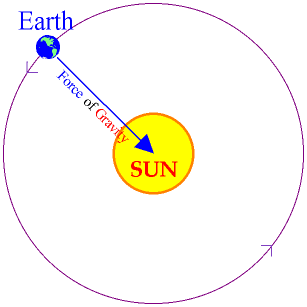
| The Earth is pulled in the direction of the present position of the Sun at each instant, right? |
Let us continue our reflections on LIGO recalling my earlier post on Neo-Newtonian Cosmology as an alternative to Einstein's Cosmology based on Einstein's equations with related posts here and the discussion about The Hen and the Egg.
In Neo-Newtonian Cosmology a gravity potential $\phi (x,t)$ (depending on an Euclidean space coordinate $x$ and time $t$) is connected to mass distribution $\rho (x,t)$ through Poisson's equation
- $\Delta\phi =\rho $
which is interpreted as creation of mass $\rho$ by the action of $\Delta$ upon the gravitational potential $\phi$ through a local instant operation of differentiation.
This is different from the standard interpretation in Newtonian cosmology with instead the gravitational potential $\phi$ created from mass $\rho$ by instant action at distance corresponding to solving or integrating Poisson's equation, as if gravitational force/potential is propagated at infinite speed. We thus have:
- Neo-Newtonian Cosmology: matter created from gravitational potential by instant local action.
- Newtonian Cosmology: gravitational potential created from mass by instant action at distance.
Now, the big mystery of Newtonian Gravitation/Cosmology is the instant action at distance, which with the optics of Neo-Newtonian Cosmology is a fictional problem, which thus can be replaced by local instant action, with the mystery of instant action at distance eliminated.
The beauty with both Newtonian and Neo-Newtonian Cosmology, as compared with Einstein's, is that motion of the Earth around the Sun gets an theoretical explanation agreeing with the following observation:
- The Earth accelerates at each instant of time in the direction of the present position of the Sun as if the action of the Sun is instant at distance.
In particular, the Earth does not accelerate in the direction where the Sun is seen, since that position through the finite speed of light, has a delay of 8 minutes. The difference comes out in the thought experiment that the Sun suddenly disappears into nothing: In Neo-Newtonian Cosmology that would mean the instant disappearance of the gravitational field and thus leave the Earth instantly continuing in the tangent direction, while with finite speed of propagation of gravitational force created at distance by the mass of the Sun, that would take 8 minutes and the path would then be different.
In Einstein' Cosmology gravitation is propagated with the finite speed of light, but that does not seem to be the case for the Sun-Earth system. Right?
Recall that Einstein was obsessed with choice of coordinates in both the special and general theory, as if this choice has anything to do with physics, as if physics carries around coordinate systems imprinted in the "fabric of space-time" as the name of the game. But coordinate systems are inventions/conventions made by humans and not the Creator of the World, who had no need of such things when putting things together and letting it go...
Recall that Einstein was obsessed with choice of coordinates in both the special and general theory, as if this choice has anything to do with physics, as if physics carries around coordinate systems imprinted in the "fabric of space-time" as the name of the game. But coordinate systems are inventions/conventions made by humans and not the Creator of the World, who had no need of such things when putting things together and letting it go...


