lördag 6 augusti 2016

New Quantum Mechanics 12: H2 Non Bonded

Here are results for two hydrogen atoms forming an H2 molecule at kernel distance R = 1.4 at minimal total energy of -1.17 and a non-bonded molecule for larger distance approaching full separation for R larger than 6-10 at a total energy of -1. The results fit quite well with table data listed below.

The computations were made (on an iPad) in cylindrical coordinates in rotational symmetry around molecule axis on a mesh of 2 x 400 along the axis and 100 in the radial direction. The electrons are separated by a plane perpendicular to the axis through the the molecule center, with a homogeneous Neumann boundary condition for each electron half space Schrödinger equation. The electronic potentials are computed by solving a Poisson equation in full space for each electron.

PS To capture energy approach to -1 as R becomes large, in particular the (delicate) $R^{-6}$ dependence of the van der Waal force, requires a (second order) perturbation analysis, which is beyond the scope of the basic model under study with $R^{-1}$ dependence of kernel and electronic potential energies.


%TABLE II. Born–Oppenheimer total, E
%Relativistic energies of the ground state of the hydrogen molecule
%L. Wolniewicz
%Citation: J. Chem. Phys. 99, 1851 (1993); 
for two hydrogen atoms separated by a distance R bohr

 R    energy
0.20 2.197803500 
0.30 0.619241793 
0.40 -0.120230242 
0.50 -0.526638671 
0.60 -0.769635353 
0.80 -1.020056603 
0.90 -1.083643180 
1.00 -1.124539664 
1.10 -1.150057316 
1.20 -1.164935195 
1.30 -1.172347104 
1.35 -1.173963683 
1.40 -1.174475671 
1.45 -1.174057029 
1.50 -1.172855038 
1.60 -1.168583333 
1.70 -1.162458688 
1.80 -1.155068699 
2.00 -1.138132919 
2.20 -1.120132079 
2.40 -1.102422568 
2.60 -1.085791199 
2.80 -1.070683196 
3.00 -1.057326233 
3.20 -1.045799627 
3.40 -1.036075361 
3.60 -1.028046276 
3.80 -1.021549766 
4.00 -1.016390228 
4.20 -1.012359938 
4.40 -1.009256497 
4.60 -1.006895204 
4.80 -1.005115986 
5.00 -1.003785643 
5.20 -1.002796804 
5.40 -1.002065047 
5.60 -1.001525243 
5.80 -1.001127874 
6.00 -1.000835702 
6.20 -1.000620961 
6.40 -1.000463077 
6.60 -1.000346878 
6.80 -1.000261213 
7.00 -1.000197911 
7.20 -1.000150992 
7.40 -1.000116086 
7.60 -1.000090001 
7.80 -1.000070408 
8.00 -1.000055603 
8.50 -1.000032170 
9.00 -1.000019780 
9.50 -1.000012855
10.00 -1.000008754 
11.00 -1.000004506 
12.00 -1.000002546

onsdag 3 augusti 2016

New Quantum Mechanics 11: Helium Mystery Resolved

The modern physics of quantum mechanics born in 1926 was a towering success for the Hydrogen atom with one electron, but already Helium with two electrons posed difficulties, which have never been resolved (to be true).

The result is that prominent physicists always pride themselves by stating that quantum mechanics cannot be understood, only be followed to the benefit of humanity, like a religion:
  • I think I can safely say that nobody understands quantum mechanics. (Richard Feynman, in The Character of Physical Law (1965))
Text books and tables list the ground state of Helium as $1S^2$ with two spherically symmetric electrons (the S) with opposite spin in a first shell (the 1), named parahelium.  The energy of a $1S^2$ state according to basic quantum  theory is equal to -2.75 (Hartree), while the observation of ground state energy  is -2.903. To handle this apparent collapse of basic quantum theory, the computation of energy is changed by introducing a suitable perturbation away from spherical symmetry which delivers the wanted result of -2.903, while maintaining that the ground state still is $1S^2$.

Of course, this does not make sense, but since quantum mechanics is not "anschaulich" or  "visualisable" (as required by Schrödinger) and therefore cannot be understood by humans, this is not a big deal.  By a suitable perturbation the desired result can be reached, and we are not allowed to ask any further questions following the dictate of Dirac: Shut up and calculate.

New Quantum Mechanics resolves the situation as follows:

The ground state is predicted to be a spherically (half-)symmetric continuous electron charge distribution with each electron occupying a half-space, and the electrons meeting on at plane (free boundary) where the normal derivative for each electron charge distribution vanishes. The result of ground state energy computations according to earlier posts shows close agreement with the observed -2.903:

Notice the asymmetric electron potential and the resulting slightly asymmetric charge distribution with polar accumulation. The model shows a non-standard electron configuration, which may be the true one (if there is anything like that).


fredag 29 juli 2016

Secret of Laser vs Secret of Piano

There is a connection between the action of a piano as presented in the sequence of posts The Secret of the Piano  and a laser (Light Amplification by Stimulated Emission of Radiation), which is remarkable as an expression of a fundamental resonance phenomenon.

To see the connection we start with the following quote from Principles of Lasers by Orazio Svelto:
  • There is a fundamental difference between spontaneous and stimulated emission processes. 
  • In the case of spontaneous emission, the atoms emit e.m waves that has no definite phase relation with that emitted by another atom... 
  • In the case of stimulated emission, since the process is forced by the incident e.m. wave, the emission of any atom adds in phase to that of the incoming wave...
A laser hus emits coherent light as electromagnetic waves all in-phase, and thereby can transmit intense energy over distance. 

The question is how the emission/radiation can be coordinated so that the e.m. waves from many/all atoms are kept in-phase. Without coordination the emission will become more or less out-of-phase resulting in weak radiation. 

The Secret of the Piano reveals that the emission from the three strings for each note in the middle register, which may have a frequency spread of about half a Herz, are kept in phase by interacting with a common soundboard through a common bridge in a "breathing mode" with the soundboard/bridge vibrating with half a period phase lag with respect to the strings. The breathing mode is initiated when the hammer feeds energy into the strings by a hard hit.

In the breathing mode strings and soundboard act together to generate an outgoing sound from the soundboard fed by energy from the strings, which has a long sustain/duration in time, as the miracle of the piano. 

If we translate the experience from the piano to the laser, we understand that laser emission/radiation is (probably) kept in phase by interaction with a stabilising half a period out-of-phase forcing corresponding to the soundboard, while leaving part of the emission to strong in-phase action on a target.

An alternative to quick hammer initiation is in-phase forcing over time, which requires a switch from input to output by half a period shift of the forcing. 

We are also led to the idea that black body radiation, which is partially coherent, is kept in phase by interaction with a receiver/soundboard. Without receiver/soundboard there will be no radiation. It is thus meaningless to speak about black body radiation into some vacuous nothingness, which is often done based on a fiction of "photon" particles being spitted out from a body even without receiver, as physically meaningless as speaking into the desert.    

torsdag 28 juli 2016

New Quantum Mechanics 10: Ionisation Energy

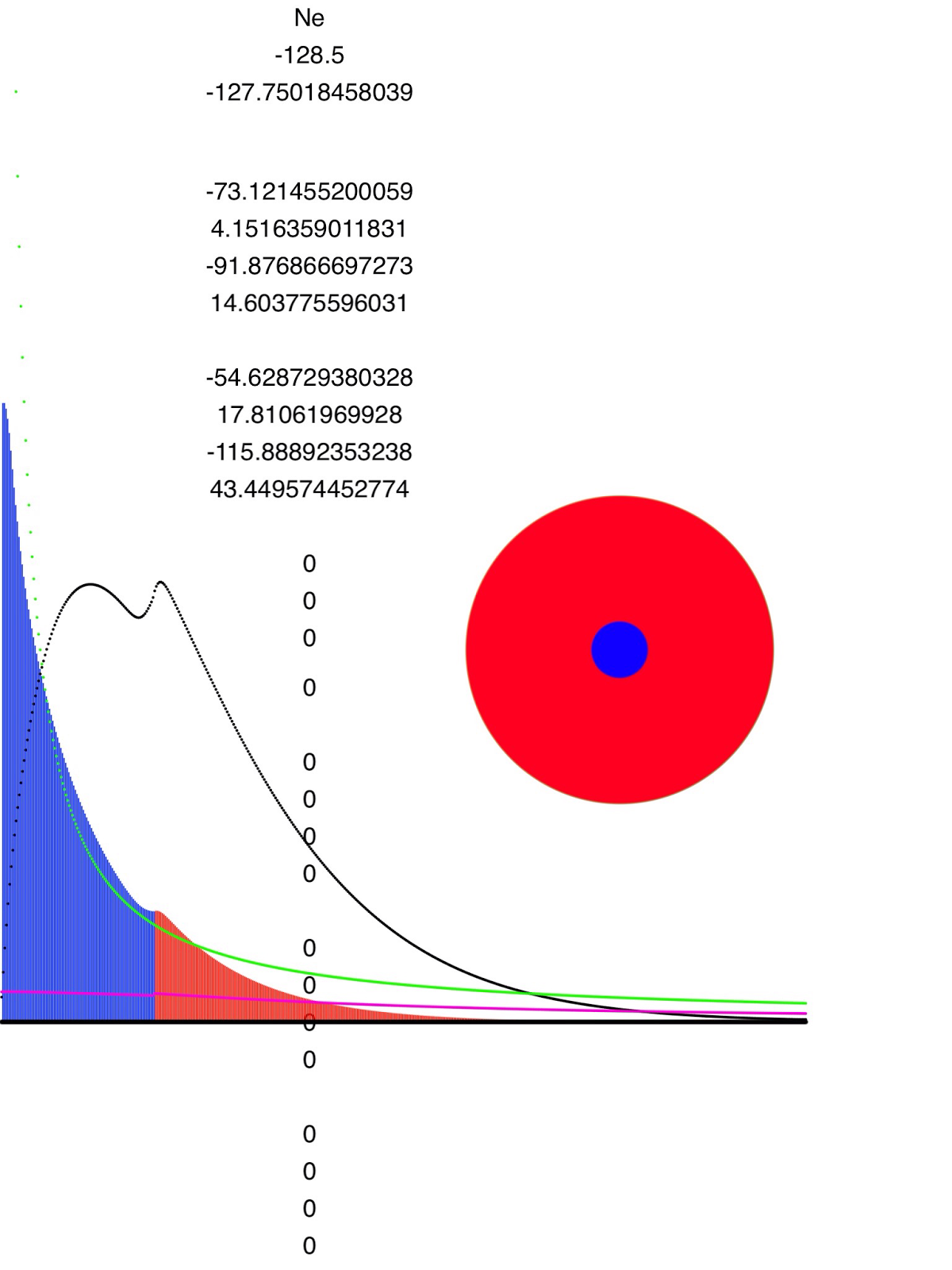
Below are sample computations of ground states for Li1+, C1+, Ne1+ and Na1+ showing good agreement with table data of first ionisation energies of 0.2, 0.4, 0.8 and 0.2, respectively.

Note that computation of first ionisation energy is delicate, since it represents a small fraction of total energy.


onsdag 27 juli 2016

New Quantum Mechanics 9: Alkaline (Earth) Metals

The result presentation continues below with alkaline and alkaline earth metals Na (2-8-1), Mg (2-8-2), K (2-8-8-1), Ca (2-8-8-2),  Rb (2-8-18-8-1), Sr (2-8-18-8-2), Cs (2-8-18-18-8-1) and Ba (2-8-18-18-8-2):


New Quantum Mechanics 8: Noble Gases Atoms 18, 36, 54 and 86

The presentation of computational results continues below with the noble gases Ar (2-8-8), Kr (2-8-18-8), Xe (2-8-18-18-8) and Rn (2-8-18-32-18-8) with the shell structure indicated.

Again we see good agreement of ground state energy with NIST data, and we notice nearly equal energy in fully filled shells.

Note that the NIST ionization data does not reveal true shell energies since it displays a fixed shell energy distribution independent of ionization level, and thus cannot be used for comparison of shell energies.


New Quantum Mechanics 7: Atoms 1-10

This post presents computations with the model of New Quantum Mechanics 5 for ground states of atoms with N= 2 - 10 electrons in spherical symmetry with 2 electrons in an inner spherical shell and N-2 electrons in an outer shell with the radius of the free boundary as the interface of the shells adjusted to maintain continuity of charge density. The electrons in each shell are smeared to spherical symmetry and the repulsive electron potential is reduced by the factor n-1/n with n the number of electrons in a shell to account for lack of self repulsion.

The ground state is computed by parabolic relaxation in the charge density formulation of New Quantum Mechanics 1 with restoration of total charge after each relaxation and shows good agreement with table data as shown in the figures below.

The graphs show as functions of radius, charge density per unit volume in color, charge density per unit radius in black, kernel potential in green and total electron potential in cadmium red. The homogeneous Neumann condition at the interface of charge density per unit volume is clearly visible.

The shell structure with 2 electrons in the inner shell and N-2 in the outer shell is imposed based on a principle of "electron size" depending on the strength of effective kernel potential, which gives the familiar pattern of  2-8-18-32 of electrons in successively filled shells as a consequence of shell volume of nearly constant thickness scaling quadratically with shell number. This replaces the ad hoc unphysical Pauli exclusion principle with a simple physical principle of size and no overlap.

The electron size principle allows the first shell to house at most 2 electrons, the second shell 8 electrons, the third 18 electrons,  et cet.

In the next post similar results for Atoms 11-86 will be presented and it will be noted that a characteristic of a filled shell structure 2-8-18-32- is comparable total energy in each shell, as can be seen for Neon below.

The numbers below show table data of total energy in the first line and computed in second line, while the groups show total energy, kinetic energy, kernel potential energy and electron potential energy in each shell.


måndag 25 juli 2016

New Quantum Mechanics 6: H2 Molecule

Computing with the model of the previous post in polar coordinates with origin at the center of an H2 molecule assuming rotational symmetry around the axis connecting the two kernels, gives the following results (in atomic units) for the ground state using a $50\times 40$ uniform mesh:
  • total energy = -1.167   (kernel potential: -4.28, electron potential: 0.587 and kinetic: 1.147)
  • kernel distance = 1.44
in close correspondence to table data (-1.1744 and 1.40). Here is a plot of output:

söndag 24 juli 2016

New Quantum Mechanics 5: Model as Schrödinger + Neumann

This sequence of posts presents an alternative Schrödinger equation for an atom with $N$ electrons starting from a wave function Ansatz of the form
  • $\psi (x,t) = \sum_{j=1}^N\psi_j(x,t)$      (1)
as a sum of $N$ electronic complex-valued wave functions $\psi_j(x,t)$, depending on a common 3d space coordinate $x$ and a time coordinate $t$, with non-overlapping spatial supports $\Omega_j(t)$ filling 3d space, satisfying for $j=1,...,N$ and all time:
  • $i\dot\psi_j + H\psi_j = 0$ in $\Omega_j$,       (2a)
  • $\frac{\partial\psi_j}{\partial n} = 0$ on $\Gamma_j(t)$,   (2b)
where $\Gamma_j(t)$ is the boundary of $\Omega_j(t)$, $\dot\psi =\frac{\partial\psi}{\partial t}$ and $H=H(x,t)$ is the (normalised) Hamiltonian given by
  • $H = -\frac{1}{2}\Delta - \frac{N}{\vert x\vert}+\sum_{k\neq j}V_k(x)$ for $x\in\Omega_j(t)$,
with $V_k(x)$ the repulsion potential corresponding to electron $k$ defined by 
  • $V_k(x)=\int\frac{\psi_k^2(y)}{2\vert x-y\vert}dy$, 
and the electron wave functions are normalised to unit charge of each electron:
  • $\int_{\Omega_j(t)}\psi_j^2(x,t) dx=1$ for $j=1,..,N$ and all time.   (2c)
The differential equation (2a) with homogeneous Neumann boundary condition (2b) is complemented by the following global free boundary condition:
  • $\psi (x,t)$ is continuous across inter-electron boundaries $\Gamma_j(t)$.    (2d)

The ground state is determined as a the real-valued time-independent minimiser $\psi (x)=\sum_j\psi_j(x)$ of the total energy
  • $E(\psi ) = \frac{1}{2}\int\vert\nabla\psi\vert^2\, dx - \int\frac{N\psi^2(x)}{\vert x\vert}dx+\sum_{k\neq j}\int V_k(x)\psi^2(x)\, dx$,
under the normalisation (2c), the homogeneous Neumann boundary condition (2b) and the free boundary condition (2d).

In the next post I will present computational results in the form of energy of ground states for atoms with up to 54 electrons and corresponding time-periodic solutions in spherical symmetry, together with ground state and dissociation energy for H2 and CO2 molecules in rotational symmetry.

In summary, the model is formed as a system of one-electron Schrödinger equations, or electron container model, on a partition of 3d space depending of a common spatial variable and time, supplemented by a homogeneous Neumann condition for each electron on the boundary of its domain of support combined with a free boundary condition asking continuity of charge density across inter-element boundaries. 

We shall see that for atoms with spherically symmetric electron partitions in the form of a sequence of shells centered at the kernel, the homogeneous Neumann condition corresponds to vanishing kinetic energy of each electron normal to the boundary of its support as a condition of separation or interface condition between different electrons meeting with continuous charge density.

Here is one example: Argon with 2-8-8 shell structure with NIST Atomic data base ground state energy in first line (526.22), the computed in second line and the total energies in the different shells in three groups with kinetic energy in second row, kernel potential energy in third and repulsive electron energy in the last row. Note that the total energy in the fully filled first (2 electrons) and second shell (8 electrons) are nearly the same, while the partially filled third shell (also 8 electrons out of 18 when fully filled) has lower energy. The color plot shows charge density per unit volume and the black curve charge density per unit radial increment as functions of radius. The green curve is the kernel potential and the cyrano the total electron potential. Note in particular the vanishing derivative of charge density/kinetic energy at shell interfaces.


lördag 2 juli 2016

New Quantum Mechanics 4: Free Boundary Condition

This is a continuation of previous posts presenting an atom model in the form of a free boundary problem for a joint continuously differentiable electron charge density, as a sum of individual electron charge densities with disjoint supports, satisfying a classical Schrödinger wave equation in 3 space dimensions.

The ground state of minimal total energy is computed by parabolic relaxation with the free boundary separating different electrons determined by a condition of zero gradient of charge density. Computations in spherical symmetry show close correspondence with observation, as illustrated by the case of Oxygen with 2 electrons in an inner shell (blue) and 6 electrons in an outer shell (red) as illustrated below in a radial plot of charge density showing in particular the zero gradient of charge density at the boundary separating the shells at minimum total energy (with -74.81 observed and -74.91 computed energy). The green curve shows truncated kernel potential, the magenta the electron potential and the black curve charge density per radial increment.

The new aspect is the free boundary condition as zero gradient of charge density/kinetic energy.