måndag 24 september 2012

New Theory of Flight vs Observation


This picture from the Dryden Water Tunnel shows the 3d rotational separation at the trailing edge of the wing, which is a central aspect of the New Theory of Flight, as illustrated in the following generic image:


We see the dye injected on top of the wing follow a streamline along the surface without rotation until the trailing edge where counter-rotating rolls are formed as in the following Navier-Stokes simulation of the flow around a circular cylinder displaying 3d rotational separation:


Aerodynamics Expertise Without Knowledge


Aerospaceweb.org is
  • a non-profit site operated by engineers and scientists in the aerospace field. The goal of this site is to provide educational information on a variety of subjects ranging from aviation to space travel to aerospace technology. Our primary areas of expertise include aerodynamics, propulsion systems, vehicle design, engineering career information, and aerospace history. Learn more about these and other topics by visiting the following sections of our site.
Under Aerodynamics Questions we read as an answer to the question How Does a Wing Work?:
  • So the reader may be asking which of these theories (Bernoulli, Newton, Circulation) is correct
  • In truth, each is valid in some respect and useful for certain applications, but the ultimate question is which is the most fundamental explanation. 
  • Mathematicians would surely prefer the circulation theory, which is certainly a very elegant approach firmly based on mathematical principles, but it fails to explain what force of nature creates circulation or lift. 
  • Many would argue that the Newtonian explanation is most fundamental since it is "derived" from Newtonian laws of motion. While this is true to some degree, the theory lacks an explanation as to why an airfoil deflects the flow downward in the first place. Even accepting this principle, the idea that an airfoil deflects the flow and therefore experiences lift also fails to capture the fundamental tools of nature (pressure and friction) that create and exert that force on the body.
  • Proponents of this explanation generally deride the Bernoulli theory because it relies on less fundamental concepts, like the Bernoulli and Continuity equations. There is some truth to this complaint, and the theory may be more difficult for the novice to understand as a result.
  • However, both equations are derived from Newtonian physics, and I would argue from more fundamental and more mathematically sound premises than the Newtonian theory. 
  • In the end, I leave it up to the reader to decide.
We see here the collected expertise of aerodynamics being unable to explain anything of value about the generation of lift of a wing, simply giving up and passing the question of How Does a Wing Work  over to the reader. 

But there is a New Theory of Flight giving a true scientific explanation different from the above trivial no-explanations.

Pilots Fooled by Federal Aviation Administration

Let us now check out how the generation of lift of a wing is presented in Pilots Handbook of Aeronautical Knowledge by Federal Aviation Adminstration. We read in Chapter 3 Principles of Flight:
  • The formulation of lift has historically been the adaptation over the past few centuries of basic physical laws. These laws, although seemingly applicable to all aspects of lift, do not answer how lift is formulated. In fact, one must consider the many airfoils that are symmetrical, yet produce significant lift.
This is not a very promising start. The next step is a digression into the Magnus effect of a rotating cylinder:
  • In 1852, the German physicist and chemist, Heinrich Gustav Magnus (1802–1870), made experimental studies of the aerodynamic forces on spinning spheres and cylinders. (The effect had already been mentioned by Newton in 1672, apparently in regard to spheres or tennis balls). These experiments led to the discovery of the Magnus Effect, which helps explain the theory of lift.
  • To summarize the Magnus effect, an airfoil with a positive AOA develops air circulation about the upper surface of the wing. Its sharp trailing edge forces the rear stagnation point to be aft of the trailing edge, while the front stagnation point falls below the leading edge. [Figure 3-4]

We see here an attempt to explain the Kutta-Zhukovsky circulation theory, which is unphysical by asking the incoming flow to change direction. This is sensed by FAA feeling that prospective pilot will not be convinced, and so seeks to enhance the message by: 
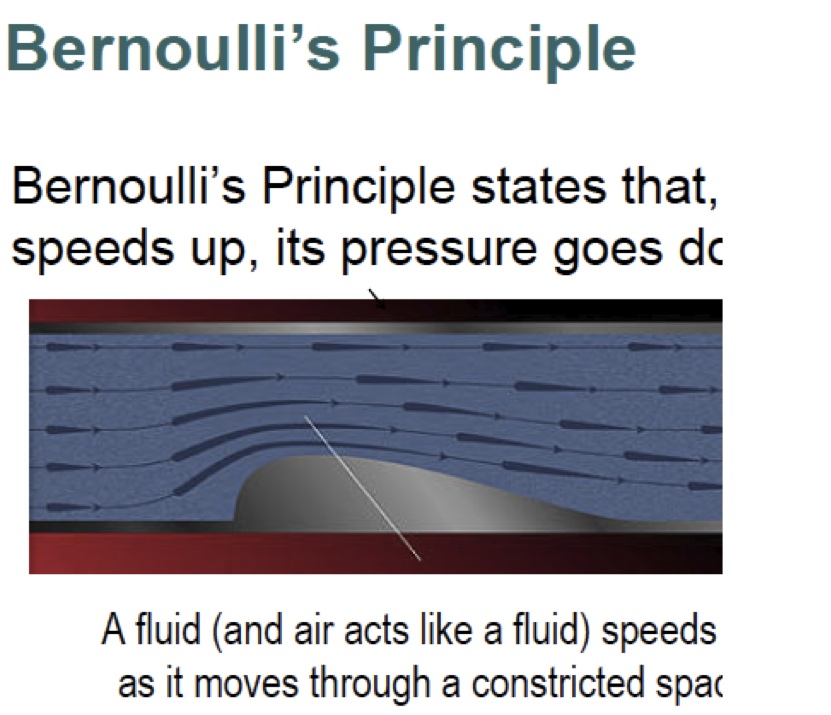
  • A half-century after Newton formulated his laws, Daniel Bernoulli, a Swiss mathematician, explained how the pressure of a moving fluid (liquid or gas) varies with its speed of motion. Bernoulli’s Principle states that as the velocity of a moving fluid (liquid or gas) increases, the pressure within the fluid decreases. This principle explains what happens to air passing over the curved top of the airplane wing. 
This time it is not circulation but instead Bernoulli with lower pressure above supported by a picture illustrating the Venturi effect:

FAA thus hints at the "Venturi" effect, which however is identified by NASA as Incorrect Lift Theory #3.

The discussion is then rounded off by:
  • Since air is recognized as a body and it is accepted that it must follow the above laws, one can begin to see how and why an airplane wing develops lift. As the wing moves through the air, the flow of air across the curved top surface increases in velocity creating a low-pressure area. 
  • Although Newton, Magnus, Bernoulli, and hundreds of other early scientists who studied the physical laws of the universe did not have the sophisticated laboratories available today, they provided great insight to the contemporary viewpoint of how lift is created. 
We see again how a governmental agency struggles with the sad fact that there is no convincing theory of lift offered by aerodynamicists to be taught to pilots. 

The New Theory of Flight presented on The Secret of Flight is the first scientific explanation of the generation of lift of a wing, and as such it both describes real physics and is possible to understand, by both prospective pilots and air passengers.

söndag 23 september 2012

Flight Theory in NSF GK12 Aerodynamics Contradicted by NASA

The NSF GK-12 Wind Energy and Aerospace Workshop 2009 teaches young minds about Fundamentals of Flight, Stability and Control in the following pictures:


We see here the "Venturi" theory which is described by NASA as Incorrect Theory #3. This is yet another example of a science of aerodynamics in crisis with contradicting messages sent by different parts of the science administration here in the form of NSF and NASA.

Unphysical AIAA Lift Theory


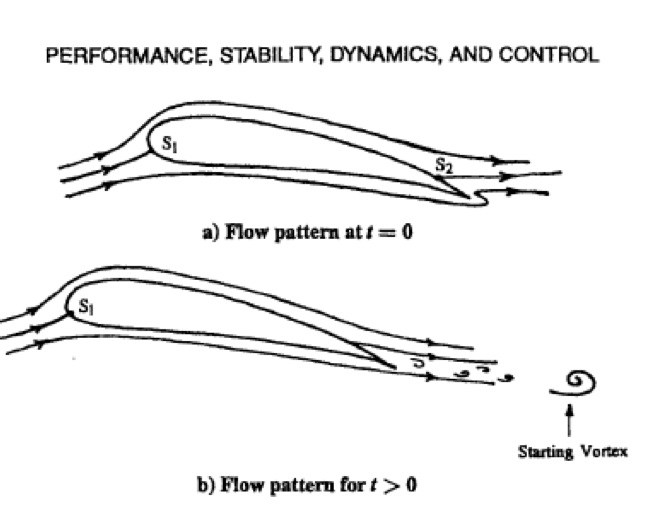
Performance, Stability, Dynamics and Control by B. N. Pamadi in AIAA Education Series, describes the generation of lift of an airfoil as follows (with illustrations above):
  • The lifting line theory will be used to obtain expressions for the lift-curve slope.
  • In lifting line theory the wing is modeled as a horse-shoe vortex formed by a bound vortex, trailing vortices from the wing tips completed by a so-called starting vortex.
  • The bound vortex induces an upwash in from of the wing and a downwash behind. The trailing vortices induce downwash everywhere ... negligible in the vicinity of the wing.
  • To understand how a starting vortex can be a physical reality....
This is Prandtl's lifting line theory. The basic idea is that the bound vortex generates upwash in front and downwash behind and thus generates lift.

As indicated by the phrase "to obtain expressions" (for the lift-curce slope), lifting line theory is on one hand not really supposed to describe actual aerodynamics but only give a way of computing the one number of the lift-curve slope, and on the other hand it is described in suggestive pictures as if being real in some sense, although the action of the starting vortex is surrounded by mystery. The presentation is thus ambigious.

The truth is that lifting line theory does not describe actual physics: The upwash in front of the wing is not seen in real flow, nor in Navier-Stokes simulations, and in fact not in the top left picture either. What is seen is downwash at the trailing edge as a result of 3d rotational separation as described in the New Theory of Flight.

The New Theory is in the words of AIAA editor Greg Blaisdell, when rejecting it for publication in AIAA Journal, described as follows:
  • Your paper is unusual in that it challenges our existing understanding of aerodynamics.
Yes, it does, and shows that existing understanding is incomplete. To reject work increasing understanding is not beneficial to the science of aerodynamics and to engineers designing airplanes.


lördag 22 september 2012

AIAA Lift Theory Contradicted by NASA


The generation of lift of an airfoil is described in Introduction to Aeronautics: A Design Perspective in AIAA Education Series with support of the above pictures, as follows:
  • As the flow moves downstream, the orientation of the airfoil causes more of an obstruction to the flow above it than it does to the flow below it. This obstruction to the flow causes the stream tube above the airfoil to be constricted. 


We see that AIAA and NASA present contradictory information about the most central problem of aeronautics: generation of lift by a wing. Notice also the unphysical high pressure at the trailing edge on the upper right picture.

This is yet another illustration of the complete collapse of aeronautics education fostered by AIAA, making it possible to reject the New Theory of Flight without real scientific evaluation.

fredag 21 september 2012

Aircraft Design Engineers Fooled by AIAA


Let us continue our study how AIAA expresses its world-leading expertise in the book Aircraft Design: A Conceptual Approach, by D. Raymer, 1992, published in the AIAA Education Series described as "creating a comprehensive library of the established practices in aerospace design" with the following conclusion of the Foreword: "For many years Aircraft Design will be a valuable text book for all who struggle with the fundamentals and intricacies of aircraft design".  We read on p 35 under Airfoil Lift and Drag: 
  • An airfoil generates lift by changing the velocity of the air passing over and under itself. The airfoil angle of attack and/or camber causes the air over the top of the wing to travel faster than the air beneath the wing.
  • It can be seen that the effect of the airfoil is to introduce a change in airflow, which seems to circulate around the airfoil...
  • This "circulation" is the theoretical basis for the classical calculation of lift and drag-due-to-lift The the greater the circulation the greater the lift. 
  • Odd as it sounds, an airfoil in two-dimensional flow does not experience any drag due to the creation of lift. 
  • The figure below shows typical pressure distributions for the upper and lower surfaces of a lifting airfoil at subsonic speeds. Note that the upper surface of the wing contributes about two-thirds of the total lift. 

AIAA thus sells the 2d Kutta-Zhukovsky circulation theory of lift. AIAA claims that the theory offers a way to calculate lift and drag, but then directly admits that the drag comes out to be zero, which is described as "odd".

But AIAA does not admit that the pressure distribution in the presented figure with its high pressure at the trailing edge suggested by the theory, is not what is observed in reality. 

AIAA is thus fooling aircraft design engineers into relying on an unphysical theory which does not describe reality. AIAA continues along the same track by rejecting the New Theory of Flight without proper evaluation, which is also "odd".

AIAA further ruins the hope of any prospective CFD-user during any foreseeable future:
  • No current codes actually attempt to solve the true full Navier-Stokes equations due to the difficulty of mathematical analyzing turbulence. Turbulence occurs at the molecular level, which would probably require gridding with billions of molecular sized grids. 
  • CFD does not replace the wind tunnel. In fact , it really doesn't even reduce the number of wind-tunnel test hours.
But if this was true in 1992, it is not true any more in 2012: The computations behind the New Theory of Flight shows that it is indeed possible to solve the full 3d Navier-Stokes and thereby compute lift, drag and pressure distribution for a full aircraft using affordable millions of mesh points, thus basically eliminating the need of a wind tunnel. This possibility is today rejected by AIAA without evaluation, which is another way of fooling aircraft design engineers.

Von Karman on Incorrect KZ-theory of Lift


The above pictures from von Karman's Aerodynamics (1954) compares the lift coefficient for different angles of attack (left) and pressure distribution around a NACA 4412 airfoil, between Kutta-Zhukovsky circulation theory of lift and experimental values.

We see that the theoretical lift coefficient is too big and does not include the drop at stall at 16 degrees, and that the high pressure at the trailing edge from theory is not observed in experiments.

Von Karmann comments on p 46:
  • The pictures show that the usefulness of the theory is restricted to a limited range of angles of attack, comprising relatively small angles, positive and negative. Beyond this range the measured values falls far below the values predicted by the theory.
This comment alone would have been sufficient to discard KZ-theory as unphysical (and thus dangerous to use), if there had only been a better theory around. But it was not and so the incorrect KZ-theory has survived into our days as the text-book theory of lift. 

With the advent of the New Theory of Flight as the first the physically correct theory predicting both lift and pressure distribution in close correspondence to observation for all angles of attack including stall and beyond, the KZ-theory can now finally be put into the wardrobe of incorrect physical theories along with flogiston theory. It will take some time before this is realized and acknowledged by AIAA: The World's Forum for Aerospace Leadership, but it will come.


torsdag 20 september 2012

Ahlborn: Early Critic of Prandtl


Friedrich Ahlborn (1858-1937), a today forgotten pioneer of fluid dynamics, performed and photographed experiments in Hamburg similar to those performed by Prandtl in Hanover described in his 1904 article representing the birth of modern fluid mechanics with the all-important role of the boundary layer as the novelty, as described in The Dawn of Fluid Dynamics.

Ahlborn's motto was "Per experimentum et induction omnia" (everything is to be obtained inductively from experiments).

Ahlborn compared the boundary layer to a ball bearing, "like frictional rolls between the solid surface and the surrounding free flow", which he referred to as a "balanus layer" from the Latin word "balanus" meaning barnacle. Ahlborn further identified in his photographs "tender cycloidal serpentines" supporting his view that the transitional space to the free stream at some distance from the surface was "filled with a long chain of vortices".

Ahlborn thus identified the same structures experimentally as we have identified as 3d rotational separation in computational simulations 100 years later, as described on The Secret of Flight.

We cite from The Dawn of Fluid Dynamics:
  • In the 1920s Ahlborn and Prandl became engaged in sometimes harsh scientific quarrels. Despite their common interest in the nature of the boundary layer and the mechanism of skin friction, their mentalities  as researchers had little in common. "Per experimentum et induction omni" Ahlborn's leitmotif, was not Prandtl's.... 

Is Scientific Truth Determined by Politicians?


Politicians deciding a scientific truth of CO2 global warming at the 2009 Copenhagen Conference. Notice that our Prime Minister (3) is skeptical but keeps quite.


Science and politics/society is closely intertwined, but is it even so that scientific truth is determined by politicians?

Yes of course you say: Just look at the climate science of CO2 global warming determined by the politicians of IPCC: Continuing burning fossil fuel will raise global temperature by catastrophical 3 C and thus has to be reduced to zero by 2050.

The real scientific evidence for the CO2 alarm is however nil.

But is this an exceptional case? Is truth in more fundamental areas of physics determined by science and scientists and not by politics and politicians?

You may, probably correctly, argue that Newton's 2nd Law is not determined by politicians, but what about quantum mechanics and relativity theory forming the foundations of modern physics?

Well, we know that Planck as an expression of the ambitions of the emerging German Empire in 1900 took on the task of solving the main open problem of classical physics of blackbody radiation, and knowing that a solution had to be delivered "at any price", gave up the most holy of all principles of physics of determinism in his resolution based on statistics. The emerging German Empire had to deliver a solution and it did, however at the price of giving up holy principles of physics. This was practical politics rather than true science.

We also know that Einstein was elevated to be the God of modern physics by Eddington in a grand gesture of reconciliation between England and Germany after the 1st Word War, which was further enforced by an enthusiastic reception in the US with relativity as the ultimate expression of modernity.  France remained skeptical to Einstein' science until the 1950s, joined by USSR, but with Einstein in the team the US could win the Cold War and so finally confirm the truth of relativity theory, as well as the statistical interpretation of quantum mechanics going back to Planck.

But few physicists of today claim to understand relativity theory, and less the 50% say that they believe in the statistical Copenhagen interpretation of quantum mechanics.

The 1st World War is known as The Chemist's war and the 2nd as The Physicist's War, both won by better science, some of which was actually true. What will science be without a war?

PS And what about the theory of flight? Was it determined by Germany in cooperation with US in the 1920s that the Kutta-Zhukovsky circulation theory explains the generation of lift under heavy protests from UK? Yes, that is the truth which is still valid.