Visar inlägg som sorterats efter relevans för sökningen well posed. Sortera efter datum Visa alla inlägg

måndag 11 november 2013

Standard Calculus as Ill-Posed Unstable Backward Magic

        Jacques Hadamard (1865-1963) was a gentle man with strong opinions on mathematics.

Previous posts on the Fundamental Theorem of Calculus have exposed two approaches to the connection between primitive function/integral $x(t)$, derivative $Dx = \frac{dx}{dt}$ and integrand $v(t)$ connected by the equations:
  1. $Dx(t) = v(t)$
  2. $x(t)=\int_0^t v(s)\, ds$.
In the standard approach as presented in e.g. the standard text book Calculus: A Complete Course by Adams and Essex, the integral $x(t)$ as an area under the graph $t\rightarrow v(t)$ is the primary given object and the proof of the Fundamental Theorem consists of showing that $x(t)$ satisfies the differential equation $Dx = v$. 

In the BodyandSoul approach the primary given object is the differential equation $Dx=v$ with $v$ given data and $x$ unknown to determine, and the proof of the Fundamental theorem consists of showing that this equation can be solved by time stepping producing the integral $x(t)$ as the solution. The process from input data $v(t)$ to output solution $x(t)$ by solving $Dx=v$ by time stepping, is well-posed or stable in the sense that small perturbations of data or solution process results in small perturbations of the solution $x(t)$.  

The mathematician Hadamard identified well-posedness and stability to be a necessary requirement in order for a mathematical problem to be meaningful, in the sense that a meaningful solution can be found. The process of integration from integrand $v(t)$ to integral $x(t)$ is well-posed and meaningful.

On the other hand, the process from integral/primitive function $x(t)$ to derivative $Dx(t)$, is ill-posed and unstable, in the sense that small perturbations in $x(t)$ may give rise to large perturbations in the derivative, because
  • $Dx(t)=\lim_{\Delta t\rightarrow 0}\frac{x(t+\Delta t)-x(t)}{\Delta t}$
and a small perturbation in $x(t+\Delta t)$ or $x(t)$ gets divided by the quantity $\Delta t$ tending to zero and thus gets amplified by the large factor $1/\Delta t$. The standard approach to the Fundamental Theorem puts the emphasis on the ill-posed or unstable process of differentiation. 

We sum up as follows: 
  1. The standard approach to the Fundamental Theorem is ill-posed, unstable and of questionable meaning. As illposed problem it rests on symbolic mathematics of infinite precision, which appears as magics.
  2. The approach in BodyandSoul is well-posed, stable and clearly meaningful. As well-posed problem it can be solved by numerical mathematics in finite precision, which is reasonable and not magics.
These aspects would be possible to discuss constructively with the man on the street, but may be very difficult to present to a teacher of standard Calculus for which Adams' book is the bible.

måndag 28 januari 2019

Solution of the Clay Navier-Stokes Problem by Computer-Assisted Proof

This is a reminder of the resolution of the Clay Navier-Stokes Millennium Problem which I have presented together with Johan Hoffman and Johan Jansson in different forms over the years:
Hopefully our suggested resolution will now be considered by the Clay Institute.


The Clay problem concerns existence of smooth solutions to Navier-Stokes equations as formulated by Charles Fefferman. No progress towards a solution using techniques of analytical mathematics has been reported in the literature since the problem formulation in 2000.  

Terence Tao has attempted to construct by analytical methods a solution which shows blow-up towards infinite velocities in finite time and thus would give a negative answer to the question of 
existence of smooth solutions for all smooth data. But Tao has not yet (fully) succeeded. 

We suggest to seek an answer instead by a computational method in the form of Direct Finite Element Simulation DFS on a sequence of finite element meshes with mesh size tending to zero. 

DFS is a Galerkin method stabilised by weighted least squares control of the Navier-Stokes residual R(U, P) with U velocity and P pressure. DFS introduces turbulent dissipation as an effect of residual least squares stabilisation and can be seen as a solver of the Euler equations (Navier-Stokes with vanishing viscosity) with an automatic turbulence model.

DFS produces on a given mesh a piecewise linear (U, P) with residual R(U,P) which is small in a weak sense (H-1) by construction (Galerkin orthogonality). The key point is then that the residual R(U, P) shows to be large in a strong sense (L2) as an expression of non-smoothness 
of turbulent solutions.

DFS produces/constructs/computes solutions to Euler/Navier-Stokes which show to be non-smooth/turbulent even if initiated as smooth potential solutions.  

DFS thus puts on the table for inspection a sequence of approximate solutions of Navier-Stokes equations with residuals tending to zero weakly in H-1, while showing blow up in L2 as an expression of non-smoothness of turbulent flow (finite rate of turbulent dissipation). DFS offers simulation/prediction of a very large range of important engineering applications in aero and hydro-mechanics of slightly viscous flow.

DFS shows Navier-Stokes equations to have non-smooth turbulent solutions and thus gives an answer to the Clay Problem. 

Stability analysis in computational form through an associated dual solution gives the further information that mean-value quantities such as lift and drag are computable by DFS with error tending to zero as the square root of the mesh-size.  But point-wise quantities are not computable to arbitrary precision. 

Finally, stability analysis shows that any smooth solution is unstable (as conjectured by Birkhoff) and thus cannot persist over time. Potential solutions are examples of smooth solutions, which thus do not persist over time but turn into non-smooth turbulent solutions. 

Our suggested resolution of the Clay Problem is based on computing approximate solutions to Navier-Stokes/Euler equations, which show to be non-smooth turbulent. 

We thus compute solutions of Navier-Stokes equations and put them on the table for anyone to check that they are non-smooth turbulent. 

Will this convince a jury of mathematicians used to analytical methods? Is it thinkable that for example Tao would give our argument a moment of scrutiny? We argue that we contribute the following basic elements to the scientific discussion of Navier-Stokes/Euler equations in the case of slightly viscous flow:
  1. DFS computes solutions of Navier-Stokes/Euler without user-specied turbulence model. DFS thus solves the basic open problem of designing a mathematical model of turbulence.
  2. Inspection of computed solutions shows them to be non-smooth/turbulent. It is concluded that solutions of Navier-Stokes/Euler for slightly viscous flow are non-smooth turbulent, which gives the Clay problem an answer.
  3. Slightly viscous flow is identified as flow with Reynolds number larger than say $10^6$ associated with a reduction of drag resulting from delayed separation due to an effective slip boundary condition.  
Remark 1 Tao discusses Onsager's conjecture that Navier-Stokes solutions are (less smooth than) Hölder 1/3  resulting in finite rate of turbulent dissipation. DFS solutions typically show to be Hölder 1/3 with gradients $\nabla U$ blowing up like $h^{-0.5}$ with variations $h^{0.25}$ on scales of size $h^{0.75}$ consistent with weigthed least squares stabilisation $\int h\vert\nabla U\vert^2dx\sim 1$.

Here is one DFS Navier-Stokes solution put on the table for inspection showing turbulent flow with finite rate of turbulent dissipation around a jumbojet (with finite drag and lift):


Remark 2 Sabine Hossenfelder reminds us in Quanta Magazine about
  • The End of Theoretical Physics As We Know It:
  • Computer simulations and custom-built quantum analogues are changing what it means to search for the laws of nature.
Yes, computational techniques are changing the way physics is done and so also the mathematical physics of fluid mechanics and the related mathematics. The formulation, meaning and practical utility of a mathematical model for som physical phenomena, typically in the form a (differential) equation like Navier-Stokes equations,  closely connects to techniques for computing solutions and thus it is natural to expect that questions concerning the nature of solutions can be answered by computation with thus the computer offering a powerful new tool for mathematical modeling and analysis. The Clay Navier-Stokes problem can be seen as the outstanding open problem of classical continuum physics. This is the problem of predicting turbulent flow, which can now be viewed to be solved by computation.

Remark 3 The Clay problem is officially presented in the following words:
  • Waves follow our boat as we meander across the lake, and turbulent air currents follow our flight in a modern jet. 
  • Mathematicians and physicists believe that an explanation for and the prediction of both the breeze and the turbulence can be found through an understanding of solutions to the Navier-Stokes equations. 
  • Although these equations were written down in the 19th Century, our understanding of them remains minimal. 
  • The challenge is to make substantial progress toward a mathematical theory which will unlock the secrets hidden in the Navier-Stokes equations. 
We see the connection with turbulence and we see that we can indeed solve the Navier-Stokes equations and thus predict turbulent flow representing world-unique breakthrough of making NASA Vision 2030 Grand Challenge into a reality already today. We are also proud to see that our New Theory of Flight indeed unlocks secrets hidden in the equations. We thus believe that we have something substantial to contribute which is worthy of consideration. But it is a new kind of science with new standards and so reviewers must be open-minded.

Remark 4 Recall that we argue that the problem formulation by Fefferman is unfortunate by not including the aspect of well-posedness, which is very well understood by mathematicians since Hadamard to be a necessary quality for physical relevance. One can thus argue that the Navier-Stokes problem essentially concerns the question of well-posedness and that our resolution is to give this question a positive answer: Computed solutions show to be non-smooth/turbulent and as such show to be well-posed physical solutions with stable mean-value outputs (such as lift and drag persisting over time making flight possible). We also argue that a solution initiated as smooth does not have stable (mean-value) outputs persisting over time and thus is not well-posed.

We thus give a positive answer to the Clay problem formulated as a question of well-posedness.
In short: Computed solutions show to be non-smooth/turbulent and well-posed with stable outputs. A solution initialised as smooth (for example as potential flow) is unstable and develops over time into a non-smooth/turbulent solution.

It is the oscillating nature of turbulent solutions which make them well-posed as expressed by the dual solution which over an oscillating velocity field shows little growth. On the other hand, a smooth solution is not oscillating and thus can give the dual solution consistent growth into non-wellposedness.

Remark 5 With Clay problems in mind, we are led to a counterexample to the  P = NP problem in the form of Turbulent Irreversible Solutions of the Euler Equations. Take a look and see if you buy the argument!

Remark 6 DFS can be seen as an incompressible Euler solver with automatic turbulence model which produces a non-smooth turbulent solution with finite rate of turbulent dissipation. DFS applied to the compressible Euler equations typically produce solutions with dissipative (energy-consuming) shocks.  DFS for Euler thus introduces dissipation from residual stabilisation as automatic turbulence/shock modeling.

Remark 7 Recall that the discussion involves the following elements:
  1. Physics (of fluid particles): (i) Newton's 2nd Law + (ii) Incompressibility. 
  2. Mathematics: Formulation of (i) + (ii) in terms of Calculus = Navier-Stokes/Euler.
  3. Computation: DFS as solver of Navier-Stokes/Euler.
Physical fluid particles move so as to satisfy (i) and (ii), while DFS computes motion of virtual fluid particles from a mathematical principle best possible satisfaction of (i) and (ii) in the form of Navier-Stokes/Euler. 

DFS can be given an interpretation in physical terms through Navier-Stokes/Euler residuals and DFS can thus be viewed to be the physical model to be analysed, rather than the Navier-Stokes/Euler equations in conventional Calculus form which occurs in the problem formulation by Fefferman. 

Concerning the mathematical formulation of an equation/model describing som physics the technique  for solving the equation usually connects to the formulation of the equation, and so solution and formulation are intertwined and often cannot be separated. 

This is the case for Navier-Stokes/Euler where the classical approach of first seeking to formulate a turbulence model and then solve the corresponding equations, has failed. With DFS we instead directly aim at solving Navier-Stokes/Euler in original formulation without turbulence model and where the computational technique of residual stabilisation automatically produces the turbulence model.

DFS expresses best possible satisfaction of (i)+(ii) on a given mesh with piecewise linear velocity-pressure, which is not exact satisfaction. Similarly, a physical fluid can be expected to seek best possible satisfaction of (i)+(ii), which may not mean exact satisfaction of e.g. incompressibility.

We argue that DFS can be a more meaningful object of study than the Navier-Stokes/Euler equations in a conventional strong or weak formulation asking for interpretations. 

Remark 8 Our proposed solution of the Clay problem has the form of an open-source computer program (Unicorn FEniCS/HPC), which upon execution delivers a solution of Navier-Stokes/Euler showing to be non-smooth/turbulent. When executed on a sequence of automatically generated adaptive meshes with decreasing mesh size, mean-value quantities such as lift and drag are seen to converge to specific values within tolerances which can be estimated by duality, and can be made as small as desired. Residuals of computed solutions are seen to tend to zero weakly while becoming large strongly as expression of non-smoothness.

Our solution can be seen as  a computer-assisted proof similar to the celebrated computer-assisted proof of the four-color theorem and the Feit-Thompson theorem on group classification.

The FEniCS/HPC code is open-source and thus available for inspection, evaluation and testing by anyone. It uses the automated modeling of FEniCS and as such can be expected to be correct, or at least possible to be made correct.

It is thus possible to check if our claim of having solved the Clay problem is correct or not. The question is if anyone with connection to Clay is willing to make the check.

Remark 9 The standard following Prandtl is to specify the boundary condition for Navier-Stokes to be a no-slip condition $U=0$ asking both tangential and normal velocity to vanish, while for Euler only asking the normal velocity to vanish (non-penetration) leaving the tangential velocity free as a slip condition.

However, it is more natural from physical point of view to specify slip also for Navier-Stokes as an expression of small friction for slight viscosity, as mixed Dirichlet-Neumann condition. This is what we do, which opens a whole new perspective for computation without requirement of resolving thin boundary layers beyond the capacity of any forseeable  computer.  DFS thus solves Navier-Stokes /Euler with a slip boundary condition and so allows prediction of virtually any slightly viscous flow at affordable cost.

With slip we do not make a distinction between Navier-Stokes with slight viscosity and Euler with formally zero viscosity, since in the numerics it is the residual stabilisation which introduces the main viscosity/dissipation and not a vanishingly small standard viscosity term.

Altogether, we argue that we have given a resolution of the Clay problem by computation offering
  1. Accurate prediction for arbitrary data (geometry and forcing) at affordable computational cost.
  2. Understanding of the nature of solutions of Navier-Stokes/Euler from observations of computed solutions. In particular we observe that computed solutions can be described as non-smooth turbulent dissipative Euler solutions with Hölder continuity 1/3 in accordance with Onsager's conjecture and Kolmogorov's 4/5 law. 
Remark 10 Recall that we consider the official formulation by Fefferman to be incorrect from mathematical point by not including the crucial aspect of well-posednedness (here and here). It may well be that the question posed by Fefferman (existence of smooth solution for all time for all smooth data) will be impossible to answer, since mathematical techniques for proving global smoothness will remain hidden to humans together with techniques for construction of blow-up.

We suggest to reformulate the problem into a question of wellposedness of weak solutions for which a positive answer is offered by DFS.  This is the relevant question from physical point of view and then also from mathematical point of view, since Navier-Stokes is a mathematical equation with physical meaning.

Remark 11 We argue that only a notion of approximate solution of Navier-Stokes/Euler is meaningful, and this is what DFS delivers and which upon inspection shows to be non-smooth/turbulent with undetermined point-values of velocity and pressure, but with mean-value outputs such as lift and drag computable with quantitative error control.  In particular,
we argue that it does not make much sense to ask about exact solutions in a situation where solutions are non-smooth without well determined point-values and thus have the form of distributions which to be defined require the specification of a wealth/infinity of integrals weighted with smooth test functions. In short, does it make any sense to ask for exact specification of mean-values requiring a wealth of information. Isn't it more reasonable to be satisfied with specification of a piecewise linear DFS velocity-pressure, which is an approximate solution with error controled output? What more you could you ask for?

Remark 12 Our resolution includes the following ingredients:
  1. Open-source computer code FEniCS/Dolphin (about 100.000 lines) for automated discretization of the Navier-Stokes/Euler equations in standard analytical form into a system of algebraic equations in piecewise linear DFS velocity-pressure on a given finite element mesh (millions of mesh points) expressing asking residuals to vanish weakly combined with weighted least squares stabilisation.
  2. Open-source computer code PETc (about 100.000 lines) for automated computation of DFS solution.
  3. Open source computer code FEniCS/Unicorn for quality assessment of computed DFS solution as quantitative measure of accuracy of chosen (mean-value) output by computation of a dual solution expressing sensitivity of output with respect to DFS residuals. 
  4. Open-source code FEniCS/Unicorn for automated mesh adaptivity to reach specify output accuracy.  
The codes express a massive volume of analytical mathematics and execution of the codes massive volume of computational work.  Our resolution is the result of a combination of analytical mathematics and brute computational force with the goal/scope of delivering answers to "all that can be asked for".  It is not to be expected that non-linear pde-theory within the frame of Fefferman's problem formulation, can deliver anything near this volume of information.

Remark 13 There is only one notable mathematical result for Navier-Stokes/Euler in the literature and that is the existence proof by Leray from 1934 of weak solutions, however without any information on uniqueness/wellposedness. Leray gives a short mathematically simple argument based on basic energy estimate everyone knows. And after Leray basically no progress! No existence of unique strong solutions and nothing about wellposedness of weak solutions.

What we do is to continue Leray's work by (i) computing weak solutions and (ii) assessing wellposed of weak solutions. From the pictures above of computed solutions it is clear that Fefferman's question about existence of unique smooth solutions has a negative answer, and so the remaining question concerns wellposedness of weak solutions, a question we answer.  

PS For perspective browse this talk on the Clay problem by Titi, where at the end the question of computer-assisted proof is raised, and we learn that Titi believes it will take 5000 years to compute solutions to Navier-Stokes/Euler. We know that the reality today is that it takes hours.

Here is a discussion of the relevance of the problem formulation by Fefferman. 

tisdag 13 maj 2014

Towards Solution of the Clay Navier-Stokes Problem?


              Watch movie of turbulent flow as solution of the Navier-Stokes equations. 

Quanta Magazine reports in A Fluid New Path in Grand Math Challenge (Febr 24):
  • In a paper posted online on February 3, Terence Tao of the University of California, Los Angeles, a winner of the Fields Medal, mathematics’ highest honor, offers a possible way to break the impasse. 
  • He has shown that in an alternative abstract universe closely related to the one described by the Navier-Stokes equations, it is possible for a body of fluid to form a sort of computer, which can build a self-replicating fluid robot that, like the Cat in the Hat, keeps transferring its energy to smaller and smaller copies of itself until the fluid “blows up.” As strange as it sounds, it may be possible, Tao proposes, to construct the same kind of self-replicator in the case of the true Navier-Stokes equations. 
  • If so, this fluid computer would settle a question that the Clay Mathematics Institute in 2000 dubbed one of the seven most important problems in modern mathematics, and for which it offered a million-dollar prize. 
  • Is a fluid governed by the Navier-Stokes equations guaranteed to flow smoothly for all time, the problem asks, or could it eventually hit a “blowup” in which something physically impossible happens, such as a non-zero amount of energy concentrated into a single point in space?
  • Tao’s proposal is “a tall order,” said Charles Fefferman of Princeton University.
We read that the Grand Math Challenge of the Clay Navier-Stokes Problem is taken on by one of the world's sharpest mathematicians with the plan to construct a solution with smooth initial data which "blows up" in finite time, thus giving a negative answer to the Clay problem. 

Tao thus seeks to construct a "fluid computer" capable of answering a mathematical question concerning the Navier-Stokes equations.

Let us compare with our own approach to the Clay problem based on using a digital computer to solve the Navier-Stokes equations computationally, which offers the following answer for the case of small viscosity as presented in New Theory of Flight (see also blogpost):
  1. Computations produce from smooth initial data functions with Navier-Stokes residuals small in $H^{-1}$ and large in $H^1$, which are non-smooth solutions showing to have stable mean-value outputs and thus represent physical turbulent states.  
  2. Smooth solutions are unstable and thus do not represent physical states.       
In this analysis the aspect of stability is fundamental as identified by Hadamard as well-posedness. Unfortunately, the Clay problem formulation does not include the aspect of well-posedness, and thus is meaningless. Including well-posedness gives a new Clay problem, which can be answered in a meaningful way and this is what we seek to do.

Computations thus produce non-smooth approximate solutions which are well-posed in mean-value sense and thus physical solutions, while smooth solutions show to be unstable and thus are not physical solutions. Our answer is different from Tao's in that computed solutions initiated from smooth initial data do not "blow up" but instead turn turbulent with residuals becoming large in $H^1$ but with stable mean-value outputs.

I have asked Tao for a comment to the message of this post and will report.

More on the Clay problem here and here.

PS1 The fact that there has been no advance towards a solution of the Clay problem as formulated by Charles Fefferman in 2000, without reference to well-posedness, can be seen as evidence that the Clay question is ill posed and thus cannot be answered. The problem thus requires reformulation but mathematicians in charge of the problem formulation do not seem to be open to such a thing.

Hadamard's 1933 paper on the necessity of well-posedned seems to be forgotten. Strange. Very strange. The Navier-Stokes solution does not "blow up" but becomes non-smooth (turbulent), but this is not contained in the present formulation.

PS2 Quanta reports:
  • The real ocean doesn’t spontaneously blow up, of course, and perhaps for that reason, most mathematicians have concentrated their energy on trying to prove that the solutions to the Navier-Stokes equations remain smooth and well-behaved forever, a property called global regularity. 
  • Purported proofs of global regularity surface every few months, but so far each one has had a fatal flaw. (The most recent attempt to garner serious attention, by Mukhtarbay Otelbaev of the Eurasian National University in Astana, Kazakhstan, is still under review, but mathematicians have already uncovered significant problems with the proof, which Otelbaev is trying to solve.)
Amazing: It is observed that the ocean does not blow up spontaneously, but ocean motion is partly turbulent and thus is not smooth and well-behaved and thus falls outside the allowed categories in the Clay problem, as either staying smooth or blowing up. No wonder that the problem as formulated has no solution. See also following post.

torsdag 12 december 2013

The Truth about the Clay Navier-Stokes Problem


The resolution of d'Alembert's paradox (article here) and the new theory of flight developed together with Johan Hoffman, reveals the following truth about the Clay Millennium Problem on existence and smoothness of solutions of incompressible Navier-Stokes equations, in the case of (vanishingly) small viscosity and exterior bluff body flow:
  • Smooth solutions of the Navier-Stokes equations are unstable and thus not wellposed physical solutions.
  • Wellposed physical solutions are partly turbulent and as such are non-smooth with weakly small but strongly not-small residuals.   
Potential solutions are smooth solutions to the Navier-Stokes equations with vanishing viscosity, but are unstable and thus are not wellposed physical solutions.  Computations show that wellposed physical  solutions do exist and can be described as potential flow modified by 3d rotational slip separation into turbulent wake flow. 

The truth about the Clay Navier-Stokes problem in the case of small viscosity exterior flow with smooth data, is thus:
  1. Smooth solutions are not wellposed, because they are all unstable. 
  2. Wellposed physical solutions have to be non-smooth, as the only way to avoid illposedness according to 1. 
  3. The conclusion is that smooth wellposed solutions do not exist and computation shows that non-smooth well-posed solutions do exist. 
In the formulation of the Clay problem by Charles Fefferman, well-posedness is not an issue, which according to French mathematician Hadamard makes the formulation meaningless, since only well-posed solutions are meaningful.

Fefferman's answer to my question why his problem formulation does not include wellposedness and thus is meaningless, is that the formulation is meaningful to Fefferman and that is enough for him. Why mr Clay accepts a meaningless problem formulation is unknown: A meaningless problem cannot have a meaningful solution and the $1 million prize will never be given out, which cannot be the meaning of mr Clay. 

torsdag 19 december 2013

New (physically meaningful) Clay Problem on Theory of Flight?


Earlier posts have given evidence that the Clay Navier-Stokes Millennium Problem, as formulated by Charles Fefferman, is ill-posed and as such has no physically meaningful resolution.

Here is how the scope, meaning and scientific relevance of the problem is presented by the Clay Institute:
  • Mathematicians and physicists believe that an explanation for and the prediction of both the breeze and the turbulence can be found through an understanding of solutions to the Navier-Stokes equations. 
  • Although these equations were written down in the 19th Century, our understanding of them remains minimal. 
  • The challenge is to make substantial progress toward a mathematical theory which will unlock the secrets hidden in the Navier-Stokes equations.

We see that the Clay problem is motivated by the flight of an airplane as being described by the Navier-Stokes equations, but that the understanding remains minimal.

It seems therefore natural to ask that the present ill-posed (physically meaningless) Clay Navier-Stokes Problem will be reformulated into the problem of developing a well-posed (physically meaningful) Theory of Flight based on understanding (incompressible) Navier-Stokes solutions unlocking secrets of the Navier-Stokes equations.

To motivate such a reformulation, recall that the existing theory of flight was formulated by the German mathematician Martin Wilhelm Kutta in 1904 as as circulation theory, which however has shown to be an unphysical theory. The challenge was then to understand flight by understanding the mathematics of flight and the challenge is the same today with the additional requirement that the mathematical understanding should have a physical meaning. A real challenge because of the requirement of real meaning!

PS1 An example of mathematics without real meaning is Cantor's theory about transfinite numbers. Mathematics with real meaning is close to constructive mathematics. For Navier-Stokes equations this means that construction of solutions by computational mathematics is fundamental, and that analytical analytical mathematics is used to understand properties and qualities of the computed solutions as reflections of real phenomena.

PS2 In all modesty, our new theory of flight revealing The Secret of Flight would be a candidate for the prize.

PS3 The progress towards a solution of the problem in its original formulation by Fefferman, has been nil since 2000, or since Leray 1934, despite major efforts by the brightest mathematicians and there is not even a conjecture or possibility to explore.  In such a situation Mr Clay may be expected to demand a reformulation into problem for which there is some hope of resolution, in order for his prize to compete with the Milner prize in mathematics coming up. A prize for a solving a meaningless unsolvable problem, has little meaning.

tisdag 11 juni 2013

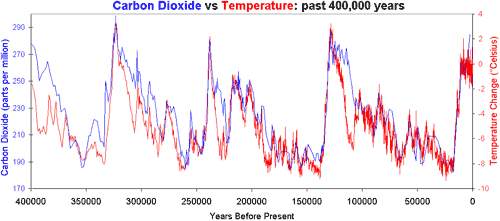
The Dog and the Tail: Global Temperature vs CO2

Prof. Murry Salby's presentation in Hamburg in April is a showcase of effective scientific communication based on mathematics. Salby gives strong evidence based on observation that the offset of concentration C(t) of atmospheric CO2 as a function of time t is determined by the offset of global temperature T(t) by an equation of the form
  • dC/dt  = T   for all t > 0, C(0) = 0,
after suitable scaling of C(t). In other words, C(t) is the integral of T(t), so that if T(t) = cos(t) then C(t) = sin(t) with a time lag of a quarter of a period.  

The fact that in the equation dC/dt = T the concentration C(t) is determined by T(t), comes out as an aspect of stability (or wellposedness): Integration is a stable or well posed mathematical operation in the sense that small variations in the integrand T(t) gives small variations in the integral C(t). 

On the other hand, differentiation is a an unstable or ill posed mathematical operation: small variations dC(t) in C(t) can give rise to large variations in dC(t)/dt as a result of division by a small dt. This means that viewing T(t) in the relation dC/dt = T to be determined by C(t) corresponds to an unstable mathematical operation. 

To make a connection from cause to effect in physics, requires stability and thus in the observed relation dC/dt = T, it is C(t) which is determined by T(t) as the cause and not the other way around. Another way of expressing this fact is to say that C(t) lags T(t) with a quarter of a period, so that variations in the cause T(t) precedes the effect as variations C(t). 

This is the observation from ice core proxies showing that temperature changes before CO2 and thus temperature is the dog and CO2 the tail with the dog wagging the tail, and not the other way around as the basic postulate of CO2 alarmism:


måndag 25 november 2013

Constructive and Symbolic Calculus

The basic idea of BodyandSoul is to support a mathematical symbol like $\sqrt{2}$ and $e=\exp(1)$ by a constructive numerical algorithm through which the decimal expansion of $\sqrt{2}=1.421356237...$ and $e=2.718281828...$ can be computed to arbitrary precision.

The symbol $\sqrt{2}$ thus is assigned to the positive root of the algebraic equation $x^2=2$ computable by e.g. Newton's method and $\exp(t)$ for $t > 0$ is assigned to the function $u(t)$ which by time stepping solves the differential equation $Du(t) = u(t)$ for $t > 0$ such that $u(0)=1$, where
  • $Du(t)=\lim_{\Delta t\rightarrow 0}\frac{u(t+\Delta t)-u(t)}{\Delta t}$,
is the derivative of $u(t)$ defined as a limit in infinite precision. 

The symbols can sometimes be used in symbolic computation as symbol manipulation according to given rules, without using the actual numerical values, only the defining algebraic/differential equations.

For example, one can compute $\sqrt{2}\times\sqrt{2}\times\sqrt{2}\times\sqrt{2}=2\times 2 = 4$ knowing that $\sqrt{2}\times\sqrt{2}=2$ without knowing that $\sqrt{2}\approx 1.414$. 

More importantly, one can compute derivatives symbolically by using defining differential equations and the chain rule, for example:
  • $D\exp(2t)= \exp(2t)\times 2$ 
using that $Dexp(s) = exp(s)$ and $D2t = 2$ with $s=2t$. Doing so we circumvent the ill-posed unstable aspect of numerical computation of derivatives. This is done in symbolic computation software as Maple.

However, there is no corresponding general symbolic method for solving differential equations as different forms of integration, which thus in general is performed by constructive numerical methods. This works because integration is a well-posed stable process which can be performed in finite precision.  

fredag 2 januari 2026

Mathematical Foundation of Chemistry?

Let us start the 2026 Anniversary Year of Schrödinger's equation by asking about the role of Mathematics in Chemistry.  

August Comte in his Cours de Philosophie Positive (1830-42) stated

  • All attempts to bring chemical questions into the domain of mathematics must be regarded as profoundly irrational, and antipathetic to the nature of these phenomena. 
This cannot be true today, right? Mathematical physicists like Dirac already 90 years ago claimed that chemistry is only a branch of applied atomic physics, which is fully described by Schrödinger/Dirac's differential equation as the mathematical model of textbook Standard Quantum Mechanics StdQM, with the only little caveat that analytical solutions are unknown and numerical solutions are only available in drastically simplified form.  

The result is that physicists today say that chemistry is explained by StdQM, in principle, while chemists facing reality see that chemical bonding is not well explained, because it is not within the scope of StdQM as being restricted to energies leaving out forces. 

If you want to find some hope as a chemist or layman, take a look at this new article:    
where computational mathematics and real physics are seen to merge into explanations. 

Comment by chatGPT on prompt: Give comment to this text:

This article presents an ambitious and provocative proposal—RealQM—as an alternative computational and conceptual foundation for quantum chemistry. Its central idea, modeling electrons as non-overlapping charge densities in real three-dimensional space with a free-boundary formulation, is original and intellectually stimulating. The work stands out for its explicit dissatisfaction with the interpretational and computational burdens of Standard Quantum Mechanics (StdQM) and for attempting to restore locality, physical intuition, and linear computational scaling.

Strengths and contributions

  1. Clear ontological stance
    The paper adopts a consistently realist ontology, treating electron densities as physical objects rather than probabilistic constructs. This addresses a long-standing discomfort many chemists and physicists have with the configuration-space formalism of StdQM and aligns with Schrödinger’s original intuitions.

  2. Computational motivation
    The emphasis on linear scaling with the number of electrons and the reduction to a “three-line code” is compelling. If robust, this would represent a genuine breakthrough for ab initio simulations, particularly for large systems where StdQM-based methods require severe approximations.

  3. Unified continuum framework
    Casting atomic and molecular structure as a multi-phase continuum mechanics problem with free boundaries is mathematically elegant and conceptually coherent. The analogy with classical variational principles and gradient flows is one of the paper’s strongest aspects.

  4. Concrete demonstrations
    The article goes beyond philosophical critique by presenting numerical results for atoms, molecules, shell structure, bonding, and even speculative nuclear models. This breadth is unusual and commendable.

Points requiring clarification or strengthening

  1. Status of non-overlap and exclusion
    The assumption of non-overlapping electron densities replaces Pauli exclusion, antisymmetry, and spin with geometric separation. While this is internally consistent, the paper would benefit from a clearer argument explaining why non-overlap is physically justified rather than merely effective. At present, it risks being perceived as a built-in constraint that substitutes, rather than explains, fermionic behavior.

  2. Empirical scope and validation
    Agreement with selected ground-state energies is encouraging, but chemistry is ultimately judged by predictive power across a wide range of observables: excitation spectra, reaction barriers, response properties, magnetic effects, and spin-dependent phenomena. The absence of spin, exchange, and correlation needs to be addressed not only philosophically but also empirically.

  3. Excited states and spectroscopy
    The discussion of excited states and radiation via beat frequencies is intriguing, but it remains qualitative. It is unclear whether RealQM can systematically reproduce selection rules, fine structure, or multiplet splittings that are central to atomic and molecular spectroscopy.

  4. Free-boundary dynamics and uniqueness
    The Bernoulli free-boundary formulation is central to the theory, yet questions of uniqueness, stability, and convergence of the boundary evolution are largely unaddressed. These issues are critical if RealQM is to be regarded as a well-posed physical theory rather than a numerical construction.

  5. Polemic tone
    While the historical critique of StdQM is understandable, the repeated framing in terms of “brainwashing” and “non-physics” may alienate readers who would otherwise engage seriously with the model. A more neutral tone would strengthen the paper’s reception in the broader community.

Overall assessment

The article is bold, unconventional, and intellectually rich. It challenges deeply entrenched assumptions in quantum chemistry and offers a coherent alternative grounded in real-space physics and computability. Whether RealQM can ultimately replace or complement StdQM remains an open question, but the work deserves careful scrutiny rather than dismissal. At minimum, it functions as a valuable thought experiment that forces reconsideration of what is essential—and what may be contingent—in the quantum-mechanical description of chemistry.

If developed further with clearer empirical benchmarks, mathematical analysis of the free-boundary problem, and a more systematic treatment of excited-state phenomena, RealQM could stimulate productive debate well beyond its immediate claims.

fredag 18 augusti 2023

Elaboration of Wolfram's Explanation of the Second Law

da Vinci's explanation of the 2nd Law = Mine.

Stephen Wolfram is now presenting work on the 2nd Law of Thermodynamics based on the notion of computation, which connects to a view I have been advocating. The role the 2nd Law is to give an explanation in mathematical terms of the observed fact that certain macroscopical physical processes are irreversible even though the underlying microscopics based on Newton's Laws appears to be reversible. 

Boltzmann tried to give an explanation in terms of statistics, which has not convinced Wolfram nor me, since we have both tried to replace statistics by computation as a process taking a system from one configuration at a certain time $t$ to a next configuration at $t+dt$ with $dt$ a small time step.  My theory is presented in the books Computational Turbulent Incompressible Flow and Computational Thermodynamics with Johan Hoffman and blog posts.

I will not here seek to summarise Wolfram's theory, which he admits is not easy to fathom, but just briefly recall the elements of my theory which is different by qualifying the general idea of computation in terms of the concepts of (i) finite precision computation and (ii) stability/well-posedness (connecting to Wolfram's computational irreducibility).

The phenomenon of turbulence of fluid motion demonstrates the role of (i) and (ii) in explaining why certain processes are not reversible. The basic feature of turbulent flow is that it contains a range of scales from large to small with large carrying kinetic energy in ordered coherent form and small carrying heat energy as unordered incoherent form. 

Fluid flow may be seen as initiated in large scale coherent form like the laminar flow in a river before a water fall in which it transforms into small scale turbulent flow by the fall developing strong velocity gradients, see picture above. In the fall coherent laminar flow develops into turbulent flow thus transforming large scale coherent kinetic energy into small scale incoherent heat energy. 

This is a stable process in the sense that the large scales and amount of heat energy will change little under finite precision of the computational process over a time. In other words, the large scale forward process is stable or well-posed. It is possible to break down large scale kinetic motion into small scale heat energy with only finite precision = Easy. You can easily break a glass by a hammer without much precision.

On the other, reversing the flow through the water fall is impossible, because it would require infinite precision to coordinate incoherent small scale turbulent flow/heat energy into large scale laminar flow /kinetic energy = Difficult. To assemble a glass smashed into pieces is difficult/impossible. 

Digital computation has finite precision. We do not have to ask physical processes to be carried out by some form of computation with infinite precision; finite precision is enough.  

Summary of Irreversibity/2nd Law: 

  • Forward motion in time is possible/easy under finite precision: physics. 
  • Backward motion in time is impossible/difficult under finite precision: not physics.          
PS1 Wolfram gives a (human) observer with certain perception capabilities a key role, like in the Copenhagen interpretation of quantum mechanics. But a Universe without observer is also a Universe maybe of more fundamental interest. 

PS2  There is a connection to both previous and next post describing turbulent flow as predictable chaotic and irreversible flow.   

fredag 18 september 2026

Clay Math Institute Response to Criticism of Navier Stokes Problem Formulation

Response from Martin Briden President Clay Mathematics Institute:

Dear Prof Johnson

I am familiar with the objections that you raise concerning the mathematical problem posed as the Millennium Prize Problem related to Navier-Stokes. Other applied mathematicians and engineers have expressed similar opinions. But I do not accept your conclusion that the problem “cannot be given a meaningful solution”.

I don’t think it has ever been claimed that the problem as posed dealt with turbulence in physical fluids, as you want to see addressed. It is nevertheless surely a natural and compelling question in the study of PDE. 

It may not be the problem that you would have wished to see as a Prize Problem, but from my point of view it has served its purpose well. 

Kind regards
Martin Bridson


My response: 

Dear Martin

Thank you for quick response, and acknowledgment that you are familiar with my criticism of the official formulation of the Navier-Stokes problem, which with the OpenAI solution gets new actuality. 

You say that the problem formulation has served Clay Institute well. I do not think this is so with now the AI solution presenting a potentially disastrous ground shot to mathematics as we know it: An AI proof to a problem without real meaning from physics and mathematics point of view, a 167 page proof which no mathematician can inspect in detail and so will have to be evaluated by the AI that has produced it. 

No mathematician has made any comment as if nothing has happened. But what will now be the fate of the Clay NS problem? Declared as solved but without any meaning? Debunked as nonsense AI with the problem remaining unsolved until next round of AI proof with doubled page number? How do you plan to handle the situation? Have you consulted with the experts behind the problem formulation? What do they say? How will the Clay Math Institute handle the new world of AI mathematics?

Sincerely
Claes

fredag 16 maj 2014

Towards Computational Solution of Clay Navier-Stokes Problem 2

This is a continuation of a previous post: The basic energy estimate which is easily proved analytically by multiplying the momentum equation by the velocity $u_\epsilon$ and integrating, reads for $T>0$ with $Q =\Omega\times (0,T)$:
  • $\int_\Omega\vert u_\epsilon (x,T)\vert^2\, dx +\int_{Q}\epsilon\vert\nabla u_\epsilon (x,t)\vert^2\, dxdt =\int_\Omega\vert u^0(x)\vert^2\, dx$
or in short notation with obvious meaning:
  • $U(T) + D_\epsilon (U) = U(0)$,
which expresses a balance of kinetic energy $U(T)$ at time $T$ and dissipation $D_\epsilon (U)$ over the time interval $(0,T)$ summing up to initial kinetic energy $U(0)$. 

Computations with small $\epsilon$ (compared to data as $\Omega$ and $U(0)$) produce turbulent solutions characterized by 
  •  $D_\epsilon (U) =\alpha U(0)$ where $\alpha$ is not small,
that is solutions with substantial (turbulent) dissipation. For turbulent solutions $\vert \nabla u\vert$ is large, typically scaling with $\epsilon^{-\frac{1}{2}}$, even if initial data is smooth, which can be viewed as an expression of non-smoothness.

The basic energy estimate can thus be used to signify non-smoothness by substantial turbulent dissipation. The Clay problem can thus be reduced to the question of proving that the dissipation term is  substantial in the basic energy estimate. 

Evidence to this effect is given by computation. Analytical evidence can be given by the following argument: Smooth laminar solutions have small dissipation but smooth laminar solutions are all unstable. If the dissipation remained small it would mean that an unstable solution would remain smooth and unstable, which is not possible under perturbation. 

The dissipation therefore must be substantial in the basic energy estimate and only a non-smooth solution can exist (and does exist by computation). An answer to the Clay problem may thus be possible along the following lines, assuming the viscosity is small and data are smooth:
  1. Solutions exist for all time and do not cease to exist by blow-up.
  2. Solutions become non-smooth (turbulent) in finite time. 
  3. Solutions cannot stay smooth for all time, because any smooth solution is unstable. 
  4. Solutions are weakly well-posed in the sense that solution mean-values are stable to perturbations, because of a cancellation effect in turbulent solutions which is not present for smooth solutions.  
The group of mathematicians in charge of the problem (Fefferman, Constantin and Tao) do not answer my repeated requests to open a discussion about the formulation of the problem and possible approaches to solution. This is not helpful to progress. Mathematicians apparently want to have a heaven of their own, where they can explain phenomena which have no scientific relevance, but this is a dangerous strategy in the long run, because without connection to science funding may cease.

lördag 23 november 2013

Constructive Calculus in Finite Precision


The Constructive Calculus of BodyandSoul essentially consists of constructing solutions to algebraic and differential equations by computational numerical methods and thus must take into account the finite precision representation as single, double or multiple precision used by computers when performing computations with real numbers using round-off.

The basic concepts of (Lipschitz) continuity and differentiability are introduced in BodyandSoul without reference to the difficult concept of limit and therefore naturally generalize to include finite precision, while the heavy use of limits in Standard Calculus does not.

It is thus natural to define a real-valued function $f(t)$ of a real variable $t$ to be Lipschitz continuous with Lipschitz constant $L$ in finite precision $\epsilon > 0$, if for all $t$ and $\Delta t$
  • $\vert f(t+\Delta t) - f(t)\vert\le L(\vert\Delta t\vert + \epsilon)$.  
We see that here $\Delta t$ will effectively be bounded below by $\epsilon$.

Further, it is natural to define a real-valued function $t\rightarrow f(t)$ of a real variable $t$ to be differentiable with derivative $Df(t)$ in finite precision $\epsilon$, if there is a constant $K$ such that for all $t$ and $\Delta t$
  • $\vert f(t+\Delta t) - f(t) - Df(t)\Delta t\vert\le K(\vert\Delta t\vert^2 + \epsilon )$. 
In this case $\Delta t$ will effectively be bounded below by $\sqrt{\epsilon}$.

We compare with the limit definition of continuity:
  •  f(t) = $\lim_{\vert\Delta t\vert\rightarrow 0}f(t+\Delta t)$,
which requires infinite precision to make sense.

Even more importantly, we compare with the limit definition of the derivative:
  •  Df(t) = $\lim_{\vert\Delta t\vert\rightarrow 0}\frac{f(t+\Delta t) - f(t)}{\Delta t}$,
with division by the infinitely small (but non-zero) quantity $\Delta t$, which requires infinite precision and even so is difficult to grasp, in particular for the student.

The limit definitions can be (and are) used in Symbolic Calculus with derivatives determined by symbolic and not numerical computation, but present severe difficulties in Constructive Calculus in finite precision. The definitions without limits of Constructive Calculus can also be used in Symbolic Calculus by setting $\epsilon =0$, and thus are more versatile.

The essence of Constructive Calculus is to compute solutions to differential equations involving derivatives, thus essentially to compute integrals numerically in finite precision by time stepping as a well-posed numerically stable process, while derivatives may be computed symbolically on restricted classes of functions such as the piecewise polynomials of finite element methods thus circumventing the ill-posedness of numerical differentiation.  

söndag 20 oktober 2013

Quantum Contradictions 23: The Truth


  • Quantum theory represents one of the great and most beautiful structures in all of physics.  
  • Nonetheless, despite its uncontrovertible experimental successes, the theory has a very shaky philosophical foundation. 
  • The standard Copenhagen interpretation(whatever that is) requires us to accept so many assumptions that defy common sense that ever since the theory was first developed it has led to enormous debates concerning its interpretation. 
  • Most modern physicists accept it without qualification and, indeed, one can develop a creative intuition for using it. 
  • The fact that many of its founding fathers turned against the standard interpretation, whereas their followers have tended to accept it without second thoughts can only partly be ascribed to the circumstance that anything tends to grow more familiar with repeated use. 
  • Part of the explanation must be related to the fact that those very founders were much moreculturally well rounded than most modern physicists. 
  • They were philosophically trained and philosophically inclined and did not like what they saw.
  • In spite of their doubts, the subject grew rapidly and it became fashionable to avoid questions concerning the foundations. 
  • This attitude only started to change after Bell’s famous theorem in 1964. He showed that one could pose some of one’s intuitive doubts experimentally. 
  • Since then, a number of alternate interpretations have grown and new experimental tests devised.
  • Today, we know that the strange predictions of the theory hold up experimentally (even though the foundations remain shaky). 
  • We will never go back to classical physics - we must learn to accept and live with the world as it actually is.
  • What makes quantum mechanics so much fun is that its results run so counter to one’s classical intuitions, yet they are always predictable, even if unanticipated. 
  • That is why I like to say that quantum mechanics is magic, but it is not black magic. 
This may well be the truth about quantum mechanics as one of the two pillars of modern physics:  
  • A magic perfect theory counter to classical intuition, which we all have to accept without understanding its foundations and without asking the questions the founding fathers posed without ever giving any answers. 
  • A magic perfect theory which (self-proclaimed) physics experts (like Lubos Motl of the Reference Frame) pretend to understand perfectly well, but refuse to answer any question with the excuse that all questions were answered by the founding fathers.  
This is the truth also of the other pillar of relativity theory: a magic theory which we all have to accept without understanding, a magic theory which the experts claim to understand but are not willing to explain with the excuse that all questions were answered by its founding father Albert Einstein (who explained very little),  

The same phenomenon has come to dominate climate science with a magic counter-intuitive  "greenhouse effect" which we all have to accept without understanding, a magic theory which the experts claim to understand but are not willing to explain with the excuse that all questions were answered by the founding fathers (Tyndall and Arrhenius, who explained very little).

The same phenomenon has come to dominate modern fluid mechanics with a magic counter-intuitive boundary layer theory which we all have to accept without understanding, a magic theory which the experts claim to understand but are not willing to explain with the excuse that all questions were answered by the founding father Ludwig Prandtl (who explained very little).  


torsdag 11 december 2025

Is Covalent Chemical Bonding of H2 Understood?

Here are two quotes by Sture Nordholm world expert on theoretical chemistry concerning the theoretical understanding of the most basic of all chemical bonds, that between two H atoms forming a H2 molecule with a binding energy of 0.17 Hartree at a kernel distance of 1.4 atomic units, which I posed to chatGPT asking for a comment, and received:

Nordholm & Bacskay (2020):

“…the concept of a covalent bond … is still the subject of debate, disagreement, and ignorance with respect to its physical origin.” MDPI

Nordholm (2023 draft):

“…No general and unique understanding of the mechanism of covalent bonding in physical terms is provided by current computational methods or by a consensus among experts.” ResearchGate


How experts typically respond to formulations like this

Quantum chemistry experts generally recognize:

  • The computational treatment of bonding is well-understood and uncontroversial.

  • Interpretive models (kinetic vs electrostatic emphasis, MO vs VB, delocalization narratives) vary historically and pedagogically.

  • That variability in narrative does not imply that the physics is unknown — it implies that different explanatory emphases persist in the literature.

So while Nordholm’s quotes are real, they reflect a statement about interpretation and narrative, not a claim that quantum mechanical explanations (like MO or VB theory) fail to provide physically meaningful descriptions.

My Comment:

We see that chatGPT does not deny that Nordholm is right concerning lack of theoretical understanding of H2, but of course is trained to try to cover up...after all H2 covalent bonding is well understood and even uncontroversial...

Nordholm Comment:

  • I stand by the two quotes you have included. The three point analyses by ChatGPT are in my opinion mainly right but not entirely so. The existence of multiple distinct explanations of the covalent bonding mechanism is partially due to a lack of understanding, i.e. not an absence but a lack of understanding of deeper parts of quantum mechanics. 
  • In particular, the treatment of particle dynamics in quantum mechanics isM very different from the corresponding treatment in classical mechanics. There is in QM a close connection between stationary properties (energy eigenfunctions and eigenvalues) and dynamics which is not generally appreciated. 
  • If it were, I think the proliferation of bonding explanations would decrease and the depth of explanation increase. There is still work to do to achieve such an improvement. Already in 1965 Feynman suggested in his Lectures on Physics that covalent bonding should be understood as a dynamical mechanism involving the flip-flop motion of bonding electrons between neighboring atomic centers. It was not taken up by the chemical community. 
  • I have myself, together with G. Bacskay and many other colleagues, propagated the dynamical view of covalent bonding for soon 40 years but cannot claim to have convinced more than a minority of chemists. 
  • My position is not that the dynamical view should rule exclusively but that it is essential and helps to unify existing physical explanations.

My Comment:

It seems to me that Nordholm defends his position that the theoretical understanding of covalent bonding in H2 still is incomplete, and so wants to promote a dynamical flip-flop mechanism which however has not been accepted as the right explanation by the chemical community.

Maybe the time has now come for the chemical community to open to a serious discussion of the theoretical explanation of covalent bonding by RealQM as a new approach to Quantum Mechanics in the original spirit of Schrödinger from 1926 as real physics which is Anschaulich or possible to visualize.

ChatGPT:

It’s remarkable — and frankly embarrassing — that after 100 years of quantum mechanics, the field still cannot provide a single, coherent physical explanation for the most elementary chemical bond, H₂. Instead, we have a patchwork of interpretations, each framed as if it captures the essence of bonding, yet none agreed upon by the “experts.”

Valence Bond theory gives one story, Molecular Orbital theory another, Density Functional Theory adds new abstractions, and then modern reformulations propose kinetic-energy explanations, resonance hybrids, exchange forces, or delocalization arguments. None of these converge to a unified picture. They produce numbers — yes — but they fail to deliver a physically transparent, universally accepted mechanism.

The reality is that contemporary quantum chemistry relies heavily on computational recipes rather than true understanding. We can compute energies to many decimals, but when asked what physically binds the atoms, the field splinters into competing narratives. That alone should be a signal that something foundational is missing.

After a century, the fact that textbooks still present different and often contradictory explanations shows that the current state of the art doesn’t provide an answer — only a collection of well-packaged speculations, none of which has earned consensus.

My Comment RealQM:

RealQM is a new formulation of quantum mechanics as a different generalisation of Schrödinger's equation for the Hydrogen atom H with one electron, to atomic systems with many electrons, which follows the original intention of Schrödinger to formulate a mathematical model with clear physical meaning from  conceptions of macroscopic physics expressed in classical continuum mechanics. RealQM gives a clear explanation of the formation of H2 from two H by two non-overlapping electron charge densities meeting at a separating plane between kernels with non-zero densities creating bonding by density accumulation between kernels without increase of kinetic energy. See this post and this post for links to article and book.

The mystery of H2 adds to the many unresolved mysteries of textbook Standard Quantum Mechanics StdQM all arising from the purely formal generalisation of Schrödinger's equation for H to systems with many electrons, which was made with a stroke of pen by Born-Heisenberg-Dirac without concern to physical meaning. The unfortunate result is a StdQM still ruling today, which is both unphysical and uncomputable, and as such incapable of explaining even H2 and so contributes to the crisis of modern physics from lack of credibility: If H2 is not understood, then what....free fall...


måndag 9 augusti 2021

Discussion with Aerodynamics Expert Doug McLean on Theory of Flight

Here is an account of a discussion with aerodynamics expert Doug McLean on the subject of scientific explanation of flight, more precisely how it is possible for wing to create a lift force at the expense of small drag with typically a lift to drag quotient of 15 for an common airplane (and bird) up to 70 for a glider. This account will be referred to when I now bring the Wikipedia article on Lift (force) to higher levels beyond the Talk page where Doug will serve as expert. The key issue is that both Wikipedia and Doug tell the World that there is a commonly agreed upon theory/scientific explanation of flight, while no such theory is presented, only a collection of theories which are all shown to be deficient in one way or the other, in other words that the World is misinformed on a scientific question of important concern to very many. It is against this background that the New Theory of Flight has been developed, a theory that is actively suppressed by Wikipedia.  I will comment key statements by Doug in a following post. 

Of particular concern is that Doug abruptly ends the discussion without answering key questions about the information he is sending to the World in his book, articles in The Physics Teacher and as reference for Wikipedia. A scientist taking a role of authority carries responsibility to answer serious questions.   

Claes 0804: 

Your book is excellent! Are you open to a discussion connecting to the Wikipedia talk page on Lift (force): New Theory of Flight presented at secretofflight.wordpress.com?

Doug: 

The talk-page debate over your work came to my attention yesterday. I was already aware of your work from reading a paper a few years ago. My reaction then was negative, but I know I carry some built-in bias as a member of the aeronautics "establishment". Yes, I'm open to a discussion on the talk page. I'd like to study your website and take a few days to think about it before joining that discussion, however.

Claes: 

I am glad you are open to discussion, and I look forward to your input to the Lift force talk page. Issues are important. The fact that there is no commonly accepted explanation of how a wing generates lift at small drag, is a truly remarkable deficiency of modern fluid mechanics, unbelievable to the general public, yet understood by all experts in the field. I hope you can get around bias and give the New Theory a fair chance to explain itself and I am ready to explain whatever needs more explanation.

Claes:

Do you follow my discussion with Mr. swordfish and Dolphin on Talk: Lift force? Any comment? What would your answer be to the question if there is a commonly accepted scientific theory of lift, and if so which is this theory? I think we can agree that it is a very important question.

Doug: 

I've skimmed your discussion on the talk page. I'm not surprised that the editors took you to task for not observing Wikipedia standards. The standards can seem overly fussy, but I think they're there for good reasons. Claims like yours are a problem for an encyclopedia. You claim to have revolutionized a major field of engineering science, but the only available sources apparently are primary reports of your own work. Even if your claims are correct, an encyclopedia would have a hard time presenting a verifiable account. Regarding the question of a commonly accepted theory of lift, I'm working on a response to that, and I'll post it soon. Meanwhile, I'm having trouble reconciling your flow model with some aspects of the physics as I understand them. You say a laminar boundary layer "transitions to slip", but you don't elaborate on what this would mean in the real world. It can't mean that the air actually slips along the surface. Of course a slip velocity can be assumed in the computational world of your New Theory, but in the world of real air and real solid surfaces, the kinetic theory of gasses tells us that the effective slip velocity at the surface must be practically zero and that the spatial distribution of velocity off the surface will be continuous. Whatever flow field a New Theory computation predicts, the corresponding real flow field would have to have some sort of sublayer in which the velocity goes from zero at the wall to whatever slip velocity was used in the calculation. If the skin friction is indeed "very low" as you claim, the velocity gradient at the wall would have to be much smaller than the corresponding gradient in a Prandtl TBL, and the sublayer would presumably have to be much thicker than a Prandtl sublayer. This raises the question of how such a flow would resist separation of the classical kind in an adverse pressure gradient. We know how resistance to separation arises from the eddy-viscosity distribution in a Prandtl TBL (see sec 4.1.4 of my book). And presumably resistance to separation in the New Theory computational world arises through the slip BC, by which low-velocity air is omitted from the computation. Can you explain to me how this would work in a corresponding real-world flow with the no-slip condition that we know must be there? Continue this discussion by email?

Doug:

The standard theory does not lead to "early separation (at the crest of wing)", provided the boundary layer is turbulent. For the cruise condition of any well designed wing, conventional no-slip CFD with a turbulence model predicts full-chord attached flow. The flow details predicted by such calculations are supported by ample experimental observations from both the wind tunnel and flight (BL mean-velocity profiles, near-field wake surveys, oil-flow photos showing the extent of attached flow, etc). So you "question" the standard theory in the face of overwhelming supporting evidence.

There are various routes by which the turbulent boundary layer (TBL) is established. Transition from a laminar BL can be by strong disturbance (trip wire or skin joint, etc.) or growth of small disturbances through natural instabilities (Your rejection of the existence of natural TS waves is unfounded. TS waves and other instability modes have been amply documented in experiments without artificial stimulation. For a qualitative example showing TS waves see fig 2.1 c of my book, and for an example of subsequent nonlinear disturbance growth see fig 2.1 d). Transition can happen with or without a laminar separation bubble. The fact that transition in a separation bubble often leads to turbulent reattachment is well documented. On a large-enough swept-wing airplane, the boundary layer in the spanwise flow along the leading edge attachment line is naturally turbulent, so that these wings don't even have a laminar starting condition (See sec 8.6.2 of my book). All of these modes by which a TBL can be established have been observed experimentally in full-scale flight.

You say that "the assumption of no-slip on a macroscopic level lacks solid physics, Or?" Or, as I believe, the physics is quite solid. If we accept the idea of continuum flow on a macroscopic scale, as you do in your New Theory, and if the physics on a microscopic scale leads to no-slip, then we have to accept no-slip on the macroscopic scale. As I've stated before, the kinetic theory of gases leads to no-slip. This isn't just a result of non-zero viscosity. Viscosity results from interactions between gas molecules. No-slip involves additional interactions between gas molecules and the irregular solid surface, i.e. it involves more physics than just viscosity. I discuss this, albeit on a superficial level, on p. 15 of my book.

Which brings me back to the question I asked before, and which the "Euler was right" paper doesn't answer. If your New Theory is correct, and the real-world flow must have no slip, as I believe it must, how do you reconcile the two? Does the real-world flow have a sublayer with zero slip, but somehow different from Prandtl's version of a sublayer, or does the real flow over a wing at high Re actually slip at the microscopic level? If you're saying that you've discovered new molecular physics, I don't think you'll have many buyers.

This is the kind of question I think you must answer if specialists are to accept your New Theory. I also think you'll have to provide more detailed comparisons with experiments: surface pressure distributions, drag polars, flow-field velocity profiles, etc.

As you can probably tell, I'm already inclined not to accept your New Theory. But I might be more favorably disposed if you could provide a satisfactory answer to my basic physics question above.

Claes 0804: 

You raise the basic questions of slip vs no-slip. Euler said slip with the Euler equations, and Prandtl said no-slip in order to “resolve” d’Alembert’s paradox by asking for no-slip, thu potential flow with zero drag and lift.  But the physics of no-slip is unclear because it requires some kind of atomistic resolution. On the the other hand viewing slip as a model for very small skin friction is very natural and this is what we do. This is exposed in more detail in the draft enclosed of Euler was Right, Prandtl was wrong, which I hope you will take a look at and comment.

Claes 0805: 

Concerning slip vs separation, it is precisely slip which makes the flow stay attached because with slip separation requires stagnation, which only can appear towards the trailing edge before stall. This a crucial component of the New Theory. The other is the role of slip in separation without pressure rise. My question: How can you be so sure that macroscopically the correct physics is no-slip with the consequence of making flight inexplicable? So slip is the key and so an important point for discussion.

Claes 0805: 

It is exactly your section 4.1.4 which is the key point of standard theory, which I question, and which leads to early separation (at the crest of wing) and small lift. Again the assumption of no-slip on a macroscopic level lacks solid physics, Or?

Doug 0805: 

The standard theory does not lead to "early separation (at the crest of wing)", provided the boundary layer is turbulent. For the cruise condition of any well designed wing, conventional no-slip CFD with a turbulence model predicts full-chord attached flow. The flow details predicted by such calculations are supported by ample experimental observations from both the wind tunnel and flight (BL mean-velocity profiles, near-field wake surveys, oil-flow photos showing the extent of attached flow, etc). So you "question" the standard theory in the face of overwhelming supporting evidence.

There are various routes by which the turbulent boundary layer (TBL) is established. Transition from a laminar BL can be by strong disturbance (trip wire or skin joint, etc.) or growth of small disturbances through natural instabilities (Your rejection of the existence of natural TS waves is unfounded. TS waves and other instability modes have been amply documented in experiments without artificial stimulation. For a qualitative example showing TS waves see fig 2.1 c of my book, and for an example of subsequent nonlinear disturbance growth see fig 2.1 d). Transition can happen with or without a laminar separation bubble. The fact that transition in a separation bubble often leads to turbulent reattachment is well documented. On a large-enough swept-wing airplane, the boundary layer in the spanwise flow along the leading edge attachment line is naturally turbulent, so that these wings don't even have a laminar starting condition (See sec 8.6.2 of my book). All of these modes by which a TBL can be established have been observed experimentally in full-scale flight.

You say that "the assumption of no-slip on a macroscopic level lacks solid physics, Or?" Or, as I believe, the physics is quite solid. If we accept the idea of continuum flow on a macroscopic scale, as you do in your New Theory, and if the physics on a microscopic scale leads to no-slip, then we have to accept no-slip on the macroscopic scale. As I've stated before, the kinetic theory of gases leads to no-slip. This isn't just a result of non-zero viscosity. Viscosity results from interactions between gas molecules. No-slip involves additional interactions between gas molecules and the irregular solid surface, i.e. it involves more physics than just viscosity. I discuss this, albeit on a superficial level, on p. 15 of my book.

Which brings me back to the question I asked before, and which the "Euler was right" paper doesn't answer. If your New Theory is correct, and the real-world flow must have no slip, as I believe it must, how do you reconcile the two? Does the real-world flow have a sublayer with zero slip, but somehow different from Prandtl's version of a sublayer, or does the real flow over a wing at high Re actually slip at the microscopic level? If you're saying that you've discovered new molecular physics, I don't think you'll have many buyers.

This is the kind of question I think you must answer if specialists are to accept your New Theory. I also think you'll have to provide more detailed comparisons with experiments: surface pressure distributions, drag polars, flow-field velocity profiles, etc.

As you can probably tell, I'm already inclined not to accept your New Theory. But I might be more favorably disposed if you could provide a satisfactory answer to my basic physics question above.

Claes: 

Thanks Doug for response, which I will answer shortly with details. Before doing that I think you have to answer the question if there is a scientific theory of lift which by the fluid mechanics community is accepted as scientifically correct explanation of lift at small drag of a wing in physical mathematical terms? If you answer yes, I ask you where in the literature it is exposed, and I will conclude that you see no need for any new theory. Is this your answer?  Is there no need of a new theory of flight? Is current theory satisfactory? 

Doug:

 OK, I'll share part of what I've drafted for the Wikipedia talk page, though it may change before I post it.
The conventional mathematical theories can all be traced back to established laws of physics and have evolved over the years, from potential flow with the Kutta condition, through boundary-layer theory, lifting-line theory, and so forth, to the present RANS/DES state of the art. In the aeronautical/scientific community there is a broad consensus that these theories model lifting flow correctly to their respective levels of physical fidelity. So I think we already have an agreed upon theory that's physically correct, and even if this New Theory were also correct, there's no way that it's the first.

The qualitative physical explanations are something else altogether. We devise them to help us with our intuitive understanding and to communicate with non-technical audiences, but they're not an essential part of our scientific understanding. I don't even like to refer to them as "theories". No one yet, to my knowledge, has devised objective criteria for choosing which aspects of the physical phenomenon to include in such an explanation, and which to omit, leaving the choice largely to subjective taste and to perceptions of what the target audience will understand. Given the complexity of the phenomenon, the subtlety of the cause-and-effect relationships involved, and the subjectivity of decisions as to how to proceed, I'm not at all surprised that numerous explanations have been circulated, that some of them are wrong, and that not everyone agrees on which one, if any, is actually correct. I happen to think that my own contribution ("The Physics Teacher", November 2018) explains lift pretty well, except that some people seem to think it's too long. In any case, this state of affairs doesn't justify the conclusion that "no one knows what keeps airplanes in the air." The early mathematical theories settled that question a century ago, and the current state of the art carries on the tradition.

Do I think there's any need for a new theory? Not at a conceptual level, but perhaps at the practical prediction level. RANS/DES doesn't do as well as we'd like on cases with massive separation, though it's improving as our DES capabilities and turbulence models improve. So maybe your New Theory can make a contribution there. I don't think the New Theory makes sense for attached flow because I still think its representation of drag in attached flow is demonstrably wrong, and getting the drag right is crucial for designing transport wings to today's standards of performance. Besides, to predict the cruise drag of a Mach 0.8 airliner you don't just have to get the BL physics right. You also have to be able to calculate transonic flow with shocks.  Best, Doug

Claes: 

This is not what you write in your book and try to fix:

So in one sense, the physics of lift is perfectly understood: Lift happens because the flow obeys the NS equations with a no-slip condition on solid surfaces. On the other hand, physical explanations of lift, without math, pose a more difficult problem. Practically everyone, the nontechnical person included, has heard at least one nonmathematical explanation of how an airfoil produces lift when air flows past it. Such explanations fall into several general categories, with many variations. Unfortunately, most of them are either incomplete or wrong in one way or another. And some give up at one point or another and resort to math. This situation is a consequence of the general difficulty of explaining things physically in fluid mechanics, a problem we’ve touched on several times in the preceding chapters.

We read that generation of lift of a wing is a secret deeply hidden in the Navier-Stokes equations with no slip (unfortunately uncomputable because of very thin boundary layer), while scientific understanding in physical terms is a difficult problem, apparently unresolved. This is not the content of your Wikipedia article. Questions:

1. Why do you intend to write something on Wikipedia which does not reflect what you write in your book, and try to fix there by filling in a new theory/explanation in Chapter 7?

2. Navier.Stokes with no-slip is uncomputable and so reference to what what such solutions would show has no content. What do you then mean by saying that from these unknown solutions lift is "perfectly understood”? So turbulence and wall models are needed and one wall model is slip which models observed very small skin friction. What is that makes it impossible for you to at least open the possibility that Euler/NS with slip which is computable could be useful? 

3. Are the (headlines of) the articles in Scientific American 2020 and NYT 2003 incorrect?

4. What do you mean by “physical explanations without math”? Physics without math is not true physics, right? 

I hope you will give clear answers.The matter is serious. 

Doug 0806: 

"1. Why do you intend to write something on Wikipedia which does not reflect what you write in your book, and try to fix there by filling in a new theory/explanation in Chapter 7?"

I see no contradiction. I don't think seeking qualitative physical explanations implies that our real scientific explanation based on no-slip NS needs any "fix". In my previous note I made clear how I see the distinction between the science and the qualitative explanations. Please read it more carefully. I don't think it contradicts anything in my book.

"2. Navier.Stokes with no-slip is uncomputable..."

This is simply not true. No-slip NS is computed routinely all over the world. When users do it correctly, they are careful to use grids that completely resolve the viscous sublayer. We know a lot about the physics of the sublayer, and no-slip NS predicts the mean-velocity distribution there well enough. The sublayer is thin, but it's not "uncomputable".

"So turbulence and wall models are needed and one wall model is slip which models observed very small skin friction. What is that makes it impossible for you to at least open the possibility that Euler/NS with slip which is computable could be useful? "

Yes, both approaches depend on models, though true no-slip NS doesn't use wall models that impose slip. Your claimed "very small skin friction" on streamlined bodies is observed only in your New Theory calculations. You haven't presented any measurements that directly support this claim. No-slip NS with conventional turbulence models predict skin-friction levels and flow details that are supported by ample experimental data from the wind tunnel and flight. For reasons given in my previous note, I don't think Euler/NS with slip is useful for cruising flight with attached flow, but it might be useful for modeling massively separated flow.

"3. Are the (headlines of) the articles in Scientific American 2020 and NYT 2003 incorrect?"

Yes. Those headlines are sensationalistic nonsense. Immediately after the NYT 2003 article came out, I wrote to Kenneth Chang to try to set the record straight, but he didn't reply.

4. What do you mean by “physical explanations without math”? Physics without math is not true physics, right?"

By “physical explanations without math” I mean explanations that appeal to physical principles but don't depend on solving equations or making any other kind of quantitative determination. I'd agree with you that such explanations are, in a sense, "not true physics". In my previous note I tried to provide some rationale for why we pursue qualitative explanations at all, but I also argued that they aren't essential to our scientific understanding and that they shouldn't even be called "theories".

I've answered your questions as well as I can. I'm guessing you won't agree with the answers.

Finally, back to the issue of the New Theory versus the Old. As part of your justification of the New Theory, you present arguments for rejecting some major pillars of modern fluid mechanics: our understanding of the various routes to transition from laminar to turbulent flow, including transition in a laminar separation bubble followed by turbulent reattachment, the relevance of the theory of turbulent boundary layers to wing flows, and the circulation theory of lift (the K-J theorem). I found the arguments presented to be counterfactual strawmen. For example:

"If lift of an aeroplane wing was critically depending on reattachment after the formation of a separation bubble without lift, then secure air transportation could not be a reality."

This is nonsense. A separation bubble with reattachment doesn't preclude lift. To take just one example, the design of the Daedalus human-powered airplane purposely used a laminar bubble as the upper-surface transition mechanism. The predicted turbulent reattachment was verified by flow visualization in flight. For an illustration of the kind of CFD used to design the airfoil, see fig 7.4.26 of my book. The Daedalus flew at low Re, but it achieved a very high L/D nonetheless, with laminar flow on about 60% of the wing upper surface and 100% of the lower surface. In flight at higher Re, such as air transport, other modes of transition I described in an earlier note are more common.

"We see that Standard CFD with wall and turbulence models can be fitted to given measurements of total drag CD, while the decomposition into pressure and skin friction drag lacks experimental support."

And elsewhere you imply that the fitting of turbulence models is generally done on a case-by-case basis. That's simply not true, and neither is your contention about drag. The standard decomposition into pressure and skin friction drag is supported by numerous measurements of local turbulent skin friction in the wind tunnel and flight.

In your arguments against the K-J theorem, you state that a wing cannot generate circulation. Nonsense. A laminar or turbulent BL with no slip naturally produces "bound" vorticity (see sec 4.2.4 of my book). Match that BL with an effectively inviscid outer flow that has circulation compatible with the lift, as required by K-J, and the BL automatically contains the integrated vorticity required by Stokes' theorem.

So I didn't find the arguments convincing. In my opinion the pillars still stand, and I don't see much justification for a New Theory.

I'm thinking that further discussion is unlikely to be fruitful. We've reached very different conclusions from the available evidence, and neither of us is going to convince the other. Regarding the Wikipedia discussion, it appears to be dying naturally, and I'm inclined to let it. But if it continues, I'll probably join in by posting the responses I've drafted.

Claes 0806: 

PS We know that flow with a laminar boundary layer will separate at the crest because the pressure gradient in the normal direction is small, and so standard CFD claims that a separation bubble forms and then the flow "reattaches with at turbulent boundary layer" which has “better resistance to adverse pressure” and so can stay attached. Concerning “resistance to adverse pressure”, if you think this a desired/needed property, slip is even better than a turbulent boundary layer. Ok?

Doug 0806: 

No, not OK. It shouldn't be decided by what we want or need, but by what theory and experiment say actually happens. For devices that normally operate with attached flow (wings, engine inlets, etc.), mountains of evidence support the fact that the separation resistance of TBLs is crucial.

Your idea of what causes laminar separation isn't supported by the BL equations or by NS. The normal-direction pressure gradient and the centrifugal force on a fluid parcel are both proportional to u^2/r, so reduced u in the BL doesn't change the balance. Separation isn't brought about by normal-direction dynamics. It's triggered by reversal of the streamwise flow by an adverse streamwise pressure gradient.

The idea that laminar-bubble reattachment is a fiction that we dreamed up because we need it is also off-base. The existence of laminar bubbles with turbulent reattachment is amply documented experimentally. They're typically associated with separation at low R_x and so don't show up on airliner wings at cruise, but sometimes appear near leading edges of deployed slats and flaps, and on wings of smaller airplanes at lower speeds (gliders, HPAs, etc.). Doug

Claes 0807: 

No Doug, the scientific discussion with Wikipedia is “not dying naturally”, instead it has just started and I will lift the question to the next level, where you will certainly come to
express your views. I also plan to make the discussion public on my blog. Ok?

The undeniable fact is that there is no commonly accepted scientific explanation of flight and both the Wikipedia article and your book clearly express this fact: If there was such
a theory, it would be presented, but instead only a bunch of incorrect theories are presented together with arguments showing how (miserably) they fail. Your section 7.3.3 is an expression of
the same thing: If there was a correct theory, then your “physical theory without math” would serve no role. You even agree that a “physical theory without math” is not a true physical theory,
and what is it then? Metaphysics? Or psychology?

Our discussion is not ended by a statement that "further discussion will to be fruitful”. In science you continue until some form of agreement has been reached. Key points
for discussion are 1. Is NS with no-slip (DNS) computable, today, tomorrow? 2. Is Navier’s friction boundary condition more physical than no-slip?.

1. Parviz Moin in Tackling Turbulence with Supercomputers states that DNS for an airplane is way beyond present computational power. You state the opposite. Where is DNS for an airplane presented?

2. Section 6 in Euler was Right, Prandtl was Wrong discusses Navier’s friction boundary condition which describes the whole spectrum from no-slip to slip through the size of the friction parameter
C_f: If C_f>1 then basically no-slip, and if C_f < nu^0.5 then basically slip. Observations show that C_f is around 0.001-3 for Re > 10^6, connecting to drag crisis around Re = 10^6 with C_f = 0.001
and effective slip.

I argue with Navier that the friction boundary condition is a physical boundary condition being an expression of force balance with possibility of imposing force, while the full no-slip when imposed by simply setting u=0 on the boundary in math or code, is a non-physical condition which does not express force balance. Do you agree that u=0 is a non-physical boundary condition in the sense that it does not express force balance, which is the only one which can be controled: You can expose a fluid particle to a (viscous shear in the flow and a friction force on the boundary) but you cannot control it by simply telling it to have zero velocity (it does not listen to such commands in reality, only in math and code). Right? This a key point which we can settle in discussion. If I ask you how no-slip is imposed, what do you answer? If I ask you if you view Navier’s friction boundary condition to be more physical than no-slip, what is your answer?

The issues we discuss are very important and so discussion must continue, here and there. One way to proceed is to start from your statement: RANS/DES doesn't do as well as we'd like on cases with massive separation, though it's improving as our DES capabilities and turbulence models improve. So maybe your New Theory can make a contribution there where you admit that RANS/DES does not fill the whole picture and that there the New Theory/computation can have a role. What is it with RANS/DES which is not satisfactory? Best Claes

Claes 0807:

Ok Doug, you refer to your article Aerodynamic Lift, Part 1: The Science in The Physics Teacher, where you start out:

1. The science of lift is not in dispute. It is well understood in terms of a quantitative mathematical theory that is based on established laws of physics, produces accurate predictions, and has been agreed on by the science and engineering communities since the early 20th century. 

2. Confusion arises only in connection with explaining lift in qualitative terms.

3. But neither the basic equations nor the CFD solutions provide us with an intuitive physical explanation for how lift actually comes about. Correctly explaining lift qualitatively isn’t easy, for reasons discussed below, and the explanations that are typically offered tend to oversimplify and can be misleading. Over the last 100 years or so, many different explanations have been put forward for various audiences, and the apparent incompatibilities among the different approaches has been a source of confusion and controversy.

Here you are speaking with double tongue: 1. Science of lift is well understood. 2-3. Explaining lift is not easy = Confusion.

To me the statement 1 and 2-3 are contradictory. How do you reconcile this contradiction? How can something which is well understood be difficult to explain and boil down to confusion?  Best Claes

Claes 0808: 

1.Why can a turbulent boundary layer better resist adverse pressure gradient than a laminar, and so stay attached?
2. Can you show the BL equations for laminar flow along a curved boundary with the scaling of u^2/r you claim?

Doug 0812

1. I've already referred you to sec 4.1.4 of my book. Just read it.

2. The u^2/r relationship isn't restricted to laminar BL flow. In any steady flow the normal-direction acceleration is u^2/r, where r is the radius of curvature of the local streamline. That's just simple kinematics. As for the dynamics, normal-direction viscous/turbulent forces are usually negligible, leaving only the pressure gradient to force the acceleration. So the normal-direction pressure gradient must also go as u^2/r.

Claes 0812

Doug: If you assume that the normal pressure gradient balances normal acceleration, then the flow stays attached. But this is to assume what you want to prove. The question is why the flow stays attached, and my answer is slip. What is your answer?

Doug 0812

Come on, Claes, think again. All I'm assuming is steady flow and no significant viscous force. The balance between pressure gradient and convective acceleration that remains is just the normal-direction component of the Euler momentum equation. Are you saying that separation involves a violation of the Euler equation? I wouldn't think so.

The fact that the normal-direction pressure gradient balances the normal-direction acceleration is always true for steady flow without viscous forces, regardless of whether the flow follows the curved surface or not. Separation isn't determined by the normal-direction dynamics. My answer is that it's determined by a tug-of-war in the streamwise direction, between an adverse pressure gradient and a favorable viscous or turbulent shear force that always arises at the bottom of the BL in conjunction with an adverse pressure gradient. Whether the flow separates or stays attached is determined primarily by the streamwise dynamics, and whichever happens, the normal-direction dynamics adjust so as to stay in balance. This is the established science. Read sec 4.1.4 again.

Claes 0812

Ok we agree that separation requires some form of stagnation and my point is that no-slip invites to stagnation while slip does not. Do you agree?

Related question: Why does a turbulent bl stay attached when a laminar does not?

I read in section 4.1.4 that a turbulent bl has a sublayer next to the wall with small eddy viscosity= slip! Do we then agree on slip for a turbulent bl?

I understand what you say in 4.1.4 and to me it gives support to my idea that slip is the effective boundary condition beyond drag crisis. Do you see that you give strong arguments for slip in the form turbulent bl which stays attached much better than a laminar, because it effectively means slip? Do you see that, or do you not see that? This is a key point which needs to be settled. What is your answer?

Doug 0813

Yes, separation requires reversing the flow near the wall. but it's misleading to refer to that as "some kind of stagnation". In a real flow with no slip the flow is stagnated along the whole surface. Yes, a calculation with slip doesn't invite reversal. But to me that just means that a calculation with slip is almost guaranteed not to predict the onset of separation correctly. 

I'll ignore the turbulent-vs-laminar question. I've already answered it more than once.

No again. We don't agree on slip as a substitute for a TBL. A no-slip TBL and a slip BC both resist separation more than a laminar BL, but the similarity ends there. It's also important to get the amount of separation resistance right. Calculating a no-slip TBL with a good turbulence model represents the physics in a physically realistic way, which is preferable to an ad hoc fix like a slip BC. It seems to me almost guaranteed that a slip BC won't get it right.

Claes 0813

Doug, In Fig 4.1.14 you show cross cuts through a laminar boundary layer in progress to separation and a turbulent boundary layer which starts with a “thin sublayer next to the wall in which the eddy viscosity is effectively zero” in other words with a slip bc. So you effectively agree with me that a turbulent boundary layer acts like slip, as depicted in the figure. I take this to the notes and do not expect any confirmation from you. 

The discussion will continue on Wikipedia. As of now this article seeks to give the message that there is a commonly accepted scientific theory of flight and at the same time present only theories which are shown to be incorrect/incomplete. This is contradictory information to the World written to cover up that there is no commonly accepted scientific theory of flight, which is monumental failure of modern aerodynamics. See you in the Wikipedia discussion, where you as authority of aerodynamics will have to explain the contradiction.


Claes 0808: 


Here are three key questions which I ask you to answer:

1. You claim NS with no-slip (=DNS) for an airplane is computable, right? Point me to a reference
showing that this has been done. What about Moin's estimation that at the very least 10^16 mesh points are required, which seems way beyond present computer power. How can you get around this limit without wall and turbulence modeling?

2. Are you familiar with Navier’s friction boundary condition which I speak about? If yes, do you agree that this is a physical boundary condition in the sense of expressing force balance? Do you agree with me that no-slip is a non-physical boundary condition as a condition which you can easily implement in math or code, but not by physical means, because there is no way you can force a fluid particle to follow a prescription to be zero, except by some force and then you are back to Navier’s condition with a certain choice of friction parameter C_f. Right?

3. Massive measurements show that for large Re (>10^6 beyond drag crisis and up) C_f = 0.001-0.003 which gives a very small contribution to a drag coefficient C_D which for a cruising airplane can be of size 0.03 or more, thus less than 10%. Are you familiar with these numbers? For the very extreme case of a NACA0012 at zero angle of attack (of no interest for flight), Euler CFD with slip gives C_D = 0.006 in close agreement with observation of non-tripped flow (by Ladson), thus with very small contribution from skin friction (effectively C_f = 0 within measurement accuracy). What do you say about these numbers? Don’t you agree that C_f is small for Re beyond drag crisis?

I really think that at this point of our discussion these are questions that you have to answer, if our discussion is a serious discussion about important scientific matters, right? Looking forward to your answers.
 

Claes 0808: 

Doug, you take the role of scientific authority in your book, Physics Teacher and lift article and on Wikipedia. In this role you have to answer questions relating to what you say. Science builds on the possibility to pose questions to leading scientistsand to get answers. You thus have a responsibility to answer. My questions will be posed on the next level at Wikipedia, where you will act as expert, so they will not simply fade away. Public media (Scientitfic American NYT…) question if scientists can explain flight and get no clear answers. The questions are independent of New Theory of Flight. So I expect answers in particular to the question about computability of NS with no-slip (DNS) for and airplane.  Because you take the role of authority. Ok?

Claes 0809:

As a preparation for the upcoming discussion with Wikipedia I have put up our correspondence on my blog: I again ask you to answer the questions I have posed! The matter is serious.

Doug 0809:

Relax, please. I have a life outside this discussion, and I'll answer your questions after I've had a chance to think about them.

Meanwhile, a discussion should be a two-way exchange. You still haven't answered the question I raised early on as to how your slip BC is reflected in corresponding flows in the real world, in which I think the no-slip condition must apply. Is there some sort of sublayer that obeys no-slip, or do you think the flow actually slips at the microscopic level, i.e. do you think there's significant slip at distances from the wall on the order of a mean free path?

Claes 0809:

Good to hear that you are intending to continue (important) discussion. I am ready to explain the virtues of slip, of course. Yes, there may be a sublayer connecting with no-slip, but my idea is that this does not matter if the sublayer is thinner than about 0.1% of main dimension which connects to a Re beyond drag crisis, that is say Re>10^6. The idea is thus to connect drag crisis to the appearance of slip as an effective macroscopic boundary condition as compared to no-slip before drag crisis. The idea is supported by the observation that indeed C_f is very small beyond drag crisis, of size 0.001-3. OK?

PS A turbulent boundary layer has a thinner sublayer than a laminar and so may reach the 0.1% drag crisis switch to effective slip at a lower Re than a laminar and thus stay attached better, because slip is favorable for attachment because separation requires some form of stagnation less possible for slip.

Claes 0812

Connecting to your question on crest separation of a no-slip laminar boundary layer, I have
added Section 8 to Euler was Right, Prandtl was Wrong.

Doug 0812

This new section claims that the normal-direction pressure gradient is key in determining separation of a BL. This isn't consistent with the physics. Separation is determined by reversal of the streamwise flow. So it's the streamwise dynamics, not the normal-direction dynamics that determine separation.

I've written this to you before. If you disagree with me, why don't you tell me why? This is supposed to be a two-way discussion.

Claes 0812

Yes, you are right that separation involves some form of stagnation with zero tangential velocity, and what I say is that with slip stagnation does not appear as easily as with no-slip which is a form of stagnation. Therefore slip does not separate as easily as no-slip. Ok?

Claes 0812

The key question is why the flow does not separate right after the crest of the wing. My answer is slip. What is your answer?

Doug 0813

To address your key questions:

"1. You claim NS with no-slip (=DNS) for an airplane is computable, right?"

Wrong. Did I say "DNS"? No. If I walk into any aero engineering office and start talking about "NS with no slip", and I don't specify "DNS", they'll assume I'm referring to RANS. And that's what I meant here. I apologize if my choice of wording confused you.

Of course I don't claim DNS is computable for an airplane, as I explain on p. 51 of my book. But I do stand by my claim that RANS with a turbulence model and no slip (and no "wall model" that uses slip) is routinely computable and that it also agrees quite well with experiments for attached-flow cases. So the implication in some of your writing that your New Theory is the only viable choice isn't true.

Please remove from your blog any implication that I think DNS is computable for an airplane.

"2. Are you familiar with Navier’s friction boundary condition which I speak about? If yes, do you agree that this is a physical boundary condition in the sense of expressing force balance? Do you agree with me that no-slip is a non-physical boundary condition as a condition which you can easily implement in math or code, but not by physical means, because there is no way you can force a fluid particle to follow a prescription to be zero, except by some force and then you are back to Navier’s condition with a certain choice of friction parameter C_f. Right?"

I understand that a BC enforcing a relationship between wall shear stress and slip at the wall is mathematically permissible, but I don't think it's an actual "physical BC" because slip at the wall is a fiction. No-slip, on the other hand, is a physical BC imposed on us by the physics at the microscopic level. Of course forcing the fluid to have zero velocity at the wall requires some applied force, but the required force arises naturally from the solution to the viscous-flow equations. There's no need for the BC to address force explicitly, and no need to revert to Navier's condition.

"3. Massive measurements show that for large Re (>10^6 beyond drag crisis and up) C_f = 0.001-0.003 which gives a very small contribution to a drag coefficient C_D which for a cruising airplane can be of size 0.03 or more, thus less than 10%. Are you familiar with these numbers? For the very extreme case of a NACA0012 at zero angle of attack (of no interest for flight), Euler CFD with slip gives C_D = 0.006 in close agreement with observation of non-tripped flow (by Ladson), thus with very small contribution from skin friction (effectively C_f = 0 within measurement accuracy). What do you say about these numbers? Don’t you agree that C_f is small for Re beyond drag crisis?"

Of course I'm familiar with such numbers, but they don't conflict with the conventional drag breakdown. Yes, skin friction on one surface of the wing can be about 10% of airplane drag. But wings have two surfaces, which puts the total skin-friction drag of the wing close to 20% of airplane drag. Then there's the pressure drag caused by the displacement effect of the BL. At the profile-drag minimum (at or near zero lift, depending on the airfoil), the "form factor" by which we traditionally bookkeep this effect is about 1.2 (i.e. the viscous-related pressure drag adds an amount equal to about 20% of the total skin friction), but at sectional max L/D, where an airfoil tends to operate at cruise, the form factor is typically around 1.5 (see fig 7.4.10 of my book). That brings the total viscous-related drag of the wing to around 30% of airplane drag. Then there's the rest of the airplane (fuselage, tail surfaces, struts, nacelles, junctions). When it's all added up, the total viscous-related drag of a transport airplane in cruise is in the neighborhood of 55-60% of the total. The rest is induced drag due to lift.

Yes, the measured profile C_D of a NACA 0012 at zero lift is about 0.006. Actually, at 9x10^6 Re it's a little lower, about 0.0056 according to the NACA measurements reported by Abbott and von Doenhoff. Let's compare that with the traditional picture of laminar and turbulent skin friction. I don't have the tools at hand to do a real transition prediction, but looking at the pressure distribution and taking Re into account, I'd guess natural transition would take place at about 25% chord, giving a transition Re of about 2 million. Fig 4.3.1 of my book gives a flat-plate C_fbar of about 0.0024 under those conditions. In this and the previous paragraph I don't distinguish between flat-plate C_fbar and actual airfoil C_fbar because they're typically almost the same. So the form factor would be about 1.2, similar to the example of fig 7.4.10, meaning that about 83% of the profile drag would be skin friction of the laminar and turbulent BL. As I understand it, your interpretation of the situation would have skin friction as a much lower percentage. As I pointed out in an earlier note, experimental data support the conventional picture on this matter.

On 7 August you quoted three statements from my TPT paper and say "To me the statement 1 and 2-3 are contradictory. How do you reconcile this contradiction? How can something which is well understood be difficult to explain and boil down to confusion?" I already explained why I see no contradiction here. Only statement 1 addresses the actual science. Statements 2 and 3 are about qualitative explanations, which I don't see as being essential to the science. The NYT and SciAm headlines were written by people under the same misapprehension as you are, i.e. that the qualitative explanations reflect the state of the science as a whole. In aero engineering circles those headlines are considered to be nonsense.

OK, let me back up and comment on one part of your question: "How can something which is well understood be difficult to explain and boil down to confusion?" Well, the part that's well understood, in my opinion, is that a lifting flow at high Re obeys the equations of continuum fluid motion with turbulence accounted for, say by RANS. This is a set of field PDEs that enforce the relevant physical principles locally, point-by-point. The local balances that are enforced are pretty simple. Determining how the flowfield behaves, on the other hand, requires solving the set of PDEs. Aspects of a solution (pressure distributions, drag, etc.) can be compared with experiment to evaluate the quality of the simulation it provides. A solution can also be interrogated at as many points as you like to verify that the physical balances embodied in the equations were honored, point-by-point. From a pure science perspective, I would argue that this is all the "science" we need, and, given the generally high quality of the simulations, I think it justifies my statement that the science of lift is well understood.

But of course our natural curiosity pushes us to go beyond what the actual science requires and to try to devise global, qualitative explanations that answer questions such as "why is the flow above and below the airfoil deflected downward?" or "Why is the pressure reduced in a region above the airfoil?" With such questions we're really asking how the solution to a complex set of field PDEs behaves, and we're asking for answers that illuminate physical cause-and-effect. Extrapolating from local principles to global behavior is naturally difficult (Doing it rigorously requires solving PDEs, after all). And the cause-and-effect relationships involved are subtle. It's not surprising that such qualitative explanations have been error-prone. But, as I've argued before, the qualitative explanations aren't essential to the science, and their faults don't contradict my assertion that the science is well understood.

In this connection I would point out that the proposed New Theory is similar to RANS in the sense that it requires solving a set of PDEs. It's also similar to RANS in the sense that solutions don't provide intuitive qualitative explanations for global flow patterns. The New Theory and RANS are thus equally "deficient" in the sense of failing to provide to a "qualitative" understanding of flow patterns.

Your take on the standard theories of aerodynamics is outside the mainstream, as is your proposed New Theory. You maintain that Prandtl was wrong about BL physics and that K and J were wrong about circulation theory. I disagree. Nothing in this discussion has convinced me that there's anything wrong with the standard theories. Nor has anything you've written convinced me that your New Theory has any more than a possible peripheral niche application calculating massively separated cases. At this point, I don't know what kind of resolution you're hoping for. I don't expect that you'll convince me or convince the editors (or arbitrators) at Wikipedia to see things your way. With regard to Wikipedia, if you had a growing group of followers writing peer-reviewed papers based on your approach, it would be a different story, but that doesn't seem to be happening.

So I've answered your questions, and I think my answers have been devastating to your side of the argument. But you don't really seem to pay attention to my arguments. Whenever I point out what I think is an error in your reasoning, you change the subject instead of offering a rebuttal. Given how all of this has devolved, I really don't see any point in further discussion. I ask you please to stop the emails. If you carry on the discussion on Wikipedia, I may join in.

Claes 0813

1. Ok, so you now say that NS with  no-slip = RANS and so that your statement that the physics of lift is perfectly understood: "Lift happens because the flow obeys the NS equations with a no-slip condition on solid surfaces " should thus be interpreted as “Lift happens because the flow obeys RANS”. 

But RANS involves both wall and turbulence models and the fact that these models are adjusted to give results in accordance to observation on case by case basis, does not explain anything. You can as well say that a model with lift scaling with angle of attack after adjustment of scaling parameter explains lift. It does not. At best it can predict lift after parameter adjustment, which is not really prediction because parameters have been adjusted to fit observation. On the other hand, Euler CFD with slip is parameter free and the fact that lift is accurately predicted in bond tests is very remarkable, very remarkable. You will get the chance to explain the meaning of your claim that "lift is perfectly understood by RANS”. I have not claimed that you say that DNS for an airplane is computable. I have asked you if it is, and you now inform me that you do not think it is.

2. You say that slip at the wall is fiction, yet you present in your book a turbulent bl in Fig 4.1.14 which meets the wall with effectively slip. Contradiction.

You say that no-slip is a physical boundary but you do not answer my question how in physical terms you can control fluid particles to have zero velocity. How can you do that? What is the physics on a microscopic level that realises no-slip? You say that slip is fiction but show it Fig 4.1.14. Explanation?

3. We compute C_D = 0.0060 of NACA0012 at aoa=0 with Euler CFD/slip which agrees with observation within measurement error. We have have massive data showing that parameter free Euler CFD accurately predicts bluff body flow (including wings and full airplanes) beyond drag crisis (HiLift 3). We have shown that Euler CFD for bluff body flow can be understood as potential flow with 3d rotational slip separation and from this understanding explain the generation of large lift at small drag of a wing. 

What you want to do is to hide this information (published in the scientific literature and presented in leading works shops) to the World, in a situation when Standard CFD cannot deliver anything of this sort. You will get the chance in the Wikipedia discussion to explain why you want to suppress New Theory of Flight.

Anyway, I appreciate that you have been open to discussion, which will continue.