lördag 29 september 2012

Why My Book is Banned by KTH


My ebook BodyandSoul Mathematical Simulation Technology (MST) is banned by KTH: No link to the book is allowed on any website controled by KTH.

If you want to know why KTH exercises this oppression of free speech, the most holy principle of both science and democracy, you will find the answer in the following TED talk by Conrad Wolfram:
What Wolfram says is precisely what MST says: 
  • We've got a real problem with math education today.
  • I believe that computers correctly used is the silver bullet that can make math education work.
  • Computer-based math: Critical reform.
  • The country that does it first will leap-frog others.
  • This is not an incremental sort of change.
  • I want to see a completely renewed changed math curriculum built form the ground up based on computers...
  • I am not even sure we should brand the subject as math.
  • What I am sure is that it is the main-stream subject of the future.
This is revolutionary and this is why MST is being banned by KTH. See also computerbasedmath.org.

fredag 28 september 2012

Why Circulation Theory of Lift is Unphysical

The Kutta-Zhukobsky circulation theory of lift is considered to explain how a wing generates lift. The usual text-book presentation of circulation theory starts out with the so called Magnus effect of a circular cylinder which is moving perpendicular to its axis (from left to right) while rotating (clockwise) around its axis, described by the following picture supposedly describing a section of the flow (right) resulting from potential flow (left) augmented by circulating flow (middle):


The idea is that the rotation of the cylinder somehow by viscosity generates the circulating flow, which redirects both the incoming and outgoing flow and thus generates an upward reaction force on the cylinder as a lift force.

But the flow pattern in the right picture is not what observed. It is unphysical because
  1. It is symmetric in the flow direction. Reversing the flow will give the same picture. The real flow is not symmetric: the flow attachment and flow separation are different.
  2. The incoming attaching flow in the right picture has a different direction than that of the left picture. It is inconceivable that the mere rotation of the cylinder can cause such a major change of the incoming flow.
The real flow simulated by solving the Navier-Stokes equations for a non-rotating sphere (left) and rotating sphere (right) is shown below, in both cases with incoming horizontal flow from left to right:


We see that the flow is unsymmetric in the flow direction both with and without rotation. We see that with rotation the separation is unsymmetric in the vertical direction, which is the true cause of the lift, not large scale circulation with symmetric attachment and separation, as in the unphysical right picture above.


It is instructive to compare with the following picture on Wikipedia which also shows an unsymmetric flow (now from right to left) with different separation and attachment:

See also Why a Topspin Tennis Ball Curves Down.


After this preparation circulation theory of lift of a wing is then typically pictured as follows suggesting the presence of a large scale circulation generating lift:


But this is again a picture of an unphysical mechanism which does not describe reality. The true mechanism is revealed in New Theory of Flight and as above results from different flow attachment and separation.

Watch the incorrect circulation theory:

onsdag 26 september 2012

Incorrect Fundamentals of Aviation


The book Fundamentals of Aviation and Space Technology, published by University of Illinois/Urbana in 1962, is presented as follows:
  • The reception accorded the first edition of this book under its present title was very gratifying. It appealed especially to teachers and students, as well as to the  air transportation industry for orientation courses. 
  • The continued success of the book has again exhausted the supply, and a new printing is necessary only two years after the previous revision.
As an apparently very successful example of a university level educational text, let us check how the Theory of Flight is presented in Chapter 3. It starts out
  • Whenever, in casual conversation, a group of people start to discuss airplanes, someone is almost certain to exclaim, "Why, some of those airplanes weigh tons. I don't see how they stay in the air." Very few people understand the forces that control an airplane in flight. 
  • For many years engineers have studied the motion of air over airplane parts in order to learn how a change in the shape of the part affects the force created on it by the moving air. Although a large amount of information is presently available on this subject, the desire to make airplanes go higher, faster, farther, and carry greater loads requires continuous research.
Then follows the "equal transit time" theory = Incorrect theory #1 identified by NASA:
  • If we move the wing through the air at a relatively high speed with the rounded or leading edge forward, the following things happen: The blunt and thick leading edge pushes the air out of the way. Part of this displaced air flows rapidly (the speed is important) over the wing and part of it flows under the wing. The layers of air, after going over and under the wing, join again behind the trailing edge. 
  • The important thing to remember is that due to the curved upper surface the air that flowed over the wing had to go farther than the air that went under the wing. 
  • Consequently, air that flowed over the wing had to travel faster than the air that went under the more or less flat bottom surface. 
  • The air which had to travel farther across the top of the wing is stretched out and becomes thinner, creating a reduced pressure on the upper surface. 
  • The air traveling along the bottom of the airfoil is slightly compressed, and consequently develops increased pressure. 
  • The difference in pressure between the air on the upper and lower surfaces of the wing, when exerted on the entire wing area, produces lift. 
But this was 50 years ago, you may say: It cannot be true that books of today continue to teach theories of flight which are known to be incorrect.

But then you are wrong! There is no current text-book which teaches a correct theory of flight. It is now time  to rewrite text-books to teach the New Theory of Flight.

PS Checking pageview statistics of this blog I see that the interest in understanding what keeps airplanes in the air appears to be close to nil. Can it be that 100 years of incorrect theories has ruined the subject? If so, it is now high time for revival of the keen interest 100 years ago from the pioneers of aviation.

Letter to NASA Glenn Research Center

Thomas Benson
Glenn Research Center

Hi again Tom:

I hope you are willing to continue the interview from 2009. Since then we have completed our New Theory of Flight which is presented on the web site The Secret of Flight.

The New Theory is now under review by AIAA with communication recorded here.

In your Beginners Guide to Aeronautics you still write:
  • The real details of how an object generates lift are very complex and do not lend themselves to simplification. 
  • To truly understand the details of the generation of lift, one has to have a good working knowledge of the Euler Equations.
My questions:

1. Do you have the required "working knowledge of the Euler Equations" and do you "truly understand the details of the generation of lift"?

2. If not, can you direct me to a person at NASA or outside with this knowledge?

3. Since 2009 you have added circulation theory, with starting vortex et cet, to the Beginners Guide.
Is this supposed to be the knowledge asked for in 1?

I hope you will answer my questions, and also take up the New Theory of Flight to discussion/evaluation at NASA.

We have massive evidence from mathematics, computation and experiment supporting the New Theory and we are confident that we have something new of genuine interest to NASA.

Best regards,

Claes

tisdag 25 september 2012

NASA: What Keeps Planes in the Air?

                                             Dad, what keeps the airplane in the air?

To check if someone understands a physical phenomenon it is often instructive to study how it is presented to young innocent minds. As an example, let us see how NASA Glenn Research Center in its Beginners Guide to Aeronautics, explains how an airplane is kept in the air by an upward lift force generated by the wings balancing gravitation:
  • How is lift generated? 
  • There are many explanations for the generation of lift found in encyclopedias, in basic physics textbooks, and on Web sites. 
  • Unfortunately, many of the explanations are misleading and incorrect. 
  • Theories on the generation of lift have become a source of great controversy and a topic for heated arguments for many years.
  • The proponents of the arguments usually fall into two camps: (1) those who support the "Bernoulli" position that lift is generated by a pressure difference across the wing, and (2) those who support the "Newton" position that lift is the reaction force on a body caused by deflecting a flow of gas.
  • Which camp is correct? How is lift generated?
After this challenging start NASA disappoints the curious young mind by:
  • The real details of how an object generates lift are very complex and do not lend themselves to simplification.  
  • To truly understand the details of the generation of lift, one has to have a good working knowledge of the Euler Equations.
NASA thus has no explanation of lift to offer, only a mathematical Euler Equation mystification, and so in a desperate move to maintain scientific authority and credibility resorts to presenting, instead of any correct theory, three incorrect theories: "equal transit time", "Venturi" and "skipping stone".

But if NASA would learn about the New Theory of Flight then NASA would be able to fill its mission to reach young minds with essential science, instead of as now delivering only mystical or incorrect science.

I have tried before to get the attention of NASA (see Interview with Glenn Research Center from  2009) and will now make a new try and report...

PS In a last attempt to save face NASA throws in circulation theory:
  • From a Newtonian perspective, lift is generated by turning a flow of air. 
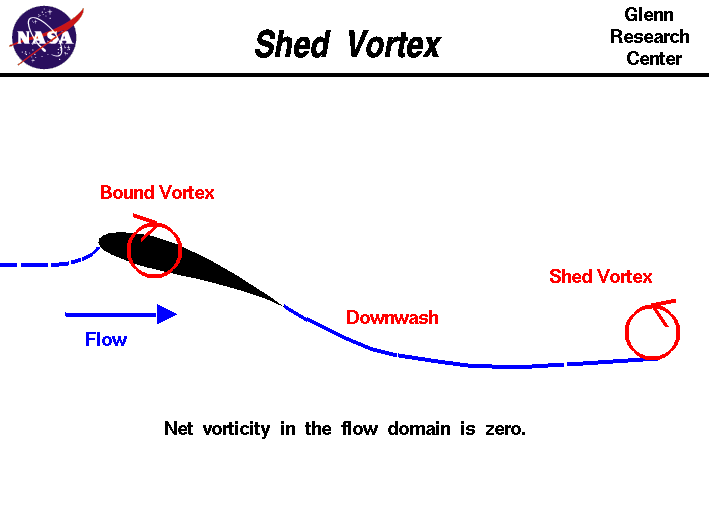
  • The flow turning that occurs in the creation of lift also creates bound vorticity within the airfoil.
  • The existence of the bound vortex (or vortices) within the airfoil created an important theoretical problem when it was first proposed.
  • With a bound vortex within the object, there would then have to be another vortex of opposite strength present within the flow domain.
  • It took some very careful experimental work by Ludwig Prandtl to actually "catch" the other vortex on film (the so-called starting vortex)
Computer drawing of an airfoil showing the bound vortex
 and the shed vortex.
The New Theory of Flight shows that this 2d picture does not describe actual real 3d physics, only fictional physics which only Prandtl could "catch" in his mind, as a mystery to generations of aerodynamicists flocking at NASA.


måndag 24 september 2012

Direct Simulation of Flight Stability

The New Theory of Flight based on computational solution of the Navier-Stokes equations with slip boundary condition allows direct simulation of dynamic flight stability under the action of aileron, rudder and elevator using the Fluid-Structure-Interaction code Unicorn/FEniCS. This is a new capability which opens many possibilities of new design and control.


AIAA says no-thanks to this capability when rejecting the New Theory of Flight. It is not so clever. Compare Flapping Bird.

New Theory of Flight vs Observation


This picture from the Dryden Water Tunnel shows the 3d rotational separation at the trailing edge of the wing, which is a central aspect of the New Theory of Flight, as illustrated in the following generic image:


We see the dye injected on top of the wing follow a streamline along the surface without rotation until the trailing edge where counter-rotating rolls are formed as in the following Navier-Stokes simulation of the flow around a circular cylinder displaying 3d rotational separation:


Aerodynamics Expertise Without Knowledge


Aerospaceweb.org is
  • a non-profit site operated by engineers and scientists in the aerospace field. The goal of this site is to provide educational information on a variety of subjects ranging from aviation to space travel to aerospace technology. Our primary areas of expertise include aerodynamics, propulsion systems, vehicle design, engineering career information, and aerospace history. Learn more about these and other topics by visiting the following sections of our site.
Under Aerodynamics Questions we read as an answer to the question How Does a Wing Work?:
  • So the reader may be asking which of these theories (Bernoulli, Newton, Circulation) is correct
  • In truth, each is valid in some respect and useful for certain applications, but the ultimate question is which is the most fundamental explanation. 
  • Mathematicians would surely prefer the circulation theory, which is certainly a very elegant approach firmly based on mathematical principles, but it fails to explain what force of nature creates circulation or lift. 
  • Many would argue that the Newtonian explanation is most fundamental since it is "derived" from Newtonian laws of motion. While this is true to some degree, the theory lacks an explanation as to why an airfoil deflects the flow downward in the first place. Even accepting this principle, the idea that an airfoil deflects the flow and therefore experiences lift also fails to capture the fundamental tools of nature (pressure and friction) that create and exert that force on the body.
  • Proponents of this explanation generally deride the Bernoulli theory because it relies on less fundamental concepts, like the Bernoulli and Continuity equations. There is some truth to this complaint, and the theory may be more difficult for the novice to understand as a result.
  • However, both equations are derived from Newtonian physics, and I would argue from more fundamental and more mathematically sound premises than the Newtonian theory. 
  • In the end, I leave it up to the reader to decide.
We see here the collected expertise of aerodynamics being unable to explain anything of value about the generation of lift of a wing, simply giving up and passing the question of How Does a Wing Work  over to the reader. 

But there is a New Theory of Flight giving a true scientific explanation different from the above trivial no-explanations.

Pilots Fooled by Federal Aviation Administration

Let us now check out how the generation of lift of a wing is presented in Pilots Handbook of Aeronautical Knowledge by Federal Aviation Adminstration. We read in Chapter 3 Principles of Flight:
  • The formulation of lift has historically been the adaptation over the past few centuries of basic physical laws. These laws, although seemingly applicable to all aspects of lift, do not answer how lift is formulated. In fact, one must consider the many airfoils that are symmetrical, yet produce significant lift.
This is not a very promising start. The next step is a digression into the Magnus effect of a rotating cylinder:
  • In 1852, the German physicist and chemist, Heinrich Gustav Magnus (1802–1870), made experimental studies of the aerodynamic forces on spinning spheres and cylinders. (The effect had already been mentioned by Newton in 1672, apparently in regard to spheres or tennis balls). These experiments led to the discovery of the Magnus Effect, which helps explain the theory of lift.
  • To summarize the Magnus effect, an airfoil with a positive AOA develops air circulation about the upper surface of the wing. Its sharp trailing edge forces the rear stagnation point to be aft of the trailing edge, while the front stagnation point falls below the leading edge. [Figure 3-4]

We see here an attempt to explain the Kutta-Zhukovsky circulation theory, which is unphysical by asking the incoming flow to change direction. This is sensed by FAA feeling that prospective pilot will not be convinced, and so seeks to enhance the message by: 
  • A half-century after Newton formulated his laws, Daniel Bernoulli, a Swiss mathematician, explained how the pressure of a moving fluid (liquid or gas) varies with its speed of motion. Bernoulli’s Principle states that as the velocity of a moving fluid (liquid or gas) increases, the pressure within the fluid decreases. This principle explains what happens to air passing over the curved top of the airplane wing. 
This time it is not circulation but instead Bernoulli with lower pressure above supported by a picture illustrating the Venturi effect:

FAA thus hints at the "Venturi" effect, which however is identified by NASA as Incorrect Lift Theory #3.

The discussion is then rounded off by:
  • Since air is recognized as a body and it is accepted that it must follow the above laws, one can begin to see how and why an airplane wing develops lift. As the wing moves through the air, the flow of air across the curved top surface increases in velocity creating a low-pressure area. 
  • Although Newton, Magnus, Bernoulli, and hundreds of other early scientists who studied the physical laws of the universe did not have the sophisticated laboratories available today, they provided great insight to the contemporary viewpoint of how lift is created. 
We see again how a governmental agency struggles with the sad fact that there is no convincing theory of lift offered by aerodynamicists to be taught to pilots. 

The New Theory of Flight presented on The Secret of Flight is the first scientific explanation of the generation of lift of a wing, and as such it both describes real physics and is possible to understand, by both prospective pilots and air passengers.

söndag 23 september 2012

Flight Theory in NSF GK12 Aerodynamics Contradicted by NASA

The NSF GK-12 Wind Energy and Aerospace Workshop 2009 teaches young minds about Fundamentals of Flight, Stability and Control in the following pictures:


We see here the "Venturi" theory which is described by NASA as Incorrect Theory #3. This is yet another example of a science of aerodynamics in crisis with contradicting messages sent by different parts of the science administration here in the form of NSF and NASA.